Blog
Manila vs Bacolod for Offshore Staff: A Strategic Guide for Australian Businesses

The prestige of a Manila office might actually be the greatest risk to your Australian business’s operational stability. While the capital offers a massive talent pool, it also presents a marketplace defined by aggressive poaching and high attrition rates that can cripple a growing team. Deciding on Manila vs Bacolod for offshore staff requires a strategic shift in perspective, moving away from mere scale toward long-term security and staff loyalty.
You likely recognise that the Philippines is the premier destination for offshoring, yet the prospect of navigating complex labour laws and fluctuating infrastructure costs remains a significant concern. This guide provides the clarity you need to choose a location that offers a genuine balance of talent and cost-efficiency. We’ll examine the specific advantages of both hubs, from Manila’s established commercial centres to Bacolod’s lower cost of living, while detailing how the 2026 CREATE MORE Act influences your tax obligations. By the end, you’ll have a clear roadmap to building a compliant, loyal team that functions as a secure extension of your Australian operations.
Key Takeaways
- Understand why transitioning from a generic outsourcing model to a strategic hub selection is critical for securing your intellectual property and operational continuity.
- Identify the specific scenarios where Manila’s hyper-specialised talent pool in Makati and BGC justifies the higher overheads for niche technical roles.
- Evaluate Manila vs Bacolod for offshore staff to capitalise on the “loyalty dividend” and significantly lower attrition rates found in regional centres.
- Access a data-driven framework for benchmarking salaries and attrition rates to ensure your offshore budget remains realistic and sustainable through 2026.
- Discover how a robust “Compliance Shield” can mitigate the legal risks of navigating foreign labour laws while maintaining strict alignment with Australian standards.
The Philippine Offshoring Landscape: Why Manila vs Bacolod Matters in 2026
Selecting a hub for your Philippine operations is a decision that extends far beyond real estate or payroll. In 2026, the conversation around Manila vs Bacolod for offshore staff has matured into a sophisticated analysis of risk mitigation and structural integrity. For Australian businesses, the choice of city is the first line of defence against the high attrition rates and operational volatility that plague saturated markets. If you fail to account for the geographic nuances of the Philippines, you risk building a team on a foundation of sand.
The traditional approach of “anywhere in the Philippines” is no longer viable for firms that value intellectual property and operational security. Metro Manila remains a powerhouse, but its sheer density has created a marketplace where poaching is the norm rather than the exception. When a staff member is recruited away by a competitor offering a marginal salary increase, they don’t just take their skills; they take your institutional knowledge. This makes location choice a critical factor in your broader security framework. Australian SMEs, which often rely on lean, highly integrated teams, are uniquely positioned to benefit from the stability offered by regional hubs.
The Maturation of the Philippine BPO Sector
The history of the Philippine BPO industry overview reveals Manila as the original centre of gravity. However, the sector has evolved. By 2026, Bacolod has firmly established itself as a “Next Wave City” for IT-BPM services. This shift isn’t merely about cost; it’s about the maturation of local talent pools. The current landscape favours distributed models where businesses can secure niche technical talent in the capital while maintaining their core operational engine in more stable regional centres. This dual-hub strategy allows you to absorb the benefits of both environments while mitigating their respective weaknesses.
Location as a Risk Mitigation Strategy
Geographic risk is a physical reality that impacts your bottom line. Manila’s infrastructure often struggles under the weight of its own success, leading to severe traffic congestion that can compromise staff punctuality and mental well-being. Conversely, Bacolod offers a more manageable infrastructure load and a higher quality of life, which translates directly into staff loyalty. If your team feels secure and valued in their local community, they’re far less likely to seek employment elsewhere. MyBPO maintains a presence in both Manila and Bacolod to ensure our clients have a “compliance shield” in place. By providing dedicated workspaces and comprehensive EOR services in both locations, we allow you to secure your interests and navigate the complexities of local labour laws with absolute confidence.
Metro Manila: The High-Octane Hub for Scale and Specialist Talent
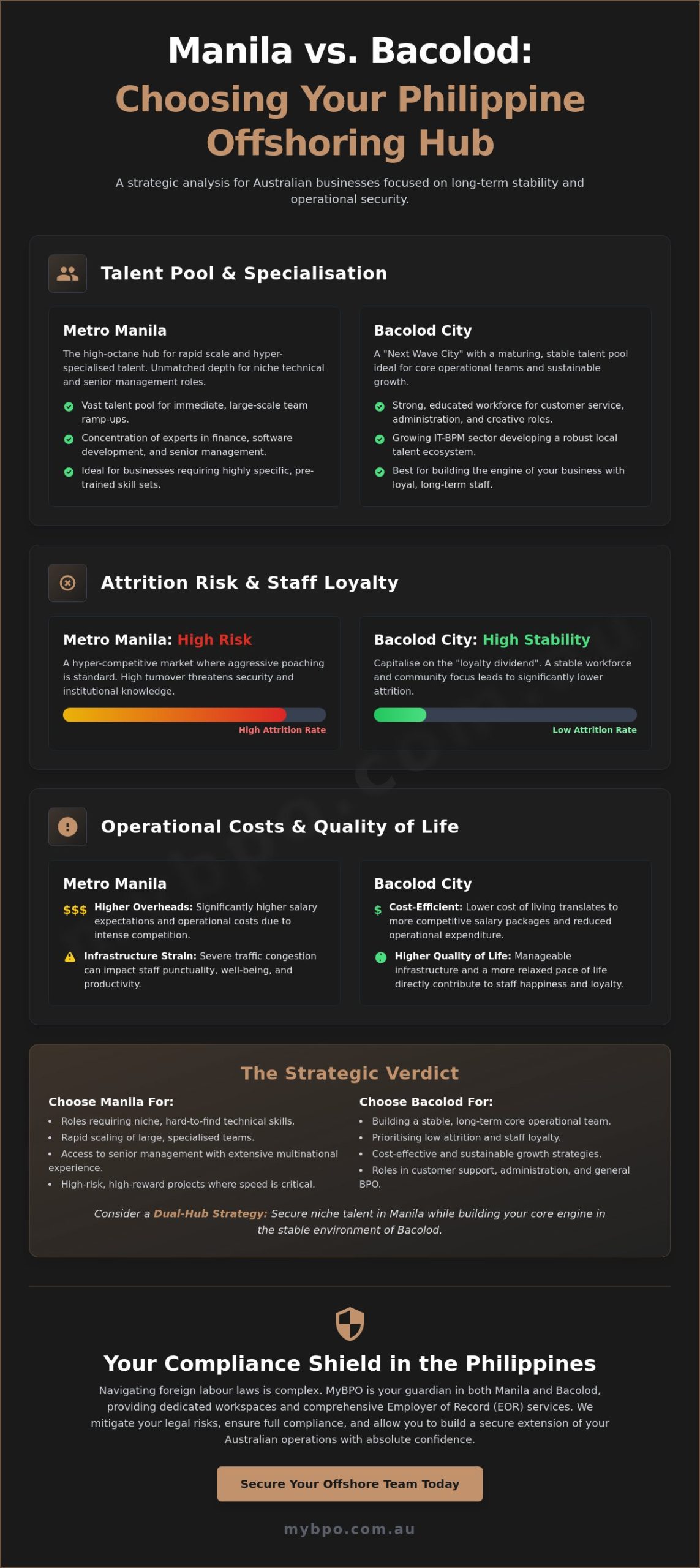
Metro Manila remains the primary destination for global brands seeking rapid scale and hyper-specialised talent. Central Business Districts (CBDs) such as Makati and Bonifacio Global City (BGC) function as the engine room of the national economy, housing the highest concentration of senior management and technical architects in the country. For an Australian business requiring a niche software developer or a complex financial analyst, the capital offers a depth of expertise that regional cities cannot yet match. However, this prestige is coupled with significant operational volatility.
The sheer volume of U.S. investment in Philippine IT-BPM has historically anchored itself in Manila, creating a mature but hyper-competitive ecosystem. If you need to ramp up a team of fifty specialised agents in a matter of weeks, the infrastructure and talent pipelines of the Metro area provide the necessary velocity. When evaluating Manila vs Bacolod for offshore staff, the capital represents the high-risk, high-reward end of the spectrum. The availability of talent is absolute, but so is the competition for it.
Unrivalled Talent Depth for Specialist Roles
The concentration of multinational experience in Manila allows for the recruitment of staff who have already been trained to global standards. You aren’t just hiring a worker; you’re often hiring someone with a decade of experience in Western business processes. This makes the capital ideal for senior leadership roles or complex technical positions that require a deep understanding of international jurisdictional boundaries. The speed of recruitment here is a distinct advantage, provided you are prepared to pay the premium required to secure such talent.
The Hidden Costs of the Manila Grind
While the talent is abundant, the environment is increasingly hostile to long-term staff retention. In Manila, attrition rates frequently sit between 25% and 40%, driven by a pervasive poaching culture. If a competitor in the same building offers a 10% salary increase, a staff member may leave regardless of their relationship with your brand. This churn creates a constant cycle of recruitment and training that can erode your operational cost savings.
The physical costs are equally demanding. As of May 2026, commercial rental rates in BGC have climbed to ₱1,250 per square metre, while Makati remains high at ₱1,125. When you factor in the “Great Manila Traffic,” which severely impacts staff productivity and mental health, the true cost of a Manila headquarters becomes clear. To mitigate these risks, many savvy operators choose to secure a dedicated workspace that provides a stable, professional environment for their team, shielding them from the external chaos of the city. This structured approach is essential if you intend to maintain a presence in the capital without succumbing to its inherent instability.
Bacolod City: The High-Stability Alternative for Sustainable Growth
While Manila offers the raw scale for rapid expansion, Bacolod City provides the structural stability required for long-term operational health. For many Australian SMEs, the primary threat to offshore success isn’t the quality of work, but the frequency of staff turnover. Bacolod mitigates this risk by offering a “loyalty dividend” that is increasingly rare in the capital. When you compare Manila vs Bacolod for offshore staff, you’re essentially choosing between a high-churn marketplace and a community where staff tenure is measured in years rather than months.
The economic reality of Bacolod supports this stability. Rent prices here are 62.6% lower than in Manila, and the overall cost of living is significantly more manageable for local professionals. This disparity allows for sustainable wage structures that provide staff with a high quality of life without inflating your operational costs. Because the local economy isn’t as hyper-saturated as Makati or BGC, your firm becomes an employer of choice rather than just another stop on a resume. This environment is particularly conducive to securing talent for back-office operations, customer service, and accounting roles where institutional knowledge is a vital asset.
A Culture of Loyalty and Work-Life Balance
The psychological impact of the local environment cannot be overstated. In Bacolod, a 15-minute commute is the standard, a stark contrast to the three-hour traffic jams common in Manila. This reduction in daily stress translates directly into higher staff productivity and mental well-being. Staff retention rates in Bacolod typically sit between 10% and 15%, which is remarkably low compared to the 25% to 40% attrition often seen in the capital. This continuity allows your business to build a deep repository of internal processes and client history, safeguarding your intellectual property through the simple mechanism of staff loyalty.
Infrastructure and Government Support
Bacolod’s status as a “Next Wave City” is backed by robust physical and digital infrastructure. The city is digital-ready, equipped with reliable fibre-optic connectivity and a power grid designed to support the 24/7 requirements of the IT-BPM sector. Local government units (LGUs) actively incentivise offshore operators, creating a pro-business atmosphere that simplifies the navigation of local regulations. Furthermore, the city draws from a steady pipeline of graduates from top Visayan universities, ensuring that your recruitment needs are met by a literate, highly trainable, and culturally aligned workforce. By choosing Bacolod, you aren’t just saving on costs; you’re securing a stable harbour for your Australian team’s growth.
The Comparison Framework: Manila vs Bacolod for Offshore Staff
A side-by-side comparison reveals that the choice between Manila vs Bacolod for offshore staff depends entirely on your risk tolerance and the specific complexity of the roles you need to fill. While the capital offers immediate access to a deeper pool of specialists, it carries a heavy “attrition tax” that can destabilise an Australian small business. In Manila, you should expect attrition rates between 25% and 40%, whereas Bacolod remains significantly more stable at 10% to 15%. This 25% gap represents more than just a recruitment fee; it’s a loss of institutional memory and a recurring disruption to your workflow.
The salary premium in Metro Manila typically ranges from 20% to 50% higher than in provincial hubs. For instance, the average monthly net salary in Manila is approximately ₱30,160, compared to ₱13,000 in Bacolod. When you factor in that rent prices in Bacolod are 62.6% lower than in the capital, it becomes clear why regional staff are more content with their compensation packages. This stability aligns perfectly with the Australian “fair go” mentality, where loyalty is earned through mutual respect and fair living conditions rather than a constant bidding war for talent.
Cost of Operations: Beyond the Basic Wage
If you focus solely on base salaries, you’ll overlook the hidden liabilities of high-turnover hubs. Recruitment fees, background checks, and the intensive onboarding of new staff every twelve months in Manila can quickly erode your expected savings. Office space also presents a stark contrast; while BGC rates have risen to ₱1,250 per square metre, Bacolod remains an affordable alternative for firms prioritising lean operations. You must also account for local taxes and mandatory contributions such as SSS and PhilHealth, which typically add 15% to 30% to your total employment cost. Under the CREATE MORE Act of 2026, firms can benefit from a 5% Special Corporate Income Tax, but navigating these jurisdictional boundaries requires a partner who understands the local LGU caps.
Talent Availability vs Retention
Your decision should be guided by your three-year growth plan. Use Manila for “hard to find” skills like senior solution architects or niche legal analysts. Use Bacolod for “hard to keep” roles such as customer support, accounting, and general administration. Regardless of the city, maintaining dedicated workspaces in the Philippines is a non-negotiable requirement for data security and operational control. A physical office provides a controlled environment that remote-only models cannot replicate, protecting your client data from the risks of unmonitored home networks.
To ensure your team is built on a foundation of total compliance and structural integrity, you should consult with an expert EOR partner who can manage the risks of both hubs on your behalf.
Securing Your Team: Why MyBPO is Your Guardian in Both Cities
Deciding on the optimal location between Manila vs Bacolod for offshore staff is a significant strategic step, but the long-term success of your team depends on the structural integrity of your employment framework. Navigating the intersection of Australian Fair Work standards and Philippine labour codes is a complex undertaking that carries substantial legal and financial risk. MyBPO functions as your local guardian and compliance shield, providing a secure bridge between your Brisbane headquarters and your Philippine operations. Our Australian ownership ensures that we speak your language and understand the high stakes of cross-border liability.
The primary danger for Australian firms is the risk of sham contracting penalties and operational instability. If your offshore engagement is not structured correctly, you may face severe consequences under Australian law while simultaneously violating Philippine Department of Labor and Employment (DOLE) regulations. We absorb this risk by acting as the legal employer on the ground. This protective layer allows you to focus on output and quality while we secure the administrative and regulatory boundaries of your team. With a physical presence in Brisbane, Manila, and Bacolod, we provide total oversight that abstract digital platforms simply cannot offer.
The MyBPO EOR Advantage for Australian Firms
The Australian regulatory environment is becoming increasingly stringent, particularly with the implementation of the “Closing Loopholes Act.” When you hire offshore, you must ensure your workflows don’t inadvertently trigger domestic employment liabilities. Simultaneously, you must manage Philippine-specific requirements such as the mandatory 13th-month pay, PhilHealth contributions, and strict termination protocols. Utilising an Employer of Record in Australia is the only secure pathway to ensure your expansion is fully compliant in both jurisdictions. We handle the intricacies of local payroll and tax withholding, ensuring your staff are paid accurately and on time, which is the foundation of the loyalty dividend we discussed earlier.
Customised Staffing Solutions
Every business has unique requirements that a one-size-fits-all approach cannot satisfy. We specialise in creating hybrid team models that allow you to capitalise on the strengths of both hubs. For example, you might secure senior leadership and technical architects in Manila while maintaining your core operational engine in Bacolod to ensure long-term stability. This dual-hub strategy, supported by our on-the-ground recruitment services and equipment leasing, ensures your offshore staff feel like a valued extension of your local team. Our dedicated workspaces provide the professional environment necessary to maintain high productivity and strict data security. If you are ready to build a resilient, compliant, and high-performing team, you should secure your offshore team with MyBPO today.
Securing a Stable Foundation for Your Philippine Operations
The choice between Manila vs Bacolod for offshore staff isn’t merely a matter of geography; it’s a strategic decision about the structural integrity of your Australian business. While Manila offers the depth required for hyper-specialised roles, Bacolod provides the operational stability and staff loyalty that protect your institutional knowledge. Success in the Philippines requires more than just hiring talent; it demands a rigorous adherence to both Australian Fair Work standards and Philippine labour codes.
MyBPO acts as your vigilant guardian in both hubs. As an Australian-owned and operated firm with a physical presence in Brisbane, Manila, and Bacolod, we specialise in Fair Work and DOLE compliance. We absorb the legal and operational risks of international employment, allowing you to manage your team with absolute confidence and security. Our local expertise ensures that your expansion is built on a foundation of total compliance and structural safety.
Book a Compliance Consultation with MyBPO to secure your offshore team today. Building a loyal, high-performing offshore department is within your reach when you have the right local ally by your side.
Frequently Asked Questions
Which city is better for hiring virtual assistants in the Philippines?
Bacolod City is generally the superior choice for hiring virtual assistants if your priority is long-term stability and staff loyalty. While Manila offers a larger volume of candidates, the lower attrition rates in Bacolod ensure that your virtual assistant remains with your business for years rather than months. This continuity is vital for preserving institutional knowledge and maintaining the quality of your administrative support without the constant disruption of recruitment cycles.
Are salaries significantly lower in Bacolod compared to Manila?
Yes, salary expectations in Bacolod are substantially lower, often by 50% or more depending on the role. Verified data shows that the average monthly net salary in Manila is approximately ₱30,160, whereas in Bacolod it is around ₱13,000. This disparity is driven by the lower cost of living in regional hubs, where rent prices are 62.6% cheaper than in the capital. When evaluating Manila vs Bacolod for offshore staff, these savings allow Australian SMEs to offer highly competitive local wages while still reducing operational overheads.
How does the infrastructure in Bacolod compare to Metro Manila for remote work?
Bacolod is a “digital-ready” city that offers reliable fibre-optic connectivity and a stable power grid designed to support the IT-BPM sector. While Manila has a higher concentration of 5G coverage, its infrastructure often struggles under the weight of extreme density and traffic congestion. Bacolod provides a more consistent environment for remote operations, as staff don’t face the same productivity-draining commutes or infrastructure loads found in the capital’s saturated CBDs.
Is it harder to find specialised IT talent in Bacolod?
Finding hyper-specialised IT talent, such as senior solution architects or niche cybersecurity experts, is typically easier in Manila’s Makati or BGC districts. The capital remains the primary hub for multinational experience and high-level technical training. However, Bacolod is an excellent source for software developers, QA testers, and IT support staff who value the work-life balance of a regional city. For many firms, the trade-off involves securing core technical talent in Bacolod to ensure they don’t lose their best developers to poaching.
What are the main risks of hiring offshore staff in the Philippines without an EOR?
The primary risks include sham contracting penalties, intellectual property theft, and non-compliance with Philippine DOLE regulations. Without an Employer of Record (EOR), your business lacks a legal “compliance shield” to manage mandatory benefits like 13th-month pay, SSS, and PhilHealth contributions. If a dispute arises, you have no local jurisdictional protection, leaving your Australian entity vulnerable to foreign legal action and significant financial liabilities.
How does the “Closing Loopholes Act” affect Australian companies with staff in Manila or Bacolod?
The Closing Loopholes Act increases the risk of offshore workers being reclassified as employees under Australian law if the engagement mimics domestic employment. This is a critical concern when deciding on Manila vs Bacolod for offshore staff, as a direct-hire model may inadvertently trigger Australian tax and superannuation obligations. An EOR mitigates this risk by establishing a clear jurisdictional boundary, ensuring that the worker is legally employed by a Philippine entity while you maintain operational control.
Can I have a split team between Manila and Bacolod?
Absolutely, a dual-hub strategy is a highly effective risk-mitigation tactic for Australian firms. You can secure senior leadership and specialised technical roles in Manila to leverage the capital’s talent depth while placing your core operational engine in Bacolod. This model allows you to balance the need for high-level expertise with the desire for long-term staff loyalty, ensuring your business isn’t overly dependent on a single geographic location.
Need a strategy session?
Tell us about your team and we will map out the right structure, fixed-cost quote included.
Book a call