Blog
Beyond the Yes Culture: A Leader’s Guide to Cultural Integration in Filipino-Australian Teams
The polite “yes” from your offshore team isn’t always a confirmation of understanding; often, it’s a structural risk to your project timeline. You’ve likely experienced the frustration of discovering a task was misunderstood only after the deadline has passed, despite receiving multiple assurances that everything was on track. This disconnect is rarely a matter of skill. Instead, it’s a predictable outcome of poor cultural integration within Filipino-Australian teams, particularly when direct Australian feedback meets the Filipino priority for social harmony.
You want to drive results without appearing insensitive or triggering high staff turnover. We understand that navigating these cross-border complexities requires more than just a management style; it requires a protective framework for communication. This guide will teach you how to bridge the gap between Australian directness and Filipino harmony to secure operational continuity and team performance. We’ll explore the mechanics of the “yes-culture” and provide a logical path to establish a high-trust environment where risks are flagged before they become failures.
Key Takeaways
- Identify the hidden mechanics of “silent delays” to mitigate the operational risks that arise when cultural friction impacts your project delivery.
- Contrast Australian directness with Filipino “Pakikisama” to ensure project delays are never masked by a cultural preference for social harmony.
- Deploy structural strategies like the “Three-Way Check” to verify task comprehension while respecting the high power distance inherent in Philippine workplaces.
- Learn why strategic cultural integration filipino australian teams utilise is the most effective safeguard against staff turnover and operational rework.
- Understand how an Australian-owned EOR serves as a compliance shield, providing the local expertise needed to navigate both legal and cultural complexities.
The Business Case for Cultural Integration: Mitigating Hidden Operational Risks
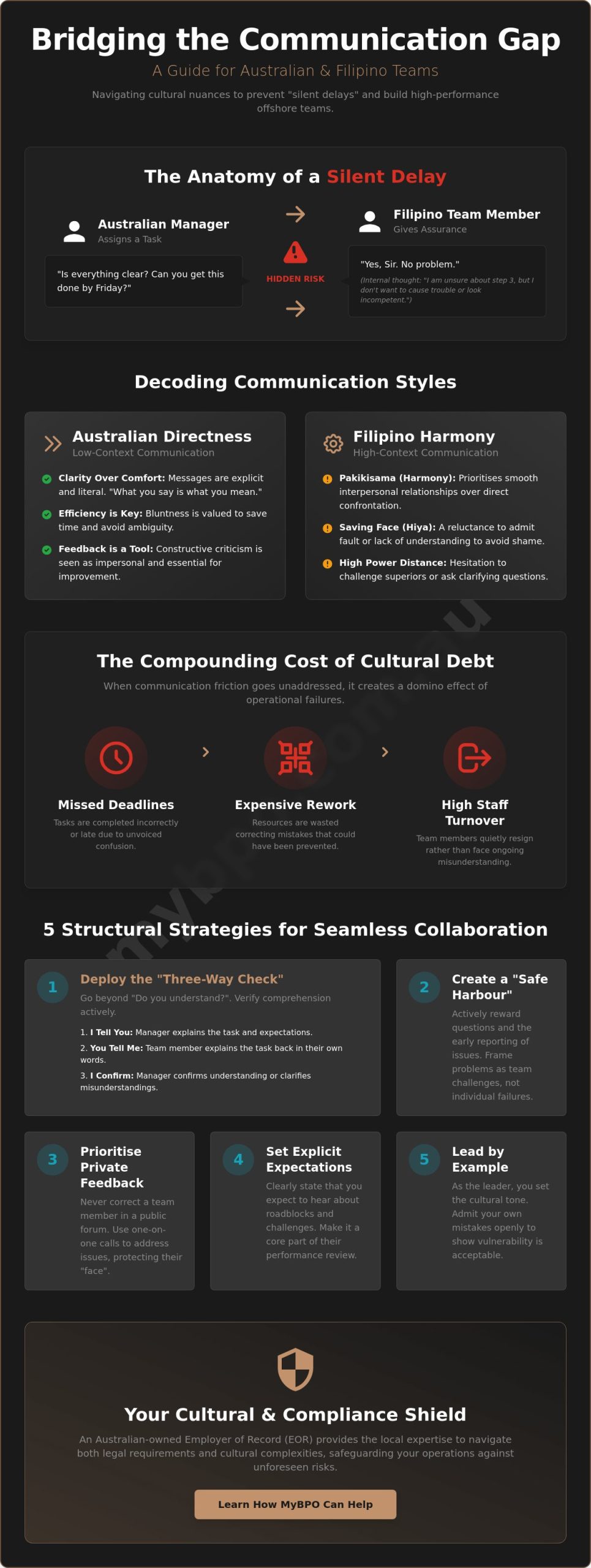
Cultural friction is often the primary driver of “silent delays” in offshore operations. These delays occur when a team member identifies a problem but chooses not to flag it to avoid disrupting group harmony. For an Australian business, this isn’t just a communication quirk; it represents a compounding “cultural debt” that eventually manifests as missed deadlines and budget overruns. Successful cultural integration filipino australian teams rely on depends on acknowledging that these gaps are operational hazards, not just social nuances. When communication fails, the business absorbs the cost of inefficiency and rework.
From Social Nuance to Professional Liability
There’s a fundamental difference between social politeness and professional transparency. In the Philippines, the concept of “hiya” (shame or saving face) can prevent staff from admitting they don’t understand a brief or have hit a roadblock. Australian managers, who typically value bluntness and directness, often mistake this harmony-seeking behaviour for a lack of competence or engagement. This misalignment creates a significant liability under Australian operational standards, where clear, real-time reporting is mandatory for compliance and risk management.
Understanding the basics of cross-cultural communication allows leaders to establish a “safe harbour” where honest feedback is incentivised rather than feared. If you don’t build this bridge, you’re essentially operating in the dark. You must move beyond the surface-level politeness to create a environment where professional transparency is the standard. When you remove the risk of shame, you secure the flow of information and protect the business from hidden errors.
Protecting Operational Continuity
Operational continuity is fragile when communication styles are mismatched. If a team feels they cannot challenge a directive from an Australian leader due to high power distance, the business risks executing flawed strategies. This leads to expensive rework and high staff turnover, as Filipino employees may quietly resign rather than confront a misunderstood manager. It’s a silent drain on resources that many Australian companies fail to account for until the project is in jeopardy.
The Australian leader must set the cultural “north star” for the team. This involves more than just giving orders; it requires setting explicit expectations for how feedback is delivered and received. Effective cultural integration filipino australian teams require involves building a stable environment that protects intellectual property and retains high-performing talent. By addressing these risks early, you prevent the friction that leads to systemic operational failure. Stability is not a happy accident; it’s the result of structured, risk-aware management.
Decoding Communication Styles: The Direct Aussie vs. Harmonious Filipino
Effective cultural integration filipino australian teams require depends on understanding the fundamental divide between low-context and high-context communication. In Australia, communication is low-context; meaning is literal, explicit, and delivered with a bluntness that values efficiency over ego. Conversely, Filipino culture is high-context. Meaning is often found between the lines, conveyed through non-verbal cues and a deep-seated desire to preserve the relationship. If you apply a “standard” Australian management style without adjusting for these nuances, you risk creating a culture of silence where critical information is withheld to avoid friction.
Understanding Pakikisama and Saving Face
At the heart of Filipino social and professional interaction is “Pakikisama,” or the pursuit of smooth interpersonal relations. This isn’t merely politeness; it’s a structural priority to maintain group harmony at all costs. In a business setting, Pakikisama often manifests as a reluctance to disagree with a superior or report bad news that might “disrupt” the mood. This is compounded by the concept of “Saving Face.” If an Australian manager corrects a Filipino staff member in a public forum, such as a group Zoom call, it can cause intense “hiya” (shame), leading to immediate disengagement or even resignation.
To mitigate this risk, leaders must invite disagreement through private, one-on-one channels. Instead of asking “Do you have any questions?”, which often triggers a default “No,” try asking “What are the three biggest risks to this deadline?”. This shifts the focus from personal failure to objective problem-solving. Given the strong people-to-people links between our two nations, as evidenced by the $10.8 billion in bilateral trade, mastering these subtle shifts is essential for any business looking to secure its offshore investments.
The Australian Directness Trap
The Australian value of “mate-ship” can be incredibly confusing for a hierarchy-conscious Filipino worker. While we use informal language to build rapport, a Filipino employee often views the “boss” as a parental figure who requires a specific level of deference. When an Australian manager uses blunt, constructive feedback to “get to the point,” it can be perceived as personal aggression rather than professional guidance. This mismatch is a primary driver of staff turnover in unmanaged offshore teams.
You can soften your directness without losing clarity by using “sandwich” feedback or framing corrections as a collaborative effort. It’s about protecting the individual’s dignity while maintaining high operational standards. If you find the nuances of these interactions are impacting your team’s output, engaging an Australian-owned EOR can provide the necessary cultural shield to protect your operations. They act as a local interpreter, ensuring that your directness is translated into actionable, non-threatening instructions for your Manila-based staff.
Identifying the “Yes” is your most critical task. You must distinguish between the “Yes” that acknowledges you are speaking and the “Yes” that confirms a task is feasible. Without a structured way to verify this, your project timelines remain vulnerable to the “Yes-Culture” tax.
Overcoming the Power Distance Barrier to Maximise Team Autonomy
Australian workplace culture often prides itself on a flat hierarchy where everyone is encouraged to “have a go” and challenge the status quo. However, applying this expectation to offshore staff without a strategy for cultural integration filipino australian teams require can lead to operational paralysis. In the Philippines, the professional environment is governed by a high degree of respect for authority. If a directive is given, it is followed to the letter; even if the employee suspects a more efficient method exists. This creates a “wait-and-see” attitude that many Australian managers find frustrating, yet it is a deeply ingrained protective mechanism designed to avoid overstepping bounds.
Power Distance is the perceived gap between leadership and staff that dictates initiative levels. According to Hofstede’s cultural dimensions, the Philippines maintains a high score in this area, suggesting that hierarchy is not just a preference but a structural necessity for clarity. Without explicit permission to deviate from a path, Filipino workers may remain in a “task-taker” mode, which limits the team’s ability to scale and innovate. To secure better outcomes, leaders must actively deconstruct this barrier by formalising the right to question processes.
Moving from Task-Takers to Problem-Solvers
Transitioning staff from following orders to providing solutions requires a foundation of psychological safety. If an employee feels that suggesting an alternative might be perceived as a challenge to your authority, they will remain silent. You must provide a “safety net” through robust Standard Operating Procedures (SOPs). These documents shouldn’t just dictate steps; they should define the boundaries within which an employee has the autonomy to make decisions. When a worker knows exactly where their liability ends, they are more likely to take the initiative.
The Role of Hierarchy in Filipino Work Culture
While Australians often pursue a flat structure to encourage collaboration, this approach can cause confusion in Manila. A clear chain of command provides the security and comfort your team needs to perform. Rather than managing every individual directly, successful cultural integration filipino australian teams often utilise local Team Leads. These leads act as a vital bridge, absorbing your direct Australian feedback and translating it into a culturally appropriate context for the rest of the staff.
Avoiding the “flat structure” trap is essential for maintaining order. If responsibilities are too vague, the team may hesitate to act for fear of stepping on a colleague’s toes or offending a superior. By establishing a defined hierarchy, you don’t stifle creativity; you provide the structural integrity required for your offshore operation to function autonomously. This methodical approach ensures that your business doesn’t just survive the cultural gap but thrives because of its structural clarity.
Five Structural Strategies for Seamless Cross-Border Collaboration
Relying on personality or “gut feel” is an insufficient strategy for managing offshore operations. To secure consistent performance, you must implement repeatable systems that bypass the pitfalls of the “Yes-Culture.” These structures act as a protective layer, ensuring that cultural integration filipino australian teams rely on is built into your daily workflows rather than left to chance. When you standardise communication, you mitigate the risk of silent delays and operational rework.
- The Three-Way Check: Never ask “Do you understand?”. Instead, require the team member to outline the first three steps of the task, the required resources, and the expected deadline in their own words.
- Private Feedback Loops: Conduct all performance coaching in one-on-one sessions. Public critique triggers “hiya” (shame), which can lead to immediate disengagement.
- Visual Trust Building: High-context communicators rely on non-verbal cues. Defaulting to video-on meetings establishes the visual rapport necessary for Filipino staff to feel secure in their roles.
- The Aussie Glossary: Standardise a list of common Australian business terms. Colloquialisms like “fair dinkum” or “she’ll be right” can create unnecessary barriers to clarity for a non-local team.
- Cultural Rituals: Recognise milestones that matter in the Philippines, such as family achievements and the traditional 13th-month pay cycle, to build long-term loyalty.
The Art of the Indirect Check-In
Direct questioning often yields a polite but unhelpful confirmation. To verify comprehension, ask “What are your first three steps?” or “What do you see as the biggest hurdle here?”. This approach removes the binary “yes/no” option and forces a practical discussion of the task. Using screen-sharing tools creates a shared visual context, which is essential for high-context learners. A brief “pre-meeting” chat about family or weekend plans further builds the rapport needed to make these check-ins feel supportive rather than interrogatory.
Building Rapport Through Cultural Recognition
The Filipino value of “Bayanihan,” or community spirit, is a powerful tool for team-building. When you acknowledge this collective mindset, you foster a culture where team members support one another to meet your objectives. This includes respecting Philippine public holidays and understanding their impact on your Australian work cycles. Planning for these dates ensures operational continuity without causing resentment.
Managing these nuances requires a partner who understands the local landscape. Our Employer of Record Australia: The Definitive Guide for Secure Offshore Expansion in 2026 outlines how a structured approach protects your business from the risks of international employment. If you are ready to secure your offshore team’s performance through professional cultural integration filipino australian teams, consider how our recruitment and EOR services can act as your cultural and compliance shield. We take on the burden of local regulations, allowing you to focus on driving results.
How an Australian-Owned EOR Acts as Your Cultural and Compliance Shield
Managing an offshore team from a distance introduces significant legal and operational liabilities that can’t be ignored. An Australian-owned Employer of Record (EOR) serves as a vigilant guardian, bridging the distance between your head office and your Manila-based staff. By maintaining a local presence in both jurisdictions, MyBPO ensures that your corporate values aren’t lost in translation. This structural alignment is the most effective way to achieve the deep cultural integration filipino australian teams require to remain productive and compliant. When you have a partner who understands the high stakes of international employment, you move from a position of vulnerability to one of total operational security.
Local Presence, Global Protection
Having a partner that shares your home business culture is vital for accurate value translation. Our Filipino HR experts act as on-the-ground interpreters, identifying cultural “red flags” like declining engagement or excessive “yes-culture” before they escalate into legal disputes or staff turnover. Beyond human management, a dedicated workspace in the Philippines provides the physical infrastructure necessary to secure your intellectual property and data. This centre for cultural stability ensures that your staff operate in a professional, high-trust environment that mirrors your Australian standards. It’s about creating a “safe harbour” where local workers feel supported and your assets remain protected.
We absorb the burden of Philippine labour code compliance, including the management of the 13th-month pay and the complexities of local holiday pay. If a regulatory change occurs, such as the upcoming Australian Annual Wage Review in June 2026, we ensure your offshore strategy remains aligned with your broader financial commitments. This level of protection allows you to focus on performance while we mitigate the risks of international employment law. It’s a methodical approach that ensures every piece of information serves to reinforce your core business values.
Securing Your Future Offshore
An EOR is more than a payroll provider; it’s a cultural mediator that takes on the burden of risk for Australian SMEs. By providing a structured framework for management, we allow you to bypass the common pitfalls of cross-border expansion. We navigate the jurisdictional boundaries so you don’t have to. Cultural integration filipino australian teams need isn’t a “soft” goal. It’s a hard operational requirement that we secure through human presence and tangible infrastructure. This partnership provides the relief and operational freedom you need to scale without fear of regulatory friction.
Contact MyBPO to secure your offshore team’s cultural and compliance future.
Securing Your Operational Future Across the AU-PH Corridor
Success in international expansion is not a product of luck; it is the result of deliberate, structural management. By deconstructing the “Yes-Culture” and implementing robust feedback loops, you transform potential communication liabilities into a competitive advantage. Effective cultural integration filipino australian teams require moves beyond social awareness to establish a rigorous framework for accountability and transparency. This approach ensures that project delays are identified early and operational continuity is never compromised by cultural friction.
MyBPO acts as your vigilant guardian in this space. As an Australian-owned and operated specialist with a widespread physical presence in key operational hubs, we provide the total accountability you need to scale with confidence. We navigate the complexities of the AU-PH compliance corridor so you can focus on driving performance. Secure your offshore team with MyBPO’s expert EOR services and build a workforce that is both culturally aligned and operationally resilient. Your journey toward a high-performing, global team starts with the right structural shield.
Frequently Asked Questions
What is the “yes-culture” in the Philippines and how does it affect business?
The “yes-culture” is rooted in the concept of Pakikisama, where maintaining social harmony takes precedence over literal accuracy. In a business context, it means a team member may agree to a deadline they cannot meet simply to avoid disappointing a superior. This creates a hidden operational risk, as project delays only become apparent when it is too late to mitigate them without significant rework or cost.
How can I give constructive feedback to Filipino staff without causing offence?
Constructive feedback must be delivered in a private, one-on-one environment to avoid triggering “hiya” or public shame. Australian leaders should frame corrections as a collaborative effort to improve a process rather than a personal critique. By removing the threat of public embarrassment, you secure a more transparent relationship. This is a critical component of cultural integration filipino australian teams rely on for long-term stability and performance.
Why do Filipino employees often avoid asking questions during meetings?
Silence in meetings is usually a sign of respect for authority rather than a lack of engagement. In high power distance cultures, questioning a manager in a group setting can be perceived as challenging their expertise or clarity. To overcome this, you should explicitly invite input through structured check-ins that require verbal participation in a non-threatening, private way to ensure all risks are identified early.
What are the most important Philippine holidays an Australian employer should know?
Key dates include Holy Week (Maundy Thursday and Good Friday), Independence Day on June 12, and the extended Christmas season. It is also vital to account for the 13th-month pay, a mandatory benefit usually paid by December 24. Planning for these dates ensures your Australian operations remain continuous while respecting local labour laws and traditions. Our EOR services help you navigate these specific jurisdictional requirements seamlessly.
How does “Saving Face” impact project management in offshore teams?
“Saving Face” acts as a barrier to early risk detection. If a staff member fears that admitting a mistake will lead to a loss of dignity, they may attempt to fix the issue in secret, often leading to compounded errors. Successful cultural integration filipino australian teams implement requires establishing a “safe harbour” where reporting risks is incentivised as a protective measure for the business rather than a personal failure.
Can an Australian business implement a flat hierarchy with a Filipino team?
While a flat hierarchy is popular in Australia, it often creates a vacuum of leadership that confuses Filipino staff. A clear, defined chain of command provides the structural security your team needs to take action. Without a designated authority figure to provide final approval, offshore teams may hesitate to move forward, leading to significant productivity bottlenecks and a lack of clear accountability.
How do I know if my offshore staff member actually understands a task?
Verification requires moving beyond binary “yes or no” questions. Implement a “Three-Way Check” by asking the staff member to summarise the first three steps of the project and identify potential hurdles in their own words. If they can articulate the process and the resources required, you have a high level of certainty that the task is understood and the project timeline is secure from silent delays.
What is the best way to build rapport with a remote Filipino team?
Building rapport is achieved through consistent visual engagement and personal recognition. Defaulting to video-on meetings helps bridge the gap for high-context communicators who rely on non-verbal cues. Additionally, starting meetings with brief enquiries about family or local milestones builds the “Bayanihan” or community spirit that is essential for remote team loyalty. This personal connection acts as a foundation for professional accountability and long-term retention.
Need a strategy session?
Tell us about your team and we will map out the right structure, fixed-cost quote included.
Book a call