Blog
Employer of Record (EOR): A Guide for Australian Business

Could a single error in how you classify an offshore worker lead to a $495,000 civil penalty for your Australian business? With the Fair Work Ombudsman and the ATO increasing their scrutiny on sham contracting, the financial stakes of international hiring have never been higher. Many directors feel a justified sense of unease when balancing the need for global talent against the complexity of foreign labour codes and data security. An Employer of Record provides a structured resolution to these challenges by acting as the legal employer in the host country, effectively serving as a compliance shield for your domestic operations.
You likely recognise that offshore talent is a powerful lever for growth, yet the recent criminalisation of intentional wage theft and the shift to “Payday Super” create a minefield of potential liability. We will show you how to navigate these complexities and protect your business from significant regulatory risks. This guide outlines the path to establishing a fully compliant offshore team with fixed, predictable costs, allowing you to focus on your core objectives while we absorb the administrative and legal burdens of cross-border employment.
Key Takeaways
- Understand the heightened risks of informal offshore hiring and why the Australian regulatory landscape now demands a robust legal framework.
- Discover how an Employer of Record serves as a compliance shield by assuming legal liability while you maintain operational control.
- Identify the specific triggers for sham contracting penalties and learn how to mitigate the risk of misclassification when engaging international talent.
- Recognise why physical infrastructure and dedicated workspaces are essential for protecting business data and maintaining professional standards offshore.
- Explore the strategic advantages of partnering with an Australian-owned provider to ensure local accountability and a secure transition for your team.
Navigating the Complexities of Offshore Employment for Australian Firms
The landscape of offshore employment has undergone a fundamental transformation. By 2026, Australian firms have moved beyond task-based outsourcing toward the integration of sophisticated, full-time offshore teams. This evolution has occurred alongside a regulatory environment that is increasingly hostile toward informal or direct-to-contractor hiring arrangements. For an Australian director, the allure of reduced overheads can quickly be eclipsed by the hidden dangers of misclassification and the personal liability that follows.
An Employer of Record (EOR) functions as a critical legal barrier. It absorbs the complexities of local labour laws while protecting the parent company from domestic litigation. Without this protective layer, a business remains directly exposed to the shifting definitions of employment within both Australian and foreign jurisdictions. Establishing a secure framework is no longer an optional luxury; it is a prerequisite for operational survival in a globalised economy.
The Impact of the Closing Loopholes Act on Offshore Staffing
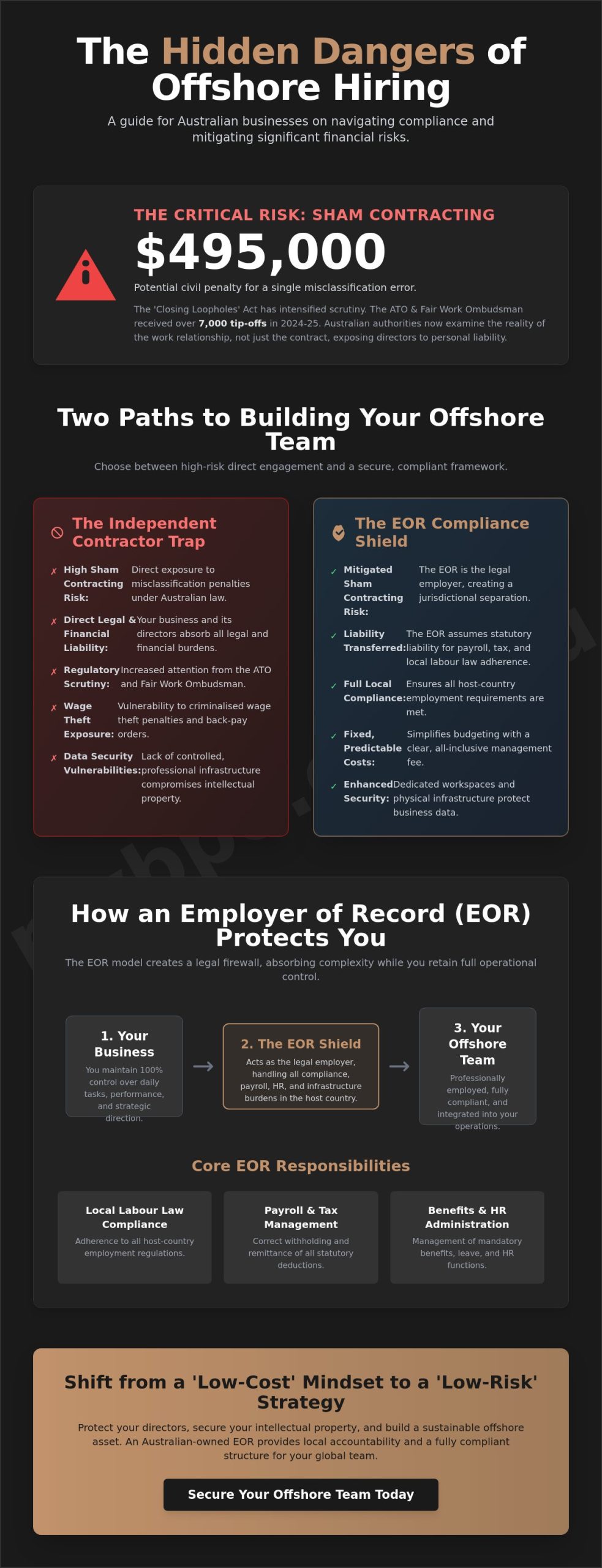
The “Closing Loopholes” legislation has significantly narrowed the legal definition of an independent contractor. Australian authorities now look past written contracts to examine the practical reality and true nature of the working relationship. If an offshore worker performs duties similar to a local employee, uses company-provided equipment, and follows strict corporate schedules, they may be deemed an employee under Australian law. This creates a “sham contracting” risk that carries severe consequences. Traditional freelance platforms often fail to provide the necessary jurisdictional separation, leaving businesses vulnerable to civil penalties that can reach $495,000 for corporations with 15 or more employees. Maintaining a clear, legally recognised boundary between your Australian entity and your offshore staff is the only way to mitigate this risk.
Risk Mitigation as a Strategic Business Priority
Non-compliance in cross-border employment is a high-stakes financial risk. The Australian Taxation Office (ATO) and the Fair Work Ombudsman (FWO) have increased their collaboration, evidenced by over 7,000 tip-offs regarding sham contracting in the 2024-2025 period alone. A professional Employer of Record mitigates these dangers by assuming all statutory liabilities. This includes managing local tax obligations, social security contributions, and mandatory benefits in the worker’s home country. Transitioning from a “low-cost” freelance mindset to a “low-risk” operational model ensures your offshore presence remains a strategic asset. By securing your team through a formal EOR structure, you protect your intellectual property and insulate your Australian directors from the threat of criminalised wage theft penalties and significant back-pay orders.
What is an Employer of Record (EOR) and How Does it Protect You?
An Employer of Record is not merely a service provider; it is the legal employer of your staff within a specific jurisdiction, such as the Philippines. While you retain full control over the day-to-day tasks, workflows, and performance management of your team, the EOR assumes the entire burden of legal compliance. This structure creates a “Compliance Shield” between your Australian corporate entity and the complexities of foreign labour markets. By serving as the legal employer on paper, the EOR ensures that all local statutory requirements are met without necessitating the establishment of a costly and high-maintenance foreign branch or subsidiary.
The core responsibilities of an EOR revolve around risk mitigation and administrative integrity. They manage the technicalities of payroll, withhold the correct taxes, and administer mandatory local benefits. This is particularly vital when navigating contractor rights and protections, as many Australian firms unknowingly breach foreign labour codes by treating contractors like employees. By engaging a formal EOR, you transfer the liability for adherence to these regulations to a specialist who understands the local landscape deeply.
The Mechanics of the EOR Relationship
The foundation of this model is a tripartite agreement between the Australian client, the EOR, and the employee. This legal triangle ensures that accountability is clearly defined and risks are appropriately distributed across the relationship. The Employer of Record is the specific entity responsible for the mandatory 13th-month pay, social security contributions, and PhilHealth payments required under Filipino law. Beyond financial obligations, a professional EOR secures your intellectual property through robust local employment contracts that are enforceable within the host country’s legal system. This provides a level of security that informal freelance arrangements or B2C marketplaces simply cannot provide. If you are looking to build a secure, long-term team, exploring EOR services can provide the structural integrity your business requires.
EOR vs. PEO: Choosing the Right Structure
Australian firms often encounter the term “Professional Employer Organisation” (PEO) and assume it is synonymous with an EOR. This confusion often stems from the American market, where PEOs operate on a “co-employment” model. In a typical PEO arrangement, the client often retains a significant portion of the legal and financial liability. Conversely, the EOR model offers a higher level of jurisdictional protection because the EOR becomes the sole legal employer. For an Australian business, this complete transfer of liability is essential for risk management. It ensures that your Australian entity remains insulated from foreign employment disputes and regulatory audits. Selecting the EOR model provides a definitive “safe harbour” for your international operations.
EOR vs. Independent Contracting: Mitigating Sham Contracting Risks
Many Australian businesses unknowingly expose themselves to significant liability by engaging offshore talent as independent contractors. While this model appears cost-effective on the surface, it often fails the multi-factor test used by Australian authorities to distinguish between genuine contractors and employees. If your business exerts significant control over how, when, and where a worker performs their duties, you’re likely engaging in sham contracting. The financial consequences are severe. As of January 2025, intentional wage underpayment is a criminal offence, and civil penalties for misclassification can reach $495,000 for businesses with 15 or more employees.
An Employer of Record mitigates these risks by formalising the employment relationship within a compliant legal framework. By assuming the role of the legal employer in the host country, the EOR ensures that the worker receives all statutory entitlements and is taxed correctly. This transition from an informal contractor arrangement to a structured employment model satisfies the expectations of both Australian and foreign regulators. It transforms a precarious legal position into a secure, scalable operational foundation that protects your directors from personal liability.
The Dangers of the “Freelancer” Trap
Utilising B2C freelance marketplaces or paying offshore staff via platforms like PayPal and credit cards creates a clear compliance red flag. These payment methods often bypass the mandatory social security contributions and tax withholdings required in jurisdictions like the Philippines. If a worker is later deemed an employee, your business could be held liable for years of unpaid benefits, including the 13th-month pay and leave entitlements. Relying on a contractor agreement doesn’t provide a defence if the practical reality of the work suggests an employment relationship. EOR services offer a legitimate pathway for long-term talent, ensuring your team is protected by local labour laws from day one.
Satisfying the Fair Work Ombudsman’s Standards
The Fair Work Ombudsman increasingly applies employee-like standards to offshore arrangements that mirror domestic employment. To remain compliant, you must ensure that your offshore operations don’t circumvent the spirit of Australian labour protections. Partnering with a local Australian expert provides the peace of mind that your structure aligns with domestic regulatory expectations. For a comprehensive look at how to secure your business, refer to our Employer of Record Australia guide for deep-dive compliance details. This proactive approach allows you to focus on growth while we manage the intricate legal requirements of cross-border staffing.
Beyond Payroll: The Critical Need for Physical Infrastructure
Many digital-only providers position the Employer of Record model as a purely administrative software solution. This narrow focus ignores the physical reality of offshore operations and the substantial risks inherent in “Work From Home” (WFH) arrangements. For an Australian business, data security and operational continuity are not abstract concepts; they are the foundation of professional integrity. Relying on a worker’s residential internet and unmanaged home environment introduces vulnerabilities that no amount of legal paperwork can fully mitigate.
A comprehensive Employer of Record service provides more than just a legal contract; it offers a secure physical bridge between two countries. By moving staff into dedicated workspaces, you ensure that your team operates within an environment that mirrors Australian professional standards. This physical presence allows for direct oversight, managed security protocols, and the reliable infrastructure required to maintain high-level output without the constant threat of technical disruption.
Securing Your Data and Intellectual Property
Physical office environments are the most effective deterrent against data breaches in offshore teams. Within a managed facility, access to sensitive information is restricted to secure networks and monitored hardware. This eliminates the significant risks associated with “Bring Your Own Device” (BYOD) policies, where personal laptops often lack the necessary encryption and security patches. Equipment leasing ensures that every staff member uses standardised, high-performance tools that are maintained by on-site technical support. For a detailed breakdown of how to audit your offshore setup, refer to our Dedicated Workspace Philippines guide for infrastructure checklists. Protecting your intellectual property requires a strategy that combines legal frameworks with tangible, physical security measures.
The Value of a Physical Presence in the Philippines
The human element of offshore management is often the deciding factor in staff retention and long-term performance. An on-the-ground HR team provides the necessary cultural bridge, ensuring that local nuances are respected while Australian corporate expectations are met. This local management presence allows for immediate resolution of personal or professional issues that could otherwise lead to attrition. Beyond personnel management, the physical facility itself acts as a safeguard against regional instability. Industrial-grade backup power systems and redundant fibre-optic internet connections within a managed facility prevent the frequent downtime associated with residential infrastructure in Southeast Asia. If you want to eliminate operational uncertainty, you can secure your offshore team with a dedicated workspace to ensure consistent, high-quality results.
Implementing a Secure Strategy with an Australian-Owned EOR
Choosing a global generalist often means prioritising a software interface over genuine accountability. While large-scale platforms offer digital convenience, an Australian-owned and operated Employer of Record provides a level of local accountability that a faceless dashboard cannot match. For an Australian SME, the AU-PH corridor is a specific strategic lane that requires a specialist’s touch. You need a partner who is physically present in the Philippines but remains answerable to the same business culture and professional standards you uphold in Australia.
Transitioning from a risky contractor model to a secure EOR framework is the most effective way to de-risk your international operations. This shift involves moving away from the “freelancer” mindset and establishing a structured employment relationship that regulators recognise as legitimate. Whether you are scaling from a single dedicated virtual assistant to a multi-role department, the EOR model ensures that your expansion is built on a foundation of structural integrity. Your employment costs become fixed and predictable, while the administrative burden of managing foreign payroll and taxes is entirely absorbed by your partner.
The Onboarding Roadmap for Australian Businesses
Establishing a compliant offshore presence follows a logical, sequential process designed to protect your interests at every stage. Successful integration requires more than just a signed contract; it demands a clear alignment between your Australian corporate culture and your offshore team’s daily environment. To ensure a smooth transition, follow these critical steps:
- Strategic Recruitment: Identify the specific technical skills and cultural fit required for your business objectives. Refer to our guide on Offshore Recruitment Philippines for hiring best practices.
- Contractual Formalisation: Execute the tripartite agreement that clearly defines the EOR as the legal employer while you maintain operational direction.
- Infrastructure Setup: Provision managed hardware and secure workspace within a professional facility to ensure data security from day one.
- Compliance Initiation: Establish the first compliant pay run, ensuring all local taxes, social security, and 13th-month pay obligations are met.
Your Vigilant Guardian in Offshore Staffing
The primary value of partnering with MyBPO lies in the relief of offloading the burden of international risk management. We don’t just provide a service; we act as a “Safe Harbour” for Australian firms navigating unfamiliar regulatory waters. By positioning ourselves as your compliance shield, we allow you to focus on your core business growth while we secure your offshore future. Don’t leave your business exposed to the shifting tides of international labour law. Secure your offshore operations today by implementing a framework built on accountability, physical security, and total compliance.
Securing Your Global Growth with a Local Ally
The transition from a high-risk contractor model to a structured offshore department is a fundamental step in protecting your Australian business from regulatory exposure. By implementing a professional Employer of Record, you effectively insulate your directors from the financial and legal consequences of misclassification and wage theft penalties. Success in the AU-PH corridor isn’t achieved through software alone; it requires the integration of local accountability and tangible physical security. We’ve established that managed workspaces and on-the-ground HR support are essential for maintaining the professional standards your clients expect.
MyBPO serves as your compliance shield, combining Australian ownership with physical offices in key Philippine hubs. Our deep expertise in both Fair Work and DOLE compliance ensures that your international expansion remains a secure and scalable asset rather than a liability. You can now secure your offshore team with MyBPO’s expert EOR services and focus on your core objectives with total peace of mind. Building a global team doesn’t have to mean compromising on safety or operational control.
Frequently Asked Questions
What exactly does an Employer of Record do for my Australian business?
An Employer of Record serves as the legal entity that employs staff on your behalf in a foreign jurisdiction. It handles the technicalities of local labour law, payroll processing, and tax withholding, allowing you to operate without a local branch. By absorbing these administrative burdens, the EOR ensures your offshore presence is fully compliant with the host country’s regulatory framework.
Is an EOR the same as a recruitment agency?
No, an EOR and a recruitment agency serve different functions. A recruitment agency focuses on identifying and sourcing talent for specific roles. In contrast, an EOR provides the ongoing legal and administrative structure to employ that talent long-term. While some providers offer both, the EOR’s primary role is to act as the “employer on paper” to mitigate jurisdictional risks.
How does an EOR protect me from sham contracting penalties in Australia?
An EOR protects you by formalising the relationship as a legitimate employment arrangement rather than a precarious contractor model. Since Australian authorities use a multi-factor test to identify sham contracting, having a professional entity manage statutory benefits and taxes provides a clear legal boundary. This structure demonstrates that you aren’t attempting to circumvent the National Employment Standards or avoid local tax obligations.
Who is responsible for the employees’ day-to-day work and performance?
You remain responsible for the day-to-day management, task allocation, and performance reviews of your offshore staff. The EOR manages the “back-office” legalities, such as ensuring the worker is paid correctly and receives their legal entitlements. This division of labour allows you to focus on output and corporate culture while the EOR maintains the compliance shield that protects your Australian entity.
Does an EOR handle Philippine mandatory contributions like SSS and PhilHealth?
Yes, managing mandatory contributions like SSS, PhilHealth, and Pag-IBIG is a fundamental part of the service. In the Philippines, failing to remit these contributions can lead to legal action and significant penalties for the employer. Your Employer of Record ensures these payments are made on time and in full, alongside the mandatory 13th-month pay required under Filipino law.
Can I use an EOR if I already have staff in the Philippines?
You can certainly transition existing offshore staff into an EOR framework. Many Australian businesses choose this path when they realise their current “direct-to-contractor” model exposes them to misclassification risks. We facilitate the onboarding process for your current team, ensuring their previous tenure is respected while bringing their employment status into full legal compliance with local labour codes.
How much does an Employer of Record service typically cost?
The cost of an Employer of Record service is typically structured as a fixed monthly management fee per employee. This fee is separate from the worker’s gross salary and statutory benefits. While costs vary based on the level of physical infrastructure and support required, this model provides businesses with fixed, predictable employment costs that are easier to budget than the variable risks of non-compliance.
What happens if I need to terminate an offshore employee under an EOR?
Termination is managed in strict accordance with the labour laws of the host country, such as the Department of Labor and Employment (DOLE) in the Philippines. The EOR guides you through the necessary due process, including the “twin-notice” rule, to ensure the separation is legally defensible. This protective approach prevents the risk of “illegal dismissal” claims that could otherwise damage your reputation and financial standing.
Need a strategy session?
Tell us about your team and we will map out the right structure, fixed-cost quote included.
Book a call