Blog
Payroll in the Philippines for Australian Companies: The 2026 Compliance Reference

Your offshore payroll is no longer just an administrative task; it has become your primary line of defence against Australian sham contracting penalties under the latest “Closing Loopholes” legislation. While the cost savings of hiring in the Philippines remain significant, the regulatory burden has shifted. You likely recognise that managing payroll Philippines for Australian companies requires more than just a bank transfer; it demands a sophisticated understanding of local mandates to mitigate serious legal liability. If these jurisdictional boundaries are not respected, your organisation faces the risk of back-pay, unpaid superannuation, and heavy fines.
This reference guide provides the structural integrity your business needs to master Philippine payroll, statutory contributions, and Australian compliance risks. We will navigate the complexities of SSS, PhilHealth, and Pag-IBIG rates for 2026, while explaining how to secure your offshore operations through a “set and forget” solution. By the end of this article, you will understand how to absorb these operational risks and maintain a loyal, fully protected workforce that is immune to audit scrutiny.
Key Takeaways
- Identify the legal pitfalls of “direct-to-bank” payments and how to structure your operations to respect both Australian and Philippine labour laws.
- Access the latest 2026 contribution rates for SSS, PhilHealth, and Pag-IBIG to maintain full statutory compliance for your offshore team.
- Mitigate the risk of sham contracting by aligning your employment structures with the Australian “Closing Loopholes” legislation.
- Streamline your administrative workflow for payroll Philippines for Australian companies, ensuring seamless onboarding and the accurate calculation of 13th-month pay.
- Leverage the protection of an Australian-owned Employer of Record (EOR) to provide a physical, accountable bridge between your home office and Philippine operations.
Navigating Payroll in the Philippines for Australian Companies
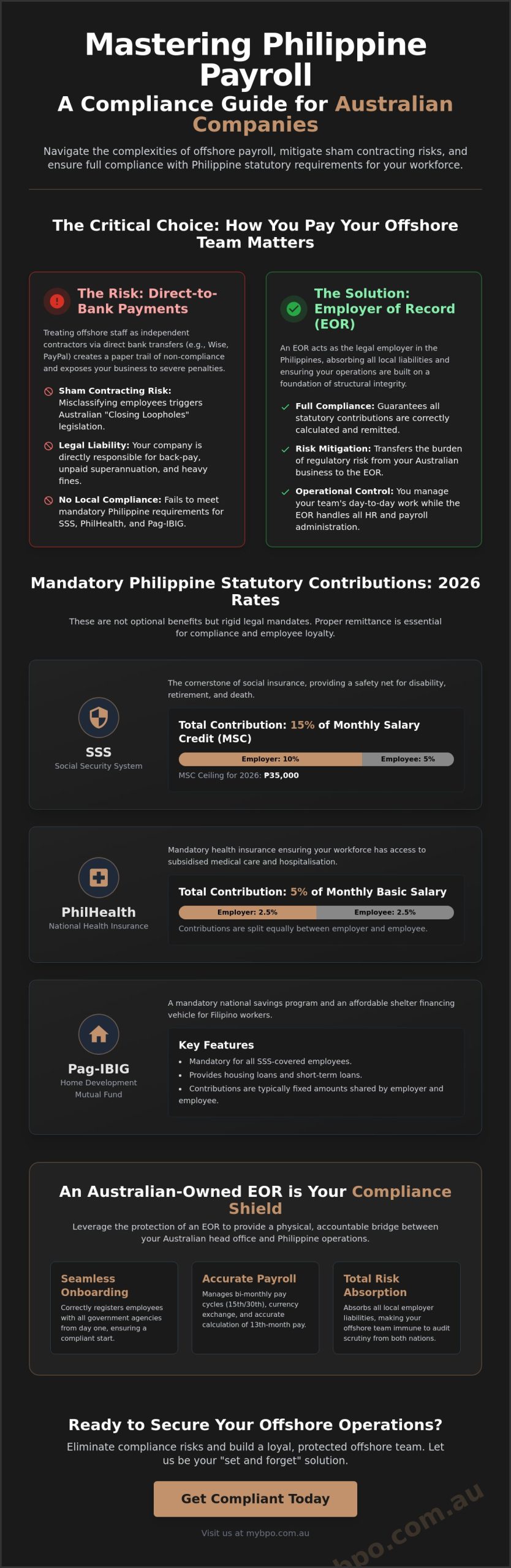
Managing payroll Philippines for Australian companies is a dual-jurisdiction challenge that carries significant legal weight. Many Australian directors mistakenly assume that hiring offshore staff is as simple as treating them as independent contractors and transferring funds into a bank account. This approach is fundamentally flawed. If your organisation pays a worker directly via platforms like PayPal or Wise without accounting for local taxes and benefits, you aren’t just paying a salary; you’re creating a paper trail of non-compliance. Australian authorities increasingly view these arrangements through the lens of sham contracting, while Philippine labour laws demand strict adherence to statutory contributions.
The solution lies in the Employer of Record (EOR) model. An EOR acts as the legal employer in the Philippines, providing a structural bridge between your Australian head office and your offshore team. This entity absorbs the local employer liabilities, ensuring that every worker is registered with the necessary government agencies. This includes processing deductions for the Philippine Social Security System (SSS), which is a non-negotiable requirement for private-sector employees. By using an EOR, your company maintains operational control while transferring the burden of regulatory risk to a specialist guardian.
The Complexity of Cross-Border Employment
There is a critical distinction between a standard payroll provider and a legal Employer of Record. A payroll provider simply processes data and facilitates transfers, leaving the legal liability on your shoulders. Conversely, a professional employer of record Australia assumes the role of the legal employer of your Philippine staff. This protects your business from the risks of direct payment, where the lack of formal tax shielding can lead to severe penalties during an audit. Using an EOR ensures that your offshore operations are built on a foundation of structural integrity rather than the fragile hope of remaining unnoticed by regulators.
Standard Payroll Cycles and Timezone Alignment
The Philippine labour market operates on a bi-monthly payroll schedule, typically falling on the 15th and 30th of each month. This cycle is deeply ingrained in local culture and is essential for employee financial stability. For Australian businesses, the GMT+8 timezone offers a significant operational advantage; it allows for real-time collaboration with only a two-hour difference from AEST. However, managing the volatility of AUD to PHP exchange rates is vital. A secure payroll strategy includes currency management to ensure that your staff receives a consistent take-home pay, which directly impacts long-term loyalty and staff retention.
Mandatory Philippine Statutory Contributions and 2026 Compliance
Achieving total compliance in the Philippines requires a granular understanding of the four pillars of statutory contributions. For Australian directors, these are not optional benefits but rigid legal mandates. Failing to remit these funds correctly does more than just frustrate your staff; it triggers immediate red flags with the Department of Labour and Employment (DOLE). As highlighted in the Australian Government’s View on Philippine Market, the economic ties between our nations are strengthening, but this growth necessitates that Australian firms respect local labour frameworks. Managing payroll Philippines for Australian companies effectively means absorbing these costs into your financial planning from day one to avoid costly litigation.
Breaking Down the SSS, PhilHealth, and Pag-IBIG
The Philippine Social Security System (SSS) serves as the cornerstone of social insurance for private-sector employees, providing a safety net for disability, retirement, and death. For 2026, the contribution rate is 15% of the Monthly Salary Credit (MSC), with the employer absorbing 10% and the employee contributing 5%. The MSC ceiling is currently set at ₱35,000, providing a definitive cap on these liabilities.
PhilHealth operates as the mandatory health insurance vehicle, ensuring your workforce has access to subsidised medical care. The 2026 rate stands at 5% of the monthly basic salary, split equally at 2.5% each for the employer and employee, with a salary ceiling of ₱100,000. Finally, Pag-IBIG (the Home Development Mutual Fund) facilitates housing loans and savings for staff. Employers contribute 2% based on a maximum fund salary of ₱10,000, which results in a maximum employer contribution of ₱200 per month. While these individual amounts are manageable, the administrative burden of tracking them across a growing team is significant. To ensure your compensation packages are benchmarked correctly against current market rates, reviewing the average pay in the Philippines for 2026 is an essential step before finalising your payroll structure.
The 13th Month Pay: Calculation and Deadlines
One of the most common points of confusion for Australian businesses is the 13th Month Pay. It’s vital to understand that this is not a performance-based bonus or a discretionary gift; it’s a statutory requirement for all rank-and-file employees who’ve worked for at least one month. The calculation is simple: take the total basic salary earned during the calendar year and divide it by 12. This amount is tax-exempt for the employee up to a threshold of ₱90,000.
The deadline for this payment is non-negotiable. It must be remitted on or before December 24th. Late payments often lead to formal complaints with DOLE, which can jeopardise your operational standing. Partnering with an Employer of Record (EOR) service ensures these accruals are managed accurately throughout the year, protecting your cash flow and ensuring your staff remain loyal, motivated, and fully compensated according to local law.
EOR vs. Independent Contracting: Mitigating Australian Sham Contracting Risks
The Australian “Closing Loopholes” legislation has fundamentally altered the risk profile for domestic firms engaging offshore talent. It is no longer sufficient to rely on a written contract that labels a worker as an “independent contractor.” Australian authorities now apply a “whole of relationship” test, scrutinising the practical reality of how work is performed. If your organisation exercises significant control over an offshore worker’s daily tasks, equipment, and schedule, you are likely engaging in sham contracting. This misclassification can lead to catastrophic financial penalties under the Fair Work Act, regardless of where the worker is physically located.
Managing payroll Philippines for Australian companies requires a structure that explicitly defines the employment relationship to satisfy both Fair Work Australia and the Philippine Department of Labour and Employment. While direct contracting might seem cost-effective initially, it leaves your business vulnerable to claims for unpaid superannuation, leave entitlements, and back-pay. A robust Employer of Record (EOR) model provides the necessary legal protection by formalising the employment status within the local jurisdiction.
The Danger of Misclassification Under Australian Law
The degree of control is the primary metric used by regulators to determine employment status. If you dictate specific working hours, provide the primary tools of trade, or demand exclusivity, that worker is an employee in the eyes of the law. Businesses found guilty of sham contracting face substantial fines and administrative orders that can cripple offshore operations. This makes the process of offshore recruitment Philippines a high-stakes endeavour if handled without a secure legal framework. You cannot simply ignore Australian labour standards just because the staff member is located in Manila or Bacolod. Understanding the full scope of your sham contracting Philippines risk under the 2025 Closing Loopholes amendments is essential before engaging any offshore worker as a contractor.
How EOR Services Provide a Legal Firebreak
An Employer of Record functions as a legal firebreak, effectively insulating your Australian company from direct employment liability. By becoming the legal employer on record in the Philippines, the EOR absorbs the responsibility for payroll tax, workers’ compensation, and statutory leave entitlements. This ensures your business remains a client of the EOR rather than the direct employer of the staff. Providing a dedicated workspace Philippines through your EOR partner further solidifies this professional arrangement. It demonstrates a legitimate, structured employment environment that is distinct from the ambiguous nature of freelance contracting. This structural integrity is your best defence against a Fair Work audit and ensures long-term operational freedom.
Operationalising Your Offshore Payroll: From Onboarding to 13th Month Pay
Establishing a functional workflow for payroll Philippines for Australian companies is the final step in securing your offshore investment. This process moves beyond legal theory into the practical realities of monthly administration. For an Australian business owner or CFO, the objective is to create a seamless bridge where Philippine staff are paid accurately and on time, while the Australian head office receives transparent, audit-ready reporting. Compliance is not a static achievement; it requires a structured cycle that begins the moment a new hire is signed.
Onboarding and Data Security
Onboarding is a rigorous verification process rather than a simple collection of resumes. To integrate a staff member into the formal economy, you must collect their Tax Identification Number (TIN) from the Bureau of Internal Revenue (BIR), along with their unique SSS, PhilHealth, and Pag-IBIG identifiers. If these details are missing or incorrect, remissions will fail, leaving your company liable for back-payments and penalties. Because this involves sensitive personal and financial data, our Australian-owned structure ensures that information is handled according to strict data privacy standards. This provides a level of security that freelance platforms or unmanaged providers simply cannot replicate.
Managing Leave, Holidays, and Overtime
The Philippine Labour Code mandates specific leave and holiday pay structures that differ from Australian standards. One primary requirement is Service Incentive Leave (SIL), which grants five days of paid leave to employees who have completed one year of service. While many Australian firms choose to offer more generous leave packages to remain competitive, the SIL remains the legal floor.
Timezone alignment also introduces specific payroll variables. If your staff work hours that fall between 10 PM and 6 AM Manila time to align with Australian early starters, they are entitled to a “Night Differential” of at least 10% on top of their regular wage. Managing these calculations, alongside overtime and the distinction between “Regular” and “Special Non-Working” holidays, is essential for maintaining staff morale and legal standing. Beyond accurate pay calculations, retaining your offshore team over the long term requires a deeper understanding of what motivates Filipino professionals; implementing effective Filipino employee engagement strategies is just as critical as getting the payroll numbers right. To ensure your business is fully protected against these administrative complexities, you can secure your offshore payroll workflow with a partner that understands the Australian-Philippine employment corridor.
For the Australian CFO, reporting must be definitive. Each payroll cycle should produce a breakdown of gross pay, statutory deductions, and net take-home pay, accompanied by proof of government remissions. This transparency allows you to maintain the “whole of relationship” integrity required by Australian regulators while ensuring your offshore team feels valued and secure. Setting salaries at the right level from the outset requires a clear understanding of the average pay in the Philippines across key professional roles, so your compensation benchmarks remain competitive and compliant.
Why an Australian-Owned EOR is Your Compliance Shield in the Philippines
The complexity of managing payroll Philippines for Australian companies often leads businesses to seek out global, automated platforms. However, these faceless entities frequently lack the jurisdictional depth required to protect an Australian director from domestic legal repercussions. If a regulatory shift occurs or a labour dispute arises, you need a partner who is physically present and accountable in your home market. MyBPO serves as a vigilant guardian of the AU-PH employment corridor, providing a level of professional gravity that offshore-only providers cannot match. Our Australian ownership ensures that we operate under the same ethical and legal expectations as your own organisation, creating a seamless bridge between two very different worlds.
Working with an Australian-owned Employer of Record (EOR) means you are not just buying a software subscription; you are securing a compliance shield. We take on the burden of risk by becoming the legal employer of your staff in the Philippines, absorbing the liabilities that would otherwise fall on your shoulders. This structural integrity allows you to focus on your core business objectives while we navigate the intricate details of local labour codes and tax frameworks. It is a partnership defined by transparency, accountability, and a shared understanding of the high stakes involved in international employment.
The Local Advantage: Brisbane and Manila Presence
Having an Australian point of contact is critical for legal accountability and clear communication. If you have concerns regarding how the Australian “Closing Loopholes” legislation impacts your specific team structure, you can speak directly with our team in Brisbane. This domestic presence is paired with our comprehensive on-the-ground support in Manila and Bacolod. We manage the physical reality of your Philippine workforce, providing a “Safe Harbour” effect where your business is protected by specialists who understand both legal codes. This dual-presence model ensures that no detail is lost in translation and that every statutory requirement is met with precision.
Beyond Payroll: Equipment and Workspace
True operational security in the Philippines extends beyond the digital transfer of funds. A robust payroll strategy must be supported by tangible infrastructure to be truly effective. By offering equipment leasing and dedicated workspaces, we ensure that your staff have a secure, professional environment that meets Australian data privacy expectations. This synergy between recruitment, payroll, and physical operational support solidifies the employment relationship. It moves your offshore strategy away from the fragility of freelance marketplaces toward a structured, long-term asset. Secure your offshore team with MyBPO’s EOR services today.
Securing Your Future in the AU-PH Employment Corridor
The regulatory landscape for 2026 leaves no room for administrative ambiguity. Successfully managing payroll Philippines for Australian companies now requires a proactive shift from risky direct-contracting models to a secure, structured Employer of Record framework. By ensuring that SSS, PhilHealth, and Pag-IBIG contributions are remitted with precision, you don’t just avoid penalties; you build a foundation of loyalty and trust with your offshore team. This structural integrity is your most effective tool for navigating the complexities of the Australian “Closing Loopholes” legislation.
MyBPO stands as your vigilant guardian, providing the only true bridge between Brisbane, Manila, and Bacolod. As an Australian-owned and operated specialist, we provide the physical presence and regulatory expertise needed to absorb your local employer liabilities. It’s time to move beyond the uncertainty of faceless platforms and secure your operations with a partner that understands the high stakes of cross-border compliance. Request a Compliance Audit for Your Philippine Payroll today to ensure your business is fully protected. With the right compliance shield in place, you can finally enjoy the operational freedom and growth that a talented Philippine workforce provides.
Frequently Asked Questions
Is 13th-month pay mandatory for Australian companies hiring in the Philippines?
Yes, 13th-month pay is a statutory requirement for all rank-and-file employees who have worked for at least one month. It is not a discretionary bonus. You must pay 1/12 of the employee’s total basic salary earned during the calendar year on or before December 24th. If your organisation fails to meet this deadline, you face immediate legal risk and potential labour disputes.
How do I handle Philippine income tax for my offshore employees?
Income tax is managed through a monthly withholding system based on annual salary brackets. For 2026, those earning ₱250,000 and below are exempt, while those earning between ₱400,000 and ₱800,000 incur a ₱22,500 base tax plus 20% of the excess. An EOR ensures these deductions are calculated correctly and remitted to the Bureau of Internal Revenue (BIR) on your behalf.
What are the risks of paying Philippine staff as independent contractors?
Paying staff as contractors creates a significant risk of sham contracting under both Australian and Philippine law. If regulators determine you exercise high levels of control over the worker, you may be liable for years of back-pay, unpaid statutory benefits, and substantial fines. Using a formal employment structure is the only way to mitigate this liability effectively and secure your operations.
Do I need to pay Australian Superannuation for staff based in the Philippines?
You don’t need to pay Australian Superannuation for staff who are not Australian residents and are performing work entirely outside of Australia. However, if a worker is misclassified as an independent contractor rather than an employee of a local entity, Australian authorities may deem them an employee of your Australian firm. In such cases, unpaid superannuation becomes a major financial liability during a Fair Work audit.
What are SSS, PhilHealth, and Pag-IBIG, and why must I pay them?
These are the three mandatory social security pillars in the Philippines. SSS provides social insurance, PhilHealth covers health insurance, and Pag-IBIG is a national savings and housing fund. When managing payroll Philippines for Australian companies, these remissions are absolute legal requirements. If these are not paid, your organisation cannot claim to be compliant with local labour laws, leaving you open to prosecution.
How does the Australian “Closing Loopholes Act” affect my offshore team?
The legislation introduces a “whole of relationship” test that prioritises the practical reality of the working arrangement over the written contract. If your offshore team functions like employees, they must be treated as such to avoid sham contracting penalties. This makes the use of an EOR critical, as it establishes a legitimate local employment relationship that satisfies Australian regulators and protects your directors.
Can I pay my Philippine staff in Australian Dollars (AUD)?
While you can agree on an AUD-equivalent salary, statutory contributions and taxes must be remitted in Philippine Pesos (PHP). Paying staff directly in AUD often complicates tax shielding and leaves employees vulnerable to exchange rate volatility. A professional payroll solution manages currency conversion internally to ensure that the employee’s net take-home pay remains stable while meeting all local currency requirements.
What happens if a Philippine employee is terminated? What are the payroll obligations?
Termination requires the release of “final pay” within 30 days of the last day of service. This must include the pro-rated 13th-month pay, the value of unused Service Incentive Leave (SIL), and any unpaid wages. If the termination is for an “authorised cause,” such as redundancy, you are also legally required to pay separation pay, which is typically calculated based on their years of service.
Need a strategy session?
Tell us about your team and we will map out the right structure, fixed-cost quote included.
Book a call