Blog
Exposing the Sham Contracting Philippines Risk: A Guide for Australian Firms in 2026

Could your independent contractor in Manila actually cost your business $8.25 million and a decade of jail time? The distance between Sydney and Southeast Asia no longer provides a legal buffer for Australian firms. Under the 2025 Closing Loopholes amendments, the Fair Work Commission now applies a “whole of relationship” test that prioritises daily operational reality over any written agreement. If your offshore team members are treated like employees but paid as freelancers, you’re exposed to a severe sham contracting Philippines risk that could trigger civil penalties exceeding $495,000 for larger firms.
We understand that you likely moved offshore to find efficiency, not to gamble your Australian assets on a legal technicality. This guide will help you navigate the high-stakes jurisdictional overlap between Australian Fair Work laws and Philippine labour codes to secure your operations. We will break down the 2026 mandatory contribution rates for SSS and PhilHealth, explain why distance is no defence in a tribunal, and provide a clear strategy to transition your hiring model into a compliant safe harbour.
Key Takeaways
- Understand why a signed “Independent Contractor Agreement” provides no legal immunity if the daily working relationship mirrors employment under Australian law.
- Learn how the Closing Loopholes Act 2025 has redefined the sham contracting Philippines risk by shifting the focus from contractual terms to the practical reality of the worker’s role.
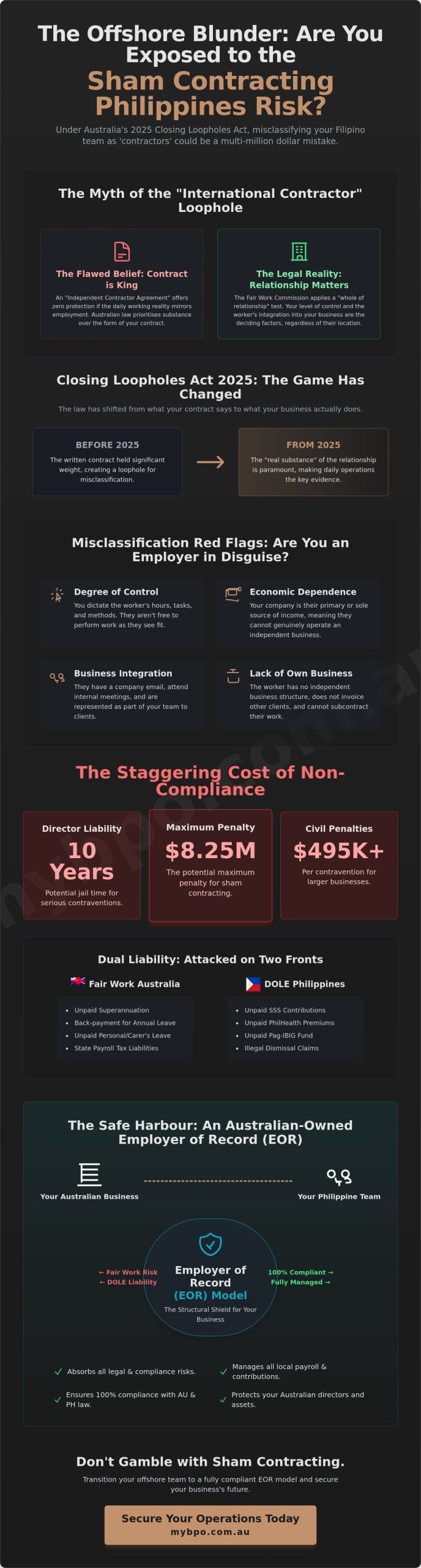
- Identify the specific indicators of misclassification, such as the degree of control your firm exerts and the level of economic dependence of the offshore worker.
- Quantify the financial exposure of non-compliance, including 2026 Fair Work penalties and the personal liability risks for Australian directors.
- Discover how an Australian-owned Employer of Record (EOR) model can absorb these legal risks and ensure total compliance with both Fair Work and Philippine labour codes.
Understanding the Jurisdictional Overlap: What is Sham Contracting Offshore?
In the Australian legal landscape of 2026, sham contracting is no longer confined to domestic building sites or local delivery drivers. It has evolved into a complex cross-border liability. At its core, sham contracting occurs when a business misrepresents an employment relationship as an independent contracting arrangement. This is typically done to avoid paying mandatory entitlements such as superannuation, leave, and payroll tax. For firms engaging remote staff, the sham contracting Philippines risk stems from the mistaken belief that a worker’s physical location in Manila or Cebu creates a legal barrier that the Fair Work Act cannot cross.
The Fair Work Commission operates on the “substance over form” principle. This means that a written “Independent Contractor Agreement” offers zero protection if the practical reality of the work contradicts the text. Courts look at the “totality of the relationship” rather than the label on the contract. If your contractor is integrated into your business, follows your specific directions, and cannot reasonably work for others, they are likely an employee in the eyes of the law. This fundamental employee vs. contractor distinction is the primary metric used to determine if a business has bypassed its legal obligations.
The Myth of the “International Contractor” Loophole
Many Australian directors believe that because a worker resides in the Philippines, they are beyond the reach of the Fair Work Act. This is a dangerous misconception. Case law, including the precedent set in Pascua v Doessel Group Pty Ltd, confirms that a worker’s offshore status does not automatically exempt the Australian hiring entity from local employment standards. Hiring a Filipino as a contractor to perform a permanent, full-time role is a high-risk strategy that often fails legal scrutiny. Australian courts determine employment status by assessing the level of control a business exerts over a worker’s tasks and the degree to which that individual is integrated into the daily operations of the firm.
Dual Liability: Fair Work (AU) vs. DOLE (PH)
Engaging staff through direct hire contractor models creates a massive compliance vacuum. You aren’t just answering to the Fair Work Ombudsman in Australia; you’re also exposed to the Philippine Department of Labor and Employment (DOLE). DOLE is notoriously protective of Philippine workers and can pursue Australian firms for unpaid mandatory benefits like SSS, PhilHealth, and Pag-IBIG. This creates a dual liability scenario where a business can be penalised at home for sham contracting while simultaneously being sued in a Philippine labour court for illegal dismissal or unpaid benefits. Direct hiring without a local legal entity leaves your Australian business assets vulnerable to these overlapping jurisdictions, as there is no structural shield to absorb the risk.
The Closing Loopholes Act 2025 and Its Impact on Offshore Teams
The legislative landscape shifted significantly with the full commencement of the Closing Loopholes Act 2025. This reform effectively dismantled the previous “contract-first” approach that allowed businesses to rely on written agreements to define a worker’s status. In 2026, the Australian legal system has returned to a “real substance” test. This means that even if a worker in the Philippines signs a document stating they are an independent contractor, the Fair Work Ombudsman (FWO) will disregard that document if the day-to-day reality suggests an employment relationship. For many firms, the sham contracting Philippines risk has escalated because the FWO is now actively investigating offshore arrangements that appear designed to circumvent Australian payroll tax and superannuation obligations.
Regulators are particularly aggressive toward businesses that re-engage former Australian-based employees as offshore contractors. If an individual moves to the Philippines and continues to perform the same role under the same management structure, but is now classified as a “contractor,” it triggers an immediate red flag. The law now views this as a deliberate attempt to avoid entitlements. Under the 2026 enforcement regime, the burden of proof has shifted; businesses must be able to demonstrate that the contractor is truly running their own independent enterprise, rather than simply being a remote staff member without benefits.
The “Real Substance” Test in 2026
Determining the status of your Philippine team requires a cold assessment of control. If your firm dictates specific working hours, mandates the use of company-branded email signatures, and requires attendance at every internal meeting, the “Right to Direct” likely rests with you. This is a hallmark of employment. Equipment provision is another critical factor. When an Australian business provides a laptop through equipment leasing or direct purchase, it reinforces the argument that the worker is not an independent contractor. True contractors generally provide their own tools of trade. If you own the equipment and control the workflow, you aren’t engaging a contractor; you’re managing an employee in a non-compliant framework.
Avoiding “Closing Loopholes” Penalties
To mitigate these risks, businesses must move away from the direct-hire contractor model. Utilising an Employer of Record (EOR) in Australia provides a robust compliance shield. An EOR absorbs the legal employer status in the Philippines, ensuring that the worker is classified as a full-time employee under Philippine law while being leased back to your firm. This structure creates the necessary “arms-length” relationship required to satisfy Australian regulators. It ensures that mandatory contributions are paid in the Philippines and that the Australian entity is not the common law employer. If you are concerned about your current exposure, the first step is to audit your offshore structure to ensure it aligns with the 2025 legislative standards.
Indicators of Misclassification: Contractor vs. Employee in the Philippines
Identifying the legal boundary between a genuine contractor and a misclassified employee requires more than a cursory glance at a contract. To mitigate the sham contracting Philippines risk, Australian firms must scrutinise the practical mechanics of how their offshore staff operate. Regulators in both jurisdictions look for specific markers that suggest a person is “part and parcel” of your organisation rather than an independent business entity. If your remote worker is integrated into your internal Slack channels, appears on your public organisational chart, and uses a company email address, the argument for a contractor relationship begins to dissolve.
A primary indicator is the “Results vs. Time” distinction. Genuine contractors are typically engaged to deliver a specific outcome for a fixed fee, whereas employees are paid for their availability during set hours. If you’re paying a Filipino worker an hourly rate for a 9-to-5 shift and monitoring their screen activity, you’ve likely crossed from a service-based agreement into a traditional employment model. Economic dependence also plays a vital role; if the worker relies solely on your firm for their livelihood and doesn’t provide services to other clients, they are economically dependent, which strongly signals employee status under both Australian and Philippine law.
The Philippine “Four-Fold Test”
While Australian courts focus on the “totality of the relationship,” Philippine labour law relies on a specific diagnostic known as the Four-Fold Test. This test assesses the relationship based on four pillars: the selection and engagement of the worker, the payment of wages, the power of dismissal, and the power of control. Philippine courts use the Four-Fold Test to determine employment status by evaluating who selects the worker, who pays their wages, who holds the power of dismissal, and who controls the methods of work. The power of control remains the most decisive factor in establishing an employer-employee relationship.
Mandatory Benefits and the “Sham” Trigger
The absence of mandatory statutory benefits is often the first “smoking gun” in a misclassification audit. In 2026, Philippine law requires employers to contribute 10% toward the Social Security System (SSS) and 2.5% for PhilHealth, alongside Pag-IBIG contributions. If these are missing, it suggests the arrangement is a sham designed to bypass local labour codes. For a precise breakdown of how to calculate your total SSS, PhilHealth, and Pag-IBIG contributions as an employer, Australian firms should consult a dedicated 2026 compliance reference to avoid administrative oversights that trigger DOLE penalties. Additionally, the failure to provide 13th month pay in the Philippines is a significant red flag. This mandatory benefit is a non-negotiable entitlement for all rank-and-file employees. Its exclusion from a full-time remote worker’s compensation package is frequently used as evidence by the Department of Labor and Employment (DOLE) to prove that a sham contracting arrangement exists.
The High Cost of Non-Compliance: Penalties and Legal Liabilities
The financial consequences of misclassifying offshore staff have reached an all-time high in 2026. Under the current Fair Work Act provisions, the sham contracting Philippines risk is no longer just a regulatory headache; it is a potential threat to your firm’s solvency. Civil penalties for businesses with 15 or more employees now start at the greater of $495,000 per contravention or three times the total underpayment amount. For individual directors or managers found to be involved in the arrangement, personal fines of up to $19,800 apply. These figures do not include the criminal penalties introduced by the Closing Loopholes Act, which can result in fines up to $8.25 million and imprisonment for up to 10 years for intentional wage theft.
Beyond the initial fines, the Fair Work Commission and the Australian Taxation Office (ATO) can compel businesses to provide back-pay for years of missed entitlements. This includes unpaid annual leave, sick leave, and public holiday rates. Furthermore, being blacklisted by the Fair Work Commission creates a lasting reputational stain that can hinder your ability to secure government contracts or attract top-tier talent in Australia. If your “contractor” model is found to be a sham, you are essentially carrying a massive, unhedged debt on your balance sheet that could be called in at any moment by a single disgruntled worker or an ATO audit.
Financial Fallout in Australia
In 2026, the mandatory employer contribution to superannuation has reached 12% of an employee’s ordinary time earnings. If a Philippine contractor is reclassified as an employee, you’re liable for the Superannuation Guarantee Charge (SGC), which includes the unpaid super, interest, and administrative fees. Unlike many other corporate debts, directors can be held personally liable for unpaid SGC through Director Penalty Notices. This means your personal assets are at risk if your offshore staffing model fails the “real substance” test. Additionally, the ATO has increased data-matching with Philippine financial institutions to identify firms using contractor labels to avoid payroll tax obligations.
Legal Vulnerabilities in the Philippines
Australian firms often overlook the “Regularisation” risk inherent in Philippine labour law. If a worker is found to be performing tasks necessary to your business, they can claim status as a regular employee through the Department of Labor and Employment (DOLE). This entitles them to back-dated 13th-month payments and mandatory separation pay if the relationship is terminated. To ensure your payments align with local standards, you should consult our guide on payroll in the Philippines for Australian companies. Failing to account for these local liabilities can result in your business being barred from operating or hiring within the Philippines entirely. To protect your business from these dual-jurisdiction penalties, you should secure your offshore operations with an Australian-owned EOR that absorbs these legal liabilities on your behalf.
Mitigating Risk through an Australian-Owned Employer of Record (EOR)
The transition from a high-risk contractor model to a compliant employment structure is the only definitive way to neutralise the sham contracting Philippines risk. While the legal complexities of 2026 may seem daunting; the solution lies in structural alignment. An Employer of Record (EOR) provides the necessary legal distance between your Australian firm and the day-to-day labour obligations in the Philippines. By utilising an Australian-owned partner, you ensure that the person managing your compliance understands the specific nuances of the Fair Work Act and the “real substance” tests applied by Australian tribunals. This isn’t just about outsourcing payroll; it’s about building a compliance shield that protects your domestic assets from cross-border litigation.
Transitioning your existing contractors into a formal employment model doesn’t mean losing your best talent. In fact, most Filipino professionals prefer the security of regular employment, as it provides them with access to bank loans, health insurance, and government benefits that the contractor model lacks. We facilitate this migration by absorbing the legal employer status; allowing you to maintain your operational workflow while we take on the burden of regulatory accountability. Our on-the-ground presence in Manila and Bacolod ensures that your team is supported by local HR experts who can navigate the Department of Labor and Employment (DOLE) requirements in real-time.
MyBPO: Your Compliance Shield
Our EOR model is designed to absorb the legal employment risk entirely. We ensure that all mandatory SSS, PhilHealth, and Pag-IBIG contributions are calculated and remitted with precision; eliminating the “sham” triggers that often lead to audits. Beyond the paperwork, we provide the tangible infrastructure that proves a professional employment relationship exists. By providing your team with a dedicated workspace in the Philippines, you move the relationship out of the ambiguous “freelance” territory and into a structured, professional environment that satisfies both Australian and Philippine regulators.
Securing Your 2026 Offshore Strategy
Adopting a “Safe Harbour” structure provides the peace of mind necessary for long-term offshore expansion. In the current enforcement climate, hoping that your contractor model remains unnoticed is a failing strategy. The first step toward total compliance is a comprehensive audit of your current offshore team to identify misclassification red flags. We help you evaluate the degree of control, the provision of equipment, and the payment structures currently in place. Once the risks are identified, we provide a clear roadmap to regularise your staff under our local entity; ensuring that your 2026 offshore strategy is built on a foundation of legal integrity rather than a ticking time bomb of liability.
Securing Your Future in the Philippines
The regulatory environment of 2026 has transformed the “independent contractor” model into a liability that few Australian businesses can afford to carry. As the Closing Loopholes Act and the Philippine Four-Fold Test converge, firms are now exposed to unprecedented civil penalties and personal director liability. Ignoring the sham contracting Philippines risk does not mitigate it; it simply allows the potential financial and reputational fallout to accumulate on your balance sheet.
Protecting your enterprise requires a transition from abstract digital arrangements to a grounded, compliant structure. MyBPO serves as a dedicated compliance shield, offering the unique advantage of being Australian-owned and operated with local accountability. With a physical presence in Manila and Bacolod for total oversight, we specialise in the precise jurisdictional alignment of Fair Work and DOLE standards. This ensures your offshore operations are both ethical and legally resilient. Secure your offshore team today with a MyBPO Compliance Audit. Taking this step allows you to focus on growth while we absorb the burden of cross-border risk.
Frequently Asked Questions
What is the “real substance” test under the Closing Loopholes Act?
The “real substance” test is a legal diagnostic that prioritises the daily operational reality of a working relationship over the text of a written agreement. Under the Closing Loopholes Act 2025, the Fair Work Commission evaluates factors like your degree of control, the provision of equipment, and whether the worker is integrated into your business. If the practical substance of the role mirrors employment, the “independent contractor” label is legally disregarded.
Can an Australian company be sued in the Philippines for sham contracting?
Yes, Australian firms can face legal action in the Philippines via the Department of Labor and Employment (DOLE). If an offshore worker is misclassified, they can file for “regularisation” or illegal dismissal. Without a local legal entity or an EOR to absorb the risk, your firm is directly exposed to Philippine labour courts, which are notoriously protective of workers’ rights and the mandatory payment of benefits.
Is it illegal to hire a virtual assistant in the Philippines as a contractor?
It isn’t inherently illegal to engage a virtual assistant as a contractor, but it becomes a sham contracting Philippines risk if the role functions as a permanent employment position. If the VA works exclusively for you, follows set hours, and uses your systems, they are likely an employee. Misclassifying them to avoid paying entitlements is where the legal violation occurs under both Australian and Philippine law.
What are the penalties for sham contracting in Australia in 2026?
In 2026, civil penalties for businesses with 15 or more staff start at the greater of $495,000 per contravention or three times the underpayment amount. Intentional misclassification can also trigger criminal penalties under the “Closing Loopholes” reforms, including fines up to $8.25 million and up to 10 years of imprisonment. Directors also face personal fines of $19,800 for their involvement in such non-compliant arrangements.
How does an Employer of Record (EOR) protect me from sham contracting risks?
An Employer of Record (EOR) protects you by becoming the legal employer of your Philippine staff within a compliant local framework. The EOR absorbs all statutory liabilities, including the remittance of SSS, PhilHealth, and Pag-IBIG contributions. This structure creates a necessary legal “safe harbour,” ensuring that your Australian firm maintains an arm’s-length relationship with the worker, thereby neutralising the sham contracting Philippines risk.
Do I have to pay superannuation for my Philippine contractors?
You must pay superannuation if the contractor is deemed an employee under the “real substance” test or the extended definition in the Superannuation Guarantee Act. In 2026, this mandatory contribution is 12% of ordinary time earnings. Failing to pay this for misclassified contractors results in the Superannuation Guarantee Charge, which includes back-pay, interest, and administrative penalties that directors may be personally liable for.
What happens if the Philippine DOLE classifies my contractor as an employee?
If the Philippine DOLE classifies your contractor as a regular employee, you’re immediately liable for all back-dated mandatory benefits. This includes unpaid SSS and PhilHealth contributions, 13th-month pay, and service incentive leave. Additionally, you cannot terminate the relationship without “just cause” and following strict due process. Failure to comply can lead to significant separation pay requirements and your business being barred from hiring within the country.
Why is Australian ownership important for a Philippines BPO or EOR?
Australian ownership ensures that your provider understands the specific risks associated with the Fair Work Act and the ATO. Unlike local Philippine firms or generic global platforms, an Australian-owned EOR provides local accountability and a shared understanding of your domestic legal obligations. This bridge between jurisdictions is essential for ensuring that your offshore strategy doesn’t inadvertently compromise your Australian business assets or trigger domestic regulatory audits.
Need a strategy session?
Tell us about your team and we will map out the right structure, fixed-cost quote included.
Book a call