Blog
SSS, PhilHealth, and Pag-IBIG Contributions: A 2026 Employer Reference for Australian Firms

Could a minor administrative oversight in your Manila office expose your Australian firm to catastrophic legal liability and DOLE penalties? For many directors, managing SSS PhilHealth Pag-IBIG contributions employer obligations feels like navigating a regulatory minefield without a reliable map. It’s a common frustration to feel overwhelmed by the multiple government agencies and the complex, shifting contribution schedules that define the Philippine labour landscape.
This article serves as your definitive 2026 reference to master these mandatory employee contributions and secure your offshore operations against compliance risks. You’ll gain a clear breakdown of the current SSS, PhilHealth, and Pag-IBIG rates, allowing you to calculate total employee on-costs with surgical precision. We’ll examine the mechanics of each fund and provide a structured path to ensure your business maintains total compliance while mitigating the structural risks of sham contracting.
Key Takeaways
- Understand the statutory nature of Philippine employee funds, which function as the mandatory equivalent to the Australian superannuation and Medicare levy system.
- Master the calculation of SSS PhilHealth Pag-IBIG contributions employer liabilities using current 2026 salary brackets to ensure precise budgeting for your offshore team.
- Recognise the critical risks of late remittances, which attract compounding monthly penalties and can lead to serious criminal exposure for directors under the Social Security Act.
- Identify the specific components of the 2026 rate hikes, including the mandatory Employees Compensation (EC) program and the expanded PhilHealth universal healthcare levies.
- Explore how partnering with an Australian-owned Employer of Record (EOR) allows you to offload all statutory liability and manage Philippine payroll through a single, transparent AUD invoice.
The Foundation of Philippine Labour Compliance: SSS, PhilHealth, and Pag-IBIG
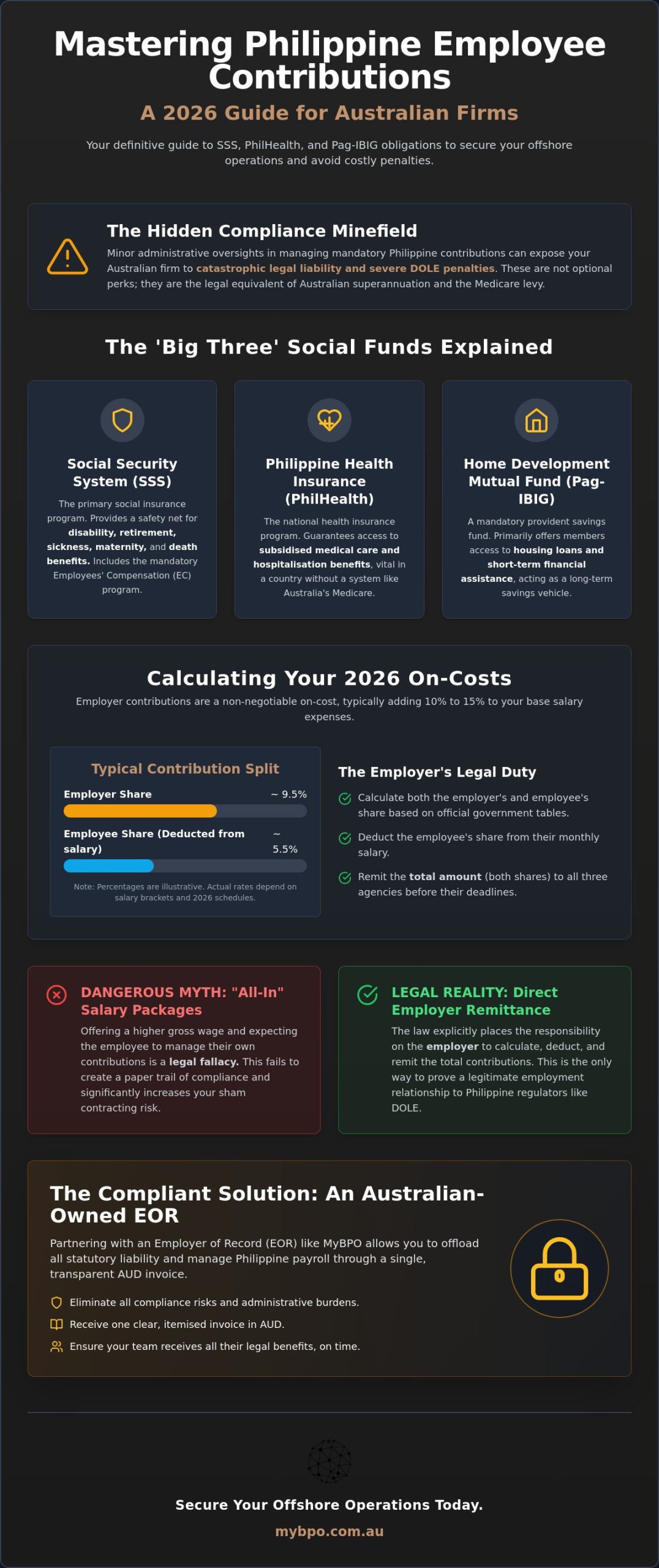
For Australian directors, the Philippine regulatory environment can initially appear opaque. However, the most critical pillar of local employment law rests on three specific social funds. These mandatory SSS PhilHealth Pag-IBIG contributions employer obligations are the direct functional equivalent of the Australian superannuation and Medicare levy system. They are not optional bonuses or discretionary perks; they are non-negotiable statutory requirements for every legally employed worker in the Philippines.
If a firm fails to remit these funds, it doesn’t just create a financial debt. It generates a distinct “paper trail” of non-compliance. Philippine regulators, specifically the Department of Labour and Employment (DOLE), use the absence of these contributions to identify and penalise foreign firms for illegal labour practices. Australian businesses must view these payments as essential on-costs. In a compliant structure, these typically range between 10% and 15% of the employee’s base salary, depending on the specific wage bracket.
The “Big Three” Agencies Explained
To secure your operations, you must understand the specific mandate of each agency and why they are central to the employee value proposition in the Philippines:
- Social Security System (SSS): This is the primary social insurance program. It provides workers with a safety net for disability, retirement, sickness, maternity, and death benefits.
- Philippine Health Insurance Corporation (PhilHealth): This national health insurance program ensures that employees have access to subsidised medical care and hospitalisation benefits, which is vital in a country without a universal free healthcare system like Australia’s Medicare.
- Home Development Mutual Fund (Pag-IBIG): This is a mandatory provident savings fund. It primarily offers housing loans and short-term financial assistance to its members, functioning as a long-term savings vehicle.
Why “All-In” Salary Packages Often Fail
A common mistake made by foreign firms is offering an “all-in” salary package. Directors often believe that paying a higher gross wage to cover these benefits satisfies their legal duty. This is a dangerous legal fallacy. Under Philippine law, the responsibility lies with the employer to deduct the employee’s share and remit the total amount, including the employer’s portion, to the respective agencies. Managing SSS PhilHealth Pag-IBIG contributions employer duties correctly is the only way to prove a legitimate employment relationship exists.
Simply handing over the cash and expecting the worker to manage their own contributions is not a valid defence. When these specific line items are missing from a payroll ledger, the sham contracting Philippines risk increases exponentially. Without a documented history of statutory remittances, your offshore staff may be reclassified as regular employees by DOLE, triggering massive back-pay orders and administrative fines. Total compliance requires a structural approach to payroll that mirrors the rigour of Australian PAYG and superannuation standards.
Breaking Down the Components: Social Security, Healthcare, and Housing Funds
Managing SSS PhilHealth Pag-IBIG contributions employer mandates involves more than a simple payroll calculation. It requires dealing with three distinct government bureaucracies, each with its own reporting cycles and remittance deadlines. While they share the common goal of social protection, the mechanical requirements for each fund vary significantly. Accurately calculating the SSS PhilHealth Pag-IBIG contributions employer portion is vital for maintaining a clean audit trail and protecting your local operations.
SSS: More Than Just a Pension
The Social Security System (SSS) is frequently misunderstood as a mere retirement fund. In reality, it acts as a comprehensive safety net. It funds maternity leave, sickness benefits, and unemployment insurance for your local staff. A critical, often overlooked component is the Employees Compensation (EC) program. This is a mandatory employer-paid levy of either ₱10 or ₱30 per month, designed to cover work-related injuries or illnesses.
Contributions are determined by the Monthly Salary Credit (MSC), which ranges from ₱5,000 to ₱35,000 as of June 2026. Because SSS is the most visible benefit for employees, it’s the primary metric used during DOLE compliance audits. If your records show gaps in SSS remittances, it’s an immediate red flag for regulatory intervention. Timely payments ensure your staff can access these benefits without delay, which directly impacts morale and trust.
PhilHealth and Pag-IBIG: Essential Safety Nets
PhilHealth rates have reached their final scheduled adjustment under the Universal Health Care Law. For 2026, the contribution rate is 5% of the monthly basic salary, split equally between the firm and the employee. Consulting the Official PhilHealth Contribution Guidelines is essential to ensure you aren’t under-contributing for high-earners, as the salary ceiling now sits at ₱100,000. This contribution ensures your team has financial protection against significant medical expenses.
In contrast, Pag-IBIG contributions remain the most predictable on-cost. While the rate is 2% for both parties, the “Maximum Fund Salary” is capped at ₱10,000. This means the employer share is limited to ₱200 per month. Despite the low cost, Pag-IBIG is a powerful retention tool. It grants employees eligibility for low-interest housing loans, a benefit highly valued in the local market.
Each of these funds requires separate monthly reporting and remittance. Missing a single deadline for one agency can trigger penalties even if the others are paid on time. If the administrative burden of these three separate systems seems excessive, many firms choose to partner with an Australian-owned EOR to consolidate these liabilities into a single, secure process.
Calculating Employer Liabilities: Contribution Tables and Thresholds for 2026
Managing SSS PhilHealth Pag-IBIG contributions employer mandates requires a departure from the flat-percentage thinking common in Australian payroll. In the Philippines, statutory liabilities are defined by tiered salary brackets. This means the actual dollar amount of your on-costs fluctuates based on the specific Monthly Salary Credit (MSC) assigned to each employee’s wage level. For Australian firms, maintaining accurate payroll Philippines for Australian companies is only possible through automated systems that can handle these complex, non-linear calculations.
The employer share is an additional cost that sits above the gross salary. If you haven’t factored this into your initial hire costs, your offshore budget will quickly fall out of alignment. Accurate SSS PhilHealth Pag-IBIG contributions employer reporting is the only way to safeguard your firm from the risk of misclassification. When these tiers are miscalculated, it doesn’t just create a debt to the government; it signals a lack of operational control to local labour regulators.
The 2026 Rate Schedule Framework
The 2026 fiscal year sees the SSS contribution rate settled at 15% of the MSC, with the employer share absorbing 10%. For high-income earners in the offshore sector, the MSC now peaks at ₱35,000. Any earnings above this threshold are directed into the mandatory provident fund (MPF). PhilHealth has also finalised its scheduled adjustments, maintaining a 5% premium rate. While the salary ceiling for PhilHealth is ₱100,000, Pag-IBIG remains capped at a monthly fund salary of ₱10,000. This cap ensures that even for executive-level offshore staff, the employer’s Pag-IBIG liability stays fixed at ₱200 per month.
Calculating the Total Cost of Employment (TCOE)
Australian CFOs must calculate the Total Cost of Employment (TCOE) rather than looking at gross salary in isolation. The formula is straightforward: Base Salary + SSS + PhilHealth + Pag-IBIG + 13th Month Pay. You cannot ignore the 13th month pay Philippines compliance requirement, as this represents a mandatory additional month of salary that must be accrued throughout the year. If these figures aren’t integrated into your annual budget, your offshore operations will face a significant funding gap by December. The TCOE is the only metric that matters for offshore budgeting.
The Risk of Non-Compliance: Penalties, Interest, and Legal Exposure
Non-compliance with statutory obligations is not merely an administrative oversight. It’s a high-stakes legal failure that carries immediate financial consequences. In the Philippines, late remittances of SSS PhilHealth Pag-IBIG contributions employer payments attract a mandatory 2% monthly penalty. This interest compounds. If left unaddressed for several months, the debt can quickly eclipse the original principal, creating a significant unbudgeted liability for your firm.
The legal exposure extends beyond financial fines. Under the Social Security Act, the failure to deduct and remit contributions is classified as a criminal offence. This is a severe distinction. It allows the state to issue warrants for the arrest of local directors or responsible officers. For Australian firms operating through a local subsidiary, this places your executive team in the direct line of fire. Regulatory bodies like the Department of Labour and Employment (DOLE) conduct spot audits, often triggered by a single employee complaint, to verify these records.
Using an unlicenced entity or a “grey market” provider offers no protection against these risks. Regulators can “pierce the corporate veil,” holding the Australian parent company accountable for unpaid liabilities. This exposure is particularly acute if you haven’t established a compliant local presence. To eliminate these risks and ensure total regulatory protection, you should secure your operations with MyBPO.
The Link to Australian Fair Work Penalties
The danger isn’t confined to Manila. Australian courts are increasingly scrutinising offshore arrangements to identify sham contracting. If your firm claims a worker is an “independent contractor” but fails to provide the SSS PhilHealth Pag-IBIG contributions employer mandates that define a legitimate employment relationship, you’re providing the Fair Work Ombudsman with a smoking gun. This evidence of labour exploitation can lead to massive fines in Australia and irreparable reputational damage to your brand. Direct hiring via PayPal or similar digital platforms provides zero protection; it simply documents the absence of a compliant structure. To ensure your business remains protected from broader regulatory scrutiny, visit The Sphere Group to learn about the red flags that can trigger an ATO tax audit.
DOLE Audits and Business Permit Risks
A failed DOLE audit has immediate operational consequences. The most severe is the suspension of your business permit, effectively halting your right to operate in the country. Beyond the legalities, missing contributions create internal friction. When an employee cannot access PhilHealth for a medical emergency or a Pag-IBIG loan because of your missing remittances, the relationship breaks down. Rectifying years of missed payments is an administrative nightmare that requires manual reconciliation with three separate agencies, often taking months to resolve.
Navigating Mandatory Contributions via an Australian-Owned EOR
The complexity of managing SSS PhilHealth Pag-IBIG contributions employer obligations often serves as a barrier to successful offshore expansion. While the tiered calculations and monthly reporting cycles are burdensome, the true challenge lies in the legal accountability. By partnering with an Employer of Record (EOR) like MyBPO, your firm effectively transfers this entire statutory burden. We absorb all legal liability for remittances, ensuring your operations remain shielded from the penalties and audits discussed previously.
Operational simplicity is a core component of our service. Instead of navigating multiple Philippine government portals and managing foreign currency fluctuations, you receive a single, transparent invoice in AUD. This covers the base salary, all mandatory on-costs, and our management fee. Our physical infrastructure in Manila and Bacolod provides the tangible presence required for local agency compliance. This allows you to focus on your core business objectives while we secure the perimeter of your employment structure.
Why MyBPO is the Secure Choice
As an Australian-owned and operated entity, we bridge the jurisdictional gap between your head office and your Manila team. We understand the nuances of the Fair Work Act and how offshore arrangements can impact your local standing. By engaging a specialist employer of record Australia firm, you ensure that your intellectual property is protected under a robust commercial contract while we handle the granular details of Philippine labour law. Our “Compliance Shield” approach means we take on the operational risk, providing you with automated reporting and total visibility over every cent remitted.
The Transition to Total Compliance
Many firms come to us with existing offshore teams currently operating under “contractor” arrangements. This is a high-risk state. We begin by conducting a thorough audit of your current team to identify contribution gaps and potential misclassification liabilities. Once the risks are quantified, we manage the migration of your staff into a fully compliant EOR structure. This transition secures the employee’s access to vital benefits like PhilHealth and SSS loans, which significantly improves long-term retention. Secure your offshore team today and contact MyBPO for a compliance audit to rectify any hidden vulnerabilities in your current payroll setup.
Secure Your Offshore Operations Against Regulatory Risk
The 2026 landscape for Philippine employment requires more than just administrative accuracy; it demands a structural commitment to compliance. Managing SSS PhilHealth Pag-IBIG contributions employer mandates involves navigating tiered salary credits and rigorous reporting cycles that directly impact your legal standing in both Manila and Australia. Failing to remit these funds correctly doesn’t just attract compounding 2% monthly penalties. It exposes your firm to criminal liability and the severe risks of sham contracting reclassification.
MyBPO provides a definitive compliance shield. Being Australian-owned and operated, we possess the specific expertise in AU-PH cross-border labour law required to protect your interests. With a tangible, on-the-ground presence in Manila and Bacolod, we absorb your statutory liabilities and consolidate them into a single AUD invoice. Take the first step toward a secure, risk-free offshore strategy today.
Download our 2026 Philippine Employment Compliance Checklist
Frequently Asked Questions
Is the employer required to pay SSS, PhilHealth, and Pag-IBIG for part-time staff?
Yes, employers must remit contributions for part-time staff. Philippine labour law does not distinguish between full-time and part-time status regarding these statutory benefits. If a worker is legally classified as an employee, the SSS PhilHealth Pag-IBIG contributions employer mandates apply in full. The specific amount you pay will be determined by the employee’s actual monthly salary credit bracket, ensuring they maintain their coverage under the national social safety net.
Can an Australian company pay these contributions directly to the Philippine government?
No, an Australian company cannot pay these contributions directly without a registered local entity. These government agencies require a local employer identification number and a physical presence within the Philippines to process remittances. Most Australian firms resolve this by using an Employer of Record (EOR). The EOR acts as the legal employer on the ground, handling all registrations and remitting the necessary funds to ensure your operations remain compliant with local laws.
What happens if an employee already has an existing SSS or PhilHealth number?
You must use the employee’s existing SSS, PhilHealth, and Pag-IBIG numbers. These identifiers are permanent and stay with the individual throughout their entire working life. During onboarding, your payroll team or EOR provider will collect these numbers to ensure that all future contributions are correctly credited to the worker’s established accounts. Attempting to create duplicate accounts is a significant administrative error that can prevent employees from accessing their medical or loan benefits.
How much extra should an Australian employer budget for these contributions on top of the base salary?
You should budget an additional 10% to 15% on top of the base salary to cover statutory on-costs. This margin accounts for the employer’s share of SSS PhilHealth Pag-IBIG contributions employer liabilities, including the mandatory Employees Compensation (EC) program. While the tiered nature of the contribution tables means the exact percentage varies by salary level, this range provides a reliable baseline for most offshore roles. You must also factor in the 13th month pay separately in your annual projections.
Are these contributions tax-deductible for the Australian business?
These contributions are generally considered a legitimate business expense and are tax-deductible for the Australian entity. When you partner with an EOR, the total cost of employment is typically invoiced as a single service fee, which simplifies your local tax reporting. It’s vital to consult with a qualified tax professional to ensure your offshore structure aligns with ATO guidelines; additionally, those looking to strengthen their domestic operations can discover Business Wise for insights on regional business growth and advisory.
Is the 13th month pay separate from these monthly contributions?
Yes, the 13th month pay is a distinct legal requirement and is entirely separate from monthly statutory contributions. While SSS, PhilHealth, and Pag-IBIG are remitted every month, the 13th month pay is a mandatory bonus equivalent to one-twelfth of the employee’s basic salary earned during the calendar year. It must be paid to the employee no later than December 24th. This is a non-negotiable benefit under Philippine law and cannot be used to offset social insurance obligations.
What is the deadline for monthly remittances to SSS, PhilHealth, and Pag-IBIG?
Deadlines vary by agency but generally fall between the 10th and 20th day of the following month. For instance, the SSS deadline is often determined by the last digit of the employer’s registration number. Missing these specific windows by even twenty-four hours triggers the mandatory 2% monthly penalty. Because each agency operates on a different schedule, many firms use a consolidated payroll service to ensure no deadline is overlooked.
Can I hire Philippine staff as independent contractors to avoid these payments?
Hiring staff as independent contractors to avoid statutory payments is a high-risk strategy that frequently results in sham contracting penalties. If you exercise control over the worker’s schedule and methods, Philippine regulators will likely reclassify them as regular employees during an audit. This reclassification forces the Australian firm to pay all missed contributions, compounding interest, and potential administrative fines. It’s far more secure to utilise a compliant EOR structure that acknowledges the employment relationship from the outset.
Need a strategy session?
Tell us about your team and we will map out the right structure, fixed-cost quote included.
Book a call