Blog
Risks of Hiring Contractors in the Philippines: 5 Myths Busted for Australian Firms

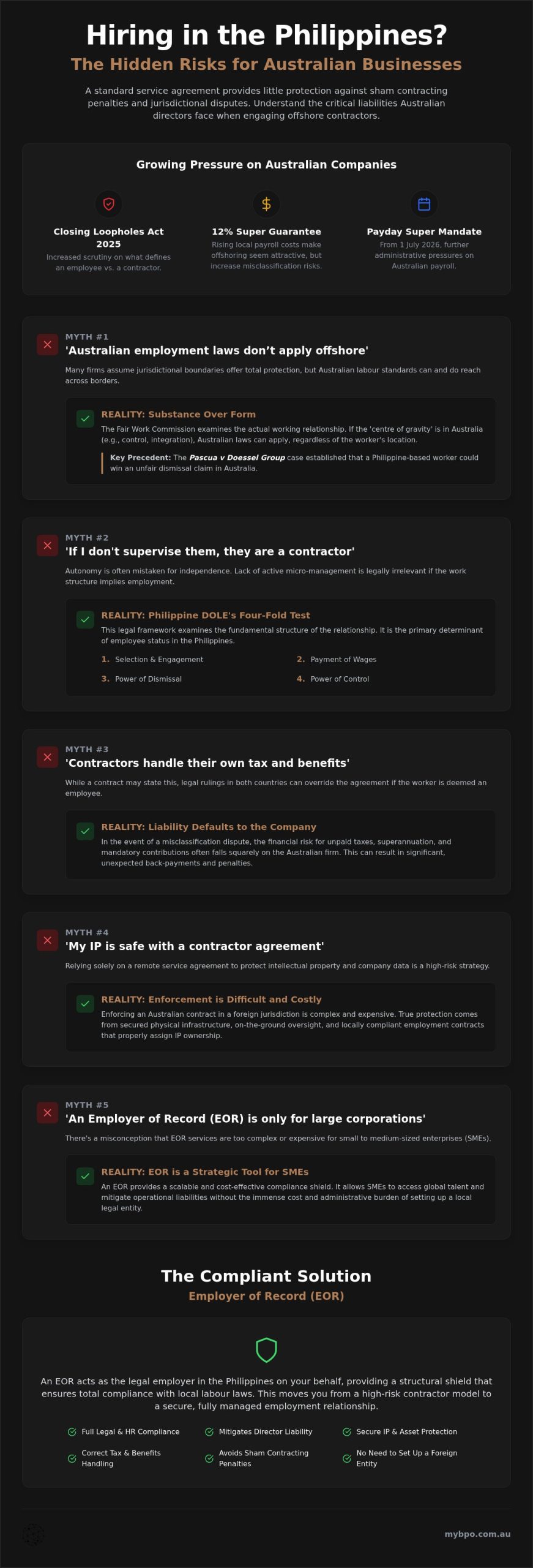
Thinking that hiring an independent contractor in Manila is a simple shortcut to lower overheads is no longer just a mistake; it is a high-stakes liability. When Australian directors overlook the structural risks of hiring contractors Philippines based, they often find themselves caught between the Closing Loopholes Act 2025 and the strict enforcement of the Philippine Department of Labor and Employment. You likely want the agility of offshore talent without the administrative weight of a foreign entity, but a standard service agreement provides little protection against sham contracting penalties or jurisdictional disputes.
We understand the need to maintain a competitive edge, particularly as the Australian Superannuation Guarantee reaches 12% and the 1 July 2026 Payday Super mandate increases local payroll pressure. This article will uncover the hidden legal and financial liabilities of offshore contracting and explain how to secure your Philippine workforce with total compliance. We will dismantle five pervasive myths regarding IP ownership, tax obligations, and data security, providing a structured way forward to navigate these regulatory waters without risking your company’s assets or reputation.
Key Takeaways
- Recognise that both the Fair Work Commission and the Philippine DOLE prioritise the actual nature of the working relationship over the labels used in a written contract.
- Evaluate the financial risks of hiring contractors Philippines regarding unpaid tax and mandatory contributions that often default to the Australian firm during a legal dispute.
- Protect your intellectual property and company equipment by moving away from unenforceable remote agreements toward secured physical infrastructure and on-the-ground oversight.
- Learn how an Employer of Record (EOR) provides a structural compliance shield, allowing Australian SMEs to mitigate operational liabilities without the cost of a local entity.
Myth 1: ‘Australian Employment Laws Don’t Apply to Offshore Contractors’
The belief that an ocean provides a legal barrier against the Fair Work Commission is a common but costly misconception. Many Australian firms operate under the assumption that jurisdictional boundaries offer total protection; however, the reality is that Australian labour standards can, and do, reach across borders. When assessing the risks of hiring contractors Philippines based, directors must understand that the Fair Work Commission prioritises ‘substance over form’. This means the commission examines the daily reality of the working relationship rather than the label written at the top of a service agreement.
The legal distinction between contractors and employees is not defined by a worker’s physical location but by the level of control an organisation exerts. If an Australian company dictates specific working hours, provides software logins, and manages the worker as an integrated part of their team, the relationship may be legally viewed as employment. This creates a scenario where Australian courts can assert jurisdiction, potentially exposing the firm to back-pay claims for leave, public holidays, and other statutory entitlements that were bypassed under the guise of a ‘contracting’ arrangement.
The Pascua v Doessel Group Precedent
The landmark case of Pascua v Doessel Group demonstrated exactly how vulnerable Australian SMEs are when using freelance marketplaces. In this instance, a Philippine-based worker successfully won an unfair dismissal claim in Australia because the commission found the worker was, in fact, an employee. This ruling established that if the ‘centre of gravity’ of the employment relationship is in Australia, local labour laws apply regardless of the worker’s residency. Misclassification in the context of the Fair Work Act refers to the incorrect legal categorisation of a worker as an independent contractor when the true nature of their engagement is one of employment.
Vicarious Liability for Australian Directors
Directors face personal risk when offshore arrangements fail to meet Australian standards. Under the ‘sham contracting’ provisions of the Fair Work Act, individuals involved in a contravention can be held personally liable for significant civil penalties. These fines are designed to deter businesses from stripping workers of their rights by mislabelling them as contractors. To protect your personal and corporate assets, it is vital to understand how to hire in the Philippines legally. Transitioning from a loose freelance model to a structured compliance shield ensures that jurisdictional risks are mitigated before they reach a courtroom.
Myth 2: ‘If I Don’t Supervise Them, They Are a Contractor’
Australian managers often mistake autonomy for independence. They assume that as long as they aren’t ‘micro-managing’ their offshore talent, the relationship remains a standard B2B contract. However, the risks of hiring contractors Philippines based are heavily dictated by the ‘Four-Fold Test’ applied by the Department of Labor and Employment (DOLE). This legal framework looks past the daily supervision levels to examine the fundamental structure of the relationship. If the underlying structure suggests an employer-employee bond, the lack of active supervision becomes legally irrelevant.
Philippine courts frequently apply the ‘economic reality’ test to determine if a worker is truly an independent professional or a dependent employee. If the worker depends entirely on your firm for their livelihood and performs tasks essential to your core business, they are an employee in the eyes of the law. Providing a company email address, a specific software seat, or access to internal communication channels is often enough to prove ‘integration’ into the business. This integration triggers employment status in Philippine labour disputes, regardless of what your written service agreement claims.
The Four-Fold Test Breakdown
To navigate these complexities, you must understand the four criteria DOLE uses to classify workers:
- Selection and engagement: If you personally interview, vet, and select the individual rather than engaging a firm to provide a result, you are acting as an employer.
- Payment of wages: Regular, fixed monthly payments are viewed as salary. True contractors typically invoice based on milestones or project completion.
- Power of dismissal: If you have the right to terminate the individual for performance issues or conduct, you are exercising employer-like authority.
- Power of control: This is the most critical factor. It refers not just to the result, but to the ‘means and methods’ used to achieve it.
Common ‘Control’ Traps for Australian Managers
A classic trap involves requiring specific working hours, such as 9 AM to 5 PM AEST. While the rules for Hiring contractors in Australia focus heavily on taxation and superannuation, the Philippine system views mandated hours as a clear indicator of employment. If you also provide company-branded equipment or require mandatory attendance at internal training sessions, you are inadvertently building a case for employment. This creates a significant sham contracting Philippines risk that can lead to back-dated benefit claims. To avoid these pitfalls, many firms find that securing your workforce through a dedicated EOR is the only way to maintain operational control without assuming the legal burden of direct employment.
Myth 3: ‘Contractors Are Responsible for Their Own Tax and Benefits’
A dangerous assumption among Australian directors is that paying a flat project fee absolves them of all statutory obligations. While a service agreement might state that the worker is responsible for their own taxes, Philippine labour law often overrides these private arrangements. If a dispute arises and the relationship is reclassified as employment, the ‘foreign principal’ is typically held jointly and severally liable for all unpaid contributions. This is one of the most severe financial risks of hiring contractors Philippines based, as it exposes your firm to retrospective claims that can span several years.
In the Philippines, employees are entitled to a suite of mandatory benefits, including Social Security System (SSS) contributions, PhilHealth, and the Pag-IBIG Fund. When these are ignored, the Bureau of Internal Revenue (BIR) can impose a 25% surcharge on unpaid taxes plus 12% annual interest. These penalties are not merely theoretical; they are frequently triggered during BIR audits or when a disgruntled worker files a claim with the National Labor Relations Commission. Managing these liabilities from a distance is nearly impossible, which is why payroll in the Philippines for Australian companies must be anchored in local expertise and physical presence.
The Hidden Cost of Unpaid Contributions
The administrative burden of a tax audit in a foreign jurisdiction can quickly paralyse an SME’s operations. Philippine courts do not just look at the current year; they calculate back-pay for the entire duration of the engagement. Beyond the 25% BIR surcharge, PhilHealth penalties can reach PHP 50,000 per employee. When combined with the Australian Superannuation Guarantee rate of 12% for the 2026-2027 financial year, the total cost of a misclassified worker can easily double your expected labour spend. The Closing Loopholes Act 2025 further complicates this by tightening the definition of employment, making it easier for offshore workers to argue they are entitled to Australian-standard benefits if the ‘substance’ of their role mirrors that of a local employee.
The 13th-Month Pay Misconception
Perhaps the most misunderstood element of Philippine compensation is the 13th-month pay. This is not a discretionary Christmas bonus; it is a statutory requirement under Presidential Decree No. 851. Contractors frequently claim this payment retrospectively during termination disputes to prove an employment relationship existed. If you have been paying a fixed monthly amount without a clear distinction of project-based milestones, a court is likely to view that 13th-month payment as a non-negotiable right. The financial shock of multi-year retrospective claims for 13th-month pay, combined with unpaid leave credits, has the potential to wipe out any cost savings gained from offshore contracting.
Myth 4: ‘My Intellectual Property is Safe with a Contractor Agreement’
Relying on a standard Australian service agreement to protect your trade secrets is a high-risk strategy. While the document might look ironclad in Sydney, it often lacks teeth in a Manila court. One of the primary risks of hiring contractors Philippines based is the “unenforceability gap”. If a contractor misappropriates your data or refuses to return company property, the cost of pursuing legal action in a foreign jurisdiction often exceeds the value of the lost asset. You’re left with a piece of paper that holds little practical weight when your sensitive information has already been compromised.
Under the Intellectual Property Code of the Philippines (Republic Act No. 8293), independent contractors own the copyright to the work they create by default. Unless you have a specific, written agreement that explicitly transfers these rights to your firm, your intellectual property (IP) remains legally tethered to the individual. Even with such an agreement, the lack of physical oversight means you have no way to prevent data from being copied onto personal hard drives or shared via unsecured home networks. When a worker is operating from a private residence, your “right to audit” is a theoretical concept rather than a functional security measure.
Jurisdictional Hurdles in IP Disputes
Litigation in the Philippines is a prolonged and expensive process that few Australian SMEs have the resources to navigate. When evaluating direct hire Philippines vs BPO models, the security of your data must be the deciding factor. A direct hire freelancer operates outside your physical control; if they choose to “ghost” your organisation, you may lose access to critical accounts and proprietary code instantly. Without a local entity to intervene, your recourse is limited to the Philippine legal system, which operates on a “first-to-file” basis for trademarks and patents, adding another layer of complexity to asset recovery.
Securing Assets with Physical Infrastructure
Home-based arrangements are inherently vulnerable to equipment theft and data leakage. Recovering a laptop from a private residence in a provincial area is a logistical nightmare that most Australian firms aren’t equipped to handle. Utilising dedicated workspace Philippines solutions eliminates this vulnerability by housing your team in a managed, professional environment with enterprise-grade security protocols. This physical presence ensures that your IP never leaves a controlled facility.
To maintain total control over your company hardware and sensitive data, we recommend leasing equipment through an Australian-owned partner with physical offices on the ground. This structural approach allows you to revoke access and secure physical assets immediately if a relationship ends, providing a level of protection that no remote contract can match.
Myth 5: ‘Hiring an EOR is Only for Large Corporations’
Small businesses often view an Employer of Record (EOR) as an unnecessary luxury reserved for multinational corporations. This perspective overlooks the fact that SMEs are actually more vulnerable to the financial and legal fallout of misclassification. While a large firm might absorb a BIR fine or a Fair Work dispute as a line item, such events can be terminal for a growing Australian business. An EOR is not a cost centre; it is a strategic investment that eliminates the structural risks of hiring contractors Philippines by providing a legitimate, local legal framework for your team.
The transition from direct contracting to a managed employment model is often the difference between a scalable operation and a legal liability. When you hire through an EOR, you aren’t just outsourcing payroll; you are securing a compliance shield that protects your Australian entity from foreign regulatory overreach. This model allows you to maintain the agility of a small team while benefiting from the robust infrastructure typically only available to major enterprises. Understanding the difference between Employer of Record and Business Process Outsourcing is essential before committing to either model, as each carries distinct legal, financial, and operational implications for Australian firms expanding into the Philippines. For a deeper analysis of how these two global hiring models compare across compliance, cost, and control, our guide on EOR vs BPO for choosing the best global hiring model provides a comprehensive framework to inform your decision.
The EOR as Risk Insurance
By engaging MyBPO, you effectively transfer the burden of compliance to a specialist entity. We become the legal employer in the Philippines, which means we absorb the direct liabilities associated with labour codes, tax filings, and mandatory benefit contributions. This arrangement creates a ‘Safe Harbour’ effect for Australian directors, ensuring that your local business remains insulated from disputes arising in a foreign jurisdiction. Utilising an employer of record Australia based specialist is the gold standard for expansion because it bridges the gap between Australian business culture and Philippine legal requirements with absolute precision.
Building a Sustainable Offshore Strategy
Moving from a ‘freelance’ mindset to a ‘dedicated’ staff model is essential for long-term retention and service quality. Remote contractors often lack the sense of security and professional growth that comes with formal employment, which can lead to high turnover and the risks of hiring contractors Philippines who may leave for a more stable offer. By providing your Philippine team with statutory benefits, HMO coverage, and a professional workspace, you foster a culture of accountability and loyalty.
Our on-the-ground support ensures that your employees are engaged and managed according to local best practices, providing a level of oversight that digital-only platforms cannot match. We recommend starting with a risk-free compliance audit of your current offshore team. This methodical review identifies hidden vulnerabilities in your existing arrangements and provides a clear, structured path to total compliance, allowing you to focus on your core business while we secure your offshore perimeter.
Securing Your Business Against Cross-Border Compliance Hazards
Protecting your Australian firm from liability requires a move away from informal contracting toward a robust, structured employment model. The risks of hiring contractors Philippines based involve a convergence of Australian Fair Work standards and Philippine labour codes that a simple service agreement cannot mitigate. By addressing misclassification and securing your physical assets, you transform a potential legal trap into a scalable business asset.
MyBPO operates as a vigilant guardian for your offshore expansion. We are an Australian-owned and operated organisation with a physical presence in Brisbane, Manila, and Bacolod. Our expertise in the AU-PH regulatory corridor allows us to absorb your operational risks and secure your intellectual property. Secure your offshore team today; book a Compliance Audit with MyBPO to ensure your workforce is built on a foundation of total compliance. Take the first step toward a safer, more professional offshore strategy.
Frequently Asked Questions
Can a Philippine contractor sue an Australian company for unfair dismissal?
Yes, a worker based in the Philippines can file an unfair dismissal claim against an Australian firm if the relationship is legally classified as employment. This was established in the Pascua v Doessel Group case, where the Fair Work Commission found that the worker was an employee despite their location. If the business manages the worker’s daily tasks and provides tools, the commission may assert jurisdiction regardless of the worker’s residency.
What is the ‘Four-Fold Test’ in Philippine labour law?
The ‘Four-Fold Test’ is the legal framework used by the Philippine Department of Labor and Employment to determine employment status. It examines the selection and engagement of the worker, the payment of wages, the power of dismissal, and the power of control. The ‘control test’ is the most decisive factor; it evaluates whether the employer dictates not just the end result, but the specific means and methods used to achieve it.
Are Australian businesses liable for Philippine taxes when hiring contractors?
Australian businesses can be held liable for Philippine taxes and mandatory contributions if their contractors are reclassified as employees. Under Philippine law, the ‘foreign principal’ is often jointly and severally liable for unpaid Bureau of Internal Revenue (BIR) taxes and social security contributions. This creates significant financial risks of hiring contractors Philippines based, as penalties include a 25% surcharge on unpaid amounts and 12% annual interest.
Does the Fair Work Act apply to employees living in the Philippines?
The Fair Work Act can apply to offshore workers if the employment relationship has a sufficiently strong connection to Australia. If the ‘centre of gravity’ of the work is Australian, the Fair Work Commission may find that local labour standards apply. This means that offshore staff functioning as employees may be entitled to Australian leave provisions, public holiday pay, and protection from unfair dismissal.
What is the penalty for sham contracting in Australia in 2026?
In 2026, the penalties for sham contracting under the Fair Work Act remain severe, with civil penalties reaching hundreds of thousands of dollars for corporations. Individual directors can also face personal fines for their involvement in misclassifying employees as contractors. These penalties are designed to deter firms from bypassing statutory entitlements and are enforced aggressively by the Fair Work Ombudsman and the courts.
How does an Employer of Record (EOR) protect against misclassification risks?
An Employer of Record (EOR) protects your firm by becoming the legal employer of your Philippine team and absorbing all associated risks. The EOR handles all statutory filings, tax payments, and labour code compliance, acting as a shield between your Australian entity and foreign regulatory bodies. This structure effectively eliminates the risks of hiring contractors Philippines by ensuring that every worker is engaged through a fully compliant employment framework.
Is 13th-month pay mandatory for independent contractors in the Philippines?
True independent contractors are not legally entitled to 13th-month pay; however, its payment is frequently used as evidence of an employment relationship in court. Under Presidential Decree No. 851, this payment is mandatory for all rank-and-file employees. If you pay a fixed monthly fee that resembles a salary, a disgruntled contractor may retrospectively claim 13th-month pay to prove they were actually an employee.
How can I protect my intellectual property when hiring offshore?
Protecting your intellectual property requires a combination of explicit written assignments and physical security measures. Relying on remote contracts is often insufficient due to the ‘unenforceability gap’ in foreign courts. To truly secure your assets, you should utilise dedicated workspaces and equipment leasing. These solutions ensure that sensitive data remains within a controlled facility and that company hardware can be recovered immediately if a relationship ends.
Need a strategy session?
Tell us about your team and we will map out the right structure, fixed-cost quote included.
Book a call