Blog
Virtual Assistant Philippines: The 2026 Compliance and Strategy Guide for Australian Firms

What if your cost-saving offshore strategy is actually a legal liability waiting to be triggered by the Fair Work Commission? For many Australian firms, hiring a virtual assistant philippines has become the standard for scaling operations, yet the 2026 “Closing Loopholes” legislation has turned a simple hiring decision into a complex regulatory minefield. You likely recognise that the talent in Manila is world-class, but the anxiety over misclassification penalties and data security often stalls your operational growth.
This guide provides the structural clarity you need to move forward without risk. You’ll learn how to securely integrate high-performing Philippine virtual assistants into your Australian business while navigating the latest 2026 compliance and tax regulations with total confidence. We’ll examine the specific frameworks required to protect your intellectual property, the reality of the Fair Work Act’s reach across borders, and the exact vetting process needed to secure a loyal, high-performing team member who operates as a seamless extension of your local office.
Key Takeaways
- Identify the specific risks under the “Closing Loopholes Act 2025” and how to avoid sham contracting penalties when engaging offshore talent.
- Understand why a virtual assistant philippines remains the premier strategic asset for Australian firms seeking cultural alignment and high-level English proficiency.
- Evaluate the total cost of ownership across different engagement models to ensure your strategy provides structural integrity rather than just short-term savings.
- Master a rigorous onboarding process that applies Australian-standard KPIs and technical vetting to secure a high-performing, loyal team member.
- Discover how an Australian-owned Employer of Record (EOR) functions as a compliance shield, mitigating the legal and operational complexities of international labour laws.
Understanding the Virtual Assistant Philippines Landscape in 2026
The role of a virtual assistant philippines has evolved from a transactional task-runner into a sophisticated operational pillar for Australian firms. In 2026, the market isn’t defined by gig-economy freelancers but by dedicated professionals who operate as remote extensions of your local office. This professionalisation is a direct result of the maturing Business process outsourcing (BPO) industry in the Philippines, which now supports over 1.82 million professionals according to IBPAP data. For an Australian business, this means access to a talent pool that understands the gravity of corporate accountability and long-term commitment.
There is a critical distinction between a freelance VA and a managed virtual assistant philippines who is dedicated to your firm. Freelancers often juggle multiple clients, creating a fragmented workflow and significant data security risks. In contrast, a dedicated virtual assistant Philippines focuses exclusively on your business, allowing them to absorb your specific processes and culture. This model ensures structural integrity within your team. Core roles have expanded far beyond simple admin; they now encompass specialised functions such as technical bookkeeping, CRM coordination, and complex digital marketing management.
The Evolution of Offshore Staffing for Australians
The AU-PH corridor has matured beyond the rudimentary data entry tasks of the previous decade. Australian firms are now shifting toward long-term, integrated team members who grow with the company rather than project-based workers who disappear after a deadline. This evolution reflects a broader desire for stability and institutional knowledge retention. A dedicated virtual assistant provides the necessary structural support for an Australian SME to scale its operations without the prohibitive overhead of local physical expansion.
Why Cultural Synergy Matters in 2026
Cultural alignment remains the primary reason the Philippines is the premier destination for Australian businesses. The shared emphasis on clear communication and the “fair go” ethos ensures that Philippine professionals integrate into Australian teams with minimal friction. This synergy is reinforced by geographic proximity. Since the Philippines operates in a time zone that closely aligns with Australian business hours, your offshore team can manage real-time operational centres alongside your Brisbane or Sydney staff. This synchronicity is vital for maintaining high-speed service delivery and immediate internal communication.
The Compliance Shield: Navigating Fair Work and Australian Law
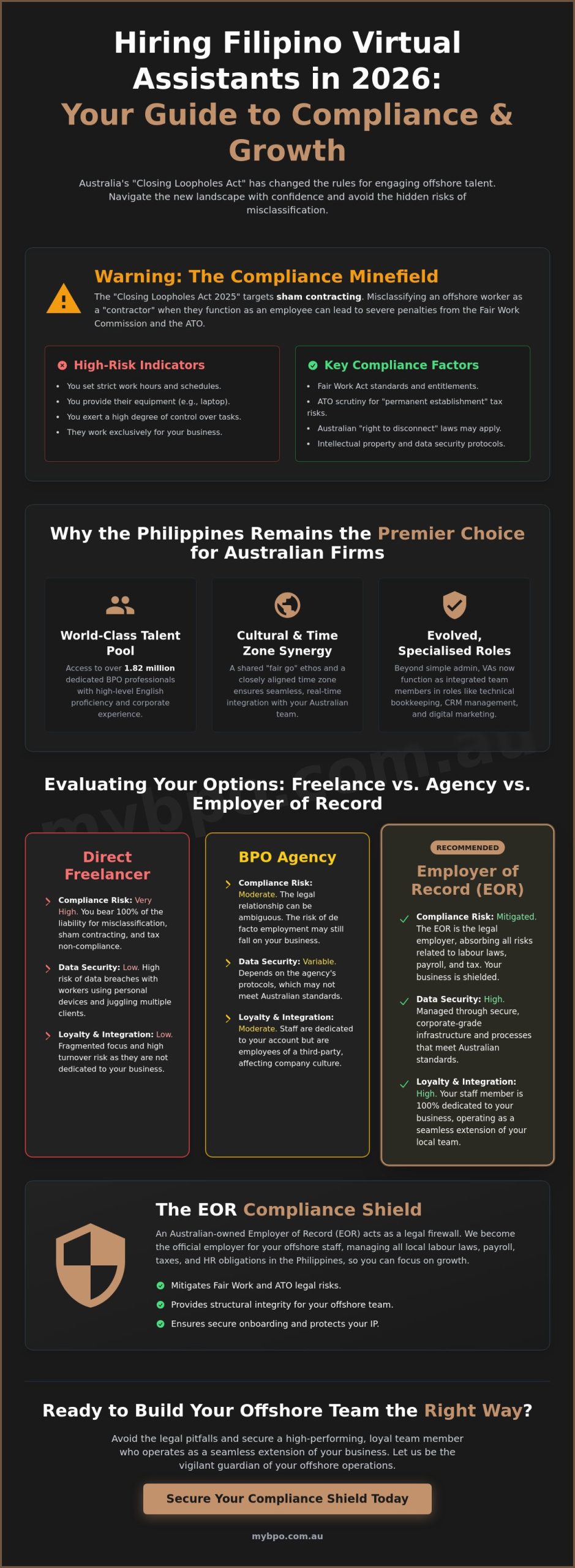
The legal landscape for hiring a virtual assistant philippines has shifted dramatically with the introduction of the “Closing Loopholes Act 2025”. Directors can no longer rely on the ambiguity of “freelance” arrangements to bypass Australian employment standards. If your relationship with an offshore worker mirrors that of an employee, the Fair Work Commission may treat it as such, regardless of the labels used in your contract. This regulatory shift means that simply calling someone a “contractor” won’t protect your business from significant back-pay claims or penalties if the reality of the work suggests otherwise.
Sham contracting remains a primary target for regulators. According to Australian law on contractors, the distinction hinges on factors like the degree of control you exert over the worker’s hours and the equipment they use. If you provide a laptop, set strict daily schedules, and manage every task, the law likely views that person as an employee. Beyond Fair Work, the ATO is increasing its scrutiny on offshore payments to identify “permanent establishment” risks. If your local firm is found to be operating as a de facto employer in a foreign jurisdiction without proper registration, the resulting tax liabilities can be devastating. An Australian-owned Employer of Record (EOR) functions as a vital protective barrier, absorbing these legal risks by acting as the official employer of your offshore staff.
Misclassification: The Silent Business Killer
Recent Australian labour reforms, including the “right to disconnect”, now carry weight even in remote and offshore settings. If an offshore worker is deemed a de facto employee, they may be entitled to the same protections as your local staff. Failing to account for these changes leaves your firm vulnerable to litigation. Utilising a professional employer of record Australia ensures that your engagement with a virtual assistant philippines is structurally sound and compliant with both jurisdictions. This proactive approach is the only way to secure long-term operational freedom while protecting your local entity from avoidable legal exposure.
Securing Intellectual Property and Data
Hiring through unmanaged freelance platforms creates a significant vulnerability for your intellectual property (IP). If a data breach or IP theft occurs, an Australian court has virtually no jurisdiction over an individual contractor located in Manila. Contracts signed on generic marketplaces are often unenforceable across international borders. To mitigate this, your agreements must be governed by Australian law and backed by a partner with a physical presence in both countries. This ensures that your sensitive data and proprietary processes remain under a robust, enforceable legal framework that respects Australian privacy standards.
Evaluating Your Options: Freelance, Agency, or EOR?
Hiring a virtual assistant philippines requires a deliberate choice between three primary structural models: direct freelancing, traditional BPO, or an Employer of Record (EOR). Direct freelancing through digital marketplaces often appears cost-effective initially, yet it leaves the Australian director entirely exposed to the compliance risks discussed in previous sections. Traditional BPO agencies typically focus on high-volume, project-based work which can lead to a lack of role-specific dedication. In 2026, the EOR model has emerged as the preferred strategy for firms seeking a permanent, integrated team member. This model ensures that while you manage the daily tasks, a local entity handles the legalities, providing a “safe harbour” for your operations.
Understanding the Total Cost of Ownership (TCO) is essential for long-term budget integrity. Beyond the base hourly rate, Philippine law mandates specific statutory contributions that are non-negotiable for compliant engagement. These include the Social Security System (SSS), PhilHealth for medical coverage, and Pag-IBIG for housing funds. An Australian Fair Work Commission ruling has previously highlighted how these employment indicators can influence the legal standing of offshore workers. Additionally, you must account for “13th Month Pay,” a mandatory bonus equivalent to one-twelfth of the employee’s basic annual salary, paid by December 24. Neglecting these benefits is a primary driver of staff attrition and legal friction.
The Hidden Costs of “Cheap” Virtual Assistants
The allure of the lowest possible hourly rate often masks significant downstream expenses. High turnover is the most common hidden cost; if you don’t provide statutory benefits, your virtual assistant philippines will likely leave for a compliant employer the moment an opportunity arises. This creates a perpetual cycle of recruitment and training that drains your internal resources. Furthermore, unmanaged staff often lack professional-grade infrastructure, leading to frequent downtime from power outages or unstable internet. For a detailed analysis of these obligations, refer to our guide on payroll Philippines for Australian companies.
Why EOR is the Gold Standard for 2026
An EOR manages the entire employment lifecycle from recruitment and rigorous vetting to the complexities of termination under Philippine labour codes. By having a legal employer on the ground in Manila or Bacolod, your business gains a physical presence that validates the employment relationship. This structure allows for equipment leasing and dedicated workspaces that freelance models simply cannot provide. Crucially, the EOR absorbs the primary employer liability, insulating the Australian client from the direct administrative and legal burdens of international labour management.
Practical Steps to Onboarding a Dedicated Virtual Assistant
Successful integration of a virtual assistant philippines requires a methodical transition from recruitment to operational immersion. Many Australian firms fail because they treat offshore onboarding as a casual process rather than a structured business expansion. To secure your investment, you must establish clear, Australian-standard KPIs from day one. These should not be vague expectations but measurable outcomes; such as specific response times for customer enquiries or accuracy rates for data entry. Without these benchmarks, you lose the ability to audit performance effectively across jurisdictional boundaries.
Your onboarding sequence should follow a logical progression to mitigate operational risk. Start by defining the role with precise documentation. Move to a rigorous vetting stage that includes technical assessments and cultural alignment interviews. Once a candidate is selected, you must provision secure hardware and establish a formal communication rhythm. This process concludes with a dedicated immersion period where the assistant learns your specific business values and Australian workplace etiquette. This structured approach ensures that your new team member understands the gravity of their responsibilities from the outset.
Vetting for Quality: Beyond the Resume
A polished CV is merely a starting point. To identify high-performing talent, your interview process must focus on scenario-based testing that reveals real-world problem-solving abilities. Ask candidates how they would handle a specific technical failure or a conflicting priority. Background checks and past employment verification are non-negotiable steps to ensure the integrity of your offshore team. For a comprehensive look at securing top-tier talent, review our guide on offshore recruitment Philippines.
The Infrastructure Factor: Equipment and Workspaces
Relying on a “Work From Home” (WFH) model introduces significant vulnerabilities to your data security and operational uptime. Residential internet in the Philippines can be unstable, and frequent power interruptions can halt your business. Utilising a dedicated workspace Philippines provides your assistant with enterprise-grade hardware, redundant fibre-optic internet, and back-up power systems. This physical infrastructure is the only way to ensure your remote operations maintain the same reliability as your Australian office. Securing your team in a professional environment protects your sensitive information from the risks inherent in unmanaged home networks.
If you are ready to build a secure, high-performing offshore team with full legal protection, contact MyBPO today to discuss our EOR and workspace solutions.
Why MyBPO is the Vigilant Guardian of Your Offshore Team
MyBPO operates as your primary compliance shield, bridging the gap between Australian business requirements and Philippine labour realities. Unlike generic digital marketplaces, our Brisbane-based leadership ensures that your offshore strategy is overseen by fellow Australian directors who understand the gravity of Fair Work obligations. We maintain a physical presence with operational hubs in Manila and Bacolod, providing the tangible infrastructure that remote-only platforms lack. This local presence allows us to manage the daily complexities of your virtual assistant philippines while you focus on scaling your core business functions.
Our “Compliance-First” philosophy is designed to absorb the inherent risks of cross-border employment. If you engage staff through MyBPO, we take on the burden of statutory registrations, tax withholdings, and jurisdictional reporting. This integrated approach combines professional recruitment services with equipment leasing and dedicated workspaces, ensuring your team has the tools and legal framework required for high-level performance. By consolidating these functions, we mitigate the operational fragmentation that often leads to data breaches and staff attrition.
Australian Ownership, Philippine Expertise
Dealing with an Australian-owned entity provides a level of accountability that international agencies cannot match. You have the security of knowing your partner is rooted in the same legal and business culture as your firm. Our on-the-ground management team in the Philippines focuses on staff retention and morale; this ensures your assistants feel valued and secure in their roles. We maintain 100% transparency in all payroll and statutory compliance matters, providing you with total peace of mind that your offshore operations are ethically and legally sound.
Start Your Secure Offshore Journey Today
Transitioning from a fragmented freelance model to a structured EOR framework is the only way to protect your business from the evolving regulatory landscape of 2026. The first step in building your dedicated Philippine team involves a consultation to define your specific role requirements and security needs. MyBPO then navigates the recruitment and onboarding process on your behalf, securing the high-performing talent you need without the administrative burden. Secure your business future by choosing a compliant, Australian-led offshore strategy that prioritises structural integrity. Reach out to MyBPO today to begin your transition to a risk-mitigated offshore model.
Securing Your Operational Future in the Philippines
Engaging a virtual assistant philippines is no longer a simple digital transaction; it’s a strategic employment commitment that requires a robust legal foundation. The 2026 regulatory environment demands that Australian firms move beyond the risks of unmanaged freelance models to avoid the severe penalties associated with sham contracting. By prioritising a “compliance-first” approach, you protect your local entity from Fair Work scrutiny while ensuring your offshore team remains high-performing and loyal.
MyBPO serves as your vigilant guardian in this space. We’re Australian-owned and operated, with physical offices in Brisbane, Manila, and Bacolod to provide tangible support where it’s needed most. As specialists in Fair Work and DOLE compliance, we absorb the operational risks so you can focus on growth with total peace of mind. Our structure ensures that your business stays protected through every stage of the employment lifecycle.
Secure your offshore team with MyBPO’s Australian-owned EOR services.
You can build a world-class team that scales with your business without compromising on security or legal integrity. Start your journey toward a secure, compliant, and high-performing offshore operation today.
Frequently Asked Questions
Is a virtual assistant in the Philippines considered an employee under Australian law?
Yes, an offshore worker can be deemed an employee if the relationship satisfies the “control test” under the Fair Work Act or if the employment contract was formed in Australia. Regulators often look past the “contractor” label to the practical reality of the engagement. If you manage their daily tasks and provide their equipment, you may be liable for minimum entitlements and protections regardless of their location.
How much does a virtual assistant in the Philippines cost for an Australian business?
The total cost for a virtual assistant philippines includes the base salary, mandatory statutory contributions, and management fees. While entry-level rates exist in the market, Australian firms should budget for a professional wage that includes SSS, PhilHealth, and Pag-IBIG contributions to ensure long-term retention. Using an EOR model provides a transparent fee structure that covers these liabilities without the hidden costs of high staff turnover.
What are the risks of paying a Philippine VA directly via PayPal or Wise?
Paying directly through digital platforms leaves your firm exposed to sham contracting allegations and ignores mandatory Philippine labour laws. These platforms don’t facilitate the payment of social security or health insurance, which are legal requirements for workers in the Philippines. This lack of structural oversight creates a significant liability for Australian directors if the relationship is ever audited by the ATO or Fair Work.
Do I need to pay superannuation for my offshore staff in the Philippines?
You generally don’t pay Australian superannuation for non-residents working entirely offshore, but you are responsible for the Philippine equivalent. This includes mandatory SSS contributions which serve a similar social security function. If your offshore staff member is misclassified as an Australian employee, you could be held liable for unpaid superannuation and associated penalties under local law.
How does the 13th-month pay work in the Philippines?
The 13th-month pay is a mandatory statutory benefit equivalent to one-twelfth of an employee’s basic annual salary. It must be paid to all rank-and-file employees by December 24 each year. This isn’t a discretionary bonus but a legal requirement under Philippine law; failing to provide it can lead to formal complaints through the Department of Labour and Employment (DOLE).
Can I hire a virtual assistant for specialised roles like accounting or legal support?
Yes, the Philippine talent pool has matured to include highly specialised roles such as software engineers, data scientists, and financial analysts. Australian firms are increasingly engaging a virtual assistant philippines for complex functions like technical bookkeeping and legal support. In the property sector, these assistants can leverage tools like PropAlly to provide investors with real-time tracking of rental cash flow and tax obligations. These professionals typically hold university degrees and have extensive experience working within Western corporate frameworks.
What happens if my virtual assistant in the Philippines has a performance issue?
Performance issues must be managed according to the “due process” requirements of the Philippine Labour Code. This involves a formal “twin-notice” rule where the worker is given a chance to explain their side before any disciplinary action is taken. An EOR partner manages this process on your behalf to ensure you don’t face illegal dismissal claims in a foreign jurisdiction.
How do I ensure my data is secure when working with a VA in the Philippines?
Data security is secured through a combination of physical infrastructure and enforceable legal agreements. Utilising a dedicated virtual assistant Philippines operating from a managed workspace ensures your staff operate on enterprise-grade hardware within a monitored network environment. This setup, combined with Data Privacy Act of 2012 compliance, provides a level of protection that unmanaged work from home arrangements simply cannot offer.
Need a strategy session?
Tell us about your team and we will map out the right structure, fixed-cost quote included.
Book a call