Blog
Philippines Probation Rules: 2026 Australian Guide

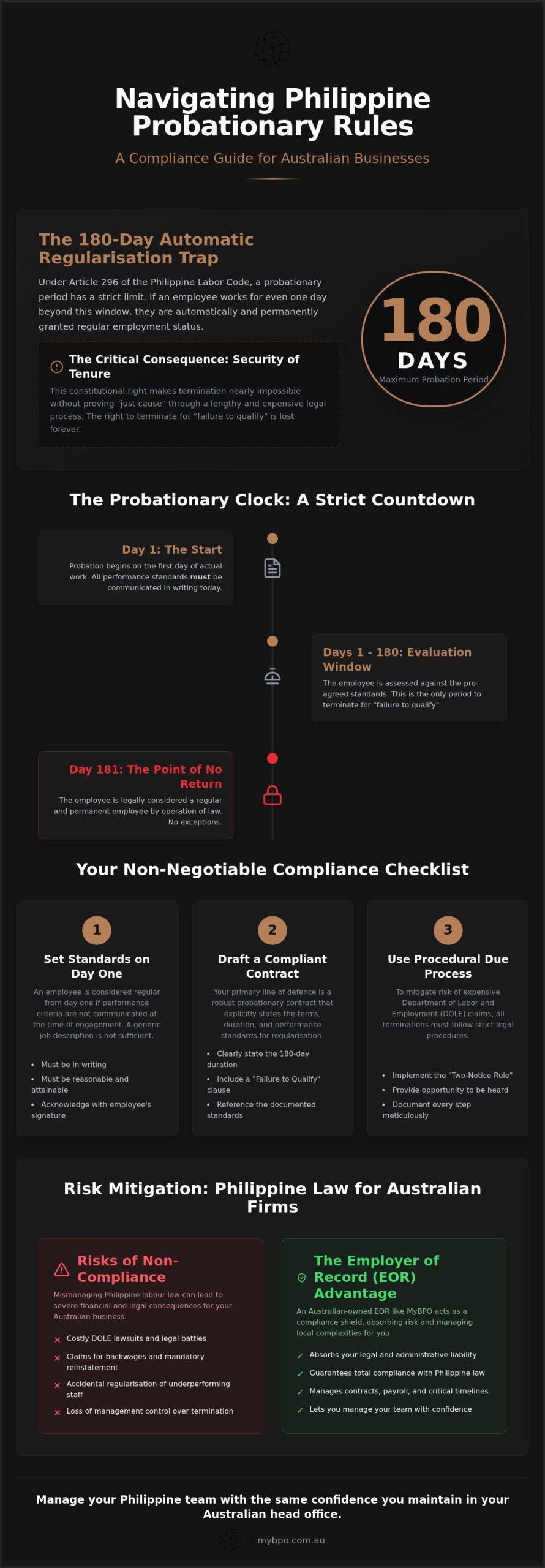
Treating a Philippine probationary period as a casual test drive for new staff is the most expensive mistake an Australian business can make in 2026. Under Article 296 of the Labor Code, the probation period rules philippines dictate a strict 180-day window that, if mismanaged by even twenty-four hours, results in the automatic and permanent regularisation of an employee. This shift grants the worker full security of tenure, making termination nearly impossible without a lengthy legal battle.
It’s understandable why you might feel uneasy about local regulations that seem to clash with standard Australian management styles. You want the freedom to scale your offshore team without the constant threat of a DOLE lawsuit or a hidden regularisation trap. This guide provides the clarity required to protect your operations and secure your workforce against jurisdictional risks.
We’ll detail the exact timeline for performance reviews, provide a checklist for legally sound contracts, and outline a structured strategy to mitigate the inherent risks of offshore staffing. By following this framework, you’ll manage your Philippine team with the same confidence and authority you maintain in your Australian head office.
Key Takeaways
- Master the strict 180-day limit to prevent the “automatic regularisation” trap, ensuring employees don’t gain permanent security of tenure by default.
- Document and communicate all performance criteria on the first day of engagement to prevent staff from becoming regular employees from day one.
- Navigate the specific probation period rules philippines to ensure your Australian management style aligns with local legal mandates.
- Implement the mandatory “Two-Notice Rule” and procedural due process to mitigate the risk of expensive Department of Labor and Employment (DOLE) claims.
- Discover how an Australian-owned Employer of Record (EOR) can absorb your legal liability and provide the physical infrastructure required for total compliance.
The 180-Day Rule: Understanding the Legal Limits of Probation
Under the Labor Code of the Philippines, the maximum duration for a probationary period is strictly six months. While this sounds straightforward, Philippine courts have refined this definition to mean exactly 180 calendar days. Navigating the probation period rules philippines requires a shift from the flexible mindset common in Australian employment, as the law does not view “six months” as a floating calendar date. If an employee remains on the payroll for even one day beyond this 180-day limit, they transition into regular employment status by operation of law. This “automatic regularisation” is a legal trap that many Australian firms fall into, often assuming they have a grace period that simply does not exist.
There are very few exceptions to this limit. Extensions are only legally permissible in rare cases, such as specific apprenticeship programmes or through a written mutual agreement intended to give an underperforming employee a final chance to qualify. However, these extensions are legally precarious and often fail to hold up during litigation if the original standards weren’t clearly documented. For most businesses, the 180-day window is an absolute boundary that dictates the future of the employment relationship.
Calculating the Probationary Timeline Accurately
The probation period rules philippines mandate that the countdown begins on the first day of actual work, not the date the contract was signed in Brisbane or Sydney. It’s a common mistake for Australian managers to apply a standard three-month probation period, thinking they can simply extend it if the staff member needs more time. In the Philippines, this lack of precision is a liability. To survive a Department of Labor and Employment (DOLE) audit, you must document the start and end dates with mathematical certainty. We recommend tracking the timeline as follows:
- Day 1: The first day the employee reports for duty or training.
- Day 180: The final legal day of the probationary period.
- Day 181: The date the employee is considered regularised by law.
The Consequences of Accidental Regularisation
Once an employee passes the 180-day threshold, they gain “Security of Tenure.” This is a constitutional right in the Philippines that makes termination nearly impossible without proving “just cause” through a rigorous legal process. If your business accidentally regularises a staff member due to a tracking error, you lose the right to terminate them for “failure to qualify.” The financial consequences are severe; mismanaged timelines often lead to claims for backwages and mandatory reinstatement. An Employer of Record (EOR) provides a necessary compliance shield here, absorbing the administrative risk by tracking these critical milestones and ensuring no employee slips into regular status by accident.
Mandatory Compliance: Setting Standards on Day One
The legal landscape of the Philippines places a heavy burden of proof on the employer from the very first hour of a new hire’s tenure. Under the strict probation period rules philippines, an employee is deemed regular from their first day of work if the employer fails to communicate the specific standards for regularisation at the time of engagement. This “Standards Requirement” is a non-negotiable pillar of local labour law. If you don’t provide these criteria in writing on Day One, you effectively waive your right to a probationary period. The Department of Labor and Employment (DOLE) mandates that these standards must be “reasonable,” which means they must be attainable, clearly defined, and directly related to the role’s core functions.
Relying on a generic job description is a high-risk strategy that rarely survives legal scrutiny. To protect your business, you must obtain a written and signed acknowledgement from the employee, confirming they understand and accept the performance expectations. Without this documented proof, any attempt to terminate based on poor performance will likely be viewed as an illegal dismissal. Using structured benchmarks ensures that both the manager and the employee are aligned on what success looks like within the 180-day window.
Drafting a Compliant Probationary Contract
A robust Philippine probationary contract is your primary line of defence. It must include an explicit “Failure to Qualify” clause, which establishes your legal right to end the relationship if standards aren’t met. While you might consider exceeding the 6-month probation period in specific circumstances, the contract must firmly anchor the initial 180-day limit. Every Key Performance Indicator (KPI) should be quantifiable. Instead of “good communication,” use “resolves 95% of tickets within four hours.” These specific metrics provide the evidentiary weight needed during a labour dispute.
The Communication Gap: Australian Managers vs PH Law
Australian management culture often relies on informal, verbal feedback loops. However, in a Philippine legal context, verbal warnings carry zero weight. A formal Day One induction is essential to meet evidentiary requirements. This session should be a structured walk-through of the KPIs, followed by the signing of the standards document. To ensure you are hiring individuals capable of meeting these rigorous benchmarks, many firms utilise offshore recruitment Philippines services to vet candidates against local performance realities. Securing your workforce starts with total compliance. If you’re unsure if your current contracts meet these rigid standards, you can partner with an Australian-owned EOR to audit your existing onboarding processes.
Termination vs Regularisation: Navigating the Performance Review
Managing the transition from a probationary hire to a permanent team member requires a deep understanding of the probation period rules philippines. In this jurisdiction, there’s a vital distinction between terminating an employee for “Just Cause,” such as serious misconduct, and termination for “Failure to Qualify.” While the former can occur at any time, the latter is specific to the probationary window. If you fail to prove that a staff member didn’t meet your pre-set standards, the law defaults to protecting the worker’s security of tenure. The burden of proof rests entirely on your shoulders; you must provide substantial evidence that the employee was unfit based on the criteria shared on Day One.
Even for probationary staff, procedural due process is mandatory. This is often managed through the “Two-Notice Rule.” The first notice alerts the employee of their failure to meet standards and offers a chance to respond, while the second notice serves as the final decision. Ignoring this process opens your Australian business to claims of illegal dismissal, regardless of how poor the actual performance was. To maintain total compliance, we advise conducting the final review at the five-month mark, specifically around Day 150, to allow sufficient time for notice periods and administrative closure before the 180-day automatic regularisation kicks in.
The Five-Month Performance Review Framework
A legally defensible appraisal must be rooted in the KPIs established at the start of employment. You shouldn’t wait until the final week to decide a hire’s fate. By Day 150, you must have a documented trail of performance feedback. This documentation is critical to mitigate the sham contracting Philippines risk, as it proves the relationship is a legitimate employment engagement with clear oversight. If the decision is to terminate for failure to qualify, the Notice of Termination must be served well before the 180th day to ensure the legal separation is finalised before the status shifts automatically.
Handling Resignations During Probation
If a probationary employee chooses to leave, the Philippines Labor Code generally requires a 30-day notice period. While Australian managers might prefer an immediate exit, forcing a staff member to stay can lead to “forced labour” allegations. Conversely, allowing an immediate exit without a written waiver can complicate the final pay process. You must follow strict “clearance” procedures, ensuring all company equipment is returned and all accountabilities are settled before releasing the final pay. This structured exit protects you from future DOLE complaints and ensures a clean break between the two jurisdictions.
Risk Mitigation: Australian Management vs Philippine Law
Australian directors often bring an “at-will” mindset to their offshore operations, assuming that a probationary hire can be let go with the same ease as a casual worker in Sydney or Melbourne. However, the probation period rules philippines don’t allow for this level of flexibility. In the Philippines, employment is a highly protected right. If an Australian manager terminates a staff member without following the rigid procedural due process discussed earlier, they risk a lawsuit that can be filed through the National Labor Relations Commission (NLRC). This legal friction often arises because Australian management styles, which value directness and speed, clash with the Philippines’ highly regulated and pro-labour legal framework.
The complexity of these arrangements is further heightened by the intersection of the Fair Work Act and offshore staff. While your Philippine workers are governed by local laws, your Australian management structure must remain aware of how domestic standards might inadvertently influence offshore contracts. Cultural nuances also play a critical role; what an Australian manager considers “blunt performance feedback” can be interpreted as public humiliation or harassment in a Philippine context. If an employee feels they’ve been forced out through an intolerable work environment, they may file a claim for “constructive dismissal,” which carries the same legal weight as an illegal firing.
Managing Remote Teams Without Losing Control
Operational control is often the first casualty of poorly managed offshore teams. Without physical oversight, the risk of “ghosting” or sudden operational gaps increases during the probationary window. Utilising a dedicated workspace Philippines helps mitigate these risks by providing a professional environment where performance is monitored by local HR staff. This physical infrastructure ensures that Australian KPIs are balanced with local leadership expectations, providing a “compliance shield” that protects your intellectual property and data. If a probationary exit becomes necessary, having an on-the-ground presence allows for the immediate retrieval of company assets and the secure deactivation of system access.
The High Cost of Non-Compliance
An illegal dismissal case in the Philippines isn’t merely an administrative nuisance; it’s a significant financial liability. If the NLRC finds in favour of the employee, the employer is typically ordered to pay full backwages, benefits, and potentially moral damages. Beyond the direct costs, a single public labour dispute can devastate your ability to recruit top-tier talent in the region. Australian firms often underestimate the speed at which news of a “bad employer” spreads within the local BPO community. To secure your business against these jurisdictional pitfalls, you can outsource your compliance to an Australian-owned EOR that absorbs these risks on your behalf.
The EOR Advantage: Safeguarding Your Operations with MyBPO
For an Australian firm, the legal liability of offshore employment can be overwhelming without a local partner to absorb the risk. An Employer of Record Australia like MyBPO acts as a compliance shield, absorbing 100% of the local employment liability. We understand that navigating the probation period rules philippines requires more than just a contract template; it requires a vigilant, on-the-ground presence. As an Australian-owned and operated partner, we bridge the gap between your domestic headquarters and your Philippine team, ensuring local labour laws are followed to the letter while you maintain operational control.
Our expertise extends to the granular details of payroll in the Philippines, including the management of mandatory government contributions from the very first day of work. When sensitive HR issues arise, such as a probationary termination, our physical presence in Manila and Bacolod becomes your greatest asset. We handle difficult conversations and procedural requirements in person, mitigating the risk of constructive dismissal claims and ensuring a clean, legal separation that protects your brand’s reputation.
Total Compliance from Recruitment to Regularisation
MyBPO automates the critical 180-day countdown to ensure no employee accidentally slips into regular status. We don’t just track dates; we actively manage the documentation of performance standards. Our HR specialists work with your managers to draft quantifiable KPIs that meet the DOLE “reasonableness” test. If a hire isn’t meeting expectations, you have immediate access to expert advice to execute a “Failure to Qualify” termination with zero margin for error. This methodical approach ensures that every step of the probation period rules philippines is satisfied before the window closes.
Your Vigilant Guardian in the Philippines
By utilising a “Safe Harbour” employment structure, you can scale your offshore team without the administrative burden of foreign labour codes. MyBPO takes on the role of the legal employer, allowing you to focus on operational growth while we manage the complex regulatory framework. This partnership provides the structural integrity needed for a secure international expansion, allowing you to scale with confidence. Contact MyBPO today to secure your offshore operations and protect your business from the regularisation trap.
Secure Your Offshore Growth Against Regulatory Risks
Expanding into the Philippines offers significant operational advantages, but the “regularisation trap” remains a constant threat for the unprepared. Mastery of the probation period rules philippines is not merely an administrative exercise; it’s a foundational component of your international risk-mitigation strategy. By strictly enforcing the 180-day limit and documenting performance standards on Day One, you insulate your firm from permanent legal liabilities and automatic tenure claims.
MyBPO acts as your vigilant compliance shield in this complex environment. We’re an Australian-owned and operated specialist with a physical presence in Brisbane, Manila, and Bacolod, allowing us to absorb the legal burdens that often derail offshore ventures. Our team provides the structural integrity and cross-border expertise required to manage your workforce with total precision. You don’t have to navigate these regulatory waters without a local ally.
Secure your Philippine team with MyBPO’s EOR services today and regain your operational freedom. We’re ready to help you scale your business with the confidence that only total compliance can provide.
Frequently Asked Questions
Can I extend a probation period in the Philippines if the employee needs more time?
You can only extend a probationary period under very limited circumstances, such as a mutual agreement to give an underperforming employee a second chance or within specific apprenticeship programmes. Without a written agreement, any work beyond the initial 180-day limit results in automatic regularisation. This is why the probation period rules philippines are considered so rigid for Australian firms. We recommend finalising all performance decisions well before the six-month boundary to avoid accidental permanent status.
Is an employee entitled to the 13th-month pay if they are terminated during probation?
Yes, probationary employees are entitled to 13th-month pay provided they have worked for at least one month. This benefit is pro-rated based on the total basic salary earned during the calendar year. If an employee is terminated for failing to qualify before the end of the year, you must include the pro-rata 13th-month pay in their final settlement. Failure to settle this statutory obligation can lead to a formal complaint with the Department of Labor and Employment.
What is the maximum duration for a probationary period under the Philippine Labor Code?
The maximum duration is six months, which the Philippine Supreme Court has defined as exactly 180 calendar days. It’s a critical error to assume this means six calendar months, as the difference of a few days can trigger automatic regularisation. Tracking the probation period rules philippines with mathematical precision is essential. If an employee is allowed to work on the 181st day without a regularisation contract, they are already considered a permanent staff member with full security of tenure.
Do I need to pay SSS and PhilHealth contributions for staff on probation?
You must pay SSS, PhilHealth, and Pag-IBIG contributions from the employee’s first day of actual work. Mandatory government benefits apply to all employees regardless of their status, including those on probation. Australian businesses often mistake probationary periods for “trial periods” where benefits don’t apply, but this is a serious compliance breach. MyBPO ensures these contributions are managed through our local payroll infrastructure, protecting your business from the penalties associated with non-payment or delayed remittances.
Can I terminate a probationary employee without notice for poor performance?
No, you cannot terminate a probationary employee without following procedural due process. Even when letting someone go for failing to meet standards, you must provide a written notice and an opportunity for the employee to be heard. This is often referred to as the “Two-Notice Rule.” Dismissing a staff member abruptly for poor performance, without documented warnings and a formal termination notice, is considered illegal dismissal under Philippine law and carries significant financial penalties.
What happens if I don’t give the employee their performance standards on Day One?
If you fail to communicate clear performance standards on the first day of work, the employee is deemed a regular employee from day one. The law requires that the criteria for regularisation be made known at the time of engagement. Without this documented acknowledgement, you lose the legal right to terminate the employee for “failure to qualify” later. This is the primary reason why structured onboarding and compliant contracts are non-negotiable for offshore operations.
Are probationary employees entitled to service incentive leave (SIL)?
Probationary employees are generally not entitled to Service Incentive Leave (SIL) because the law requires at least one year of service to qualify for this benefit. SIL consists of five days of leave with pay for every year of service. However, many Australian companies choose to offer leave credits earlier as part of a competitive benefits package. While not a statutory requirement during probation, providing these perks can help with staff retention in a crowded market.
How does the ‘Closing Loopholes’ legislation affect my Philippine staff on probation?
The Australian “Closing Loopholes” legislation increases the scrutiny on sham contracting, making it vital to ensure your Philippine staff are correctly classified. If you’re managing offshore workers directly as “independent contractors” to avoid local labour laws, you may be in breach of both Australian and Philippine regulations. Utilising an EOR model ensures that your staff are legally employed under Philippine jurisdiction, satisfying the requirements of both the Fair Work Act and the local Labor Code simultaneously.
Need a strategy session?
Tell us about your team and we will map out the right structure, fixed-cost quote included.
Book a call