Blog
EOR Service vs Platform: Choosing the Right HR Model

The most user-friendly software platform in the world cannot stand in a Philippine court to defend your business. Many Australian directors believe that subscribing to a sleek digital dashboard solves their international compliance worries, but the reality is often far more precarious. Choosing between an EOR Service vs Platform is not just a matter of choosing a user interface; it’s a decision about who carries the legal liability when local regulations shift. With the 2025 Philippine Supreme Court ruling establishing that employment begins at the offer stage, the margin for error has never been thinner.
You likely want the cost benefits of offshore talent without the constant anxiety of a Fair Work audit or a Philippine DOLE investigation. It’s a reasonable expectation to want your Philippine team to be as legally secure as your staff in Melbourne or Brisbane. This guide explores the critical differences between automated tools and service-led providers to help you secure your Australian business against offshore compliance risks. We will examine how a dedicated service model absorbs jurisdictional liability, mitigates the risk of worker misclassification, and ensures your staff retention remains high through a genuine local presence.
Key Takeaways
- Understand the fundamental distinction between an EOR Service vs Platform to ensure your Australian entity is not inadvertently exposed to foreign labour disputes.
- Learn why digital algorithms cannot replace physical in-country oversight when navigating the nuances of Philippine labour law and mandatory benefit contributions.
- Identify the specific risks posed by the Australian “Closing Loopholes” Act and how service-led models shield your business from sham contracting allegations.
- Assess your firm’s risk appetite to determine if automated software provides sufficient protection or if a comprehensive service model is required for long-term staff retention.
- Discover how Australian-led governance combined with on-the-ground infrastructure in Manila and Bacolod creates a secure safe harbour for your offshore operations.
Defining the 2026 Landscape: EOR Services vs Digital Platforms
The relationship between Australian firms and Philippine talent has transitioned from simple task-outsourcing to complex, long-term operational integration. In this environment, the Employer of Record (EOR) model has become the standard for risk mitigation. However, as the global market reaches a projected $7.45 billion in 2026, a sharp divide has emerged between automated software solutions and traditional service providers. This distinction between an EOR Service vs Platform is now the most critical decision an Australian director will make regarding their offshore strategy.
For an Australian business, the choice is not merely about which software looks better on a desktop. It is a decision about who carries the legal liability when local regulations shift or when a labour dispute arises. Software manages data, but professional services manage the human and legal complexities that an algorithm cannot see. With the Australian government increasing its scrutiny of corporate governance, understanding this divide is essential for protecting your local entity from offshore risks.
The Software-First “Platform” Model
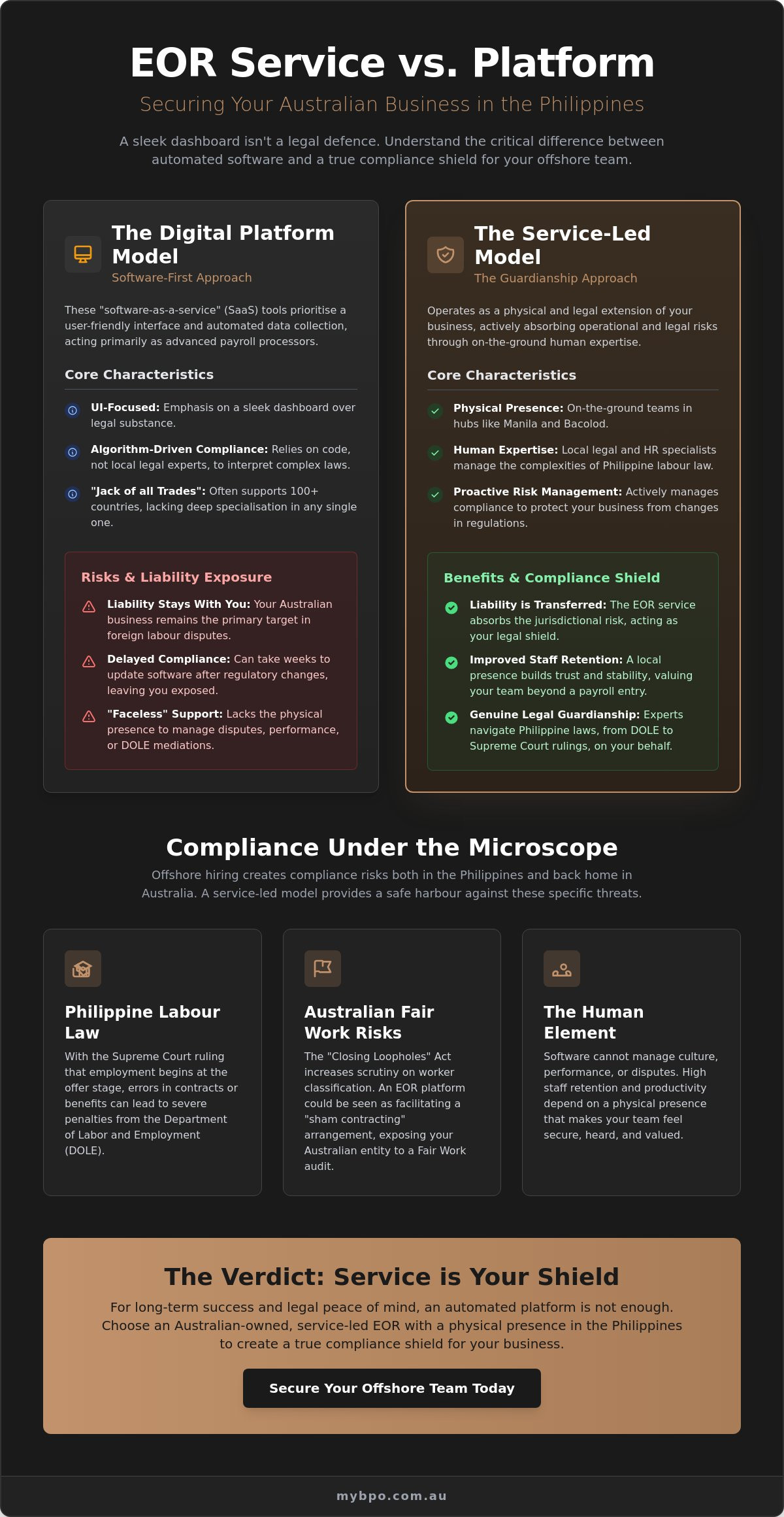
Digital platforms prioritise a “software-as-a-service” (SaaS) approach. Their primary focus is on the user interface, automated document collection, and self-service portals. These tools are often efficient for low-risk jurisdictions or small, temporary projects where the complexity of local labour law is minimal. They provide a streamlined way to view payroll data, but they often operate on a “faceless” basis. Compliance is handled by an algorithm rather than a local legal expert. If a regulatory change occurs in the Philippines, a platform may take weeks to update its code, leaving your business exposed in the interim. For many, these platforms are essentially advanced payroll tools that lack the depth of actual legal guardianship.
The Service-Led “Guardianship” Model
A service-led model operates as a physical and legal extension of your business. Unlike a platform that merely processes data, a service provider actively absorbs the operational risk. This model is built on human expertise and a physical presence in key hubs like Manila and Bacolod. It ensures that every nuance of Philippine labour law, such as the 2025 Supreme Court ruling regarding the commencement of employment relationships at the offer stage, is managed proactively. This is the essence of the EOR Service vs Platform debate. A service-led provider acts as a “Compliance Shield,” moving the liability away from the Australian parent company and onto the local expert who owns the legal infrastructure and understands the regional culture. This physical presence provides a level of workforce stability and risk mitigation that software alone cannot replicate.
The Service-Led Model: Why Physical Presence Outperforms Algorithms
Global software platforms often market themselves as a universal solution for hiring in 100 different countries. This “jack of all trades” approach creates a significant vulnerability for Australian firms targeting the Philippines. While a dashboard can track billable hours, it cannot attend a Department of Labor and Employment (DOLE) mediation or navigate the cultural nuances of performance management in Manila. The fundamental difference in the EOR Service vs Platform debate lies in the depth of local engagement. Algorithms are efficient for data entry, but they are powerless against the physical and legal realities of a foreign jurisdiction.
Managing the human element is where software solutions most frequently fail. Effective staff retention and performance management require a physical presence to facilitate communication and resolve disputes before they escalate into legal liabilities. A service-led model provides a bridge between Australian corporate culture and Philippine workplace expectations, ensuring your team feels secure and valued. If you want to build a high-performing offshore team, you need a partner that provides more than just a login screen.
Navigating Philippine DOLE and Local Regulations
Compliance in the Philippines is a high-stakes environment where errors lead to severe financial penalties. A service-led EOR employs local HR specialists who manage the complexities of Philippine Labour Law with precision. This includes the mandatory 13th-month pay, which must be distributed by December 24th each year, and the accurate processing of SSS, PhilHealth, and Pag-IBIG contributions. Automated contracts generated by platforms often lack the specific legal language required to withstand local scrutiny. When a DOLE audit occurs, a service provider stands as your physical representative, absorbing the stress and the legal burden on your behalf.
Physical Infrastructure and Operational Security
Data security and intellectual property protection are paramount for Australian directors. Relying on “Bring Your Own Device” (BYOD) policies or unmonitored home offices is an unacceptable risk for many businesses. A service-led model addresses this through tangible infrastructure. By utilising dedicated workspace Philippines, you ensure your staff work in a secure, professional environment. Combining this with equipment leasing allows your firm to maintain control over hardware and data access. This physical layer of protection is a core advantage when evaluating an EOR Service vs Platform, as software cannot prevent a data breach in an unmonitored residential setting. For a more secure approach, consider how our EOR services integrate physical security with legal compliance.
Compliance Under the Microscope: Fair Work Risks and Philippine Labour Law
The introduction of the Fair Work Legislation Amendment (Closing Loopholes) Act has fundamentally altered the risk profile for Australian companies employing offshore staff. Directors can no longer hide behind a digital interface if their engagement structures are found to be non-compliant. When evaluating an EOR Service vs Platform, the primary question must be about the absorption of liability. Most platforms operate as “aggregators,” meaning they outsource the actual employment to third-party local entities. This creates a fragmented chain of responsibility. If that third-party fails to meet local standards, the Australian entity remains vulnerable to claims of sham contracting or unpaid entitlements.
A service-led model, by contrast, typically involves a direct, entity-owned relationship. This structure ensures that the Employer of Record (EOR) is the singular point of accountability. By owning the infrastructure in the Philippines, a service provider removes the “middleman” risk that plagues aggregator-based platforms. If a legal challenge arises, you don’t want to be redirected to a third-party partner in a different time zone. You need a partner that owns the legal entity and accepts the full burden of jurisdictional compliance.
Mitigating Australian Regulatory Vulnerabilities
Australian payroll standards are increasingly being applied to offshore staffing arrangements, particularly where “employee-like” relationships exist. If your Philippine staff are managed, equipped, and directed like Australian employees, Fair Work may view them as such. This makes the distinction between an EOR Service vs Platform vital. A platform might facilitate a contract, but a service-led provider ensures that the contractual nexus is legally robust under both Australian and Philippine jurisdictions. For a comprehensive breakdown of these requirements, our Employer of Record Australia guide provides deeper insights into maintaining a secure offshore expansion.
The Philippine Labour Code: A Minefield for the Unwary
Precision in the Philippines is not a luxury; it is a legal necessity. Managing SSS, PhilHealth, and Pag-IBIG contributions requires a meticulous approach that automated systems often lack. A significant risk involves “Regularisation,” where Philippine law mandates that employees become permanent after a six-month probationary period. Platforms often fail to track these milestones effectively, leading to wrongful dismissal claims if a contract is terminated incorrectly. You need a partner with an Australian ownership structure that understands the gravity of these local laws. This dual-jurisdiction expertise ensures that your Philippine operations remain a safe harbour rather than a legal liability.
Evaluating Your Business Needs: When to Choose Service over Software
The decision to opt for an EOR Service vs Platform should be driven by the specific operational requirements and risk profile of your Australian entity. While a digital interface might seem sufficient for a small, task-based project, it often falls short when you are building a core team. If your offshore staff are responsible for sensitive client data, high-value intellectual property, or core business functions, the “hands-off” approach of a software portal becomes a significant liability. Software is designed for isolation; professional services are designed for integration.
Your risk appetite is the most honest metric for this decision. An Australian director must ask whether their firm can survive the reputational and financial damage of a Philippine legal dispute or a Fair Work audit. Platforms often automate the initial onboarding but leave the complex “human” issues for you to resolve. This creates hidden costs where your Australian management team spends hours manually correcting automated payroll errors or navigating cultural misunderstandings that a local service provider would have absorbed. If you require your offshore team to be a genuine cultural extension of your Australian office, a service-led model is the only way to ensure structural integrity.
The Checklist for Australian Decision Makers
Before committing to a provider, run through these three non-negotiable questions to determine if they can actually protect your interests:
- Question 1: Does the provider have a physical, managed office in the Philippines to oversee your staff, or are they purely a digital middleman?
- Question 2: Is the provider Australian-owned and directly accountable to Australian law, ensuring a shared understanding of corporate governance?
- Question 3: Does the service include comprehensive offshore recruitment Philippines to find the right talent, or are you left to source and vet candidates yourself?
Scalability vs. Security: Finding the Balance
Rapid scaling on a platform often leads to what we call “compliance debt.” This occurs when the speed of hiring outpaces the legal and operational guardrails required to protect the business. A service-led model supports sustainable growth by ensuring that every new hire is fully integrated into a compliant framework from day one. This proactive management has a direct impact on payroll in the Philippines for Australian companies, as accurate and timely payments are the foundation of long-term team morale and staff retention. When employees feel legally secure and professionally supported, they are far less likely to leave, which protects your recruitment investment. To secure your offshore operations with a partner that takes on the burden of risk, contact MyBPO today.
MyBPO: The Australian-Owned Compliance Shield for Philippine Teams
MyBPO represents the evolution of the service-led model, specifically engineered for the Australian-Philippine corridor. While global platforms offer a generic interface, our Brisbane-based leadership provides a “Safe Harbour” that understands the specific regulatory pressure on Australian directors. We don’t just provide a portal; we provide a physical and legal shield. By integrating recruitment services, dedicated workspaces, and equipment leasing into a single solution, we eliminate the fragmentation that often leads to compliance failures. If your provider doesn’t own the infrastructure where your staff work, you are likely carrying more risk than you realise.
Our physical presence in Manila and Bacolod allows us to absorb the operational risks that digital platforms merely facilitate. When evaluating an EOR Service vs Platform, the most significant factor is the depth of local oversight. MyBPO operates with a human-centric approach, ensuring that your Philippine team is managed with the same professional gravity you apply to your Australian staff. This local presence is not an optional extra. It is the foundation of our risk mitigation strategy, providing a level of workforce stability that an algorithm can never replicate.
Australian Accountability, Philippine Expertise
Working with a partner who speaks both Fair Work and DOLE fluently is a strategic advantage for any Australian firm. Our “Human-in-the-Loop” approach means that every payroll cycle and compliance check is verified by a specialist, not just an automated script. This prevents the accumulation of “compliance debt” and ensures that mandatory contributions are processed with legalistic precision. If a dispute arises or a regulation changes, our local HR experts intervene immediately on your behalf. Physical representation is the only way to secure your business when things go wrong offshore, moving the burden of liability away from your Australian entity.
Securing Your Global Future Today
Transitioning from a risky “contractor” model or a faceless platform to a secure EOR service is a vital step in protecting your Australian entity. The 2026 regulatory environment leaves no room for ambiguity or administrative shortcuts. By choosing a specialist guardian, you secure your global future and ensure high-quality staff retention through a genuine human presence. We act as your compliance shield, bridging the gap between two different legal worlds. Don’t leave your corporate governance to a software algorithm that cannot defend you in a local court. Contact MyBPO today for a comprehensive compliance audit of your current offshore structure and move your operations into a safe harbour.
Securing Your Australian Entity Against Global Compliance Risks
Choosing the right model for your offshore expansion determines whether your business operates from a position of strength or vulnerability. The distinction between an EOR Service vs Platform is ultimately a choice between human accountability and automated data processing. While software provides convenience, only a service-led model offers the physical infrastructure and legal guardianship required to manage the complexities of Philippine labour law and Australian Fair Work standards. You now understand how on-the-ground representation in Manila and Bacolod mitigates the risk of sham contracting and ensures your staff retention remains high through professional, local management.
MyBPO acts as your vigilant compliance shield. We are an Australian-owned and operated specialist in the AU-PH corridor, providing physical offices and local HR expertise to protect your interests. We don’t just manage payroll; we absorb the operational liability, allowing you to focus on growth with absolute peace of mind.
Secure your offshore team with MyBPO’s Australian-owned EOR services today.
Your offshore team should be your greatest asset, not a hidden liability. We look forward to helping you build a secure and sustainable international workforce.
Frequently Asked Questions
What is the primary difference between an EOR platform and an EOR service?
The fundamental distinction lies in the allocation of liability and the depth of local oversight. An EOR platform is a software-driven tool designed to automate payroll and onboarding data through a digital interface. In contrast, an EOR service acts as a physical and legal guardian. While the platform focuses on the user interface, the service model absorbs the operational risk by providing human-led compliance and in-country expertise.
Can an EOR platform protect my Australian company from sham contracting penalties?
A platform alone rarely provides a sufficient shield against sham contracting allegations under Australian law. These digital tools often facilitate worker engagements without verifying if the relationship meets the strict criteria defined by the Fair Work Commission. If your engagement structure is found to be non-compliant, the platform’s terms of service usually leave the legal and financial burden on your Australian entity. A service-led model proactively secures these boundaries.
Why is Australian ownership important when choosing an EOR for the Philippines?
Australian ownership provides a critical layer of accountability that global, venture-backed platforms cannot offer. When your provider is Australian-owned, they operate under the same corporate governance standards and legal expectations as your own business. This shared understanding ensures that your offshore operations in the Philippines are managed with a focus on protecting your Australian entity from jurisdictional risks. It creates a safe harbour built on mutual legal accountability.
Do EOR platforms handle Philippine-specific benefits like 13th-month pay correctly?
Automation often fails to account for the physical and cultural nuances of Philippine benefits. While a platform might calculate the 13th-month pay, it often lacks the local HR presence to ensure it is distributed by the mandatory December 24th deadline. Service-led providers manage these contributions with legalistic precision, ensuring that SSS, PhilHealth, and Pag-IBIG payments are not just calculated but physically verified and filed according to local Department of Labor regulations.
What happens if a Philippine employee files a labour dispute against a platform-based EOR?
If a dispute arises, platform users are frequently left to navigate the Philippine legal system through a third-party aggregator. This fragmented chain of responsibility often leads to delays and increased exposure for the Australian firm. A service-led EOR with physical offices in Manila or Bacolod takes direct responsibility for the mediation. They stand as the legal employer of record, absorbing the stress and resolving the conflict through their local legal infrastructure.
Is it more expensive to use a service-led EOR versus a software platform?
While a software platform might appear cheaper on a monthly subscription basis, it often carries significant hidden costs. These include the management time required to correct automated errors and the compliance debt accrued from poor local oversight. A service-led model provides a more predictable total cost of ownership by mitigating the risk of expensive legal disputes and Fair Work penalties. It is an investment in long-term structural integrity rather than just a software fee.
How does the Fair Work Act affect Australian companies hiring in the Philippines via EOR?
The Fair Work Act, particularly following the Closing Loopholes amendments, intensifies the scrutiny on how Australian firms manage offshore talent. If your Philippine staff are directed and equipped like local employees, you face a higher risk of being held liable for Australian standards. Choosing an EOR Service vs Platform is vital because a service-led provider ensures the contractual nexus is robust enough to withstand an audit from both Australian and Philippine authorities.
Do I still need to manage recruitment if I use an EOR service?
You don’t have to manage the recruitment process if you choose a holistic service provider. Unlike platforms that merely provide the payroll infrastructure for staff you find yourself, a comprehensive EOR service often includes integrated recruitment. This ensures that every candidate is vetted for both skills and compliance from the outset. It provides a seamless transition from talent acquisition to legal employment within a secure, managed environment.
Need a strategy session?
Tell us about your team and we will map out the right structure, fixed-cost quote included.
Book a call