Blog
Philippine Labour Law: 2026 Guide for Australian Firms

Your Australian company directors could be personally liable for legal disputes occurring thousands of kilometres away in Manila or Bacolod. You’ve likely felt the mounting pressure of Australia’s “Closing Loopholes” reforms while simultaneously struggling to decipher the Philippines’ complex, pro-worker regulations. Understanding the nuances of philippine labor law for remote workers is no longer an elective for Australian firms; it’s a mandatory requirement to prevent catastrophic jurisdictional overlap.
We understand that confusion over mandatory statutory benefits like SSS, PhilHealth, and Pag-IBIG often creates a sense of regulatory vertigo for offshore employers. This 2026 guide provides the professional gravity and legal precision you need to secure your offshore team and protect your local assets. You’ll gain a clear checklist of mandatory costs, including the final 15% SSS contribution rate and the ₱755 daily minimum wage currently mandated in the NCR. We’ll also outline a robust risk-mitigation strategy to ensure your offshore structure remains a safe harbour for your business operations.
Key Takeaways
- Understand how the Telecommuting Act mandates equal treatment for off-site staff, ensuring your approach to philippine labor law for remote workers meets strict statutory standards.
- Identify non-negotiable financial obligations, including the mandatory 13th-month pay and the finalised 2026 contribution rates for SSS and PhilHealth.
- Mitigate jurisdictional risk by mastering the specific “Just Cause” and “Authorized Cause” requirements for termination in a heavily pro-worker legal environment.
- Protect your Australian directors from sham contracting penalties by aligning your offshore structure with the 2025 “Closing Loopholes” legislation.
- Discover why an Australian-owned Employer of Record (EOR) serves as a vital compliance shield, absorbing local liabilities and managing complex labour disputes on your behalf.
The Telecommuting Act (RA 11165): The Foundation of Remote Work Law
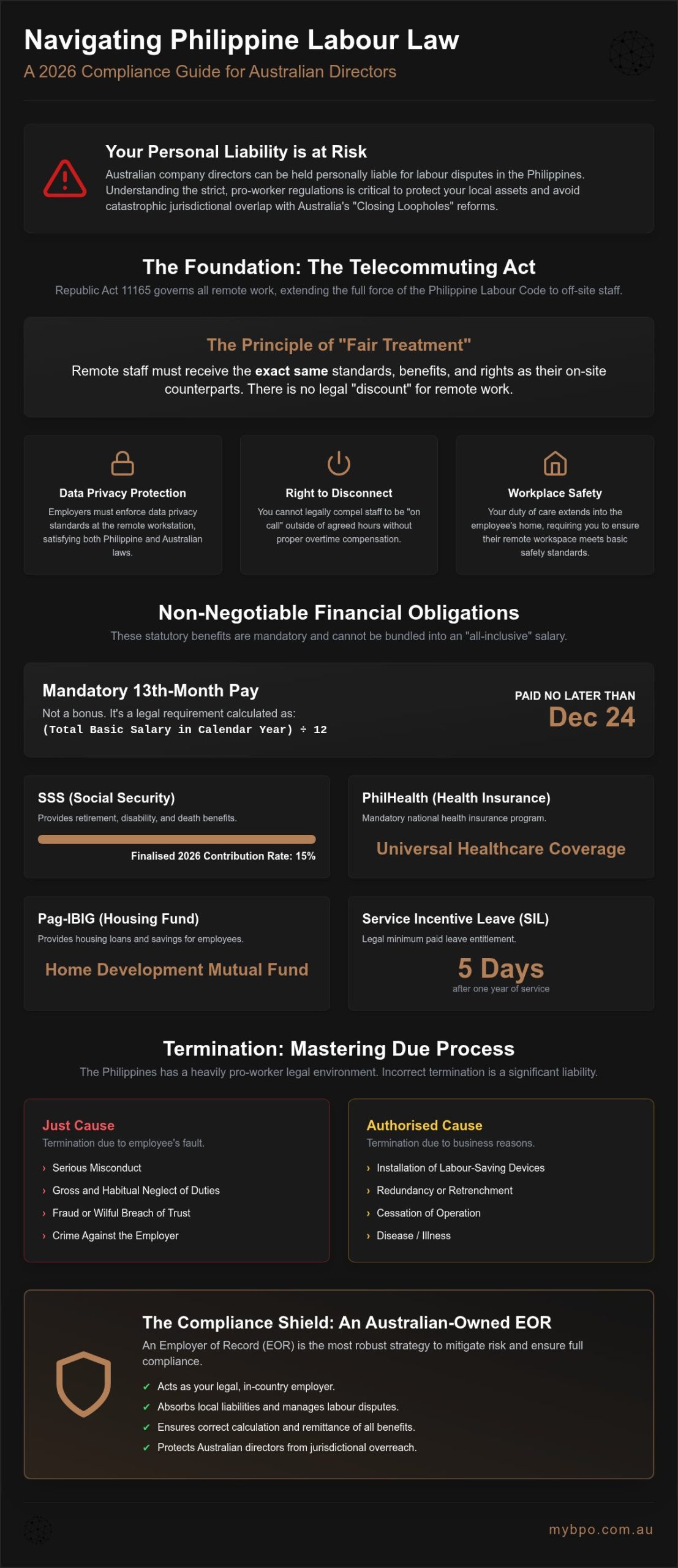
Republic Act No. 11165, or the Telecommuting Act, is the primary legal framework governing remote work in the Philippines. This legislation is a rigid extension of the Labor Code of the Philippines. If your organisation fails to align its remote work policies with this Act, you risk significant legal exposure. Central to this law is the principle of “Fair Treatment.” It dictates that remote staff must receive the exact same standards, benefits, and rights as their on-site counterparts. There is no legal “discount” for remote work; a worker in a home office in Bacolod is entitled to the same protections as one in a Makati skyscraper.
As we move through 2026, the Department of Labor and Employment (DOLE) has significantly tightened its enforcement protocols. Technological shifts in digital reporting and payroll monitoring mean that non-compliance is now easier to detect than ever before. For an Australian company, this means your “informal” arrangement with a freelancer could be reclassified as a formal employment relationship under philippine labor law for remote workers, triggering back-taxes and unpaid benefits. Compliance is not optional; it is a structural necessity.
Key Provisions for Australian Employers
Compliance requires more than just providing a laptop and an internet connection. Australian directors must ensure mandatory data privacy protections are enforced at the remote workstation to satisfy both local and AU privacy standards. Another critical factor is the “Right to Disconnect.” While the AU-PH time zone difference is manageable, you cannot legally compel staff to remain “on call” outside of their agreed hours without proper compensation. If you ignore these boundaries, you invite labour disputes that the Philippine courts are predisposed to side with the employee on. Employers are also responsible for ensuring that the remote workspace meets basic safety standards, effectively extending your duty of care into the employee’s home.
Department Order No. 237: The Implementation Rules
Department Order No. 237 (DO 237) provides the practical machinery for the Telecommuting Act. It clarifies the definition of an “Alternative Workplace,” ensuring that any location outside the traditional office is still subject to the employer’s oversight and responsibility. Documentation is your primary line of defence. You must maintain a written Telecommuting Programme that clearly outlines performance standards, work hours, and data security protocols. DOLE now actively monitors these agreements for offshore-facing teams. Without a locally registered entity or an EOR to manage these filings, your Australian firm remains dangerously exposed to Philippine jurisdiction and the associated penalties for non-compliance.
Mandatory Statutory Benefits and 13th-Month Pay
Compliance with philippine labor law for remote workers hinges on the understanding that statutory benefits are non-negotiable obligations. Unlike the Australian system where “all-inclusive” salary packages are common, the Philippine Labor Code requires specific contributions to be itemised, withheld, and remitted to various government agencies. If these payments are missed or incorrectly calculated, the liability rests solely with the employer, regardless of any private agreement made with the staff member.
Beyond basic wages, every rank-and-file employee is entitled to Service Incentive Leave (SIL). This provides five days of paid leave for those who have completed one year of service. While many Australian firms choose to offer more generous leave as a recruitment incentive, these five days represent the legal minimum that must be tracked and managed to remain compliant.
Calculating the 13th-Month Pay Correctly
The 13th-month pay is a mandatory statutory requirement, not a discretionary performance bonus. The formula is straightforward: take the total basic salary earned by the employee during the calendar year and divide it by 12. This must be paid no later than December 24th each year. Attempting to roll this into a flat hourly rate for a “contractor” is a high-risk strategy. If a dispute arises and the worker is deemed an employee, you’ll be ordered to pay the 13th-month amount on top of the rates already paid, plus significant penalties for late settlement.
The “Big Three” Contributions: SSS, PhilHealth, and Pag-IBIG
For Australian directors, it’s helpful to view these contributions as a structured compliance shield for your workforce. The Social Security System (SSS) operates as a combined pension and disability scheme. As of July 2026, the SSS contribution rate is 15%, split between a 10% employer share and a 5% employee share, capped at a Monthly Salary Credit of ₱35,000. PhilHealth, the national health insurance, is now at its final scheduled adjustment of 5%, shared equally at 2.5% each. Finally, Pag-IBIG (the Home Development Mutual Fund) requires a 2% contribution from both parties, typically calculated on a ₱10,000 monthly compensation ceiling.
Managing these varied rates across different salary levels requires precision. Using specialised payroll Philippines for Australian companies is the only way to guarantee that your remittances are accurate and timely. The risks of non-remittance are severe; in the Philippines, local directors can face criminal liability for failing to remit withheld contributions. To protect your leadership, you should secure a compliant payroll framework that handles these statutory burdens automatically.
Termination, Due Process, and Labour Code Protections
In the Philippines, the legal pendulum swings heavily in favour of the employee. Unlike the Australian landscape where “at-will” employment or simpler redundancy processes might exist, Philippine law mandates that every dismissal must be anchored in a specific, legally recognised cause. It’s a system designed to protect the livelihood of the individual above all else. For Australian firms managing offshore teams, misunderstanding philippine labor law for remote workers often leads to expensive “illegal dismissal” claims. These cases are adjudicated by the National Labor Relations Commission (NLRC), a body that strictly enforces both substantive and procedural due process.
Termination is categorised into two distinct pathways: Just Cause and Authorized Cause. Just Cause involves employee misconduct, such as serious disrespect, fraud, or gross neglect of duties. Authorized Cause relates to business necessities, such as redundancy or retrenchment due to financial losses. Failing to correctly identify the pathway or skipping procedural steps will almost certainly result in a ruling against the employer, regardless of how poorly the worker performed their duties.
The Twin Notice Rule: Avoiding Illegal Dismissal Claims
Procedural due process is as critical as the reason for termination itself. The “Twin Notice Rule” is a non-negotiable sequence that directors must follow. First, you must issue a “Notice to Explain” (NTE). This document specifies the grounds for termination and grants the employee at least five calendar days to respond. During this period, the employee has a right to a hearing or a conference to present their side. This “ample opportunity to be heard” is a cornerstone of the Philippine system; skipping it usually invalidates the entire process.
Once the administrative review is complete, a second “Notice of Decision” must be served. This final notice details the company’s conclusion after considering the employee’s response. If you fail to follow this exact sequence, the NLRC can award the employee back-wages and moral damages, even if the reason for their firing was perfectly valid. Precision in documentation is your only real defence against these claims.
Separation Pay and Authorized Causes
When an employee is terminated for Authorized Causes like redundancy, the law requires the payment of separation pay. The calculation depends on the specific cause. For redundancy, the worker is typically entitled to one month’s pay or at least one month’s pay for every year of service, whichever is higher. For retrenchment due to losses, the rate is usually half a month’s pay per year of service. Correctly applying philippine labor law for remote workers during a redundancy requires a deep understanding of local jurisprudence to ensure the “authorized cause” is genuinely substantiated.
Navigating these exits from a distance is fraught with risk. This is why employer of record Australia services are vital. An EOR acts as your local compliance shield, ensuring that every NTE is legally sound and every separation payment is calculated to the cent. By placing the burden of local labour dispute management on a specialist, you protect your Australian directors from the fallout of Philippine legal complexities.
Misclassification Risks: Linking Fair Work and PH Labour Law
The implementation of the “Closing Loopholes” Act 2025 in Australia has fundamentally altered the risk profile for companies employing offshore staff. It’s no longer enough to rely on the label of “independent contractor” in a service agreement. If the reality of the working relationship mirrors that of an employee, Australian authorities can now look through the contract to the substance of the arrangement. This creates a dangerous jurisdictional trap where your firm is simultaneously exposed to the Fair Work Ombudsman in Australia and the Department of Labor and Employment (DOLE) in the Philippines.
When you hire staff directly as contractors, you’re effectively operating without a compliance shield. If a worker in Manila feels aggrieved, they can pursue claims under philippine labor law for remote workers while your Australian entity remains vulnerable to sham contracting penalties at home. This dual exposure can lead to a situation where you’re fighting legal battles on two fronts; neither jurisdiction will recognise the limitations of the other’s private contracts.
Exposing the Sham Contracting Trap
The most significant danger lies in the “Control Test” utilised by DOLE to determine employment status. If your Australian managers dictate the “how, when, and where” of the work, Philippine authorities will likely reclassify that contractor as a full-time employee. You should review our detailed analysis of the sham contracting Philippines risk to understand how these definitions have tightened in 2026. Mastering philippine labor law for remote workers is now a prerequisite for director-level risk management. The financial consequences of misclassification are not merely administrative; they include the back-payment of all statutory benefits, unpaid 13th-month pay, and potentially massive Fair Work fines in Australia for avoiding employment obligations.
Australian Liability for Offshore Teams
Many Australian directors mistakenly believe that the geographic distance of their team offers a layer of protection. This is a high-stakes gamble. Under the 2025 and 2026 Australian labour law reforms, the veil of corporate separation is increasingly thin when it comes to worker exploitation or misclassification. Personal liability for directors is a real possibility if it’s proven they were involved in “sham” arrangements to bypass Australian standards. Direct hiring without a local entity or a robust legal framework leaves your leadership team exposed.
An Employer of Record (EOR) structure solves this by becoming the legal employer in the Philippines, thereby absorbing the local labour liabilities. This creates a watertight barrier between your Australian directors and the complexities of Philippine litigation. To eliminate these jurisdictional risks and secure your offshore operations, you should protect your business with a secure EOR structure that ensures total compliance on both sides of the ocean.
Implementing a Compliant Remote Workforce with an EOR
Transitioning from a high-risk contractor model to a secure employment structure is the only logical path for Australian directors seeking long-term stability. An Australian-owned Employer of Record (EOR) like MyBPO acts as the primary bridge between Australian corporate standards and the rigid requirements of Philippine legislation. We don’t just provide a service; we absorb the legal liability that would otherwise sit on your balance sheet. By becoming the legal employer in the Philippines, we ensure that every aspect of philippine labor law for remote workers is satisfied without requiring you to establish a local entity.
Our onboarding process is designed to align Australian workplace culture with Philippine statutory requirements from day one. This includes the provision of dedicated workspace Philippines options, which provide a controlled environment for your staff. These physical centres in Manila and Bacolod offer more than just desks; they provide the tangible infrastructure necessary to meet data security and safety standards that home offices often lack. Having a physical presence allows us to manage performance and grievances with a level of oversight that is impossible through a digital platform alone.
The MyBPO Compliance Shield
Managing the “Big Three” contributions—SSS, PhilHealth, and Pag-IBIG—is a significant administrative burden that carries criminal weight if mishandled. We handle all monthly remittances with absolute precision, ensuring your directors are never exposed to liability for non-payment. When performance issues arise, we manage the “Twin Notice” process on your behalf. This protective measure prevents the procedural errors that lead to costly illegal dismissal claims in the NLRC. Every 13th-month payment and holiday pay calculation is executed with the same rigour you expect in Brisbane or Sydney.
Strategic Advantage of the AU-PH Corridor
The AU-PH corridor is unique. Having Brisbane-based account management paired with on-the-ground execution in Manila provides a seamless experience for your leadership team. You get the benefit of local Australian communication styles while your offshore operations are protected by specialists who understand the local terrain. This structure reduces your administrative overhead while significantly increasing your legal protection. It allows you to focus on growth, knowing your compliance shield is holding firm. Moving from high-risk contracting to secure EOR employment is the final step in building a watertight offshore team. Understanding philippine labor law for remote workers is the first step, but implementing it through a specialist is the only way to guarantee security.
Secure Your Offshore Operations Against Jurisdictional Risk
Navigating the complexities of philippine labor law for remote workers requires more than just a surface-level understanding of the Labor Code. It demands a structural solution that absorbs the mounting liabilities of the 2026 regulatory landscape. By mastering non-negotiable statutory benefits and the procedural rigour of the “Twin Notice” rule, your Australian firm can build a resilient offshore team without compromising director safety. Failing to align with these standards is no longer just an administrative oversight; it’s a significant threat to your corporate integrity.
MyBPO serves as your dedicated compliance shield in the AU-PH corridor. As an Australian-owned and operated specialist, we maintain a physical presence in Brisbane, Manila, and Bacolod to manage the high-stakes intersection of Fair Work and DOLE regulations. We take on the full burden of local labour dispute management and statutory remittance so you can focus on scaling your business with absolute confidence.
Secure your offshore compliance with MyBPO EOR services and eliminate the risk of misclassification today. Your path to a legally watertight offshore structure starts with a partner who understands the reality of both jurisdictions. We look forward to securing your growth.
Frequently Asked Questions
Does the Philippine Labor Code apply to remote workers hired by Australian companies?
Yes, the Philippine Labor Code applies to any individual physically performing work within the Philippines, regardless of the employer’s location. Philippine courts prioritise local labour protections over any “choice of law” clauses in your Australian contracts. If your staff member is a Philippine resident, they’re protected by local statutes. Ignoring these laws creates a dangerous jurisdictional gap that leaves your Australian firm exposed to local litigation and heavy fines.
Is 13th-month pay mandatory for remote workers in the Philippines?
Yes, 13th-month pay is a non-negotiable statutory requirement for all rank-and-file employees, including those in remote roles. It’s not a discretionary performance bonus. You must pay one-twelfth of the total basic salary earned by the worker during the calendar year no later than December 24th. Under philippine labor law for remote workers, neglecting this payment triggers mandatory interest penalties and provides grounds for a formal labour complaint.
Can I terminate a remote Filipino worker for poor performance without separation pay?
You can terminate for poor performance without separation pay under “Just Cause,” provided you strictly follow the Twin Notice rule. This involves issuing a formal Notice to Explain and a Notice of Decision after a hearing. If you skip these procedural steps, the dismissal is deemed illegal. However, if the termination is due to redundancy or business restructuring, you’re legally required to provide separation pay regardless of the worker’s performance levels.
What are the mandatory employer contributions for remote staff in the Philippines?
Employers must remit monthly contributions to the Social Security System (SSS), PhilHealth, and Pag-IBIG. For 2026, the employer’s share for SSS is 10% of the Monthly Salary Credit, while PhilHealth is 2.5% of the basic salary. Pag-IBIG contributions are also mandatory, usually capped at ₱200 for the employer. Failing to remit these withheld funds is a criminal offence in the Philippines, which can lead to personal liability for company directors.
How does the Telecommuting Act (RA 11165) protect remote employees?
RA 11165 mandates “Fair Treatment,” ensuring remote staff receive the same rights, pay, and benefits as office-based employees. It protects the “Right to Disconnect,” meaning staff shouldn’t be penalised for being unavailable outside of agreed hours. The Act also requires a written telecommuting agreement and holds the employer responsible for ensuring the remote workstation meets safety and data privacy standards, effectively extending your duty of care to the employee’s home.
What is the risk of hiring remote workers as independent contractors?
The primary risk is misclassification, which leads to “sham contracting” penalties in both Australia and the Philippines. Philippine authorities use the “Control Test” to determine employment status; if you dictate their work hours and methods, they are employees. If reclassified, you’ll be liable for years of unpaid statutory benefits, back-taxes, and 13th-month pay. This arrangement offers no protection and invites scrutiny from both DOLE and the Fair Work Ombudsman.
How do Australian “Closing Loopholes” laws affect my Philippine offshore team?
Australian “Closing Loopholes” reforms allow authorities to look at the substance of your offshore relationships rather than just the contract. If your Philippine contractors function as employees in reality, you risk prosecution for sham contracting under Australian law. This creates a dual-threat environment. You could face legal action from the Fair Work Ombudsman at home while simultaneously fighting labour claims from the worker in the Philippines.
What is the difference between an EOR and a BPO for labor law compliance?
An EOR acts as the legal employer of record, specifically designed to absorb all local labour law liabilities and statutory obligations for your firm. A traditional BPO often focuses on project delivery and may not provide a comprehensive “compliance shield” for employment risks. Using an EOR ensures your offshore structure is legally watertight, as the EOR takes on the full burden of local litigation and regulatory filings, protecting your Australian directors.
Need a strategy session?
Tell us about your team and we will map out the right structure, fixed-cost quote included.
Book a call