Blog
Australian Tax Implications of Hiring in the Philippines: A 2026 Employer Guide

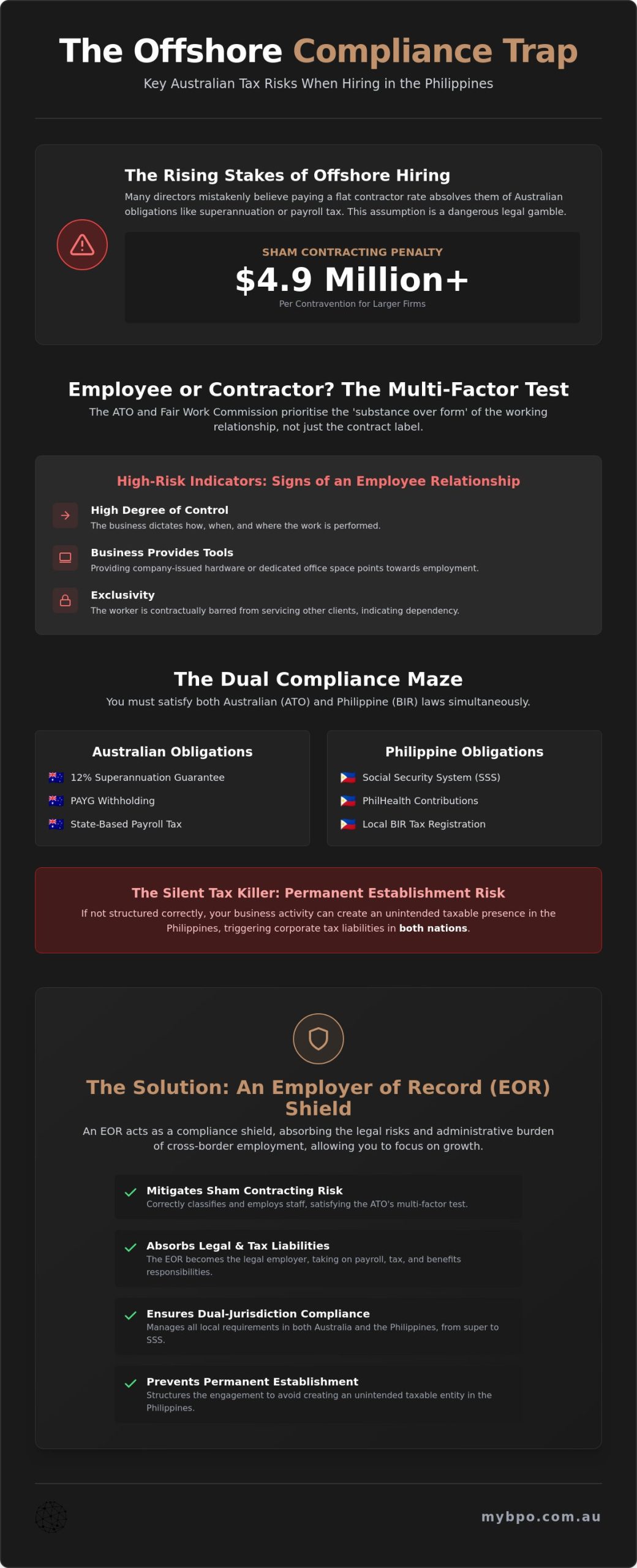
Hiring a remote team in Manila might feel like a borderless transaction, but the ATO often sees a very different picture. Understanding the Australian tax implications of hiring in the Philippines is no longer optional for businesses looking to scale offshore without attracting a multi-million dollar penalty. Many directors mistakenly believe that paying a flat contractor rate absolves them of local obligations like the 12% superannuation guarantee or payroll tax. This assumption is a dangerous legal gamble that can lead to sham contracting charges where penalties for larger firms now exceed $4.9 million per contravention.
We understand the anxiety that comes with navigating the intersection of Australian residency rules and Philippine BIR requirements. This guide provides a definitive framework to secure your operations against Permanent Establishment risks and ensure total compliance across both jurisdictions. You will learn how to classify your offshore staff correctly, avoid creating an unintended tax nexus, and utilise an Employer of Record model to absorb these complex regulatory liabilities effectively. By following this structured approach, you can protect your bottom line while accessing the talent you need to grow.
Key Takeaways
- Recognise the shifting 2026 regulatory landscape and how increased ATO data sharing makes compliance for offshore teams a non-negotiable priority.
- Identify the specific australian tax implications hiring in philippines entails, focusing on the critical legal distinction between independent contractors and employees to avoid sham contracting penalties.
- Evaluate your Permanent Establishment risk to prevent your Australian entity from inadvertently creating a taxable presence within the Philippine jurisdiction.
- Master the 2026 superannuation and PAYG withholding requirements to ensure your remote workforce meets every statutory obligation without triggering an audit.
- Implement a robust Employer of Record (EOR) framework to act as a compliance shield, effectively absorbing the legal risks of cross-border employment.
The 2026 Landscape of Australian Tax and Philippine Hiring
The cross-border employment landscape has shifted from a loosely regulated frontier to a highly monitored environment. By 2026, the Australian Taxation Office (ATO) has refined its ability to track capital flow and labour engagement across international borders. For Australian directors, understanding the australian tax implications hiring in philippines is no longer a matter of administrative preference; it’s a prerequisite for corporate survival. Australia is currently the second-largest market for Philippine BPO services, with over 300 Australian organisations employing approximately 44,000 Filipino professionals. While the 50-70% labour cost savings remain a powerful incentive, the ATO is increasingly scrutinising whether these relationships are genuine independent contracts or disguised employment.
A common misconception among local employers is that tax residency is determined solely by physical location. While a worker may be physically located in Quezon City, their operational integration into an Australian business can trigger local tax levers. These include PAYG withholding, the 12% Superannuation Guarantee, and state-based payroll tax obligations. If your business treats an offshore worker as a contractor while exercising the control typical of an employee relationship, you are exposed to significant liability.
ATO Vigilance in the Post-Remote Era
The ATO identifies “hidden” offshore employee relationships through sophisticated data-matching protocols and international information exchanges. If a worker in Manila operates under the same direction and control as an Australian staff member, the ATO may deem them an employee for tax purposes. The Australia-Philippines tax treaty provides the legal framework for this cooperation, ensuring income is taxed appropriately while preventing double taxation. However, it also gives regulators the tools to pierce the “contractor” veil. “Out of sight” no longer means “out of mind” when digital footprints and bank transfers provide a clear map of your operational reality.
The Interplay of Jurisdictions
Operating in this space requires a dual-compliance strategy that satisfies both the ATO and the Philippine Bureau of Internal Revenue (BIR). You must navigate Australian requirements for superannuation while ensuring the worker is correctly registered for local Philippine contributions like SSS and PhilHealth. Failure to harmonise these rules leads to a “tax nexus” conflict. In the context of offshore staffing, a tax nexus is the specific level of business activity that allows a jurisdiction to legally impose tax obligations on a foreign entity. If your Philippine operations are not structured correctly, you risk creating a Permanent Establishment, which triggers corporate tax liabilities in both nations.
Employee or Contractor? The Sham Contracting Trap
Labelling a worker as an “Independent Contractor” provides zero legal immunity if the functional reality of the engagement suggests otherwise. The ATO and Fair Work Commission now prioritise a “substance over form” approach, a stance reinforced by the 2026 “Closing Loopholes” amendments. If your firm fails to correctly address the australian tax implications hiring in philippines, you’re effectively carrying an unquantified liability that can be triggered by a single disgruntled worker or a routine audit. The landmark Pascua v Doessel Group case demonstrated that even offshore workers can be deemed employees if the Australian business maintains significant control over their daily operations.
The Fair Work Commission’s “Multi-Factor” Test
The Commission applies a rigorous multi-factor test to determine the true nature of an engagement. Key indicators include the degree of control you exert over how, when, and where the work is performed. If you provide the necessary tools, such as company-issued hardware or a dedicated workspace Philippines, the relationship leans heavily toward employment. Exclusivity is another red flag; if a worker is contractually barred from servicing other clients, the ATO will likely deem them an employee. This classification immediately activates your responsibility for the 12% superannuation guarantee and PAYG withholding, regardless of where the staff member is physically located.
Penalties and Personal Liability
Ignoring these classifications leads to catastrophic financial consequences. For businesses with 15 or more employees, the 2026 maximum penalty for each sham contracting contravention is the greater of $4,950,000 or three times the underpayment amount. Directors should also be aware of personal exposure. Individual penalties for involvement in a breach can reach $19,800. These costs are compounded by the requirement to back-pay superannuation, often with a significant interest component and administrative charges. You can explore these liabilities in detail by reading our guide on Exposing the Sham Contracting Philippines Risk. To secure your operations, it’s essential to organise your workforce through a structure that legally absorbs these compliance burdens.
Permanent Establishment Risk: The Silent Tax Killer
Permanent Establishment (PE) represents a threshold where your business activities in a foreign country trigger local corporate tax obligations. For many SMEs, the australian tax implications hiring in philippines are often viewed through the lens of payroll, but PE is a corporate-level threat that can compromise your entire business structure. If the Philippine Bureau of Internal Revenue (BIR) determines that your Australian company has a “taxable presence” in the Philippines, they can claim a portion of your global profits. This isn’t a hypothetical risk; it’s a structural reality governed by the Australia-Philippines Double Tax Agreement. If you fail to manage this, you’re not just hiring a worker; you’re unintentionally opening a foreign branch with all the associated tax liabilities.
The “Agency PE” trap is particularly dangerous for firms with senior offshore staff. Under international tax principles, if an offshore worker habitually exercises authority to conclude contracts on behalf of the Australian entity, they are considered a “dependent agent.” This status creates a legal bridge that allows the BIR to tax the Australian parent company. Even if no physical office exists, the presence of a decision-maker with signing authority is sufficient to trigger this tax nexus. If your Manila-based staff are negotiating deals or committing your firm to legal obligations, you are already in the red zone for an audit.
Fixed Place of Business vs. Virtual Presence
A home office in Manila generally does not constitute a “fixed base” for your company, provided the business doesn’t require the worker to use their home for company purposes or provide the equipment for it. However, the risk escalates significantly if you rent a local office or if senior management operates from the Philippines for extended periods. To mitigate this, roles should be structured as support or operational functions rather than revenue-generating or contract-concluding positions. If your staff require a professional environment, utilising a local partner’s infrastructure is a safer alternative to signing a direct commercial lease in your company’s name.
Double Taxation and Audit Vulnerability
Falling into the PE trap leads to the nightmare of double taxation. While tax treaties exist to provide relief, the administrative burden of proving you’ve already paid tax in one jurisdiction to satisfy another is immense. The BIR and ATO currently share information under modern transparency protocols, making it easier for regulators to spot inconsistencies in corporate filings. An audit in one country often triggers an enquiry in the other, leaving your business exposed on two fronts. By engaging a local EOR provider, you ensure that the legal employer is a Philippine entity, which effectively absorbs the PE risk by providing a compliant, local corporate structure for your staff to operate within.
Managing PAYG and Superannuation for Philippine Staff
The core of the australian tax implications hiring in philippines lies in the distinction between where the work is performed and the legal status of the worker. Under standard ATO rulings, if a non-resident of Australia performs all their labour in the Philippines, the income is generally considered foreign-sourced. This means PAYG withholding is typically not required. However, this exemption is strictly conditional. If that staff member travels to Australia for a strategy session or onsite training, any work performed on Australian soil immediately triggers a proportional withholding requirement. Failure to track these physical movements can lead to unexpected compliance breaches during a routine payroll audit.
Payroll tax adds another layer of complexity that many SMEs overlook during their initial offshore expansion. While you might not pay state payroll tax directly on the wages of offshore staff, those wages are frequently included in your “total Australian wages” to determine if you have exceeded the tax-free threshold in your specific state. If your Philippine team pushes your total payroll over the limit, your domestic Australian tax bill will increase. This “grouping” effect means your offshore operations are never truly invisible to state revenue offices, even if the staff never set foot in the country.
Managing these grouping effects requires careful planning; consulting with a specialist firm like The Bucket List Accountant can help you maintain compliance while optimising your business’s financial structure.
The Superannuation Guarantee (SG) Thresholds
For the 2026-2027 financial year, the superannuation guarantee rate is 12%. While the ATO generally states that super is not required for non-residents working entirely outside Australia, the misclassification risks discussed earlier create a dangerous financial loophole. If a worker is reclassified as an “employee for superannuation purposes” under Section 12 of the Superannuation Guarantee (Administration) Act 1992, you will be liable for the 12% contribution plus the Superannuation Guarantee Charge (SGC). You can find a detailed breakdown of these mechanics in our guide on Payroll in the Philippines for Australian Companies.
State-Based Payroll Tax Considerations
Navigating the “Relevant Contract” provisions is critical for businesses using direct contractors. Most Australian states have harmonised payroll tax laws that treat payments to contractors as taxable wages unless a specific exemption applies. Engaging a worker through a non-compliant structure can lead to the “Double Payroll” trap. This occurs when you are forced to pay Australian payroll tax on the contractor’s fee while also being held liable for Philippine statutory contributions like SSS and PhilHealth. To avoid these overlapping liabilities and secure your financial position, you should engage an EOR specialist who can ringfence your Australian entity from these payroll risks.
Securing Compliance with an Australian-Owned EOR Shield
The risks outlined in previous sections, from sham contracting penalties to permanent establishment triggers, are the direct result of an uninsulated engagement model. To effectively manage the australian tax implications hiring in philippines, your business requires a structural barrier that separates your Australian entity from the foreign labour market. An Employer of Record (EOR) functions as this barrier. By becoming the legal employer of your staff in the Philippines, the EOR shifts the statutory burden away from your firm. This arrangement ensures that your organisation remains a client of a service provider rather than a direct employer of foreign professionals, effectively breaking the tax nexus that regulators look for.
MyBPO acts as a vigilant guardian by providing a robust local framework that absorbs all Philippine-side liabilities. Our physical presence in Manila and Bacolod allows us to manage local tax filings and labour code requirements with precision. We don’t just facilitate payments; we provide a secure environment where your operational integrity and intellectual property are protected through formal, enforceable structures. This local expertise is essential for navigating the specific 2026 Philippine contribution rates and ensuring that your offshore operations remain invisible to the ATO’s employee reclassification audits.
The EOR as the Legal Employer
When you engage staff through MyBPO, we take full responsibility for mandatory contributions including the Social Security System (SSS), PhilHealth, and the Pag-IBIG Fund. For 2026, we manage the total SSS contribution rate of 15% and the PhilHealth rate of 5% of the monthly basic salary. This removes the administrative necessity for an Australian firm to register with the Philippine Bureau of Internal Revenue or establish a local subsidiary. By utilising our Employer of Record Australia model, you eliminate the “fixed place of business” risk and ensure that your staff are classified correctly under both jurisdictions from day one.
Why Australian Ownership Matters for Risk Mitigation
The security of your offshore team depends heavily on the accountability of your partner. Many EOR services are abstract digital platforms with no physical presence in Australia, leaving you vulnerable if a legal dispute occurs. MyBPO is an Australian-owned firm with a local presence in Brisbane. This means you are dealing with specialists who are deeply rooted in your home business culture and accountable under Australian law. We bridge the gap between Australian Fair Work standards and the Philippine labour code, allowing you to scale with the calm confidence of a specialist who understands the high stakes of international employment. Transitioning to this model is the final step in securing your business against the hidden dangers of cross-border tax liabilities.
Future-Proofing Your Offshore Operations
The 2026 regulatory environment leaves no room for ambiguity. As the ATO continues to tighten its oversight, a thorough understanding of the australian tax implications hiring in philippines provides is your best defence against severe financial and legal repercussions. You’ve seen how easily a simple contractor agreement can be dismantled under the Closing Loopholes Act, exposing your firm to millions in back-paid superannuation and penalties. Protecting your business requires more than just awareness; it requires a structured, local presence that separates your Australian entity from foreign labour liabilities.
MyBPO provides the authoritative shield your business needs to grow without fear of audit. As an Australian-owned and operated firm with a physical presence in both Brisbane and the Philippines, we take on the burden of risk. We ensure total compliance with PAYG, superannuation, and Permanent Establishment regulations, allowing you to focus on your core objectives. Don’t leave your corporate safety to chance. You can secure your offshore team with MyBPO’s expert EOR services and move forward with the confidence that your operations are fully protected. Your path to a secure, global team starts with a robust compliance strategy.
Frequently Asked Questions
Do I need to pay Australian superannuation for staff living in the Philippines?
Generally, you aren’t required to pay superannuation for non-residents working entirely outside Australia. However, if the ATO reclassifies your Philippine contractor as an “employee for superannuation purposes” under Section 12 of the SG Act, you will be liable for the 12% contribution plus the Superannuation Guarantee Charge. This risk is highest when the Australian firm maintains direct control over the worker’s daily tasks and provides their equipment.
Can the ATO fine my Australian company for misclassifying Philippine contractors?
Yes, the ATO and Fair Work Commission can impose severe penalties for sham contracting. For businesses with 15 or more employees, the 2026 maximum penalty is the greater of $4.95 million or three times the underpayment amount. These fines apply regardless of the worker’s physical location if the functional reality of the relationship is deemed to be employment rather than a genuine independent contract.
What is the Permanent Establishment risk when hiring in the Philippines?
Permanent Establishment (PE) risk occurs when your Philippine-based activities trigger local corporate tax liabilities for your Australian entity. If your offshore staff habitually negotiate contracts or if you maintain a fixed place of business in Manila, the Philippine Bureau of Internal Revenue may tax a portion of your global profits. Properly managing the australian tax implications hiring in philippines requires recognising this as a corporate-level threat rather than just a payroll issue.
Is a Philippine worker considered an Australian tax resident if they work for an AU firm?
No, a worker living and working in the Philippines is typically considered a non-resident of Australia for tax purposes. Their income is foreign-sourced and generally falls outside the Australian PAYG withholding system. However, if they perform any work while physically present in Australia, even for a brief period, those specific earnings become subject to Australian tax laws and mandatory reporting requirements.
How does the 13th-month pay in the Philippines affect my Australian tax reporting?
The 13th-month pay is a mandatory Philippine statutory requirement that you must factor into your total labour costs. While it doesn’t trigger specific Australian tax reporting if the worker is a non-resident contractor, it must be included in your “total Australian wages” for state payroll tax grouping calculations. Failing to account for this can lead to under-reporting your global wage footprint to state revenue offices.
Does the Fair Work Act apply to my offshore team in the Philippines?
The Fair Work Act has limited application to non-residents working entirely offshore, but its sham contracting provisions have extra-territorial reach that can impact your Australian entity. If the Commission determines you’ve misclassified a worker to avoid entitlements, they can pursue your Australian business for breaches. This is why many firms use an EOR to ensure the relationship is legally managed under Philippine labour law.
Can I avoid Australian payroll tax by hiring offshore?
You cannot entirely avoid Australian payroll tax simply by hiring offshore. While you don’t pay tax directly on those wages in most states, state revenue offices often include offshore labour costs when determining if your business has exceeded the payroll tax threshold. If your combined Australian and Philippine payroll surpasses the limit, your domestic Australian wages will be taxed at the applicable state rate.
What is the safest way to hire in the Philippines without triggering a tax audit?
The safest way to mitigate the australian tax implications hiring in philippines is to utilise an Australian-owned Employer of Record (EOR). This structure ensures the staff member is legally employed by a Philippine entity, effectively absorbing the risks of sham contracting and Permanent Establishment. It provides a compliant framework that protects your Australian entity from direct regulatory scrutiny while ensuring all local Philippine statutory contributions are met.
Need a strategy session?
Tell us about your team and we will map out the right structure, fixed-cost quote included.
Book a call