Blog
Visiting Your Filipino Team: A Success Guide for AU Leaders

Is your offshore operation a secure extension of your Australian headquarters, or is it a black box of unmitigated operational risk? Most leaders realise that while digital platforms facilitate work, they cannot replace the physical verification of operational security and staff wellbeing. If you’re considering visiting your philipino team, you’re likely balancing the desire for stronger loyalty against the fear of cultural “lost in translation” moments or security gaps in home-based environments. It’s a valid concern, as the distance between Melbourne and Manila can often obscure the practical realities of your team’s daily workspace.
We agree that a hands-on approach is the only way to truly mitigate the liabilities of international employment and build a safe harbour for your business. This article promises to provide a clear roadmap for your journey, covering everything from the mandatory 72-hour eTravel registration to the delicate business etiquette of saving face. We will preview the essential steps for auditing home-based setups, navigating visa-free entry for Australian citizens, and building a professional itinerary that transforms a remote resource into a resilient, culturally aligned partnership.
Key Takeaways
- Master the logistical complexities of visiting your philipino team, from timing your arrival to avoid peak typhoon seasons to managing the mandatory 2026 eTravel registration.
- Mitigate the risk of cultural “lost in translation” moments by understanding the mechanics of “saving face” and identifying the subtle differences between agreement and comprehension.
- Secure your operational integrity by physically verifying IP protection standards and clean desk policies within your team’s dedicated workspace.
- Strengthen staff loyalty and reduce turnover by converting a digital connection into a tangible partnership through structured, relationship-focused itineraries.
- Utilise established local infrastructure in Manila and Bacolod as a secure home base to ensure your visit is both professionally productive and operationally safe.
The Business Case for On-the-Ground Connection
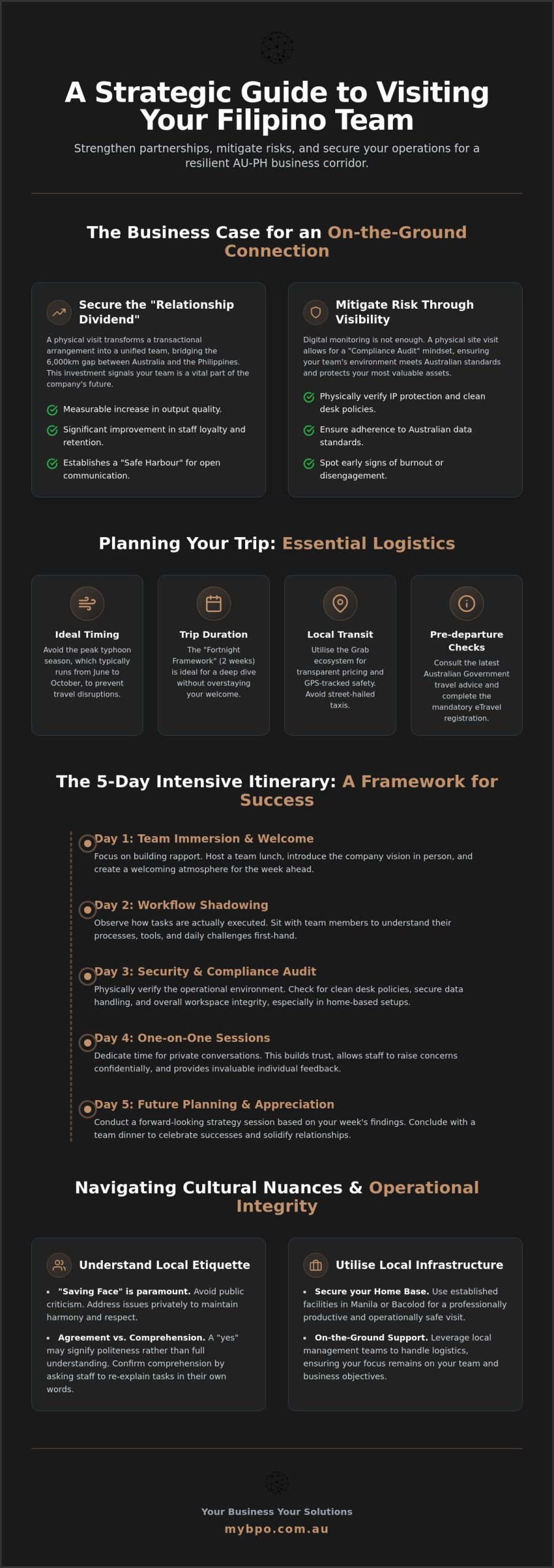
Many Australian leaders treat offshoring as a purely transactional arrangement, managed through dashboards and weekly video calls. This approach is a strategic error that leaves your operation vulnerable to high turnover and misaligned expectations. When visiting your philipino team, you are securing a “Relationship Dividend”. This isn’t a vague sentiment; it is a measurable increase in output quality and staff retention that occurs when employees feel a genuine connection to their Australian headquarters. In 2026, the “Hybrid Offshore Model” has emerged as the standard for successful firms. It effectively balances remote flexibility with the structural stability of periodic physical oversight, ensuring that the AU-PH business corridor remains robust against shifting market conditions.
Bridging the 6,000km Gap
Distance often creates a psychological disconnect that digital platforms cannot bridge. When an Australian director takes the time to fly to Manila or Bacolod, it signals that the team is a vital part of the company’s future. This humanises the Australian brand and provides a platform to share your vision in person. Understanding the nuances of Philippine culture, particularly the values of social harmony and respect, helps you establish a “Safe Harbour” for communication. This physical presence transforms the relationship from a series of outsourced tasks into a unified, integrated team where staff feel safe to raise concerns before they become expensive problems.
Risk Mitigation through Visibility
Operational security requires more than just digital monitoring; it requires physical verification. A site visit allows you to adopt a “Compliance Audit” mindset, ensuring that your team has the specific tools and environment required to maintain Australian data standards. By seeing staff in their actual place of work, you can ensure that your sham contracting Philippines risk is effectively managed. Seeing the workspace first-hand confirms that your team is operating within a secure, legal framework rather than a fragmented home-based setup that might lack proper IP protection. It also allows you to spot subtle signs of burnout or disengagement that remain invisible on a screen. This visibility allows you to secure your human capital before turnover occurs. If you don’t physically verify these conditions, you’re essentially managing your most important assets with a blindfold on.
Planning Your Trip: Logistics, Timing, and Itinerary
For Australian SMEs, we recommend the “Fortnight Framework”. A two-week stay provides the “Goldilocks” zone: enough time to overcome travel fatigue and conduct a deep dive into operations without overstaying your welcome. For local transit, you should utilise the Grab ecosystem rather than street-hailed taxis. This ensures transparent pricing and GPS-tracked safety for all movements. Before departure, always consult the latest Australian Government travel advice to remain informed about current security advisories. If you’re unsure about local coordination, our specialised management teams can help secure your local logistics.
The Ideal 5-Day Intensive Itinerary
A structured itinerary ensures your physical presence translates into measurable performance gains. We suggest a five-day core work week designed to balance oversight with relationship building:
- Days 1-2: Focus on workflow shadowing. Observe how tasks are actually executed at the desk level rather than how they appear on a dashboard.
- Day 3: Shift to strategic alignment. Conduct a “Town Hall” session to answer questions directly and reinforce your company’s 2026 objectives.
- Day 4: Prioritise social bonding. A communal team lunch is a non-negotiable cultural pillar that builds the trust necessary for long-term loyalty.
- Day 5: Conclude with one-on-one reviews. This is your opportunity to set individual KPIs and address personal career goals in a private setting.
Regional Considerations: Manila vs. Bacolod
Your logistical requirements will shift depending on your team’s location. Manila is a high-octane corporate centre, but it presents significant challenges with traffic congestion that can consume hours of your working day. Conversely, Bacolod offers a more stable and navigable environment for BPO operations. If your team is split across these regions, you must account for internal flight logistics. Managing these multi-site visits requires precise scheduling to ensure that both locations receive adequate oversight and that your operational security standards remain consistent across all jurisdictions.
Navigating Cultural Nuances During Your Visit
While logistical precision secures your travel, cultural mastery secures your operations. When visiting your philipino team, you must navigate the deeply ingrained concept of “Saving Face”. In a Philippine workplace, public criticism is not viewed as constructive; it is perceived as a personal affront that causes “hiya”, or shame. If you provide negative feedback in front of peers, you risk permanently damaging the employee’s morale and their standing within the team. To mitigate this risk, always conduct performance reviews in a private setting. This protective approach ensures that professional boundaries remain intact while maintaining social harmony.
The “Yes” Trap is another operational hazard for the uninitiated Australian leader. In local culture, saying “no” to a superior can be seen as disrespectful or disruptive to “Pakikisama”, which refers to the vital role of social harmony. Consequently, a team member might agree to a deadline they cannot meet or a process they don’t fully grasp. To secure your project timelines, move beyond binary questions. Instead of asking “Do you understand?”, ask the team member to walk you through their planned execution. This verification process is a standard part of navigating Philippine investment regulations and general business conduct, ensuring that “yes” actually translates to operational readiness.
Hierarchy is a pillar of the local professional environment. Being addressed as “Sir” or “Ma’am” is not a sign of subservience but a reflection of clear professional boundaries. Embracing this structure, rather than trying to force a flat Australian hierarchy, actually provides your staff with a sense of security and clear leadership. It establishes you as a steady authority figure they can rely on for guidance and protection.
Communication Styles: Direct vs. Indirect
Australian bluntness is often misinterpreted as aggression. While we value “calling a spade a spade”, this directness can shut down communication in a Philippine office. To encourage a “Speak Up” culture, you must soften your delivery. Use the “Sandwich Method” by layering constructive criticism between genuine praise. This method respects the individual while still achieving the necessary corrective outcome. If you don’t adjust your frequency, you’ll find your team withdrawing, which leads to invisible bottlenecks and unmitigated errors.
The Power of “Merienda” and Shared Meals
Food is the universal language of trust and a vital component of visiting your philipino team. You should never skip the “Merienda”, the traditional afternoon snack break, or the communal team lunch. These are not merely breaks from work; they are strategic opportunities to build social bonds. Budgeting for hospitality is a minor expense for an Australian director, but it serves as a massive loyalty builder. It demonstrates that you’re a reliable ally who respects local customs, which significantly reduces staff turnover and strengthens the AU-PH business corridor.
Beyond the Coffee: Assessing Operational and Security Standards
While the cultural bonding discussed earlier is essential, your visit serves a higher purpose: the physical verification of operational security. A digital dashboard cannot confirm if a clean desk policy is being ignored or if hardware is being compromised. When visiting your philipino team, you must act as a vigilant guardian of your intellectual property. You need to ensure your dedicated workspace Philippines meets the rigorous data privacy standards expected in Australia. This involves more than just software; it’s about the physical environment. Are mobile phones permitted on the production floor? Are there physical notebooks containing sensitive client data? These lapses create significant liability.
Infrastructure redundancy is another non-negotiable audit point. You should personally test the transition to backup power and verify the stability of secondary internet lines. If the local grid fails during a monsoon, your business continuity depends on these physical safeguards. Similarly, Occupational Health and Safety (OH&S) standards must be scrutinised. Sub-par conditions don’t just reduce productivity; they create a legal liability for your Australian firm under vicarious responsibility frameworks. If you need to secure your operations against these vulnerabilities, contact MyBPO to discuss our secure facility options.
The Risk of Home-Based Teams
The “Security Illusion” of home-based staff is a major risk that many Australian leaders overlook. Visiting a home-based worker is often logistically impossible and can be seen as professionally intrusive. More importantly, home environments rarely meet the physical security requirements of Australian corporate insurance policies. If you discover staff are working from unsecure locations, it’s time to transition them to a controlled facility. This move eliminates the variables of domestic life and ensures your data remains within a protected perimeter.
EOR Oversight: Your Compliance Shield
Utilising an employer of record Australia provides a compliance shield that absorbs these risks on your behalf. They manage the local DOLE (Department of Labor and Employment) inspections and ensure that mandatory benefits like SSS, PhilHealth, and Pag-IBIG are paid correctly. During your visit, you should verify these records to ensure total compliance. Visiting a facility managed by an Australian-owned partner offers a level of accountability that abstract digital platforms cannot match. It provides the peace of mind that your operation is grounded in physical reality and legal integrity.
Maximising Your Visit with MyBPO’s Local Infrastructure
Many leaders find that the isolation of remote management becomes a significant bottleneck when trying to scale. MyBPO eliminates this friction by providing a physical “Home Base” for your operations in both Manila and Bacolod. When visiting your philipino team, you aren’t just a guest in a foreign office; you’re operating from a facility designed to meet Australian corporate expectations. Our local managers act as your on-the-ground allies, facilitating complex logistics and providing real-time cultural translation. This support ensures that your time is spent on high-value strategic alignment rather than navigating administrative hurdles.
Our “Safe Harbour” advantage is built on the principle of total operational transparency. By meeting your team in a professional, Australian-standard environment, you reinforce the seriousness of your business standards. This physical presence allows you to transition from a simple oversight visit into a comprehensive long-term scaling strategy. By leveraging our Employer of Record (EOR) services, you can absorb the risks of international expansion while maintaining the operational freedom to grow your headcount with confidence. It transforms your offshore presence from a remote experiment into a secure, permanent fixture of your corporate structure.
Your Office in the Philippines
Our facilities provide more than just a desk; they offer a sophisticated corporate environment. You can utilise our dedicated boardrooms for intensive strategic planning sessions, ensuring your leadership team has the privacy and technology required for sensitive discussions. Through our equipment leasing services, we ensure that your team has the latest hardware ready for your arrival, eliminating the risk of technical delays. Because MyBPO is Australian-owned and managed, there is no “cultural gap” in management expectations. We understand the level of precision you require because we operate under the same professional code.
Next Steps: Booking Your Strategy Session
Organising a successful trip requires meticulous preparation well before you board your flight. MyBPO can assist in structuring your first (or next) team visit to ensure it delivers maximum ROI. We work with you to ensure your payroll and compliance frameworks are airtight before you touch down, allowing you to focus entirely on the human and strategic elements of your operation. If you’re ready to solidify your AU-PH business corridor, it’s time to move beyond the screen. Organise a secure visit to your Philippine team with MyBPO today to begin your operational audit and relationship-building journey.
Securing Your AU-PH Business Corridor for 2026
Building a resilient offshore operation requires moving beyond digital dashboards to verify the physical reality of your team’s workspace. We have explored how a methodical approach to logistics and cultural mastery can transform your operation from a high-risk transaction into a loyal, integrated partnership. When visiting your philipino team, your primary objective is to solidify operational security and mitigate the liabilities of remote employment. If you neglect the physical audit of IP protection or the nuances of social harmony, you leave your business vulnerable to unmanaged risks and high staff turnover.
MyBPO serves as your compliance shield, providing the local infrastructure and Australian-owned expertise needed to navigate these complexities safely. With our physical offices in Manila and Bacolod, we ensure that your team operates within a secure, professional environment that meets Australian regulatory demands. We absorb the burden of local compliance and EOR management, allowing you to focus on strategic growth. Secure your offshore operations and plan your next visit with MyBPO to ensure your business remains protected and productive. Your commitment to a hands-on presence will secure the long-term success of your international team.
Frequently Asked Questions
Do I need a special visa to visit my team in the Philippines for business?
Australian citizens can enter the Philippines visa-free for business or tourism for up to 30 days. You must ensure your passport is valid for at least six months beyond your intended stay and possess proof of a return or onward ticket. It is mandatory to register via the eTravel system within 72 hours of your arrival to generate the required QR code for immigration.
Is it safe for Australian business owners to travel to Manila and Bacolod?
Travel to major business hubs like Manila and Bacolod is generally safe provided you follow standard professional security protocols. We advise staying in established districts such as Makati or BGC and using the Grab app for all transport to ensure GPS-tracked safety. Our local management teams provide an additional layer of protection by overseeing your movements between our secure facilities.
How much should I budget for a team lunch or social event in the Philippines?
While specific costs vary by venue, a team lunch at a reputable mid-range restaurant is a modest investment that generates significant cultural capital. You should consult with your local manager to select a location that is both logistically accessible and culturally appropriate. This small gesture is a vital component of building long-term loyalty and reducing turnover within your offshore operation.
What is the best time of year to visit my offshore team to avoid weather disruptions?
The dry season, spanning from November to May, is the most reliable window for visiting your philipino team. Planning your trip during these months avoids the peak typhoon season, which typically occurs between June and October. Avoiding severe weather ensures your itinerary isn’t compromised by flight cancellations or office closures due to regional power outages.
Should I bring gifts from Australia for my Filipino staff members?
Bringing “pasalubong,” or small souvenirs from Australia, is a highly regarded cultural practice that builds social harmony. Items such as Australian chocolates or biscuits are excellent choices that humanise the connection between your headquarters and the local team. This practice demonstrates that you value the relationship beyond the transactional nature of daily work tasks.
How do I handle performance issues face-to-face without causing the staff to resign?
Always conduct performance discussions in a private setting to respect the cultural imperative of “saving face.” If you provide corrective feedback in front of peers, the resulting shame can lead to immediate resignation. A private, structured approach allows you to address operational gaps while maintaining the employee’s dignity and securing their continued commitment to your firm.
Can MyBPO help with the logistics of my visit if I use their EOR services?
Yes, MyBPO provides comprehensive on-the-ground support for our Employer of Record clients. We facilitate your visit logistics by preparing dedicated boardrooms and providing cultural guidance during your stay. Our Australian-owned infrastructure acts as a secure home base, allowing you to focus on high-level strategy while we manage the administrative complexities of your visit.
What is the “13th Month Pay” and should I discuss it during my visit?
The 13th Month Pay is a mandatory benefit under Philippine law, equivalent to one-twelfth of an employee’s basic annual salary. It must be paid by the 24th of December each year. Discussing your commitment to these statutory benefits during your visit reinforces your status as a compliant and reliable employer, which is essential for maintaining a stable and protected AU-PH business corridor.
Need a strategy session?
Tell us about your team and we will map out the right structure, fixed-cost quote included.
Book a call