Blog
Efficiently Hire Remote Philippines Staff from Australia

What if your strategy to reduce overheads by 70% actually created a hidden legal liability that could dismantle your Australian business? While Hiring Remote Staff in the Philippines from Australia offers an undeniable competitive advantage, the path is fraught with regulatory traps that many local firms overlook until it’s far too late.
You likely recognise that the talent pool in Manila is exceptional, yet the uncertainty surrounding Philippine labour laws and the risk of Australian regulatory penalties feels like a constant weight. It’s a valid concern because misclassifying a worker isn’t just a clerical error; it’s a significant operational risk that can lead to back-dated superannuation claims and heavy fines. This article provides the definitive blueprint to master these complexities, allowing you to build a secure, high-performing offshore team that integrates seamlessly with your local operations.
We will explore how to navigate the July 2026 minimum wage increases and mandatory 13th-month pay while maintaining a robust compliance shield for your firm. You’ll learn exactly how to secure your data and manage equipment through a professional on-the-ground presence, ensuring your offshore expansion remains a strategic asset rather than a legal liability.
Key Takeaways
- Transition from basic outsourcing to a mature offshore integration strategy to ensure your remote team aligns with Australian business standards and long-term growth goals.
- Mitigate the severe risks of sham contracting by understanding how Hiring Remote Staff in the Philippines from Australia intersects with the Fair Work Act and Philippine labour codes.
- Evaluate the Employer of Record (EOR) model against direct hiring to determine which framework offers the best balance of operational control and legal indemnity for your firm.
- Protect your data integrity and operational uptime through professional equipment leasing and dedicated workspaces rather than relying on unmanaged or insecure home environments.
- Establish a secure “compliance shield” by partnering with an Australian-owned specialist that maintains a physical presence and local accountability in both jurisdictions.
Hiring Remote Staff in the Philippines: The 2026 Strategic Landscape
By 2026, the economic corridor between Australia and the Philippines has matured into a sophisticated business ecosystem. Australian firms no longer view offshoring as a peripheral experiment but as a core pillar of their operational architecture. This shift represents a move away from legacy “outsourcing” toward a model of true offshore integration. Hiring Remote Staff in the Philippines from Australia has evolved into a high-stakes exercise where success is measured by team stability and regulatory security rather than just hourly rates. It’s about structural resilience in an increasingly competitive market.
The roles being successfully offshored have expanded significantly. While administrative virtual assistants remain a staple, we’re seeing a surge in specialised technical roles, including accountants, software developers, and paraplanners. This transition requires a “compliance-first” hiring model. As Australian authorities increase scrutiny on international employment structures, the focus must be on mitigating risk. The goal is no longer just cost reduction; it’s the acquisition of a compliant, scalable workforce that functions as a direct extension of your local team.
Why the Philippines Remains the Top Choice for Australians
The massive Business Process Outsourcing (BPO) industry in the Philippines, which now employs over 1.7 million workers, provides a talent foundation that is uniquely suited to the Australian market. Cultural alignment isn’t just a buzzword. It’s a functional reality reflected in high English proficiency and a deep understanding of Western corporate etiquette. The time zone difference, typically only two to three hours depending on daylight savings, allows for real-time collaboration. This synchronicity means your Manila-based staff are working while you are, attending the same morning huddles and responding to clients instantly. It’s a level of integration that distant offshore locations simply can’t match.
The Evolution from Outsourcing to Dedicated Offshore Teams
The landscape has shifted from project-based, transactional work toward building long-term, loyal teams. Modern Australian directors prioritise brand alignment and staff retention over the “gig economy” approach. They’ve realised that a dedicated virtual assistant who knows their clients’ names and understands their business values is an invaluable asset. This evolution has led to a new standard: a modern offshore team is a direct, culturally aligned extension of the Australian head office, functioning with the same accountability as a local hire. For businesses prioritising Hiring Remote Staff in the Philippines from Australia, this model ensures that staff loyalty remains high and turnover remains low, protecting the intellectual property and operational continuity of the firm.
Navigating the Legal Minefield: Fair Work and Philippine Compliance
The Fair Work Act 2009 remains the primary lens through which Australian directors must view their offshore arrangements. A common misconception is that hiring someone outside our borders exempts a company from local scrutiny. This is a dangerous fallacy. If the relationship with your offshore staff mimics employment through daily control, fixed hours, and the provision of equipment, the Australian Taxation Office (ATO) and Fair Work Commission may characterise the arrangement as a “sham contract”. The legal reality is stark. Misclassification leads to severe back-payments for superannuation and significant regulatory penalties.
For many firms, the process of Hiring Remote Staff in the Philippines from Australia begins with a focus on talent, but it must end with a focus on compliance. To maintain a secure operation, you must account for the mandatory Philippine benefits that are legally protected. In 2026, these requirements have become more stringent. Employers are responsible for managing contributions to the Social Security System (SSS), which currently sits at a 15% rate, alongside PhilHealth premiums at 5% and Pag-IBIG Fund contributions. Managing these as a foreign entity without a local presence is nearly impossible without incurring direct liability.
The Impact of the Closing Loopholes Act 2025
Recent Australian legislation has significantly tightened the definition of employment. The Closing Loopholes Act 2025 prioritises the “substance” of a working relationship over whatever label is written in a contract. If you treat a Filipino freelancer like an Australian employee, the law will likely agree with that assessment, regardless of their location. This shift has made direct-hire “freelance” models a high-risk gamble. You can read a detailed breakdown of these specific dangers in our guide on Exposing the Sham Contracting Philippines Risk.
Philippine Labour Law: What Australian Directors Must Know
The Department of Labor and Employment (DOLE) in the Philippines is a highly protective regulator. Unlike the “at-will” misconceptions often found in international business, terminating a Filipino employee requires strict adherence to “just causes” and “authorised causes” under the Labour Code. Directors must also plan for the mandatory 13th-month pay. This is not a discretionary bonus; it is a legally required payment equivalent to 1/12th of the employee’s basic annual salary, which must be distributed by 24 December each year. Failure to meet these cultural and legal expectations can lead to local labour disputes that are difficult to resolve from afar. Utilising professional Employer of Record (EOR) services allows you to absorb these risks into a structured, compliant framework, ensuring your business remains protected in both jurisdictions.
Direct Hire vs. EOR vs. Traditional BPO: Which Model Fits?
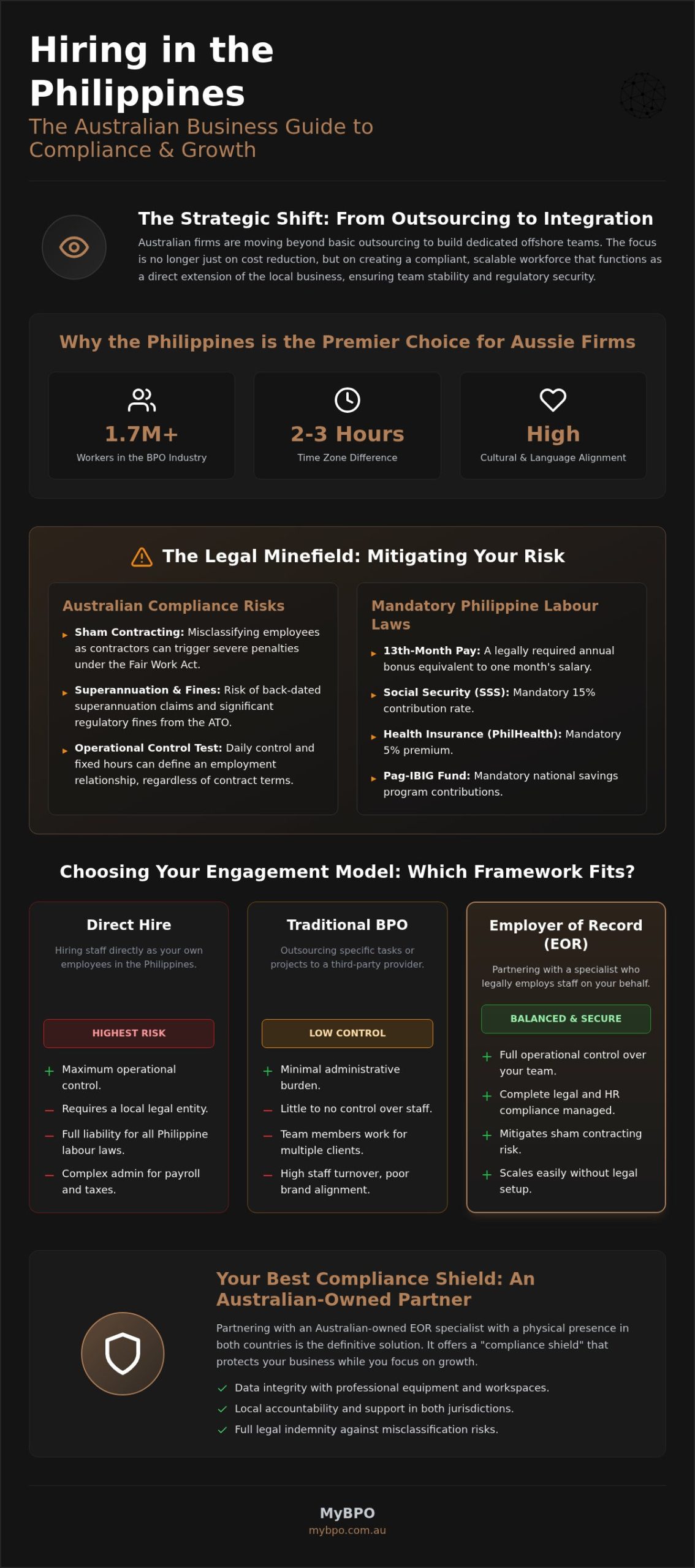
Choosing an engagement model is a critical decision that dictates your firm’s long-term risk profile. When Hiring Remote Staff in the Philippines from Australia, directors typically weigh three distinct paths: direct contracting, traditional Business Process Outsourcing (BPO), or the Employer of Record (EOR) model. Each offers a different balance of operational control and legal indemnity. While a traditional BPO provides a managed service, it often creates a barrier between you and your staff, leading to a lack of brand alignment. Conversely, direct hiring offers total control but leaves your business vulnerable to the regulatory minefield discussed previously.
For mid-sized Australian firms, the EOR model has emerged as the strategic “sweet spot”. It allows you to maintain direct day-to-day management of your team while a local partner absorbs the legal and administrative burdens of employment. This structure is particularly vital for intellectual property (IP) protection. In a direct-hire scenario, enforcing an IP agreement across international borders is notoriously difficult. A robust EOR framework ensures that IP rights are legally transferred from the Philippine employee to the local entity, and subsequently to your Australian company, through a chain of enforceable commercial contracts.
The Direct Hire Trap
The allure of direct hiring often lies in the perceived cost savings of avoiding service fees. However, this model frequently becomes an administrative trap. Managing international payroll, verifying local tax compliance, and navigating the nuances of Philippine PhilHealth and SSS contributions requires significant internal resources. If a direct contractor fails to deliver or breaches confidentiality, your legal recourse is practically non-existent without a physical presence in the Philippines. These hidden costs of self-managed offshore recruitment often far outweigh the initial savings, especially when factoring in the time lost to operational friction.
Why EOR is the Secure Pathway
The EOR model functions as your “compliance shield” by acting as the registered Legal Employer in the Philippines. While you retain full authority over the worker’s tasks, performance, and integration into your company culture, the EOR handles the complexities of local labour law. This arrangement is detailed extensively in our Employer of Record Australia: The Definitive Guide, which outlines how this model secures your offshore expansion. By partnering with an Australian-owned specialist, you bridge the jurisdictional gap. You gain the peace of mind that comes from having a partner who understands the Australian Fair Work environment and maintains a physical, accountable presence on the ground in Manila to secure your interests.
Operational Excellence: Infrastructure, Equipment, and Vetting
The transition from “hiring” to “onboarding” is the point where most offshore ventures either succeed or fail. Hiring Remote Staff in the Philippines from Australia requires more than a signed contract; it demands a robust operational framework that mirrors your local office standards. If you don’t provide the necessary tools and environment, even the most talented professional will struggle to deliver. Success in 2026 is defined by how well you integrate these staff members into your existing digital and cultural infrastructure. This requires a shift in perspective from viewing offshore staff as “external help” to treating them as a genuine, high-performing extension of your Australian team.
Establishing clear Key Performance Indicators (KPIs) from day one is essential for maintaining accountability. These metrics should be transparent and measurable, ensuring that your remote staff understand exactly what defines success in their role. Without a structured performance management framework, the geographical distance can lead to a gradual misalignment of expectations. By implementing regular check-ins and using integrated project management tools, you can maintain the same level of visibility over your Manila team as you do with your staff in Sydney or Melbourne.
Equipment Leasing and Data Security
Relying on “Bring Your Own Device” (BYOD) policies is a significant operational liability. If a staff member uses a personal laptop for business tasks, you lose visibility over your data and increase the risk of security breaches. Providing company-standard hardware is the only way to ensure that enterprise-grade security protocols are consistently applied. Our equipment leasing solutions allow you to deploy high-spec hardware pre-configured with your required software and security layers. This model also offers significant tax and asset management advantages, allowing you to treat hardware costs as a predictable monthly operational expense rather than a large capital outlay. Manage your IT support centrally from Australia while knowing your staff have the tools they need to maintain 100% uptime, often supported by robust business connectivity from Broadconnect.
The Value of a Dedicated Workspace
While the work-from-home model offers flexibility, it often introduces risks related to internet stability and power redundancy. In many regions of the Philippines, residential infrastructure cannot guarantee the level of uptime required for professional Australian operations. A Dedicated Workspace Philippines: Securing Your Operations provides a controlled environment with commercial-grade internet, backup generators, and physical security. These professional facilities also play a vital role in staff retention; employees who work in a structured office environment often report higher levels of job satisfaction and brand alignment. You can secure your team’s long-term productivity by choosing dedicated virtual assistants and workspaces that provide the structural integrity your business deserves.
Why an Australian-Owned Partner is Your Best Compliance Shield
The decision to expand into the Philippines is a significant strategic move that requires more than just a recruitment plan. It demands a partner that understands the high stakes of cross-border employment and the specific pressures of the Australian regulatory environment. Hiring Remote Staff in the Philippines from Australia through a foreign-owned marketplace or a purely digital platform often leaves directors exposed to jurisdictional gaps. MyBPO bridges this divide by maintaining a physical, accountable presence in both Australia and the Philippines. We act as your vigilant guardian, ensuring that every operational step is grounded in legal and structural reality.
Our unique position as an Australian-owned specialist allows us to provide a “safe harbour” for your business. We don’t merely facilitate a transaction; we take on the burden of risk. By providing a physical infrastructure and a local leadership team, we ensure that your offshore operations are not just a distant cost-centre but a high-performing, integrated department. This dual-presence model allows us to secure your interests in Manila while remaining directly accountable to you under Australian business standards.
Local Accountability, Global Reach
Dealing with an Australian company under Australian law provides a layer of protection that foreign entities simply cannot match. If a legal or operational complexity arises, you have the comfort of knowing your partner is governed by the same corporate standards as your own firm. MyBPO absorbs the administrative and legal weight of Philippine employment, from managing PhilHealth and SSS contributions to navigating complex termination laws. Our recruiters possess a deep understanding of Australian business culture. This ensures they source candidates who are not just technically capable but are prepared to integrate into the rhythmic flow of an Australian head office. We mitigate the friction that often occurs when different corporate worlds collide.
Getting Started: Your Roadmap to Success
A secure offshore expansion follows a methodical, step-by-step process designed to eliminate uncertainty. Success begins with a rigorous vetting phase where we assess candidates for both technical proficiency and cultural fit. We look for individuals who can become long-term assets rather than temporary fixes. Once the right talent is identified, the first 90 days of onboarding are critical. We guide you through this integration period, establishing the KPIs and communication protocols necessary for sustained productivity. This structured approach ensures that your new team members are fully aligned with your brand values from day one. If you are ready to build a secure, high-performing team without the increased legal liability, it is time to secure your offshore future with a compliant EOR solution from MyBPO.
Securing Your Competitive Edge through Compliant Integration
Building a high-performing offshore team is no longer a matter of simple recruitment; it’s a strategic exercise in risk mitigation and structural integrity. By transitioning from transactional outsourcing to a dedicated integration model, your firm can absorb the cost benefits of the Philippine market without compromising on security or brand alignment. Hiring Remote Staff in the Philippines from Australia requires a partner that understands the gravity of Fair Work Act compliance and the protective nature of DOLE regulations.
As an Australian-owned and operated specialist with a physical presence in Brisbane, Manila, and Bacolod, MyBPO serves as your vigilant compliance shield. We provide the tangible infrastructure, from dedicated workspaces to equipment leasing, that ensures your data remains secure and your operations remain resilient. Our expertise allows you to navigate complex jurisdictional boundaries with the calm confidence of a market leader who understands the high stakes of international employment.
The path to a scalable, compliant offshore workforce is clear. You can secure your offshore team with MyBPO’s Australian-owned EOR services and begin the journey toward operational freedom today. Your business deserves the protection of a partner that is as invested in your compliance as you are.
Frequently Asked Questions
Is it legal for an Australian company to hire remote staff in the Philippines directly?
Yes, it’s legal to hire directly as independent contractors, but it carries significant risk. If the relationship functions like employment, you may be liable for unpaid benefits and tax penalties. Hiring Remote Staff in the Philippines from Australia via a direct model often triggers scrutiny under the “four-fold test” used by Philippine authorities to determine employment status.
What is an Employer of Record (EOR) and why do I need one in the Philippines?
An EOR acts as the registered legal employer for your staff in the Philippines while you maintain operational control. You need one because foreign entities cannot directly manage mandatory contributions like SSS and PhilHealth. An EOR absorbs these administrative burdens and legal liabilities, providing a compliant framework that protects your Australian business from international labour disputes.
Do I have to pay Australian superannuation to my remote staff in the Philippines?
Australian superannuation is generally not required for non-residents working entirely outside of Australia. However, the risk lies in misclassification. If the ATO determines your “contractor” is legally an employee, you could be held liable for the 12% superannuation guarantee rate applicable for the 2026-2027 financial year. Correct characterisation is essential to mitigate this liability.
What are the mandatory benefits for Philippine employees in 2026?
In 2026, mandatory benefits include SSS contributions at 15% of the Monthly Salary Credit and PhilHealth premiums at 5% of the basic salary. Additionally, employers must contribute to the Pag-IBIG Fund and provide a mandatory 13th-month pay. These are legally protected rights for all rank-and-file employees who have worked for at least one month in a calendar year.
How does the Fair Work Act affect my offshore team?
The Fair Work Act, specifically the Closing Loopholes Act 2025, focuses on the “substance” of the working relationship. If your offshore staff are integrated into your business as employees, Australian authorities may apply local standards to the arrangement. This makes the correct characterisation of your offshore team a critical requirement to avoid sham contracting penalties and regulatory scrutiny.
What is the “13th-month pay” and is it compulsory for Australian employers?
13th-month pay is a legally mandated benefit in the Philippines, not a discretionary bonus. It’s equivalent to one-twelfth of an employee’s basic salary earned during the year and must be paid by 24 December. While it’s a Philippine requirement, Australian firms must facilitate this payment to remain compliant with local labour codes and maintain staff retention.
How do I ensure my data is secure when hiring remote staff in the Philippines?
Data security is best managed through a combination of dedicated workspaces and company-standard hardware. Avoiding “Bring Your Own Device” (BYOD) policies is essential. By using managed infrastructure with commercial-grade internet and power redundancy, you secure your intellectual property and ensure your Hiring Remote Staff in the Philippines from Australia strategy remains operationally resilient and protected from breaches.
Can I provide my own equipment to remote staff, or should I lease it?
While you can provide your own equipment, equipment leasing is generally more efficient for offshore teams. Shipping hardware internationally involves complex customs duties and significant logistical delays. Leasing ensures your staff have pre-configured, high-spec devices with local IT support, while allowing you to manage costs as a predictable monthly operational expense rather than a large capital outlay.
Need a strategy session?
Tell us about your team and we will map out the right structure, fixed-cost quote included.
Book a call