Blog
Mastering Offshore Staff Onboarding in the Philippines: A Compliance-First Guide for Australian Firms

An Australian director recently discovered that a simple “freelance” arrangement in Manila had transformed into a costly Fair Work Commission claim. This scenario, highlighted by the Pascua v Doessel Group Pty Ltd ruling, proves that the legal boundary between an offshore contractor and a protected Australian employee is thinner than most realise. You likely recognise the immense value of Philippine talent, yet the fear of Fair Work penalties and the complexity of Philippine labour laws often create a paralysis of risk. It’s a valid concern; a single compliance oversight during offshore staff onboarding Philippines can quickly dissolve the strategic benefits of your global team.
This guide establishes a robust framework that functions as a compliance shield for your firm. You’ll learn how to integrate high-performing talent while mitigating legal risks through structured Employer of Record (EOR) models and precise regulatory adherence. We will break down the essential mechanics of Philippine labour law, including the 15% SSS contribution rates and the mandatory 13th-month pay deadline. This ensures your new team members are productive and your Australian business remains secure from the very first day of the engagement.
Key Takeaways
- Identify the specific triggers that cause the Australian Fair Work Act to apply to overseas workers and learn how to mitigate these jurisdictional risks through formal documentation.
- Execute a structured 30-60-90 day framework for offshore staff onboarding Philippines to move beyond basic training and achieve full operational integration.
- Analyse the liability profiles of various engagement models to ensure your firm is protected from sham contracting allegations and local labour law breaches.
- Leverage an Australian-owned Employer of Record (EOR) as a compliance shield to manage complex Philippine tax, SSS contributions, and mandatory benefits on your behalf.
Strategic Onboarding as a Risk Mitigation Tool for Australian Firms
Effective offshore staff onboarding Philippines is not merely an administrative checklist; it is the critical bridge between your Australian business strategy and local execution. For many firms, the transition from recruitment to daily operations is where the greatest risks reside. If you treat onboarding as an informal handover, you inadvertently create the conditions for misclassification and sham contracting. This happens when the working relationship mimics employment but lacks the structural protections required by both Australian and Philippine law. A structured Employer of Record (EOR) model acts as a “Compliance Shield,” absorbing these liabilities from the outset.
The Business process outsourcing (BPO) industry has matured to a point where simple task-based delegation is no longer sufficient for high-level integration. Cultural synchronisation must begin at the first interaction. If a new hire doesn’t feel like a legitimate part of your organisation, their commitment will remain superficial. This lack of alignment often results in operational friction that costs your business time and reputation. By formalising the entry process, you signal professional gravity and establish the boundaries necessary for a secure working relationship.
The Consequences of Poor Onboarding
Operational drift is the most immediate result of a fragmented onboarding process. Without precise KPIs and role definitions delivered on day one, staff members often default to low-impact tasks. This leads to immediate performance issues that frustrate Australian management. Security vulnerabilities also escalate when hardware and data access are unmanaged. If you don’t have a physical presence to secure equipment or verify identity, you leave your intellectual property exposed. Finally, poor integration is the primary driver of high churn. Industry observations indicate that Filipino staff who feel disconnected from the central office are significantly more likely to resign within the first 90 days.
Onboarding as a Competitive Advantage
A rigorous onboarding process transforms your offshore team from a distant cost-centre into a high-performing asset. It allows you to build a “one team” culture across two different geographical jurisdictions. This is achieved by establishing clear reporting lines that satisfy Australian management requirements while respecting local labour norms. Formalised local contracts through an EOR ensure that your intellectual property (IP) is protected under Philippine law. This protection is often missing in freelance marketplace agreements. By investing in a structured start, you secure the long-term stability and security of your global workforce.
Navigating the Jurisdictional Divide: Fair Work vs DOLE
Australian directors often assume that hiring beyond the border exempts them from domestic employment standards. This is a high-risk fallacy. If the contract is formed in Australia, the Fair Work Act 2009 may still apply to your overseas staff. Conversely, the Philippine Department of Labor and Employment (DOLE) maintains strict oversight of local workers. Effective offshore staff onboarding Philippines requires a dual-track compliance strategy that satisfies both jurisdictions simultaneously. Failing to synchronise these legal frameworks doesn’t just lead to administrative errors; it exposes your firm to significant jurisdictional liability.
The primary legal risk for Australian firms remains “sham contracting.” If your remote team member is integrated into your operations, works set hours, and uses your equipment, they are likely an employee rather than a contractor. Neglecting this distinction during onboarding leaves you vulnerable to back-pay claims and heavy penalties. The Department of Migrant Workers (DMW) and DOLE ensure that Philippine nationals receive their full entitlements. Any discrepancy between your contract and the reality of the work relationship can trigger an investigation that transcends borders.
The Closing Loopholes Act and Offshore Teams
Recent legislative changes in Australia have narrowed the definition of an independent contractor. If you manage an offshore team directly without a local legal entity, you risk being deemed a direct employer under Australian law. An Employer of Record (EOR) model absorbs this legal status to protect the Australian entity. By utilising EOR services, you ensure that the localised employment contract mirrors Australian professional standards while strictly adhering to the Philippine Labour Code. This structure provides a definitive legal buffer that independent contractor agreements cannot offer.
Philippine Statutory Compliance (SSS, PhilHealth, Pag-IBIG)
Compliance in the Philippines is granular and mandatory. Every employee is entitled to statutory contributions, including the Social Security System (SSS), which as of 2026 sits at a total rate of 15% of the Monthly Salary Credit. You must also account for PhilHealth and Pag-IBIG contributions. A critical onboarding failure is the miscalculation of the 13th-month pay. This is a mandatory benefit, not a discretionary Christmas bonus, and it must be paid by December 24 each year. Additionally, if your team works Australian business hours starting before 6 AM Manila time, you must factor in the mandatory Night Shift Differential. The Telecommuting Act (RA 11165) further ensures these remote workers receive the same rights as office-based staff, making precise onboarding a requirement for operational safety.
The choice of engagement model is the single most important decision an Australian director makes when expanding into the Philippines. This decision dictates whether you are building a secure asset or a significant legal liability. While many firms gravitate towards the direct contractor model for its perceived simplicity, this approach often fails to survive a rigorous Australian tax or labour audit. If the relationship functions like employment, the legal system will treat it as such, regardless of the labels used in your contract. A compliant offshore staff onboarding Philippines process is only possible when the underlying engagement model is sound.
Direct Independent Contractors vs. EOR
Engaging a direct contractor in Manila places the entire burden of liability on your Australian entity. If a labour dispute arises, you have no local legal representative to absorb the shock. You are effectively operating without a shield in a foreign jurisdiction. Beyond labour law, this model introduces permanent establishment (PE) risks. If the Australian Taxation Office (ATO) determines that your offshore activities constitute a fixed place of business, your Australian firm could face unexpected corporate tax obligations in the Philippines. Infrastructure also remains a concern. A contractor working from home on a personal device creates data security gaps that no software can fully close. In contrast, an EOR model provides a professional foundation; it often includes Equipment Leasing and access to Dedicated Workspaces that ensure your data stays within a controlled environment.
BPO Outsourcing vs. EOR Staffing
Traditional BPO models often prioritise their own operational margins over your company culture. In these arrangements, you frequently lose direct control over who performs the work and how they are integrated into your team. EOR staffing allows you to own the relationship. You select the Dedicated Virtual Assistants yourself, and they report directly to your management team. This transparency extends to the financial structure. While BPOs often hide significant margins within a bundled service fee, an EOR model typically uses a transparent fee structure. This clarity is essential for long-term scalability. It allows you to grow your Philippine team without the costs ballooning due to hidden markups. By choosing an EOR, you secure the benefits of a local presence while maintaining the operational autonomy required to lead a high-performing team. This model represents the only true safe harbour for firms that value both control and compliance. For a deeper understanding of how the 2026 compliance landscape affects your hiring decisions, our guide on virtual assistant Philippines compliance and strategy for Australian firms provides the regulatory framework you need before making your next hire.
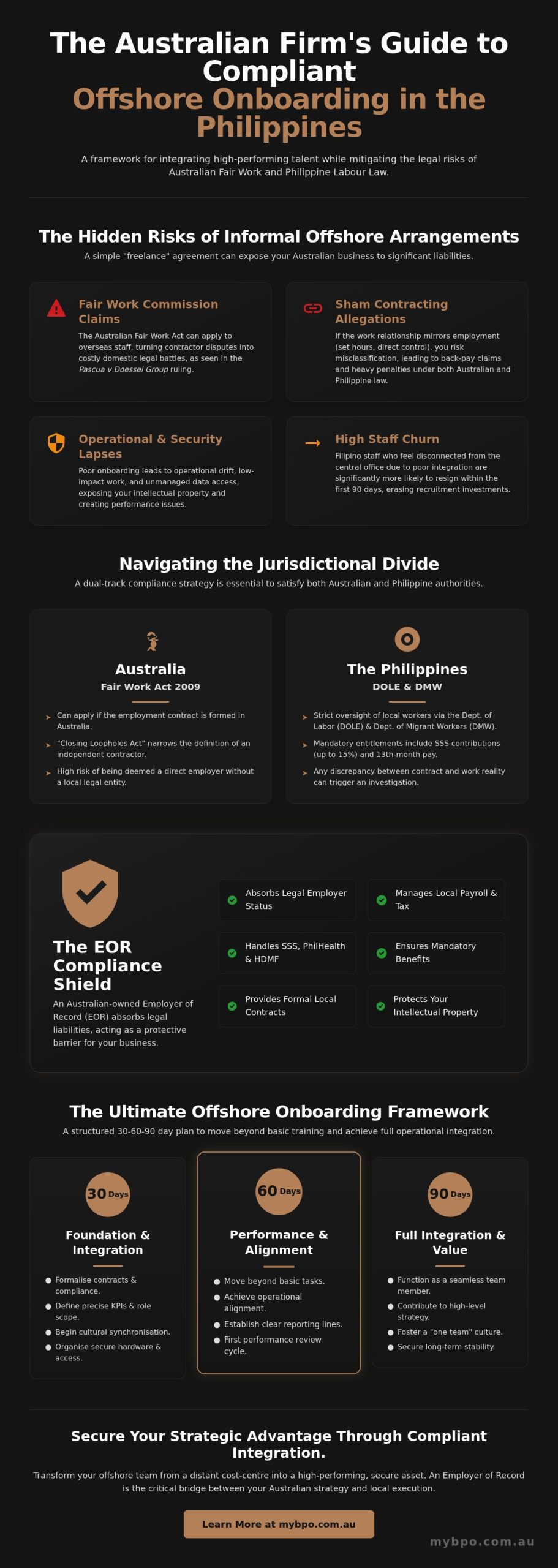
The Ultimate Offshore Onboarding Template (30-60-90 Days)
Successful offshore staff onboarding Philippines requires more than a simple login credential. It demands a structured “Calibration Period” where your Australian operational standards are meticulously mapped onto your new team member’s workflow. This 90-day framework ensures that the transition from a new hire to a fully integrated asset is both seamless and secure. By following a sequential roadmap, you mitigate the risk of performance drift and ensure that your offshore team member understands the professional gravity of their role from the outset. Before this phase begins, however, it is essential that your offshore recruitment Philippines process has already identified candidates who are aligned with both your operational requirements and compliance obligations.
Phase 1: The First 30 Days (Foundation)
The initial month is dedicated to establishing the technical and cultural foundation. On Day 1, prioritise technical setup and security orientation. This includes the deployment of pre-configured hardware through Equipment Leasing to ensure data remains within your controlled environment. A “Welcome to the Team” call establishes the human connection immediately, which is vital for remote integration. During the first week, conduct a deep dive into Australian company values and communication protocols. Whether you use Slack or Teams, you must establish clear expectations for response times and availability. By Week 4, conduct the first performance review. This serves as a critical “Cultural Fit” check-in to identify and rectify any early alignment issues before they become systemic.
Phase 2: Days 31-60 (Integration)
The second month focuses on the transfer of ownership. Your staff should move from observation to executing specific tasks and managing defined KPIs. Establishing a robust “Feedback Loop” between your Australian managers and the Philippine staff is vital during this stage. This period involves intensive training on internal software and organisational workflows to ensure the staff member operates within your specific business ecosystem. You are moving beyond the “how-to” and into the “why,” ensuring the team member understands their impact on the broader Australian operation.
Phase 3: Days 61-90 (Optimisation)
By the third month, the objective is full autonomy. Your team member should require minimal oversight for daily operations and begin contributing to process improvements. This is also the time to conduct a final review of statutory compliance and benefit enrolment status, ensuring all SSS, PhilHealth, and Pag-IBIG requirements are current and accurate. Use this phase to discuss long-term career pathing and retention strategies. A forward-looking approach secures your investment and fosters loyalty, transforming a remote worker into a long-term strategic partner. If you are ready to build a high-performing team with total peace of mind, contact us to secure your offshore team today.
Why an Australian-Owned EOR is Your Compliance Shield
Selecting an Australian-owned partner is the most effective way to secure your business against the jurisdictional complexities of international employment. While digital platforms offer a veneer of convenience, they frequently lack the legal depth required to protect an Australian firm from Fair Work scrutiny. MyBPO operates as your vigilant guardian, providing a physical bridge between your Australian operations and your Philippine workforce. This dual presence ensures that every aspect of offshore staff onboarding Philippines is conducted with a deep understanding of both Australian liability and local labour codes.
Our role as an advisory partner is to navigate these regulatory waters so you don’t have to. By maintaining a high level of professional gravity, we ensure that your cross-border operations are not just functional, but structurally sound. We establish a “safe harbour” for your business, allowing you to focus on growth while we manage the complexities of international compliance and human resource management.
Local Accountability, Global Reach
An Australian-based head office provides a layer of accountability that offshore-only providers cannot match. If a dispute arises, you’re dealing with an Australian entity bound by Australian commercial law. This structure allows MyBPO to absorb the complexities of Philippine labour law on your behalf. We manage the intricacies of SSS, PhilHealth, and Pag-IBIG contributions without exposing your firm to direct liability. Our physical representation across the Philippines ensures that your staff have immediate, on-the-ground support. This local presence is essential for maintaining morale and resolving operational issues before they escalate into legal risks.
Infrastructure and Equipment Leasing
The shift towards remote work has introduced significant security vulnerabilities for Australian firms. Relying on a “work from home” model in a foreign jurisdiction often leads to unmanaged hardware and insecure data access. Our comprehensive approach to offshore staff onboarding Philippines extends beyond mere paperwork to include the physical security of your operation. MyBPO mitigates these risks through Equipment Leasing and access to Dedicated Workspaces.
By providing managed IT support and professional office environments, we remove the inherent risks of domestic internet connections and unmonitored devices. This ensures that your intellectual property remains secure and your team operates with the efficiency of a local Australian office. We take on the burden of risk so you can experience operational freedom. To protect your business and empower your remote workforce, Secure your offshore team today with MyBPO.
Secure Your Strategic Advantage Through Compliant Integration
The transition from recruitment to operational reality is the point of highest risk for any Australian firm. By implementing a structured offshore staff onboarding Philippines, you transform a potential liability into a high-performing asset. A failure to synchronise local labour codes with Australian Fair Work standards doesn’t just hinder productivity; it creates a jurisdictional exposure that digital-only platforms cannot mitigate. Protecting your intellectual property and ensuring statutory compliance requires a partner who understands the professional gravity of cross-border employment.
MyBPO serves as your vigilant guardian, offering the security of an Australian-owned and operated entity with essential on-the-ground support in Manila and Bacolod. As specialists in both Fair Work and DOLE compliance, we absorb the burden of risk so you can focus on scaling your business with total peace of mind. Our physical infrastructure and dedicated workspaces provide a level of security that home-based models can’t match. Take the first step toward a secure, high-performing global team today.
Download our Offshore Onboarding Checklist and Secure Your Team
Building a global team is a significant milestone for your business. With the right compliance shield in place, you can lead your Philippine staff with confidence and achieve the operational excellence your firm deserves.
Frequently Asked Questions
Do I need to pay Australian Superannuation for staff in the Philippines?
You generally don’t need to pay Australian Superannuation for staff residing and working in the Philippines. Instead, you are required to contribute to the local Social Security System (SSS), which carries a total contribution rate of 15 per cent as of 2026. This ensures your business remains compliant with local labour codes while avoiding unnecessary Australian tax complexities.
How does the 13th-month pay work in the Philippines for Australian employers?
The 13th-month pay is a mandatory statutory benefit equivalent to one-twelfth of an employee’s basic annual salary. It must be paid to all rank-and-file employees on or before December 24 each year. It’s a legal requirement rather than a discretionary bonus; any amount up to ₱90,000 remains non-taxable for the employee.
Can I terminate an offshore employee if they are not performing?
Termination in the Philippines requires strict adherence to the “Just Cause” or “Authorised Cause” provisions of the Labour Code. You cannot terminate staff at will; you must follow a mandatory two-notice due process that includes a formal explanation and an opportunity for the employee to respond. Failure to follow this process exposes your firm to illegal dismissal claims.
What is the risk of sham contracting when hiring in the Philippines?
The risk of sham contracting is significant if your offshore staff are integrated into your daily operations and work under your direct supervision. Australian legislative changes, such as the Closing Loopholes Act, mean that misclassified contractors can be deemed employees by the Fair Work Commission. A structured offshore staff onboarding Philippines through an EOR model mitigates this by establishing a clear employment relationship.
Is my intellectual property protected when hiring staff via an EOR?
Your intellectual property is protected because EOR employment contracts include specific IP assignment clauses enforceable under Philippine law. Unlike freelance marketplaces where IP ownership can be ambiguous, an EOR ensures that all work product is legally transferred to your Australian entity. This provides a secure framework for firms handling sensitive data or proprietary systems.
What are the mandatory public holidays I need to provide for Philippine staff?
Philippine staff are entitled to Regular Holidays and Special Non-Working Days as mandated by the government. Regular holidays typically require 200 per cent pay if worked, while Special Non-Working days require 130 per cent. You must factor these into your payroll schedule during the offshore staff onboarding Philippines phase to ensure total compliance and maintain staff morale.
How much does it cost to onboard a new staff member in the Philippines?
Onboarding costs include statutory benefit registrations, initial equipment procurement, and administrative setup. While specific service fees vary, you must account for mandatory employer contributions to SSS, PhilHealth, and Pag-IBIG. Investing in professional Equipment Leasing and Dedicated Workspaces during this phase prevents the hidden costs associated with poor remote performance and data breaches.
Should I hire my offshore staff as contractors or employees?
You should hire through an EOR employee model to minimise jurisdictional liability and ensure long-term stability. While contractors may seem cheaper initially, they lack the legal framework to protect your firm from Australian Fair Work claims or Philippine labour disputes. The EOR model provides the only safe harbour for businesses that prioritise security and professional accountability. For a comprehensive overview of how to evaluate and select the right talent through a compliant process, review our guide on offshore recruitment Philippines strategies for Australian firms in 2026.
Need a strategy session?
Tell us about your team and we will map out the right structure, fixed-cost quote included.
Book a call