Blog
How to Hire a Filipino Software Developer: The 2026 Australian Compliance Guide

The Fair Work Commission has made its position clear: engaging overseas talent is no longer a “grey area” where Australian employment standards do not apply. If you intend to hire filipino software developer professionals in 2026, treating the arrangement as a casual freelance gig is a significant regulatory risk. You likely recognise that accessing the Philippines’ 200,000-strong developer pool is vital to solve the local talent shortage, but the threat of sham contracting penalties and intellectual property leakage is a heavy burden for any director to carry.
This guide establishes a rigorous compliance framework designed to protect your business while securing high-tier technical talent. We will outline how to navigate the current regulatory landscape, from Philippine labour laws to the essential role of an Employer of Record in absorbing your operational liability. By following this structured approach, you can integrate a high-performing offshore team that remains fully compliant, secure, and seamlessly aligned with your Australian operations. We provide the clarity you need to move from vulnerability to a position of structural integrity.
Key Takeaways
- Understand the impact of the Closing Loopholes Act 2025 and why traditional offshore contracting now poses a significant sham contracting risk to your organisation.
- Identify the strategic steps required to hire filipino software developer professionals who possess the technical seniority and cultural fit for Australian operations.
- Learn how to secure your intellectual property and maintain high productivity by moving beyond unmanaged home-office environments into dedicated workspaces.
- Discover why an Australian-owned Employer of Record (EOR) is the most effective way to absorb jurisdictional liability and manage Philippine payroll compliance.
- Implement a robust 5-stage recruitment framework to vet high-tier tech talent while eliminating common remote hiring vulnerabilities and skill-gap risks.
The 2026 Landscape: Why Australian Firms Hire Filipino Software Developers
The decision to hire filipino software developer talent is no longer a tactical cost-saving measure. It’s a strategic necessity for Australian firms facing a persistent local talent shortage. The mature Business process outsourcing (BPO) industry in the Philippines has evolved. It’s moved beyond simple task execution into a sophisticated ecosystem of high-tier engineering. In 2026, Manila and Bacolod stand as primary technical hubs. Manila provides scale and established infrastructure. Bacolod offers a stable, high-retention environment for long-term team building.
Operational friction often kills offshore initiatives. Choosing developers in Eastern Europe or India introduces significant lag due to time zone disparities. The Philippines shares a near-identical working day with Australia. This allows for real-time collaboration during your core business hours. Your local team and your offshore engineers can participate in the same daily stand-ups and sprint reviews without forcing anyone into graveyard shifts. It’s a natural corridor for Australian tech expansion.
We’ve seen the “virtual assistant” label disappear in the technical sector. Australian businesses now seek dedicated offshore engineers who function as integrated members of their internal dev teams. These aren’t gig workers. They are career professionals who expect structured environments and clear progression. They bring a level of commitment that project-based freelancers simply cannot match.
The Quality vs. Cost Equation
The narrative of “cheap labour” is outdated and dangerous for technical scaling. While monthly salaries for senior Filipino developers in 2026 typically range between ₱150,000 and ₱400,000 for international roles, the real value lies in technical depth. Senior engineers in the Philippines are now essential for Australian SaaS firms looking to scale without the prohibitive overheads of local recruitment. Retention is the new priority. Constant turnover in project-based models destroys momentum. A dedicated, long-term hire provides the continuity your codebase requires to remain stable and scalable.
Cultural Alignment and Communication
Communication failures are the leading cause of project delays. The Philippines maintains a high level of English proficiency and a business culture deeply aligned with Western standards. This synergy reduces the cognitive load on your Australian managers. Filipino developers often share the same agile work ethics found in Sydney or Melbourne tech hubs. This makes the integration process smoother. When you hire filipino software developer teams, you aren’t just buying hours. You are securing engineers who understand the “why” behind your user stories; this is critical for successful agile development cycles.
Step 1: Navigating the Compliance Minefield and Fair Work Risks
The regulatory environment for engaging international talent has tightened significantly in 2026. Australian directors must now contend with the Fair Work Act and the Closing Loopholes Act 2025, both of which have redefined the boundaries of employment relationships. If you hire filipino software developer staff through a direct contractor model, you may be inadvertently committing sham contracting. This occurs when a worker is classified as an independent contractor despite the relationship having the hallmarks of employment, such as fixed hours, company-provided equipment, and direct supervision. The financial consequences of this misclassification are no longer theoretical; they are a direct threat to your balance sheet. To maintain the same high standards for your domestic workforce, you can discover Persona Health for professional occupational health assessments and workplace injury management.
The Australia-Philippines relationship facilitates robust technical trade, yet it does not exempt your business from the specific jurisdictional requirements of either nation. An Employer of Record (EOR) model functions as the primary risk mitigation tool for AU-PH hiring by legally absorbing the employment liability in the Philippines. This structure allows you to scale your engineering team without the complexity of establishing a local foreign entity or risking direct legal conflict with the Department of Labour and Employment (DOLE).
The Danger of Misclassification
The ATO and the Fair Work Commission are increasingly vigilant regarding the status of offshore workers who function as integrated team members. If a Filipino developer is deemed an employee under Australian law, your firm could be liable for unpaid leave entitlements, superannuation, and significant payroll tax penalties. These risks are explored in depth in our analysis of Exposing the Sham Contracting Philippines Risk. Relying on informal payment platforms or direct international bank transfers to pay “contractors” offers zero protection against these regulatory audits and often serves as a red flag for authorities.
Philippine Labour Law (DOLE) Compliance
Philippine law mandates specific contributions for all employees, including the Social Security System (SSS), PhilHealth (medical insurance), and Pag-IBIG (Home Development Mutual Fund). Additionally, the 13th-month pay is a statutory requirement equivalent to one-twelfth of the basic salary, which must be paid by December 24th each year. Failing to provide these benefits or mismanaging a termination under Philippine jurisdiction can lead to expensive labour disputes and blacklisting. Engaging a professional Employer of Record service ensures these obligations are met automatically, protecting your reputation and your operational continuity.
Step 2: Vetting and Recruiting High-Performance Tech Talent
Securing elite technical talent in a competitive offshore market requires more than just a job posting. To hire filipino software developer professionals who will truly integrate into your local team, you must move beyond automated matching algorithms. High-tier engineers in the Philippines, particularly those with senior-level experience in React, Node.js, or PostgreSQL, are often passive candidates. They are already employed and require a proactive, human-centric approach to be moved. Relying on AI-driven platforms often results in a flood of low-quality applications that lack the specific cultural alignment necessary for Australian business success.
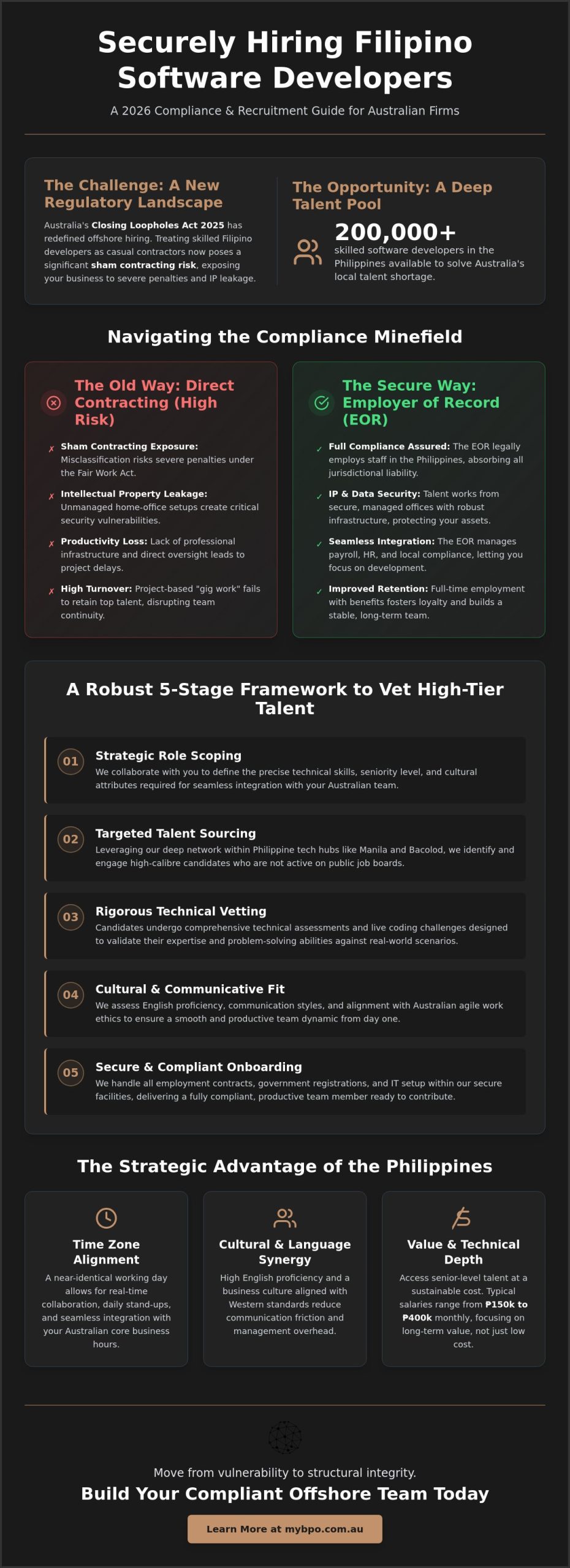
We recommend a structured 5-stage recruitment framework to ensure quality and long-term retention:
- Initial Sourcing and Portfolio Screening: Identifying candidates through local networks rather than just public job boards.
- Rigorous Technical Assessment: Using live coding environments or specific take-home projects to verify actual skill levels.
- Behavioural Interviewing: Assessing communication styles and the ability to work within Australian agile cycles.
- Client-side Deep-dive: A final technical interview with your internal leads to ensure stack compatibility.
- Background and Reference Verification: Confirming past contributions to protect your operational integrity.
This methodical approach filters out “CV padders” and identifies engineers who possess both the technical depth and the professional maturity to handle remote responsibilities. When you hire filipino software developer talent through a specialist recruitment service, you gain access to vetted talent pools that remain invisible to the average Australian firm.
Crafting an Irresistible Offer
Top-tier talent in 2026 knows their value. While monthly salaries for senior remote developers typically range from ₱150,000 to over ₱400,000, money is rarely the only factor. To secure the best, your offer must include comprehensive health insurance (HMO) for the employee and their dependents, alongside a clear budget for professional development. These benefits act as powerful retention tools in a market where headhunting is constant. For a deeper analysis of market rates and competitive positioning, consult our Offshore Recruitment Philippines: The 2026 Buying Guide.
Verifying Credentials and Background
Trust is the foundation of any offshore relationship, but it must be verified. Rigorous background checks are essential in the Philippines to confirm employment history and technical credentials. You must also ensure that your recruitment and data handling processes align with the Australian Privacy Principles (APP). Verifying technical references from previous Australian or international clients provides a reliable indicator of how the developer will perform under your specific management style. This vigilance prevents the costly mistake of hiring a candidate who looks excellent on paper but lacks the discipline required for high-stakes software engineering.
Step 3: Establishing Infrastructure and Operational Security
The “laptop and a dream” approach to remote work is a significant liability for Australian firms. Many organisations assume that if they hire filipino software developer talent, the individual’s home internet and personal computer will suffice for high-stakes engineering. This assumption ignores the physical reality of the Philippines’ infrastructure and the heightened data security requirements of 2026. A personal laptop is an unmanaged endpoint. If your developer’s hardware fails or is compromised, your intellectual property (IP) is immediately at risk, and your development velocity will stall.
Moving your technical team into a dedicated workspace provides the structural integrity that a home office lacks. These environments offer the physical security and technical redundancy required to maintain a professional standard of operation. When you provide managed hardware through equipment leasing, you maintain total control over the device’s security protocols and software environment. This proactive stance ensures that your proprietary code remains within a controlled ecosystem, even when accessed from thousands of kilometres away.
Reliability is another critical factor. While the Philippines has seen significant improvements in its digital infrastructure, residential areas remain susceptible to power fluctuations and connectivity drops. To mitigate these risks, your offshore operation should ideally include:
- Dual-ISP Redundancy: Ensuring that if one provider fails, the developer can switch to a secondary line immediately.
- Power Redundancy: Access to industrial-grade generators to bypass local “brownouts” that can otherwise derail a sprint.
- Managed Hardware: High-spec laptops provided via lease to ensure technical performance and rapid replacement in the event of failure.
Data Security and IP Protection
Endpoint security is the frontline of your IP protection strategy. By implementing enterprise-grade VPNs and strict endpoint management on leased devices, you can secure your digital assets against unauthorised access. A physical presence in the Philippines through a partner allows for the auditing of these security measures in real-time. You can learn more about these protocols in our guide on Dedicated Workspace Philippines: Securing Your Operations. This physical layer of protection is what separates a professional offshore team from a risky freelance arrangement.
Ensuring Productivity and Uptime
Productivity is directly tied to the stability of the working environment. Dedicated workspaces outperform home-based setups because they eliminate the distractions of a domestic setting while providing the high-speed connectivity required for heavy repository commits and video collaboration. Managing the hardware lifecycle is also simplified. If a leased laptop requires a repair or an upgrade, a local partner can handle the logistics immediately. This prevents the weeks of downtime that occur when an Australian firm tries to ship hardware across international borders. To ensure your team remains operational and secure, explore our dedicated workspace and equipment leasing solutions.
The MyBPO Advantage: Your Australian Partner for Secure Scaling
The complexities of cross-border employment require more than a digital platform; they demand a partner with local accountability and a physical presence. MyBPO functions as a dedicated compliance shield for Australian firms looking to hire filipino software developer talent. We recognise that the primary barrier to successful offshoring is the fear of regulatory misalignment. By choosing an Australian-owned and operated Employer of Record (EOR), you ensure that your offshore operations are governed by the same professional standards and legal expectations you maintain at home. We don’t just facilitate a transaction; we absorb the operational burden.
Our infrastructure in Manila and Bacolod provides your developers with the stability they need to perform at a high level. While you maintain direct control over your team’s technical output and sprint priorities, MyBPO manages the intricate details of Philippine payroll, mandatory benefits, and tax compliance. This includes the seamless administration of SSS, PhilHealth, and Pag-IBIG contributions, alongside the statutory 13th-month pay. We mitigate the risk of labour disputes by ensuring every engagement is fully compliant with the Department of Labour and Employment (DOLE) standards, protecting your brand from jurisdictional vulnerabilities.
We provide a comprehensive solution that combines recruitment, EOR services, and equipment leasing into a single, secure framework. This integrated approach eliminates the fragmentation that often leads to security gaps or productivity losses. If you hire filipino software developer professionals through MyBPO, they are supported by on-the-ground management that understands both the Australian business culture and the local Philippine landscape. This bridge-building allows your internal leads to focus on code quality and product roadmaps rather than administrative hurdles.
Local Accountability, Global Reach
Having a Brisbane-based leadership team means you have a local point of contact who is accountable under Australian business norms. We provide transparent pricing models that eliminate hidden compliance “surprises,” allowing for predictable scaling. Our expertise in navigating the intersection of Australian Fair Work requirements and Philippine labour codes is detailed in our Employer of Record Australia: The Definitive Guide. This local oversight ensures that your offshore expansion remains a strategic asset rather than a liability.
Next Steps: From Strategy to First Commit
Building an offshore engineering team should be a methodical process, not a rushed experiment. We offer a 30-day roadmap to guide you from initial consultation to your developer’s first commit. This process includes defining your technical stack, sourcing passive talent, and establishing the secure workspace infrastructure discussed in previous sections. To begin your transition to a high-performing, compliant offshore team, secure your offshore dev team with MyBPO today.
Securing Your Technical Future Through Structural Compliance
The decision to hire filipino software developer talent is a strategic move that requires a robust compliance shield to succeed in 2026. Transitioning from high-risk freelance arrangements to a structured Employer of Record model is the only way to mitigate the threat of sham contracting penalties. You’ve seen how physical infrastructure, such as dedicated workspaces and managed hardware, serves to secure your intellectual property and maintain development velocity. Ignoring these operational realities creates vulnerabilities that no amount of technical skill can compensate for.
As an Australian-owned and operated partner with a physical presence in Manila and Bacolod, we provide the jurisdictional expertise required to navigate both Fair Work and DOLE compliance. We absorb the legal and administrative burdens, allowing your team to focus on innovation. You can move forward with the confidence that your offshore expansion is protected by a specialist who understands the high stakes of international employment. Book a Compliance Audit for Your Offshore Hiring Strategy today and build your team on a foundation of structural integrity. We’re ready to help you scale securely.
Frequently Asked Questions
Is hiring a Filipino software developer as a contractor legal in Australia?
It is legal to engage a Filipino developer as a contractor, but it carries significant regulatory risks under the Fair Work Act. If the developer functions as an integrated team member with fixed hours and company equipment, the Fair Work Commission may reclassify the relationship as employment. This misclassification, known as sham contracting, can lead to substantial penalties and back-pay liabilities for Australian directors.
How much does it cost to hire a senior software developer in the Philippines in 2026?
Senior-level software developers in the Philippines generally command monthly salaries between ₱150,000 and ₱400,000 when working for international firms. These rates reflect the high demand for specialised technical stacks such as React and Node.js. If you intend to hire filipino software developer talent at this level, you must also factor in mandatory statutory benefits and the 13th-month pay to remain competitive and compliant.
What is the Closing Loopholes Act and how does it affect offshore hiring?
The Closing Loopholes Act 2025 is Australian legislation designed to prevent the misclassification of employees as independent contractors. It introduces a stricter “substance over form” test, meaning the actual nature of the daily work matters more than the written contract. If your offshore developers are treated like employees, Australian authorities can hold your organisation liable for local employment entitlements and payroll taxes.
Do I need to pay the 13th-month pay to my Filipino developers?
Yes, the 13th-month pay is a non-negotiable legal requirement under Philippine labour law for all rank-and-file employees. It is equivalent to one-twelfth of the employee’s basic salary earned within a calendar year and must be paid by December 24th. Failing to meet this obligation is a direct violation of Department of Labour and Employment (DOLE) regulations and can lead to formal labour disputes.
How do I protect my Intellectual Property when hiring offshore?
Protecting your Intellectual Property requires a combination of robust legal contracts and physical security layers. You should ensure that all IP assignment clauses are enforceable in both Australian and Philippine jurisdictions. Additionally, using managed hardware and dedicated workspaces prevents proprietary code from being stored on unmanaged personal devices, significantly reducing the risk of data leakage or unauthorised access.
What is the difference between a BPO and an Employer of Record (EOR)?
How do I handle Philippine payroll and mandatory tax contributions from Australia?
Handling Philippine payroll directly from an Australian entity is complex and often leads to non-compliance with local social security requirements. An EOR manages these mandatory contributions, including SSS, PhilHealth, and Pag-IBIG, on your behalf. This ensures that when you hire filipino software developer professionals, their taxes and insurances are paid correctly within their home jurisdiction, protecting your firm from international tax audits.
Can I provide equipment like high-end laptops to my developers in the Philippines?
Providing high-spec equipment is essential for software engineering, but shipping hardware from Australia involves prohibitive customs duties and logistical delays. Equipment leasing through a local partner is the most efficient solution. This allows you to deploy enterprise-grade laptops with pre-configured security protocols while ensuring that hardware repairs and upgrades are managed on the ground in Manila or Bacolod.
Need a strategy session?
Tell us about your team and we will map out the right structure, fixed-cost quote included.
Book a call