Blog
Philippines Non-Compete Guide 2026 for Australian Firms

Many Australian directors view non-compete clauses in the Philippines as little more than paper tigers, assuming that non-compete agreements philippines enforceability is an exercise in futility and exorbitant legal fees. It’s a common anxiety for firms looking to scale offshore; the fear that your proprietary systems or client lists could walk out the door to a local competitor is a heavy burden to carry. You’ve likely spent years building your business and don’t want to see that value eroded because of confusion between Philippine civil law and Australian Fair Work standards.
This guide will clarify the legal reality by explaining the specific “reasonableness” test used by Philippine courts to validate these covenants. You’ll gain a clear framework for protecting your intellectual property through structural safeguards rather than just relying on the hope of future litigation. We’ll examine the critical factors of time, trade, and geography that determine a clause’s validity, and how a local EOR partner acts as a compliance shield to secure your Australian interests on the ground.
Key Takeaways
- Understand why post-employment restrictions are governed by the Philippine Civil Code rather than the Labour Code, providing a unique framework for contractual autonomy.
- Master the specific “reasonableness” test regarding time, geography, and trade scope to ensure non-compete agreements philippines enforceability in local courts.
- Identify the critical regulatory differences between Australian Fair Work standards and Philippine law to avoid the risks of using generic, unenforceable contract templates.
- Learn how to apply the “Blue Pencil” doctrine and severability clauses to protect your intellectual property even if specific restrictions are legally challenged.
- Discover how partnering with an Australian-owned EOR provides a “compliance shield” and the physical presence in Manila or Bacolod required to make enforcement credible.
The Legal Landscape of Non-Compete Agreements in the Philippines
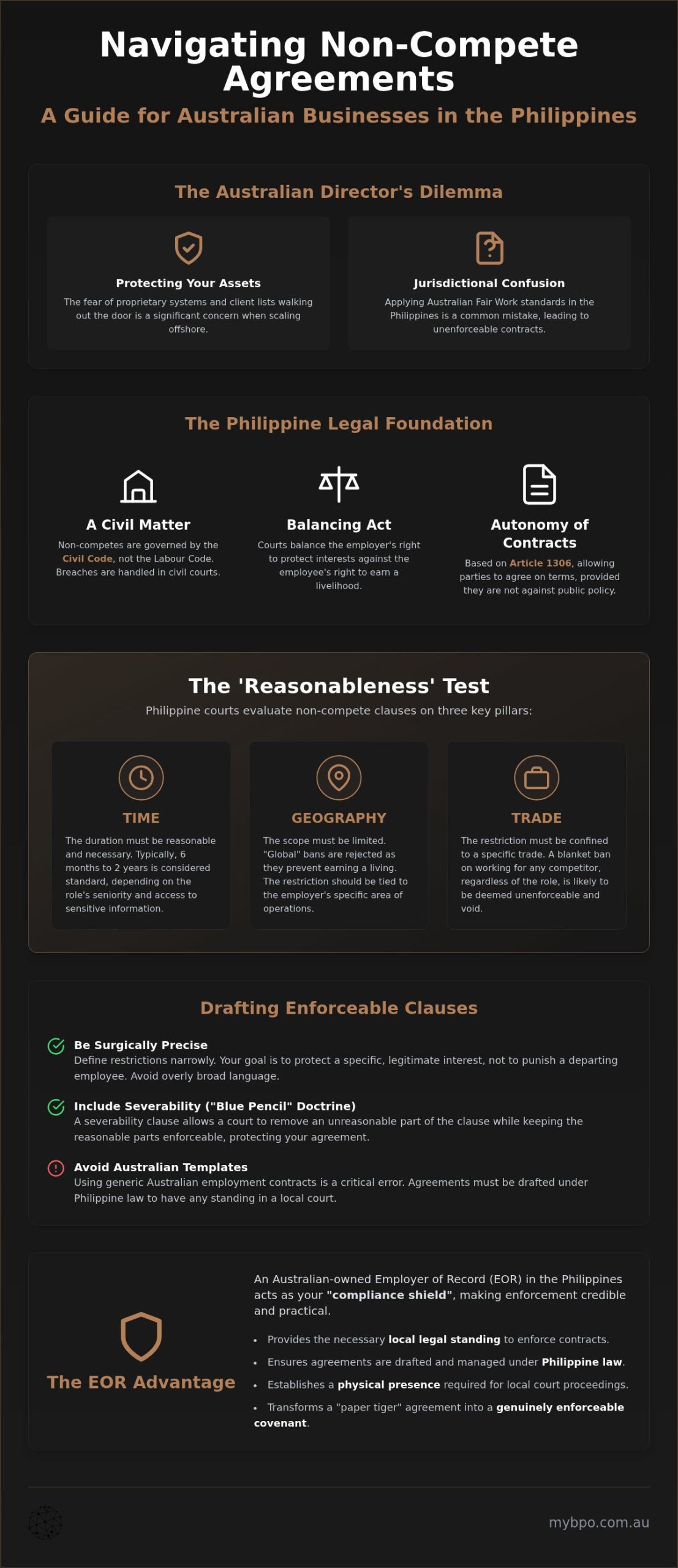
Philippine jurisprudence defines a non-compete clause as a “contract of restraint in trade,” a concept rooted in the broader legal doctrine of restraint of trade. Unlike the Australian system, where the Fair Work Commission often provides a centralised framework for employment disputes, the Philippines separates post-employment restrictions from standard labour regulations. The Philippine Labour Code is famously silent on non-compete clauses because these agreements are viewed as civil obligations rather than labour issues. This distinction is critical for Australian directors to understand; any breach of these terms is litigated in civil courts, not before a labour arbiter.
The foundation of these agreements lies in Article 1306 of the Philippine Civil Code, which establishes the principle of “Autonomy of Contracts.” This allows parties to negotiate any terms they deem necessary, provided those terms don’t violate law, morals, good customs, public order, or public policy. As a result, non-compete agreements philippines enforceability relies entirely on this civil law framework. There is a constant, inherent tension here. An Australian firm has a legitimate right to protect its proprietary systems and trade secrets, yet the Philippine state is constitutionally bound to protect the employee’s right to earn a livelihood. If a clause tips too far toward protecting the business at the total expense of the worker, it risks being struck down by the courts.
Freedom of Contract vs. Public Policy
Philippine courts don’t view a non-compete as an automatic right for the employer. While contractual freedom is respected, it’s always secondary to public policy. If a court determines a clause is “unconscionable” or serves as an absolute prohibition on work, it will be declared void. You cannot simply forbid a former staff member from working in their chosen field forever. A valid clause must be a surgical strike to protect a specific interest, not a blunt instrument used to punish a departing employee.
Jurisdictional Challenges for Australian Firms
Many Australian businesses make the mistake of assuming their standard Australian employment contracts will hold up in a Manila court. They won’t. Enforcing an Australian-law contract against a Filipino resident is a logistical and legal nightmare that often ends in failure. Local Philippine law almost always takes precedence in these disputes. Without a locally registered entity or a partner like an Employer of Record (EOR) to provide legal standing, your restrictive covenants are essentially unenforceable. Having a physical presence through an EOR creates a “compliance shield,” ensuring that your non-compete agreements philippines enforceability is grounded in local jurisdiction rather than abstract Australian standards.
The ‘Reasonableness’ Test: How Philippine Courts Determine Enforceability
Philippine courts don’t apply a rigid, one-size-fits-all rule to restrictive covenants. Instead, they rely on a judicial “reasonableness” test, a standard reaffirmed in the landmark case of Rivera v. Solidbank Corp. This test evaluates whether a restraint is necessary to protect the employer without being oppressive to the employee. For Australian firms, understanding non-compete agreements philippines enforceability requires looking at three specific pillars: time, geography, and the scope of activity. Establishing non-compete agreements philippines enforceability hinges on proving that the restriction is a surgical strike to protect a specific asset, not a blunt instrument used to control a career.
Courts consistently reject “Global” bans. Attempting to prevent a former staff member from working anywhere in the world is viewed as an unconscionable restriction on their right to earn a living. According to an analysis by L&E Global, the Philippines maintains a more tolerant stance toward restrictive covenants than some Western jurisdictions, but only when they are surgically precise. A restraint must not be greater than necessary to protect the legitimate business interests of the employer.
Time and Geographic Limitations
Determining a “reasonable” duration is a matter of judicial discretion. While there’s no statutory maximum, a two-year period has been upheld in cases like Tiu v. Platinum Plans Phil., Inc., specifically for senior employees with deep access to sensitive information. For most operational roles, six to twelve months is considered a safer, more defensible window. Geographically, you should avoid “National” bans unless the business truly operates across all 7,641 islands. In a remote-first economy, it’s more effective to define the territory by specific provinces or by naming direct competitors within a specific industry niche.
Defining Legitimate Business Interests
You cannot protect “general skills” acquired during employment. You can, however, protect trade secrets, proprietary software, and confidential client lists. Proving that a business interest is “legitimate” often requires showing that you’ve taken active steps to secure that data. This is where physical infrastructure becomes a legal asset. Utilising dedicated workspaces in the Philippines provides tangible evidence that your trade secrets are kept within a controlled, secure environment. This structural safeguard makes it much harder for an employee to argue that the information was general knowledge. If you’re concerned about the integrity of your offshore contracts, securing your operations through a local EOR is the most reliable way to ensure these clauses carry actual weight.
Australian vs. Philippine Post-Employment Restraints: Key Differences
Australian business owners face a widening gap between domestic workplace standards and the legal realities of their offshore operations. In Australia, the regulatory trajectory in 2026 has shifted aggressively toward limiting non-compete clauses for lower-income earners to encourage job mobility. Conversely, the Philippines maintains a firm stance on “contractual integrity,” where restrictive covenants remain entirely valid if they meet the reasonableness criteria discussed previously. This divergence creates a significant risk for firms that attempt to apply a “one-size-fits-all” contract across both jurisdictions. Understanding non-compete agreements in the Philippines requires accepting that local courts prioritise the sanctity of the written agreement over the Australian focus on employee flexibility.
The cultural expectation within the Philippine BPO sector also differs from the Australian market. Filipino professionals, particularly in high-value roles, expect and respect non-compete terms as a standard component of professional engagement. However, the legal weight of these terms depends on how they are structured within the local framework. For Australian firms, the Closing Loopholes Act affects offshore workers by increasing the scrutiny on how these staff are classified. If you treat a Filipino worker as an independent contractor to avoid local labour laws, you effectively undermine your ability to enforce any restrictive covenants in a Philippine court.
Navigating the 2026 Regulatory Environment
Australian managers often fall into the trap of copy-pasting Fair Work-compliant clauses into their Philippine contracts. This is a dangerous oversight. While Australia focuses on job mobility, the Philippines rewards precise contractual drafting. Attempting to bypass local standards through “sham contracting” doesn’t just invite tax penalties; it renders your IP protection worthless. If the underlying employment relationship is legally flawed, the non-compete clause built upon it will collapse under judicial review. Ensuring non-compete agreements philippines enforceability is only possible when the employment structure itself is beyond reproach.
Litigation Reality: AU vs. PH Courts
Litigation in the Philippines is rarely a swift process. It’s often a war of attrition that can drain resources and time. While the National Labour Relations Commission (NLRC) handles standard labour disputes like illegal dismissal, breaches of non-compete clauses are civil matters. This means you’ll be navigating the regular court system, where cases can linger for years. Prevention via an Australian-owned EOR is far more cost-effective than attempting a “cure” in a Manila courtroom. By establishing a local presence and clear jurisdictional standing, you mitigate the risk before it ever reaches a judge. Relying on non-compete agreements philippines enforceability as your only line of defence is a high-risk strategy; a structural shield is always superior.
Drafting Enforceable Restrictive Covenants for Offshore Teams
Precision in drafting is the only way to ensure non-compete agreements philippines enforceability when your operations cross jurisdictional lines. Australian directors often rely on the “Blue Pencil” doctrine, assuming a judge will simply strike out an invalid sentence while leaving the rest of the contract intact. In the Philippines, this is a high-risk gamble. While courts may occasionally sever illegal provisions, they’re just as likely to void an entire clause if it’s deemed unconscionable or overly broad. You must draft for severability from the outset, ensuring that one aggressive line doesn’t bring down your entire intellectual property defence.
Another critical factor is the concept of “consideration.” While the offer of employment itself is generally viewed as sufficient consideration for a non-compete in the Philippines, providing a specific financial benefit linked to the restraint can significantly strengthen your position. This is particularly true for senior roles. If a court sees that an employee was specifically compensated for their agreement not to compete, the argument that the restraint is “oppressive” becomes much harder for the defence to maintain. You should tailor every clause to the specific role; a blanket two-year ban for a junior virtual assistant is rarely defensible, whereas the same restriction for a lead software architect is often viewed as a reasonable necessity.
Best Practices for Clause Construction
Successful protection often involves using non-solicitation clauses as a primary layer of defence. These are frequently easier to enforce than full non-competes because they don’t prevent the individual from working; they merely stop them from poaching your clients or staff. When defining a “competitor,” avoid broad industry terms like “any financial services firm.” Instead, use surgical precision to name specific types of entities or even a list of direct competitors. This level of detail demonstrates to a judge that the restraint is no greater than necessary to protect your specific interests. Always anchor these restrictions to robust confidentiality and IP assignment terms to create a multi-layered security net.
The Role of Onboarding in Enforcement
The timing of the signature is just as important as the text itself. Contracts must be executed before the employee is granted access to your sensitive Australian systems or client databases. If you provide access first and ask for a signature later, the employee can argue they were pressured into signing under duress to keep their job. Transparency also matters. Use plain English to ensure the staff member fully understands the gravity of the restrictions they’re accepting. During the process of offshore recruitment in the Philippines, vetting for integrity is your first line of defence. A contract is a deterrent, but hiring the right person is the ultimate safeguard. If you want to ensure your contracts are built on a foundation of total compliance, partner with MyBPO to secure your offshore employment agreements.
Beyond the Paper: How an Australian EOR Secures Your Intellectual Property
A restrictive covenant is only as effective as the infrastructure supporting it. While earlier sections detailed the legal mechanics of non-compete agreements philippines enforceability, the practical reality is that an Australian firm often lacks the physical reach to hold a departing employee accountable. This is where an Australian-owned Employer of Record (EOR) creates a “safe harbour.” By acting as the local employer of record, MyBPO absorbs the legal complexity and provides the jurisdictional standing necessary to make a contract more than just a list of wishes. We act as your compliance shield, ensuring that the relationship is governed by Philippine law while reflecting Australian business integrity.
The value of a physical presence in Manila and Bacolod cannot be overstated. When an employee knows their employer has a local office, local HR staff, and a registered legal presence, the psychological deterrent against breaching a restrictive covenant is significantly higher. It moves the threat of enforcement from an abstract Australian email to a concrete local reality. We manage the local relationship, allowing you to focus on growth while we mitigate the risks of IP theft or client poaching. This “jurisdictional bridge” ensures your Australian standards aren’t lost in translation.
The MyBPO Advantage: On-the-Ground Protection
Operational security extends far beyond the text on a page. MyBPO manages the physical asset lifecycle, ensuring that laptops and sensitive hardware are recovered and wiped immediately upon the conclusion of employment. If a poaching issue arises, our local HR team intervenes immediately, often resolving the dispute through mediation before it ever requires a civil court filing. For smaller firms, an Employer of Record in Australia with a physical Philippine footprint is the only secure pathway to offshore expansion. It provides the structural integrity that a remote, direct-hire model simply cannot match.
Mitigating Risk Through Managed Infrastructure
Controlling the environment is just as vital as controlling the contract. Using dedicated workspaces allows you to restrict the flow of information to a secure, professional setting rather than a home office where oversight is impossible. This professional environment fosters a culture of loyalty and accountability, which is your best defence against turnover and IP leakage. A local employer who understands both worlds provides a sense of stability that keeps staff engaged and compliant. If you are ready to build a protected, compliant workforce, secure your offshore team with MyBPO’s EOR services today.
Securing Your Australian Interests in the Philippines
The path to non-compete agreements philippines enforceability requires a shift from abstract legal hope to concrete structural protection. Philippine courts respect contractual autonomy but demand surgical precision in how restraints are defined. You can’t rely on generic templates or Australian Fair Work standards to protect your proprietary data in a foreign jurisdiction. Success depends on balancing reasonable limitations with a robust local presence that makes your contractual terms defensible and credible.
MyBPO provides the essential bridge between Australian business standards and Philippine regulatory reality. As a Brisbane-based, Australian-owned specialist with physical offices in Manila and Bacolod, we act as your local compliance shield. We absorb the risks of cross-border employment while ensuring your intellectual property remains secure through managed infrastructure and expert oversight. It’s better to build a secure foundation from day one than to risk your firm’s future in a Manila courtroom.
Secure your Australian business interests with MyBPO’s expert EOR services and scale your offshore team with total confidence.
Frequently Asked Questions
Are non-compete agreements legally binding in the Philippines for 2026?
Yes, non-compete agreements remain legally binding in the Philippines through 2026 under the principle of contractual autonomy. While the Labour Code is silent on post-employment restraints, Article 1306 of the Civil Code allows parties to establish any terms they wish, provided they don’t violate public policy or morals. non-compete agreements philippines enforceability is determined by civil courts rather than labour tribunals.
What is the maximum duration for a non-compete clause in the Philippines?
There’s no statutory maximum duration, but Philippine jurisprudence generally caps “reasonable” restraints at two years for senior executives with deep access to trade secrets. For standard operational roles, a six-to-twelve-month window is far more defensible in court. If a duration is deemed excessive or oppressive, a judge may void the entire provision rather than simply shortening it.
Can an Australian company sue a Filipino worker for breach of contract?
Suing a Filipino worker directly from an Australian entity is a complex and often futile exercise. Philippine civil courts maintain jurisdiction over local residents, and without a locally registered entity or an EOR partner, an Australian firm lacks the necessary legal standing to litigate effectively. Partnering with an EOR provides the local presence required to make enforcement threats credible and actionable.
What happens if a non-compete clause is found to be ‘unreasonable’ by a Philippine court?
If a court deems a clause unreasonable, it’s typically declared null and void in its entirety. While some jurisdictions allow judges to “blue pencil” or edit an invalid clause, Philippine courts are prone to striking the whole restriction if it’s found to be unconscionable. This risk makes precise, conservative drafting essential to avoid losing all protection due to one overly aggressive sentence.
Is a non-solicitation agreement easier to enforce than a non-compete in the Philippines?
Non-solicitation agreements are generally easier to enforce because they’re less restrictive on an individual’s ability to earn a livelihood. They don’t prevent the person from working in their chosen field; they merely prohibit the poaching of your clients or staff. This lower level of restraint often passes the judicial “reasonableness” test more easily than a total ban on competition.
Do I need to pay an employee extra for signing a non-compete agreement?
You aren’t legally required to provide additional compensation specifically for a non-compete, as the initial offer of employment is considered sufficient consideration. However, providing a specific financial benefit or bonus linked to the restraint significantly strengthens your legal position. It demonstrates to a judge that the employee was fairly compensated for the limitation on their future mobility.
How does using an EOR like MyBPO help with IP protection?
MyBPO secures your intellectual property by acting as a “compliance shield” with a physical presence in Manila and Bacolod. We manage the local employment relationship, facilitate the recovery of hardware at the end of a contract, and provide the jurisdictional standing required for enforcement. This structure ensures that non-compete agreements philippines enforceability is grounded in local legal reality.
What geographic scope is considered ‘reasonable’ for an offshore developer?
A reasonable geographic scope should be limited to specific provinces or named direct competitors rather than a “Global” or “National” ban. In a digital economy, courts look for restrictions that protect a specific, legitimate market interest. If you attempt to bar a developer from working anywhere in the world, the clause will likely be struck down as an oppressive restraint on trade.
Need a strategy session?
Tell us about your team and we will map out the right structure, fixed-cost quote included.
Book a call