Blog
EOR vs BPO: Choosing the Best Global Hiring Model
The traditional BPO model you have relied on for years might actually be the single biggest threat to your Australian company’s legal standing. While many directors assume that outsourcing tasks automatically offloads their liability, the reality under evolving Australian labour laws is far more complex. You want the significant cost advantages of scaling in the Philippines, but the looming shadow of “sham contracting” investigations and Fair Work penalties creates a justified sense of hesitation. It is a high-stakes environment where a simple administrative oversight can lead to severe financial consequences.
We understand that maintaining your team culture and protecting your intellectual property are non-negotiable priorities. This guide examines the critical EOR vs BPO distinction to help you secure your operations against modern compliance risks. You will discover how an Employer of Record functions as a robust compliance shield, absorbing jurisdictional hazards while providing the transparency you need to grow with confidence. We will break down the mechanics of risk mitigation, payroll integrity, and the structural differences that determine whether your offshore venture is a strategic asset or a legal ticking clock.
Key Takeaways
- Understand the legal implications of the Closing Loopholes Act 2025/2026 to mitigate risks associated with offshore worker misclassification.
- Navigate the EOR vs BPO landscape to determine which model provides the necessary compliance shield for your Australian entity.
- Learn how to secure your intellectual property and maintain direct influence over your team culture through the EOR framework.
- Gain full visibility into your payroll costs by moving away from opaque BPO markups and towards a transparent management fee structure.
- Establish a clear decision framework to choose between building a high-quality, dedicated team or outsourcing simple, repetitive processes.
Defining the Models: What is the Difference Between EOR and BPO?
Selecting a global hiring model requires more than a simple cost comparison. It is a fundamental decision regarding where legal accountability rests and who directs the daily work. The distinction between an Employer of Record and Business Process Outsourcing determines whether you are building an internal capability or simply purchasing a finished service. It is the difference between investing in talent and procuring a commodity.
The EOR Mechanism: Your Legal Shield
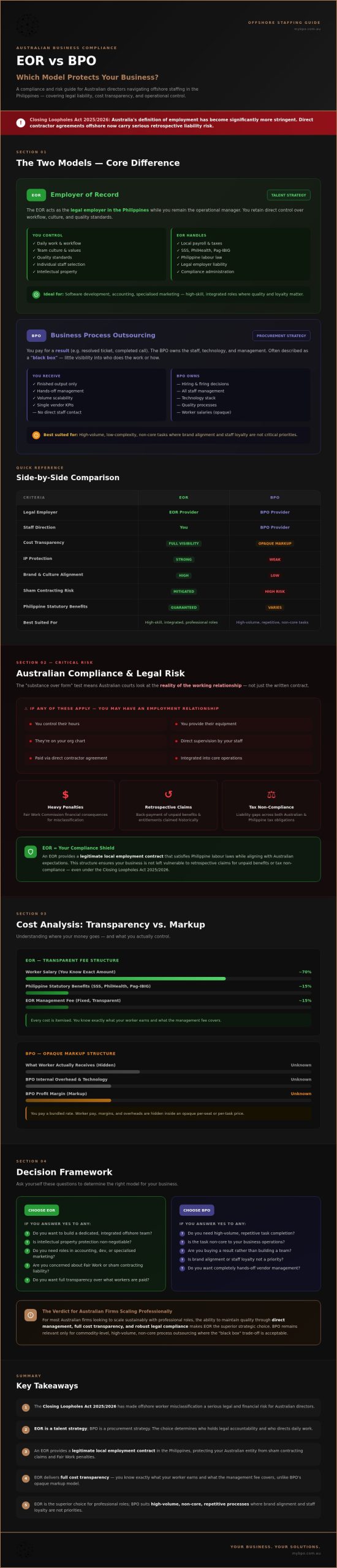
An Employer of Record acts as the legal employer in the Philippines while you remain the operational manager. In this tripartite arrangement, the EOR handles the heavy lifting of local compliance. This includes managing payroll, distributing taxes, and ensuring all Philippine statutory benefits, such as SSS, PhilHealth, and Pag-IBIG, are paid correctly and on time.
Because the EOR absorbs the employer’s legal risks, it functions as a compliance shield for your Australian entity. You retain direct control over the employee’s workflow, culture, and quality standards. This makes the model ideal for high-skill roles like software development, accounting, or specialised marketing. You aren’t just buying an output; you’re hiring a team member who happens to live offshore. It’s a transparent relationship where you know exactly what the worker is paid and what the management fees cover.
The BPO Mechanism: Managed Services
Business Process Outsourcing operates on a different logic. It is a procurement strategy where you pay for a result, such as a resolved customer ticket or a completed telemarketing call. The BPO provider owns the entire process, including the staff, the technology, and the management layer. They are responsible for the “how” and the “who,” while you focus only on the final delivery.
This is often described as a “black box” operation. You have little to no visibility into who is performing the work or how they are being managed. While this hands-off approach suits high-volume, low-complexity tasks, it often leads to a disconnect in brand alignment. If the provider meets their KPIs, they’ve fulfilled their contract. This remains true even if the staff feel no loyalty to your Australian brand or if the turnover rate is high.
When evaluating EOR vs BPO, the decision usually pivots on the level of control you require. Consider these two distinct paths:
- EOR is a talent strategy: Choose this when you want to integrate offshore staff into your core business operations and protect your intellectual property.
- BPO is a procurement strategy: Choose this when you want to offload a repetitive, non-core task to a third party and don’t require direct management of the individuals.
It’s vital to identify your core objective before signing a contract. Are you buying a result or building a team? For most Australian firms looking to scale sustainably, the ability to maintain quality through direct management makes EOR the superior choice for professional roles.
Compliance and Risk: The Australian Regulatory Perspective
Australian directors can no longer afford to ignore the jurisdictional nuances of offshore staffing. With the introduction of the Closing Loopholes Act 2025 and subsequent 2026 updates, the definition of employment has become significantly more stringent. If your Philippine-based team members operate under your direct supervision, they may be classified as employees under Australian standards. This creates a substantial liability gap for businesses that rely on direct contractor agreements.
When comparing EOR vs BPO, the primary concern for an Australian director should be the mitigation of sham contracting claims. Hiring “contractors” directly in the Philippines is a dangerous gamble; if the Fair Work Commission determines the relationship is one of employment, your firm faces heavy penalties. An EOR provides a legitimate local employment contract that satisfies Philippine labour laws while aligning with Australian expectations. This structure ensures that your business is not left vulnerable to retrospective claims for unpaid benefits or tax non-compliance.
Fair Work and Offshore Staff: Where the Lines Blur
Understanding the legal vulnerabilities of offshore hiring is essential for long-term stability. Australian courts and tribunals are increasingly applying a “substance over form” test. This means they look at the reality of the daily working relationship rather than just the written words in a contract. If you control the worker’s hours, provide their equipment, and integrate them into your organisational chart, they are likely employees. To navigate these complexities safely, you should consult our detailed resource on How to Hire in the Philippines Legally: The 2026 Australian Business Guide.
Protecting Your Intellectual Property (IP) and Data
The security of your intellectual property is often compromised in a traditional BPO setting. In these “black box” environments, staff may be rotated between different client accounts, or work in shared spaces where data privacy is difficult to enforce. This lack of transparency creates an unacceptable risk for Australian firms handling sensitive client data or proprietary code.
The EOR model addresses these concerns by providing dedicated workspaces and equipment leasing. Because the staff are legally assigned to your company, the employment contracts specifically secure all IP rights for your Australian entity from day one. You aren’t just trusting a provider’s internal policy; you’re establishing a direct, legally enforceable chain of ownership. For a comprehensive understanding of how to build a legally enforceable security framework that meets Australian privacy standards, our guide on managing data security with Philippine EOR staff outlines the physical and digital controls required to protect your business. As an Australian-owned partner, we act as your compliance shield on the ground, ensuring that your physical and digital assets remain protected under a structure designed for Australian business standards.
Talent, Culture, and Operational Control
Operational control is the primary casualty of traditional outsourcing. When you engage a BPO, you are effectively handing over the reins of your company culture to a third party. This hands-off approach often results in a dilution of brand standards and a disconnect between your Australian headquarters and your offshore team. If you want a team that thinks and acts like an extension of your local office, you must retain the ability to manage them directly.
The recruitment strategy within the EOR vs BPO framework highlights a stark contrast in quality. An EOR allows you to hand-pick your “A-team” through a rigorous recruitment process, ensuring every hire aligns with your specific business etiquette and expectations. Conversely, BPO providers typically assign staff based on their own internal availability. This leads to a lack of ownership and lower retention rates, as workers feel more connected to the service provider than to your Australian mission. Building long-term loyalty requires the worker to feel like a valued member of your organisation, not just a task-oriented resource.
The “Human-in-the-Loop” Factor in 2026
As we move into 2026, the integration of AI into business processes requires a sophisticated “human-in-the-loop” approach. You cannot simply automate complex tasks; you need dedicated virtual assistants who possess the critical thinking skills to oversee these AI workflows. An EOR model facilitates this by allowing you to train staff in your proprietary systems and Australian standards. This direct oversight ensures that performance remains high and that your offshore team can navigate the nuances of your specific industry with the same precision as your local staff.
Dedicated Workspaces vs. Work-from-Home
Maintaining operational excellence in the Philippines requires more than just a laptop and an internet connection. Relying on a work-from-home model exposes your business to significant risks, including frequent power outages and unstable residential internet. These disruptions can cripple your uptime and compromise data security. Establishing a dedicated workspace in the Philippines provides the professional infrastructure needed to secure your operations. With on-the-ground support and equipment leasing, you ensure that your team has the physical environment required to meet Australian security and productivity benchmarks. This structural integrity is a hallmark of a mature global hiring strategy.
Cost Analysis: Transparency vs. Markup
Financial clarity is often the first casualty in global hiring. When comparing EOR vs BPO, the sticker price rarely tells the full story of your investment. A traditional BPO quote might appear lower at first glance, but it often conceals a “BPO tax” consisting of significant markups on infrastructure and management layers that don’t benefit the worker or your business. To build a sustainable offshore operation, you need a model that prioritises transparency over opaque margins.
Calculating the Total Cost of Ownership (TCO) requires you to look beyond the monthly invoice. You must factor in the long-term expenses of recruitment, equipment leasing, and compliance insurance. If a provider cannot give you a line-by-line breakdown of where your money is going, they’re likely absorbing a portion of the worker’s intended salary as additional profit. This lack of transparency doesn’t just affect your budget; it undermines the stability of your team.
Hidden Costs in the BPO Model
The true cost of a BPO model is frequently buried in high staff turnover. In a managed service environment, workers often feel like interchangeable parts. This leads to attrition rates that force your business into a cycle of constant retraining and lost productivity. You pay for this instability through recruitment fees and the time your Australian managers spend onboarding new staff. There’s also the “BPO markup” on overheads, where you pay a premium for a shared office environment that provides little actual security for your specific data or intellectual property.
The EOR Advantage: Open-Book Payroll
An EOR model operates on an “open-book” basis, providing complete visibility into every cent spent. You see the base salary, the management fee, and the non-negotiable Philippine compliance costs. This includes mandatory items like the 13th Month Pay, which is a statutory requirement where employees receive an additional month’s salary, and contributions to SSS, PhilHealth, and Pag-IBIG. Understanding how payroll in the Philippines for Australian companies works allows you to budget with precision and avoid hidden surprises.
By choosing a transparent fee structure, you ensure that your investment is actually reaching the talent driving your business. This level of detail protects your bottom line and ensures that your offshore team is fairly compensated, which is the most effective way to secure long-term loyalty and high-quality performance. If you are ready to secure your financial operations with a partner who understands the AU-PH corridor, you can request a transparent cost breakdown to see the difference for yourself. This proactive approach to budgeting eliminates the “black box” of traditional outsourcing and puts you back in control of your global hiring costs.
Decision Framework: Which Model Suits Your Business?
Selecting the correct hiring model is a declaration of your company’s risk tolerance and strategic intent. The choice between EOR vs BPO should not be based on the lowest monthly invoice; it must be based on where you want the legal and operational control to sit. If your objective is to build a high-quality, long-term team that mirrors your Australian culture, the EOR model is the only logical path. It allows you to retain full control over your intellectual property while we manage the complex compliance requirements on the ground.
Conversely, a BPO model is appropriate only when you have a simple, repetitive process and don’t care who performs the task, provided the KPI is met. For many Australian firms, a hybrid approach offers the best of both worlds. They use an EOR for core functions like accounting or development and BPO for seasonal, high-volume overflow. However, for professional roles, an Australian-owned EOR provides the ultimate “Safe Harbour” for offshore expansion, protecting your directors from the fallout of mismanaged international labour. Some businesses also consider setting up a local entity in the Philippines to gain total operational control, though this path carries significant capital requirements and administrative burdens that an EOR model can help you avoid.
The 5-Point Selection Checklist
To determine which model aligns with your operational goals, evaluate your business against these five critical criteria. If you find your requirements leaning towards security and control, the EOR framework is the necessary choice.
- Risk Appetite: Are you prepared to manage the potential Fair Work and sham contracting penalties associated with direct contractor models?
- Management Capacity: Does your internal team have the bandwidth to provide direct, daily oversight to your offshore staff?
- Technical Complexity: Do the roles require specialised skills that cannot be easily commoditised by a third-party manager?
- IP Sensitivity: Is your proprietary data too valuable to be handled in a shared, “black box” BPO environment?
- Cultural Alignment: Is it essential that your offshore team understands and adopts your Australian business etiquette?
Partnering with MyBPO: Your Vigilant Guardian
MyBPO acts as your compliance shield, bridging the gap between Australian expectations and Philippine reality. We combine the accountability of an Australian-owned entity with a physical presence that provides on-the-ground support for your workforce. This ensures your team is not just a list of names on a screen, but a secured operation backed by professional infrastructure and equipment leasing. We take on the burden of jurisdictional risk so you can scale with the confidence of a seasoned expert. You can secure your offshore expansion with MyBPO EOR services today and establish a team that is built for longevity and total compliance.
Securing Your Strategic Future in the AU-PH Corridor
The decision between EOR vs BPO is ultimately a choice between building a resilient internal asset or managing a detached third-party service. You’ve seen how the EOR model acts as a compliance shield, protecting your Australian entity from the legal repercussions of the Closing Loopholes Act 2025/2026. By retaining direct operational control and utilising dedicated physical infrastructure, you ensure your intellectual property remains secure while your team culture stays aligned with your local standards.
As an Australian-owned and operated specialist, MyBPO provides the local expertise and on-the-ground support needed to navigate these complexities safely. It’s time to move beyond the uncertainty of traditional outsourcing and establish a transparent, high-performance team. Book a Compliance Audit for Your Offshore Strategy with MyBPO to verify your current structure and mitigate future risks. Scaling your business shouldn’t mean compromising your legal safety. With the right partner, you can grow with absolute confidence.
Frequently Asked Questions
What is the primary difference between EOR and BPO for an Australian company?
The primary difference between EOR vs BPO lies in the level of operational control and legal accountability. In an EOR model, you retain direct management of your staff, while the provider handles the administrative and legal employment duties. A BPO, however, manages the entire process and output, often leaving you with little visibility into who is performing the work. This makes EOR a talent strategy and BPO a procurement strategy.
Does using an EOR in the Philippines protect me from sham contracting laws in Australia?
Yes, an EOR serves as a robust compliance shield against sham contracting investigations. By establishing a legitimate local employment contract through a registered Philippine entity, you avoid the legal vulnerabilities of hiring “contractors” directly. This structure ensures that your Australian firm is not seen as the direct employer under Fair Work, effectively mitigating the risks associated with the Closing Loopholes Act 2025/2026.
Who is the legal employer of staff hired through an EOR?
Under an EOR arrangement, the legal employer is the Philippine-registered entity that manages the local payroll and statutory compliance. While they hold the employment contract, you maintain the “right of control” over the employee’s daily tasks and performance. This tripartite relationship allows you to integrate the worker into your company culture while the EOR absorbs the jurisdictional risks and administrative burdens of international labour law.
Can I move my team from a BPO to an EOR model later?
Transitioning from a BPO to an EOR model is entirely possible and often necessary as your business matures. This process involves migrating existing staff to new employment contracts and ensuring that all intellectual property rights are correctly assigned to your Australian entity. Making the switch allows you to regain direct influence over work quality and employee loyalty, which are frequently compromised in a managed service BPO environment.
Is an EOR more expensive than a BPO for a small Australian business?
While a BPO may offer a lower initial quote, an EOR is often more cost-effective when you factor in the Total Cost of Ownership. BPOs frequently apply hidden markups to staff salaries and infrastructure. An EOR provides an open-book fee structure, giving you full visibility into compensation and statutory costs. For a small Australian business, the EOR vs BPO comparison shows that transparency prevents budget blowouts and ensures you pay for talent rather than provider margins.
How does MyBPO handle data security and equipment for offshore staff?
MyBPO manages data security through dedicated workspaces and professional equipment leasing. Unlike work-from-home models, our physical infrastructure provides a controlled environment with enterprise-grade security protocols and redundant power systems. This setup protects your sensitive information and ensures maximum uptime. By providing your team with high-quality hardware and a secure office, we mitigate the operational risks that often plague traditional offshore staffing arrangements.
What are the mandatory employer contributions in the Philippines for 2026?
Mandatory contributions in the Philippines for 2026 include the 13th month pay, Social Security System (SSS), PhilHealth, and Pag-IBIG (Home Development Mutual Fund). These are non-negotiable statutory requirements that must be handled with precision to avoid local labour disputes. An EOR ensures these payments are calculated accurately and distributed on time, providing you with the peace of mind that your offshore operations remain fully compliant with Philippine law.
Why should I choose an Australian-owned EOR provider over a local Philippine BPO?
Choosing an Australian-owned provider ensures that your partner understands the specific risks you face under the Fair Work Act and the Closing Loopholes Act. Local Philippine BPOs often lack the jurisdictional context to protect your Australian directors from liability. MyBPO provides a “safe harbour” by offering local support in both countries, ensuring that your global hiring strategy is built on a foundation of Australian accountability and Philippine operational expertise.
Need a strategy session?
Tell us about your team and we will map out the right structure, fixed-cost quote included.
Book a call