Blog
13th Month Pay Philippines Compliance: A Guide for Australian Firms

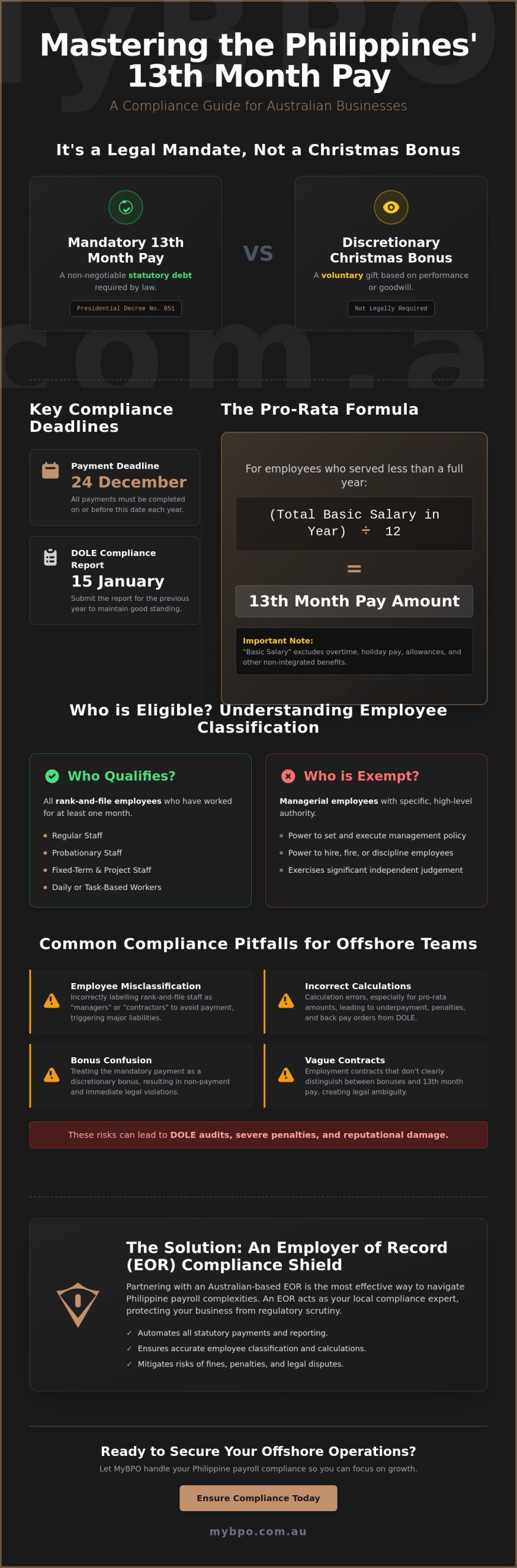
Treating the 13th month pay as a discretionary Christmas bonus isn’t just a misunderstanding; it’s a high-stakes legal liability that can trigger a Department of Labor and Employment (DOLE) audit. For many Australian firms, the distinction between a performance-based incentive and a statutory debt is often dangerously blurred. However, achieving 13th month pay Philippines compliance is a mandatory requirement under Presidential Decree No. 851, applying to every rank-and-file employee who has served for at least one month during the calendar year.
We recognise the complexity of managing cross-border payroll, where a simple calculation error can lead to severe penalties or back pay orders. This guide will help you master the statutory requirements to ensure your offshore operations remain fully compliant and risk-free. You’ll learn how to navigate the 24 December 2026 payment deadline, manage the ₱90,000 tax-exempt threshold, and accurately calculate pro-rata amounts for mid-year hires. We’ll also outline the essential reporting obligations, including the compliance report due by 15 January 2026, to ensure your organisation maintains its safe harbour status.
Key Takeaways
- Differentiate between rank-and-file and managerial roles to apply the mandate correctly and avoid overpayment or legal disputes.
- Master the precise pro-rata calculation formula to maintain 13th month pay Philippines compliance for staff who joined or departed mid-year.
- Recognise the danger of misclassifying offshore staff as contractors, a practice that triggers significant liability for unpaid benefits and back taxes.
- Leverage an Employer of Record (EOR) as a compliance shield to automate statutory payments and protect your business from local regulatory scrutiny.
Understanding the 13th Month Pay Mandate in the Philippines
For Australian firms expanding into the Philippines, the 13th month pay is often misinterpreted as a performance-linked incentive. This is a dangerous assumption that can lead to immediate legal friction. Under Philippine law, specifically Presidential Decree No. 851, every rank-and-file employee in the private sector is entitled to this payment, provided they’ve worked for at least one calendar month. It’s not a gift; it’s a statutory debt that must be settled annually. If you fail to meet this obligation, you risk heavy penalties and the loss of your operational standing in the country.
Failure to release these funds on or before 24 December each year is a direct violation of the Labor Code. While some larger corporations might offer a “14th month pay” as a competitive talent retention tool, this is entirely separate from the mandatory 13th month requirement. Understanding the 13th Month Pay Mandate requires recognising it as a fundamental component of the Philippine social safety net. It was designed to ensure workers have the financial liquidity to participate in the nation’s most significant cultural season. Maintaining 13th month pay Philippines compliance is the only way to protect your offshore operations from the scrutiny of the Department of Labor and Employment (DOLE).
The Legal Origin: Presidential Decree No. 851
Enacted in 1975, this decree was originally designed to protect the real wages of workers against the pressures of inflation. Over time, subsequent amendments and judicial interpretations have solidified its status, expanding coverage to nearly all private-sector employees. The primary trigger for this obligation is “rank-and-file” status. If an employee doesn’t hold managerial power, they’re legally entitled to this benefit. Australian firms must ensure their local payroll structures reflect this reality to avoid back-pay claims. If your staff aren’t classified correctly from day one, you’re essentially building a house on sand.
13th Month Pay vs. Christmas Bonus: Clearing the Confusion
The most common compliance risk involves confusing the statutory 13th month pay with a discretionary Christmas bonus. The former is mandatory; the latter is voluntary. If your employment contracts don’t explicitly distinguish between the two, you may inadvertently create a situation where you’re legally obligated to pay both. A Christmas bonus is a performance-based or goodwill gesture that can be withheld if the business faces financial hardship. In contrast, the 13th month pay cannot be waived, even if the company is experiencing losses. Australian businesses must secure their legal position by drafting contracts that define these payments with absolute precision. Clear definitions mitigate the risk of double-dipping or legal challenges during termination proceedings.
Eligibility and Statutory Requirements for Australian Employers
Securing your offshore operations requires a precise understanding of which team members qualify for statutory benefits. Under Philippine law, the mandate for 13th month pay is broad and inclusive. Every rank-and-file employee who has rendered at least one month of service during the calendar year is legally entitled to this payment. This eligibility remains constant regardless of the individual’s employment status; it applies equally to regular, probationary, and fixed-term staff. Australian firms often mistakenly believe that task-based or daily-paid workers are exempt. In reality, the mode of payment does not negate the requirement. If an employer-employee relationship exists, the obligation to honour the 13th month pay Philippines compliance is absolute.
Managerial employees are the only group generally excluded from this mandate. However, the definition of “managerial” in the Philippines is strictly narrow. It refers only to those who possess the power to lay down and execute management policies, or to hire, transfer, suspend, lay off, recall, discharge, or discipline employees. If your offshore staff members do not exercise these specific prerogatives, they are classified as rank-and-file. For most Australian businesses, this means their entire offshore workforce, from virtual assistants to senior developers, falls under the statutory requirement. To simplify these complexities, many firms choose to partner with an Australian EOR to manage these classifications and ensure all local labour standards are met without error.
Who Qualifies as ‘Rank-and-File’?
Determining the status of your team is a critical step in risk mitigation. Most offshore roles in the BPO sector are non-managerial by nature. Even if an employee has a title like “Team Lead,” they may still be considered rank-and-file if they lack final decision-making authority over personnel actions. Australian HR managers should use the following criteria to assess status:
- Policy Authority: Does the employee create company-wide operational policies?
- Personnel Power: Can the employee independently hire or fire staff?
- Discretionary Scope: Is their work governed by specific manuals and procedures rather than independent executive judgement?
If the employee’s role is primarily technical or administrative, they are entitled to the payment. Misclassifying these workers to avoid 13th month pay Philippines compliance can lead to formal complaints with the Department of Labor and Employment (DOLE).
Entitlements for Resigned or Terminated Staff
A common compliance pitfall is the assumption that an employee must be active on 24 December to receive the payment. This is incorrect. The 13th month pay is earned incrementally for every month worked. If an employee resigns or is terminated before the end of the year, they are entitled to a pro-rata share of the benefit. This amount must be calculated based on the total basic salary earned during the year and included in their “final pay” or “back pay” settlement. Failure to include this pro-rated amount in the separation package is a frequent cause of legal disputes that Australian firms should avoid at all costs.
How to Calculate 13th Month Pay: The Compliance Formula
Precision in payroll is the bedrock of 13th month pay Philippines compliance. A single miscalculation can expose your firm to legal disputes and Department of Labor and Employment (DOLE) penalties. The statutory formula is deceptively simple: (Total Basic Salary earned during the calendar year) / 12. However, the complexity lies in identifying exactly what constitutes “Basic Salary” and how to adjust for fluctuations in attendance or tenure. Every peso must be accounted for to ensure your business remains beyond reproach during a regulatory audit.
Defining ‘Basic Salary’ for Offshore Teams
To maintain structural integrity in your payroll, you must distinguish between basic pay and supplementary earnings. Basic salary includes the base rate and paid leave, such as sick, vacation, or service incentive leave. It strictly excludes overtime pay, night shift differentials, holiday pay premiums, and cost-of-living allowances. Maternity benefits are also excluded from the calculation, as these are paid by the Social Security System (SSS) rather than the employer. If a staff member receives a salary increase mid-year, the calculation must reflect the actual amounts earned in each period. You cannot simply use the year-end salary as the baseline for the entire twelve-month period; doing so could lead to overpayment or, conversely, a compliance breach if previous lower rates are ignored during pro-rata adjustments.
Pro-rata Calculations for Mid-year Hires
Pro-rata is defined as the total basic salary earned divided by the twelve months in a year. This is particularly relevant for Australian firms scaling their offshore teams mid-year. Consider a Virtual Assistant starting on 1 July with a basic salary of ₱30,000. If they work through December with no unpaid leave, their total basic salary earned is ₱180,000. Their 13th month pay would be ₱15,000, which is ₱180,000 divided by 12. The one-month service rule ensures that even those who join as late as November are entitled to a proportionate share, provided they have completed at least 30 days of service before the end of the year.
Unpaid leave directly reduces the “Total Basic Salary earned,” which in turn lowers the final payout. Precise record-keeping is mandatory to facilitate the annual DOLE reporting process. Employers are required to submit a compliance report via the DOLE online portal by 15 January 2026. Maintaining a clear audit trail protects your business if a discrepancy is ever questioned by local authorities. By documenting every leave day and salary adjustment, you secure a “safe harbour” for your organisation’s international employment practices.
Common Compliance Pitfalls and Risks for Offshore Teams
Australian businesses often enter the Philippine market with a “contractor-first” mindset to bypass local statutory obligations. This approach is a significant liability. Attempting to circumvent 13th month pay Philippines compliance by labelling staff as independent contractors does not provide legal immunity. If the Department of Labor and Employment (DOLE) determines that an employer-employee relationship exists, the firm is liable for all back-dated benefits, including the 13th month pay. This misclassification doesn’t just trigger local issues; it often mirrors “Sham Contracting” violations under Australia’s Fair Work Act, particularly with the increased scrutiny brought by the Closing Loopholes Act.
The “Control Test” is the primary instrument used by Philippine courts to settle these disputes. If your organisation dictates the working hours, provides the equipment, and supervises the specific methods of task execution, the law views that individual as an employee. In this scenario, the “contractor” label is legally irrelevant. Failing to recognise this reality leaves your business vulnerable to “money claims” filed through the National Labor Relations Commission (NLRC). These claims can result in substantial financial settlements and reputational damage. To mitigate these risks, you should secure your offshore operations with a compliant EOR that absorbs these statutory liabilities on your behalf.
The ‘Independent Contractor’ Trap
Simply calling someone a “contractor” or a “freelancer” in a service agreement doesn’t exempt you from the 13th month mandate. Philippine labour law prioritises the actual nature of the work relationship over the text of a contract. If the worker is economically dependent on your firm and you exercise control over their output, they are employees by default. Australian firms must be wary; a single disgruntled worker filing a claim at the NLRC can trigger a chain reaction of audits. Under current regulations, the burden of proof lies with the employer to demonstrate that a worker is truly an independent contractor, a standard that is notoriously difficult to meet for dedicated offshore staff. Understanding the full extent of the sham contracting Philippines risk under the 2025 Closing Loopholes amendments is essential for any Australian firm relying on offshore talent.
Reporting Requirements and Deadlines
Compliance extends beyond the mere act of payment. Employers are strictly required to file a Report of Compliance with the nearest DOLE office no later than 15 January 2026. This report must confirm that the 13th month pay was distributed by the 24 December 2026 deadline. Late filing or failure to pay on time is treated as a labour code violation, which can trigger a formal audit of your entire payroll system. You must maintain rigorous documentation, including signed payslips or bank transfer receipts, for at least three years. These records serve as your primary defence if a former staff member files a claim for unpaid benefits, ensuring your organisation remains a safe harbour in a complex regulatory environment.
Navigating Philippine Payroll Compliance with an Australian EOR
Achieving 13th month pay Philippines compliance requires more than just a basic understanding of payroll; it demands a robust legal infrastructure. For Australian firms without a local entity, the most secure path forward is utilizing an Employer of Record (EOR). MyBPO acts as your “Compliance Shield,” absorbing the statutory liabilities that typically fall on the employer. By positioning ourselves as the legal employer of your staff in the Philippines, we take on the full burden of regulatory adherence. This allows your organisation to focus on scaling operations without the looming threat of DOLE audits or NLRC claims.
Our role extends beyond simple payment processing. We manage the entire spectrum of mandatory contributions, including SSS, PhilHealth, and Pag-IBIG contributions employer obligations, alongside the precise calculation of 13th month entitlements. Because we are an Australian-owned partner, we speak your language and understand the high standards of governance and Fair Work expectations you operate under. This cultural alignment, combined with our physical on-the-ground presence in Manila and Bacolod, provides a level of security that abstract digital platforms cannot match. We don’t just provide a service; we establish a safe harbour for your international employment needs.
How MyBPO Absorbs Compliance Risk
Under an EOR arrangement, MyBPO assumes the primary legal responsibility for your workforce in the Philippines. This structure creates a vital layer of protection between your Australian parent company and the local labour jurisdiction. If a dispute arises, the legal accountability rests with us as the employer of record, not your Australian entity. We conduct rigorous vetting of all payroll cycles against the Philippine Labour Code to ensure every rank-and-file employee receives their entitlements exactly as prescribed. This protective barrier ensures that your business remains insulated from direct legal claims in a foreign court, effectively mitigating the risks discussed in earlier sections.
Seamless Payroll Integration for Australian Firms
We provide a transparent bridge between Australian business culture and Philippine regulatory requirements. To ensure predictable cash flow, 13th month pay is managed and reported clearly within your monthly service fee. You receive detailed documentation proving that every statutory obligation has been met, which is essential for your own corporate records. Our local expertise ensures that pro-rata calculations for mid-year hires or resigned staff are handled with mathematical precision. By removing the complexity of local payroll, we allow you to maintain operational freedom while remaining fully protected. Secure your offshore team’s compliance with MyBPO today.
Securing Your Offshore Operations for the Long Term
Maintaining 13th month pay Philippines compliance is a foundational requirement for any Australian firm serious about sustainable offshore growth. You’ve seen how the distinction between a statutory debt and a discretionary bonus impacts your legal standing; and how precise calculations prevent Department of Labor and Employment audits. Ignoring these obligations or relying on the “independent contractor” loophole creates a liability that can jeopardise your entire operation. Accuracy in pro-rata calculations and reporting is a non-negotiable standard for protecting your business interests.
As an Australian-owned and operated partner with a physical presence in both Manila and Bacolod, MyBPO serves as your local guardian. We provide the structural integrity needed to navigate AU-PH cross-border compliance with absolute certainty. You can avoid compliance risks and secure your Philippine team with MyBPO today. This partnership allows you to focus on your core business while we absorb the complexities of foreign labour laws. You’ve now got the opportunity to build a high-performing team with the peace of mind that every statutory obligation is perfectly managed.
Frequently Asked Questions
Is 13th month pay mandatory for all employees in the Philippines?
Yes, the 13th month pay is a mandatory statutory requirement for all rank-and-file employees who have rendered at least one month of service. This obligation applies to the private sector regardless of the employee’s designation or the method of their wage payment. Employers are not permitted to waive this debt or substitute it with other bonuses, as it is a protected legal right under Presidential Decree No. 851.
How do I calculate 13th month pay for a part-time offshore worker?
You calculate the payout by dividing the total basic salary earned by the worker during the calendar year by twelve. For a part-time offshore worker, the total basic salary reflects the actual hours worked and paid. This proportionate approach ensures that your payroll remains accurate while upholding 13th month pay Philippines compliance. Precise record-keeping of all hours rendered is essential to defend the calculation if questioned by local authorities.
What happens if an Australian company fails to pay the 13th month salary?
Non-payment exposes your firm to money claims filed through the National Labor Relations Commission (NLRC). These legal challenges often result in orders for immediate back-payment along with potential interests and administrative fines. DOLE may also initiate a comprehensive audit of your entire payroll and benefit structure. For Australian firms, such scrutiny can lead to operational disruptions and significant reputational damage within the competitive Philippine talent market.
Can 13th month pay be given in two instalments?
Yes, you may distribute the 13th month pay in two instalments, provided the full amount is settled by the 24 December deadline. Some organisations choose to release half in June to assist staff with school enrolment expenses and the remainder in December. This practice is legally acceptable as long as the total one-twelfth of the annual basic salary is provided within the calendar year.
Are independent contractors in the Philippines entitled to 13th month pay?
Genuine independent contractors are not entitled to this benefit because no employer-employee relationship exists. The risk for Australian firms lies in misclassification; if a worker meets the Control Test criteria, they are legally considered an employee. In such cases, the individual is entitled to the 13th month pay. Failing to identify this risk can lead to substantial liabilities for unpaid benefits and statutory contributions.
Is 13th month pay taxable for the employee?
The 13th month pay is non-taxable up to a maximum threshold of ₱90,000. This tax-exempt limit includes the 13th month pay and other related benefits provided to the employee. Any amount that exceeds this ₱90,000 cap is considered part of the employee’s gross income and is subject to standard income tax. This threshold remains the current standard under the TRAIN Law for the 2026 financial year.
What is the deadline for filing the 13th month pay compliance report to DOLE?
The mandatory compliance report must be filed with the Department of Labor and Employment (DOLE) on or before 15 January 2026. This report serves as formal evidence that you have met your statutory obligations by the December deadline. Failure to file this report via the DOLE online portal can trigger a regulatory inspection. Consistent reporting is a critical component of maintaining a safe harbour for your offshore operations.
Does the 13th month pay include overtime and bonuses?
No, the calculation is strictly based on the basic salary and excludes supplementary payments like overtime, night differentials, and holiday pay. Allowances and discretionary bonuses are also excluded unless they are specifically integrated into the basic pay by contract. Understanding these exclusions is vital for maintaining 13th month pay Philippines compliance. It ensures you are not overpaying while still meeting the minimum legal standards required for your offshore team.
Need a strategy session?
Tell us about your team and we will map out the right structure, fixed-cost quote included.
Book a call