Blog
Choosing a Philippines EOR Provider: The 2026 Guide for Australian Businesses

If the Fair Work Ombudsman audits your offshore team tomorrow, your “independent contractor” agreements might be your biggest liability. Many Australian directors operate under the false impression that distance provides a shield against sham contracting penalties. The reality in 2026 is that regulatory scrutiny has intensified, making the choice of a Philippines EOR provider a critical decision for your firm’s structural integrity. You need more than a payroll platform; you require a local ally that can absorb jurisdictional risk and ensure your offshore expansion doesn’t result in a permanent establishment trap.
You’ve likely found that managing Philippine mandatory benefits, such as the 13th-month pay or the 15% SSS contribution rate, is a complex administrative burden that distracts from your core business. It’s a common frustration, especially when you’re also trying to maintain control over remote security and productivity. This guide promises to show you how to secure your offshore operations and mitigate Australian regulatory risks by selecting a partner that merges Fair Work compliance with local operational excellence. We will preview the essential criteria for 2026, covering everything from new DOLE mandates to the seamless integration of Australian and Philippine employment standards.
Key Takeaways
- Learn why shifting from independent contracting to a formal Employer of Record model is essential to protect your firm from Australian sham contracting penalties.
- Understand the 2026 statutory landscape, including the 15% SSS contribution rate and mandatory 13th-month pay, to ensure your Philippine team remains fully compliant.
- Discover why selecting a Philippines EOR provider with physical infrastructure and on-the-ground support is superior to relying on digital-only platforms for staff retention.
- Master a vetting framework that prioritises local Philippine expertise and rapid response times over generic global scalability.
- Achieve a “compliance shield” for your business by aligning Australian leadership with dedicated Philippine operational hubs.
Selecting a Philippines EOR Provider for Australian Compliance
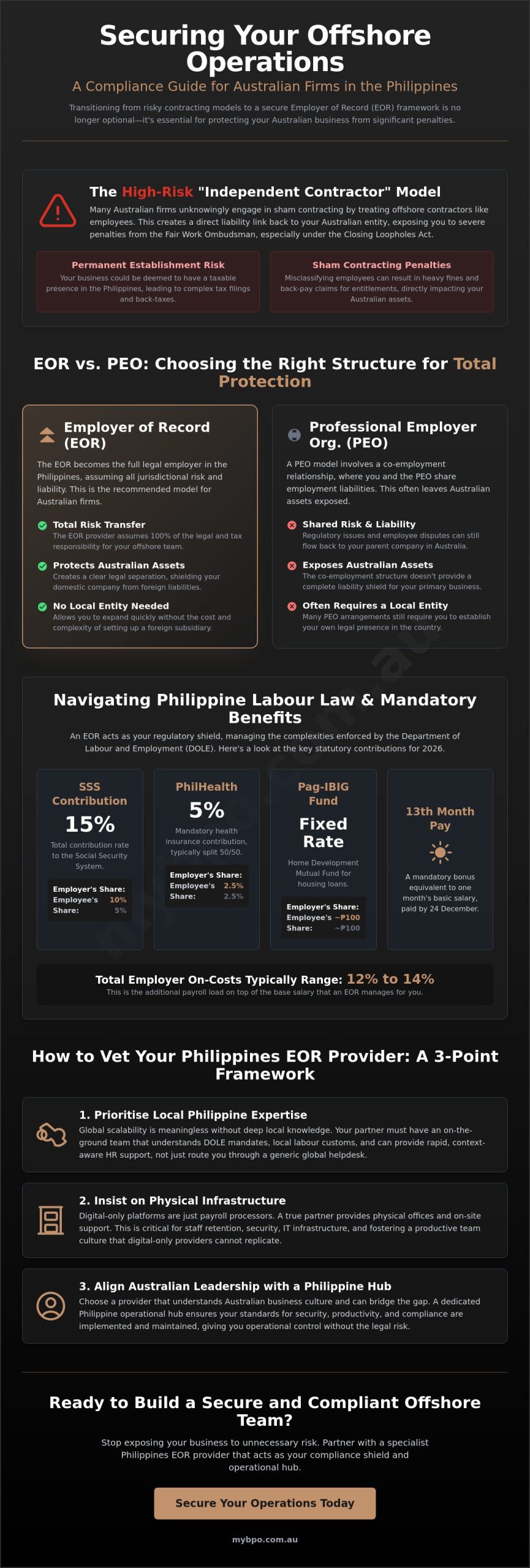
The Employer of Record (EOR) model serves as the primary structural bridge for Australian firms expanding into the Manila or Cebu markets. It’s a tripartite arrangement where the EOR becomes the legal employer on the ground, while the Australian client retains day-to-day operational control. This distinction is vital. If your business hires Filipinos as “independent contractors” while treating them like employees, you’re inviting a collision with both Australian and Philippine authorities. A specialised Philippines EOR provider acts as a circuit breaker; it absorbs the legal liabilities that would otherwise flow back to your Australian entity.
Australian firms are increasingly moving away from direct independent contracting due to the heightened risk of “permanent establishment.” This occurs when a foreign tax office decides your business has a stable, taxable presence in their country. If this happens in the Philippines, you face complex corporate tax filings and potential back-taxes. An EOR prevents this by providing the necessary local legal framework. It ensures your offshore team is housed within a compliant, locally registered organisation, allowing you to scale without the administrative burden of setting up a foreign subsidiary. For firms looking to build an offshore team in the Philippines from the ground up, understanding this structural distinction is the essential first step.
The Impact of the Closing Loopholes Act 2025
The Australian regulatory environment changed significantly with the Closing Loopholes Act. This legislation has sharpened the focus on sham contracting, where businesses misclassify employees as contractors to avoid paying entitlements. If the Fair Work Ombudsman determines your offshore staff are employees in everything but name, the financial penalties are severe. Using a Philippines EOR provider establishes a legitimate employment relationship that satisfies the strict “substance over form” tests used by regulators. This structure effectively mitigates the threat of back-pay claims and heavy fines that can cripple a growing enterprise.
EOR vs PEO: Which Structure Protects Australian Assets?
Confusion often exists between a Professional Employer Organisation (PEO) and an EOR. In a PEO model, you usually share employment risks through a co-employment contract; this often requires you to have your own local legal entity. This leaves your Australian assets exposed to regulatory scrutiny and tax liabilities. Conversely, the EOR model offers a total risk transfer. The provider assumes 100% of the legal and tax responsibility in the Philippines. For Australian directors, this is the only logical path for scaling without creating a messy, high-risk footprint in a foreign jurisdiction. It’s about protecting your domestic assets while leveraging international talent.
Navigating Philippine Labour Laws: The EOR as Your Regulatory Shield
The Department of Labour and Employment (DOLE) is the ultimate authority in the Philippine workforce, enforcing standards that often catch Australian directors off guard. Unlike the Australian system, Philippine labour law is heavily weighted toward employee protection; this means any procedural misstep during termination or performance management can lead to immediate legal action. A specialised Philippines EOR provider absorbs these risks by acting as the local legal employer, ensuring every interaction adheres to the strict due process required by the Labour Code. While recent reforms have aimed to improve the Ease of Doing Business in the Philippines, the regulatory environment remains intricate, requiring a partner that understands how to navigate local bureaucracies.
Mandatory Benefits and Statutory Contributions
Managing payroll in the Philippines involves more than just a basic salary transfer. For 2026, the Social Security System (SSS) contribution rate has reached 15%, with the employer’s share accounting for 10% of the Monthly Salary Credit. When you add the 5% PhilHealth contribution and mandatory Pag-IBIG payments, the total employer payroll load typically ranges between 12% and 14%. Your Philippines EOR provider must also secure the mandatory 13th-month pay, which is equivalent to one month of basic salary and must be distributed by 24 December. Failure to calculate these accurately or meet strict deadlines can trigger DOLE inspections and significant financial penalties. If your staff work Australian business hours, you must also manage the Night Shift Differential, a 10% premium for work performed between 10 pm and 6 am local time.
Securing Your Intellectual Property Offshore
Protecting your company’s intellectual property is a primary concern when managing a remote team. In the Philippines, IP protection is only as strong as the employment contract that governs it. A reliable EOR ensures that all contracts include robust “work-for-hire” clauses that are enforceable under local law, providing you with legal recourse that an Australian-only contract cannot offer. They also mitigate data risks by providing physical security within dedicated workspaces, ensuring that sensitive information is handled in a controlled environment. This combination of legal structural integrity and physical presence allows you to scale your operations with the confidence that your proprietary assets remain secure and fully protected within the local jurisdiction.
Beyond Digital Platforms: The Value of Physical Infrastructure
Many global tech platforms market themselves as a complete solution for hiring in the Philippines with just a few clicks. However, a digital dashboard cannot resolve a power outage in Manila or manage a local hardware failure. For an Australian business, relying solely on a software-based Philippines EOR provider creates a significant operational blind spot. You need more than an interface; you need a partner with physical skin in the game. Real-world infrastructure, such as office space with redundant internet lines and backup power generators, ensures your team stays online during the tropical storms that frequently disrupt residential connections.
Physical presence also dictates the longevity of your offshore team. Staff retention in the Philippines is often driven by a sense of belonging and a professional environment. A remote worker isolated at home is more likely to churn than one who is part of a structured office culture. On-the-ground supervisors can identify performance dips or cultural friction points before they escalate into resignations. By providing a professional hub, you aren’t just hiring a person; you’re building a stable department that feels connected to your Australian operations. Firms that also integrate an AI human in the loop strategy alongside their physical infrastructure find they can maintain quality oversight and compliance guardrails even as their offshore teams scale rapidly.
Equipment Leasing and Asset Management
Data security is a primary concern when your staff work from home on personal computers. The “Bring Your Own Device” (BYOD) model is notoriously difficult to secure and leaves your corporate data vulnerable to local breaches. Choosing a provider that offers Equipment Leasing allows you to deploy managed hardware with pre-configured security protocols. This ensures you maintain total control over your offshore assets from Australia. If a staff member leaves, the hardware is recovered and wiped by local technicians, preventing proprietary data from remaining in the wild. This structured approach to asset management is a necessary safeguard for any firm handling sensitive client information.
The Role of Dedicated Workspaces
There is a stark difference between a home-office setup and dedicated workspaces designed for high-performance teams. Supervised office environments professionalise your offshore operations and improve daily communication. In a shared physical space, team cohesion develops naturally, leading to faster problem-solving and better alignment with your Australian standards. It transforms your offshore presence from a collection of fragmented freelancers into a unified extension of your domestic office. This physical supervision provides a layer of accountability that digital tracking software simply cannot replicate.
How to Vet a Philippines EOR Provider: A Framework
Selecting a Philippines EOR provider is a high-stakes decision that requires a rigorous vetting process. While global platforms offer impressive software interfaces, they often lack the granular understanding of the Australian-Philippine regulatory corridor. You must prioritise providers that offer direct access to their local legal and operational teams rather than a generic ticketing system. If a compliance issue arises in Manila, you cannot afford to wait for a response from a support centre in a different time zone. Responsiveness is your first line of defence against operational downtime.
Transparency in pricing is equally critical. Many providers hide administrative surcharges within the “management fee” or apply opaque markups to statutory contributions. A reliable partner will provide a line-by-line breakdown of costs, ensuring you aren’t paying for phantom services. You should also verify their track record by requesting references from other Australian businesses. A provider that has successfully navigated the complexities of the 2026 tax reforms for an Australian client is far more valuable than one with a massive, generic global footprint. If they don’t understand the specific expectations of an Australian director, they aren’t the right fit.
The Importance of Australian Ownership
Communication is the foundation of any successful offshore venture. An Australian-owned partner simplifies this by providing a shared cultural and legal vocabulary. They understand the nuances of employer of record Australia requirements and how they intersect with Philippine labour codes. This dual-jurisdiction awareness ensures that your partner remains accountable under the laws you are familiar with. It creates a “compliance shield” that protects your domestic entity while allowing you to leverage the talent available in the Philippines.
Recruitment and Onboarding Capabilities
Your EOR is also your primary gateway to talent. Vetting their offshore recruitment process is essential to ensure cultural alignment between your domestic team and your new Philippine staff. Look for a partner that prioritises quality over volume, moving beyond simple resume matching to assess long-term fit and technical proficiency. The speed of transition from contract signing to the first deliverable is a key performance indicator. A structured onboarding process ensures that your new team members are productive from day one, rather than languishing in administrative limbo. To secure your firm’s future, contact our team today to discuss a tailored compliance framework for your business.
Scaling Your Offshore Team with MyBPO: The Australian Advantage
MyBPO serves as the definitive compliance shield for Australian businesses seeking a reliable Philippines EOR provider. We understand that offshore expansion is not merely a cost-saving exercise but a strategic manoeuvre that requires structural integrity. By merging Australian professional standards with deep-rooted local expertise, we absorb the complexities of foreign labour codes, allowing you to focus on your core objectives. Whether you are seeking a single dedicated virtual assistant or building a full-scale department, our model ensures that every hire is protected by a robust legal framework. Our comprehensive 2026 guide on how to build an offshore team in the Philippines walks you through each stage of this process with a risk-aware blueprint tailored for Australian businesses.
Transitioning your existing independent contractors to a compliant EOR structure is a critical step in mitigating the sham contracting risks discussed earlier. This process often feels daunting, yet it is necessary to secure your firm’s future. MyBPO facilitates this transition by providing a clear pathway that respects both Australian Fair Work expectations and Philippine statutory requirements. We don’t just provide a service; we act as a vigilant guardian for your workforce, ensuring that all mandatory benefits and taxes are managed with legalistic precision.
On-the-Ground Support and Physical Presence
Our physical representation in major Philippine hubs provides a “safe harbour” that digital-only platforms cannot match. Local MyBPO teams manage day-to-day staff welfare, performance, and compliance, ensuring that your team operates within a professional, supervised environment. This on-the-ground presence is vital for maintaining culture and reducing the churn often associated with isolated remote work. It gives you the peace of mind that your offshore operations are grounded in reality, not just a cloud-based dashboard. If a local regulatory change occurs or an infrastructure challenge arises, our teams are there to navigate the resolution immediately.
Your Pathway to Secure Growth
Choosing MyBPO is the logical conclusion for risk-aware Australian firms that value accountability and transparency. We reduce the friction in your offshore expansion strategy by providing the infrastructure, recruitment expertise, and legal protection needed to scale with confidence. Our Australian leadership ensures that your business values are translated accurately into your Philippine operations, creating a seamless bridge between your two offices. Secure your business against regulatory volatility and operational disruptions. Contact MyBPO today to secure your Philippines EOR solution.
Securing Your Firm’s Future in the Philippines
The transition from fragmented offshore contracting to a structured employment model is no longer optional for firms prioritising long-term stability. You’ve seen how a specialised Philippines EOR provider acts as a critical buffer, absorbing the complexities of local labour laws while protecting your Australian entity from sham contracting liabilities. By prioritising partners with physical hubs in Manila and Bacolod over digital-only platforms, you ensure your team has the infrastructure needed to perform at an Australian standard.
MyBPO provides this essential bridge, combining Australian ownership with deep local expertise to create a “safe harbour” for your expansion. We specialise in AU-PH regulatory compliance, ensuring your offshore operations are both high-performing and legally sound. If you’re ready to professionalise your remote team and eliminate jurisdictional risk, now is the time to act.
Secure your offshore team with MyBPO’s Australian-owned EOR services.
We look forward to helping you build a compliant, resilient team that drives your business forward.
Frequently Asked Questions
What exactly does a Philippines EOR provider do for an Australian company?
A Philippines EOR provider acts as the legal employer for your staff in the Philippines, absorbing all local liability and administrative burdens. They manage payroll, tax filings, and statutory contributions, while you retain full control over the daily tasks and output of your team. This structure allows you to build an offshore department without the time-consuming process of registering a local Philippine subsidiary.
How does an EOR protect my business from Australian sham contracting laws?
An EOR protects your firm by creating a legitimate employment relationship that satisfies Australian regulators. Under the Closing Loopholes Act 2025, hiring “contractors” who function as employees is a high-stakes risk. By using an EOR, your workers are classified correctly as employees from day one, which provides a “safe harbour” against sham contracting penalties and back-pay claims from the Fair Work Ombudsman.
Is it legal to hire staff in the Philippines without a local entity?
It is entirely legal to hire staff in the Philippines without a local entity, provided you use an EOR. The EOR provider owns the local legal structure and remains accountable to the Department of Labour and Employment (DOLE). This arrangement allows Australian businesses to scale quickly and safely without the 4 to 8 month delay and high costs associated with setting up a domestic corporation in Manila.
What are the mandatory benefits I must pay my staff in the Philippines?
Mandatory benefits include contributions to the Social Security System (SSS), PhilHealth, and the Pag-IBIG Fund. For 2026, the SSS rate is 15% of the monthly salary credit, while PhilHealth is 5%. Employers must also provide the 13th-month pay, holiday premiums, and service incentive leave. Failure to manage these correctly can lead to severe fines and DOLE inspections.
How does an EOR handle the 13th-month pay requirement?
Your EOR provider calculates the 13th-month pay based on the employee’s total basic salary earned during the calendar year. This mandatory benefit must be distributed to staff on or before 24 December. The EOR ensures this payment is processed accurately and on time, which is essential for maintaining compliance and preventing labour disputes within the Philippine jurisdiction.
Can an EOR provider help with equipment and office space in the Philippines?
Yes, a comprehensive EOR provider can manage both equipment leasing and dedicated workspaces. MyBPO provides managed hardware with secure protocols to protect your data and offers physical office environments in major hubs. This infrastructure ensures your team has reliable internet and backup power, which are often unavailable in residential work-from-home setups.
What is the difference between a Philippines EOR and a recruitment agency?
A recruitment agency focuses solely on finding and placing talent, whereas a Philippines EOR provider manages the entire employment lifecycle. While recruitment is the first step, the EOR takes on the ongoing legal, tax, and administrative responsibilities of being the employer. MyBPO integrates both services, providing a seamless transition from sourcing candidates to long-term compliant employment.
How much does it cost to use a Philippines EOR provider?
The cost of using an EOR typically includes a monthly management fee per employee plus the total employee compensation and statutory contributions. These fees vary based on the level of support and infrastructure required, such as dedicated office space or equipment. It is important to look for a transparent pricing model that avoids hidden administrative surcharges to ensure your offshore expansion remains cost-effective.
Need a strategy session?
Tell us about your team and we will map out the right structure, fixed-cost quote included.
Book a call