Blog
How to Build an Offshore Team in the Philippines: The 2026 Guide for Australian Businesses
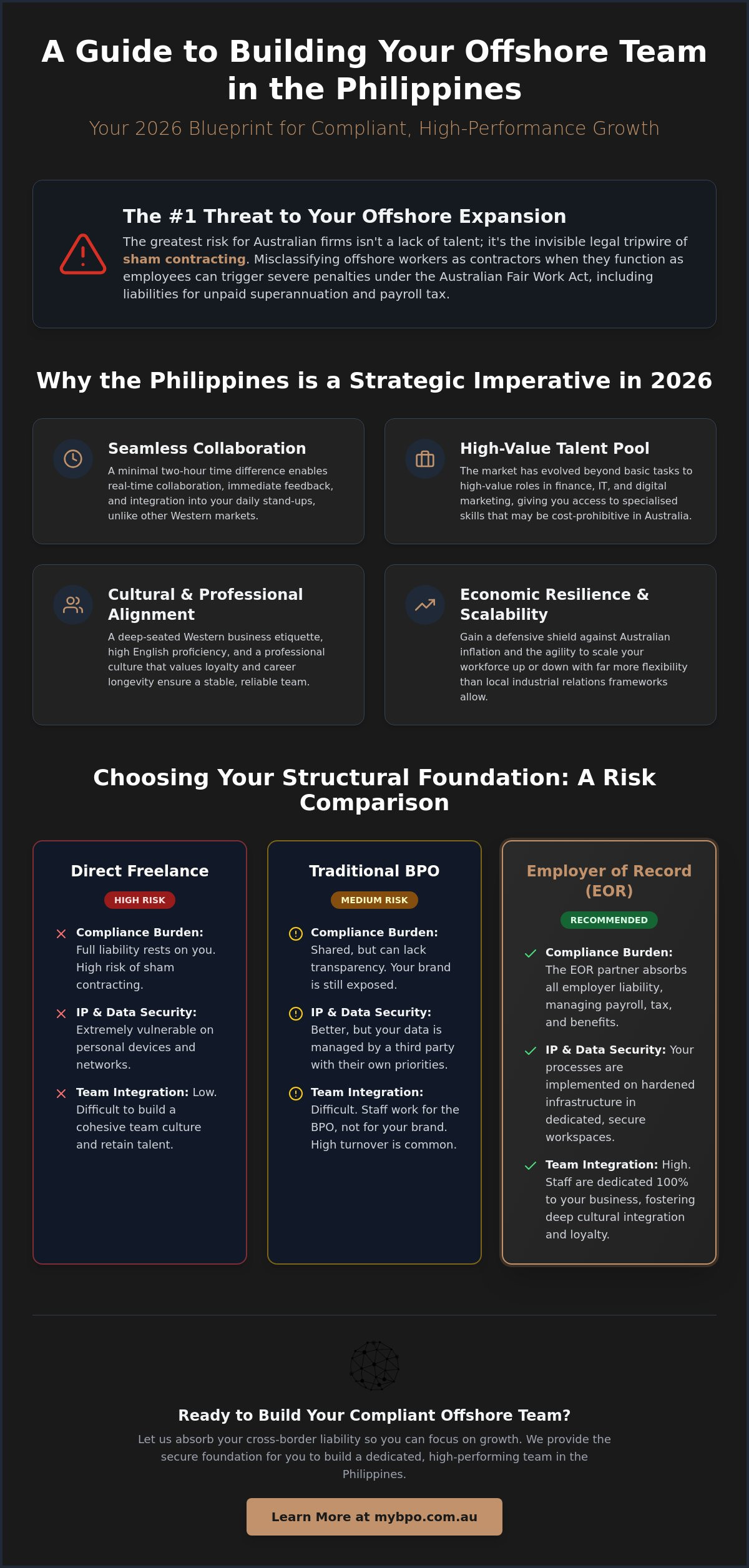
The greatest threat to your offshore expansion isn’t a lack of talent or cultural difference; it’s the invisible legal tripwire of sham contracting under Australian law. For many local firms, the desire to build offshore team Philippines operations is often tempered by the fear of regulatory fines or the confusion of navigating foreign labour codes. You recognise the need for operational cost savings, yet the complexity of mandatory benefits like 13th-month pay and the 15% SSS contribution rate creates a daunting barrier to entry.
We agree that business growth must be anchored in absolute compliance to be sustainable. This guide provides a comprehensive, risk-aware blueprint for Australian companies to ethically and securely scale their operations with Filipino talent. We will examine the 2026 regulatory landscape, including the impact of the CREATE MORE Act and how an Employer of Record (EOR) structure can absorb your cross-border liability. You’ll learn exactly how to secure a high-performing, loyal team while ensuring your Australian entity remains fully protected from legal and operational risks.
Key Takeaways
- Understand the evolution of the Philippine talent market from basic task-handling to high-value professional roles that drive genuine business growth.
- Establish a secure foundation to build offshore team Philippines operations by choosing structural models that absorb regulatory risk and ensure total compliance.
- Master a recruitment strategy that bypasses saturated job boards to source specialised talent through proactive headhunting and precise KPI alignment.
- Protect your firm’s sensitive data by identifying the inherent risks of remote work and implementing hardened infrastructure through dedicated workspaces.
- Navigate the intersection of the Australian Fair Work Act and the Philippine Labour Code to insulate your business from the “Closing Loopholes” legislation.
The Strategic Case for Building an Offshore Team in the Philippines in 2026
The decision to build offshore team Philippines operations is no longer merely a cost-saving exercise; it’s a strategic imperative for Australian SMEs facing domestic talent shortages and rising operational overheads. The AU-PH corridor has matured into a sophisticated economic bridge. Unlike the fragmented freelance markets of the past, today’s landscape is defined by long-term IP retention and the integration of highly skilled professionals into the core of Australian businesses. This shift reflects the broader maturity of Business process outsourcing in the Philippines, which has transitioned from basic transactional tasks to complex, high-value professional services.
Australian directors benefit from a unique geographical advantage. The two-hour time difference allows for seamless, real-time collaboration that most Western markets cannot replicate. Your team in Manila starts their day just as your morning coffee kicks in, facilitating immediate feedback loops and “follow-the-sun” productivity models. This proximity ensures that your offshore staff aren’t just “task-takers” working in isolation. They’re active participants in your daily stand-ups and strategic planning sessions. It’s about building a dedicated team that understands your brand’s DNA, rather than outsourcing to a faceless third party; this level of integration is crucial for firms in niche sectors, such as those partnering with BTR Marine Services LLC for specialised ship brokering and vessel acquisitions.
Cultural Alignment and Professional Proficiency
Cultural friction is the silent killer of many international ventures. Fortunately, the Philippines offers a deep-seated Western business etiquette and a high level of English proficiency that simplifies the onboarding process. Filipino professionals place a significant premium on loyalty and career longevity. This aligns perfectly with the Australian preference for stable, reliable teams. By tapping into the local “hospitality mindset,” firms can secure customer-facing staff who provide a level of empathy and service that is increasingly rare in the domestic market. It makes the transition feel less like a foreign expansion and more like a local team extension.
Economic Resilience and Scalability
In the volatile 2026 economic environment, agility is your greatest asset. Building an offshore team provides a defensive shield against local inflationary pressures. It allows you to scale your workforce up or down with a level of flexibility that Australian industrial relations frameworks often make difficult for small firms. Modern offshore teams now comprise specialised roles in finance, IT, and digital marketing. This allows you to access a calibre of talent that might otherwise be cost-prohibitive. This isn’t about replacing your local core; it’s about augmenting it with a structured, compliant, and highly scalable international arm that protects your bottom line. For those also managing the physical aspects of international trade, you can discover Freight and More Pty Ltd to ensure your global logistics are as efficient as your offshore staffing operations.
Establishing a robust offshore presence can also increase the overall valuation of your enterprise; for those looking at the broader M&A landscape, including the US market, Staffing Brokerage offers expert advisory for the buying and selling of staffing companies.
Selecting Your Structural Foundation: EOR vs. BPO vs. Freelance
Choosing the correct legal framework is the most critical decision you’ll make when you decide to build offshore team Philippines operations. While many firms prioritise talent acquisition, your structural model dictates your level of legal exposure in Australia. As highlighted in the Australian Government’s Philippines country brief, the trade relationship is robust, but it requires navigating two distinct legal systems. A traditional project-based BPO might offer quick results, but it often lacks the brand alignment and IP retention of a dedicated team. Conversely, building a branded team allows for deep cultural integration while a partner manages the administrative burden.
The Risk Profile of Independent Contractors
Engaging staff through a “Direct Freelance” model is increasingly hazardous for Australian directors. You must be acutely aware of the sham contracting Philippines risk, where offshore workers are treated as contractors but function as employees. Under 2026 Fair Work scrutiny, misclassification can trigger significant liabilities for unpaid superannuation and payroll tax. If your firm exerts control over their daily hours and work methods, they’re likely employees in the eyes of the law. “Cheap” contractors often carry a hidden price tag of regulatory fines that can cripple an unprepared SME.
The EOR Advantage for Australian Directors
An Employer of Record Australia acts as your compliance shield. The EOR becomes the legal employer on the ground, absorbing all local liabilities while you retain operational control. This structure ensures that mandatory benefits, such as the 13th-month pay and the 15% SSS contribution rate, are handled with precision. It removes the burden of withholding taxes from the Australian parent company, effectively ring-fencing your liability within the Philippine jurisdiction.
Partnering with an Australian-owned EOR provides a layer of accountability that offshore-only providers cannot match. It creates a bridge between the Philippine Labour Code and Australian business standards. You gain a local ally who manages the bi-monthly payroll cycles and remits the 5% PhilHealth premiums correctly. This protective approach allows you to focus on growth rather than regulatory paperwork. For those seeking total security, exploring our Employer of Record services is the logical first step toward a secure international expansion.
Executing the Build: A Step-by-Step Recruitment Strategy
Successful execution requires more than just posting a job ad on a generic portal. To build offshore team Philippines operations that actually deliver results, you must treat recruitment as a high-stakes procurement process rather than a simple HR task. Saturated job boards often attract “job-hoppers” who prioritise short-term salary bumps over long-term organisational loyalty. Instead, a proactive headhunting approach allows you to identify passive candidates who possess the specific technical maturity and professional gravity your Australian firm requires. This method ensures you aren’t just selecting from those looking for work, but rather attracting the best talent currently in the market.
Vetting must be multi-staged and uncompromising. It’s not enough to verify a CV; you must implement technical assessments that mirror your real-world workflows and conduct deep background checks to secure your intellectual property. As noted in Forbes’ guide to building an offshore team, the operational success of your expansion depends on finding talent that aligns with your specific technical stack and corporate values. If a candidate cannot demonstrate a clear understanding of Australian business etiquette during the interview phase, they’re unlikely to succeed in a remote environment. You’re looking for partners, not just employees.
Crafting the Ideal Candidate Profile
Finding “A-Player” talent in the Philippines starts with moving beyond generic job descriptions. You need to balance hard technical skills with the “soft skills” necessary for remote Australian collaboration, such as proactive communication and time-management autonomy. The ideal candidate profile is a foundational document that aligns Australian stakeholders with Philippine recruiters to ensure every hire is a strategic fit rather than a stop-gap measure. It should define not just what the person does, but how they contribute to the security and scalability of your firm. When you build offshore team Philippines units, this document acts as your North Star for every hiring decision.
The Onboarding and Integration Phase
Onboarding is where your retention strategy begins. You should create a comprehensive “Team Manual” that clearly outlines Australian standards and expected outcomes. This document bridges the gap between local execution and your firm’s high-level objectives. Use video introductions and virtual “meet and greets” to humanise the relationship from the first hour. Setting up strict communication cadences, such as daily standups and weekly syncs, ensures immediate momentum and prevents the isolation that often leads to staff turnover. Clear expectations are the best protection against operational drift and ensure your new staff feel like valued members of the organisation rather than distant contractors. As automation becomes more prevalent in managing offshore workflows, implementing an AI human in the loop strategy ensures that technology enhances your team’s output without sacrificing the nuanced judgement required to protect your brand’s integrity. For a comprehensive framework on how to hire and manage remote staff for Australian growth, including the compliance obligations that come with each engagement model, directors should review the full operational and legal considerations before committing to a structure.
Hardening Your Operations: Infrastructure and Data Security
Operational stability is forged in the physical environment, not just the digital one. While the recruitment phase is vital to build offshore team Philippines units, your expansion remains vulnerable if it relies on a fragmented Work From Home (WFH) model. Residential infrastructure in the Philippines often lacks the redundancy required for Australian corporate standards. Internet instability and frequent power outages can derail productivity and compromise your client service levels. Transitioning your team into a controlled environment is the only way to ensure 99.9% uptime and professional-grade output.
A dedicated workspace Philippines provides the necessary physical and digital barriers to protect your firm’s sensitive data. These centres are equipped with enterprise-grade fibre connections, backup generators, and strict biometric access controls. Beyond the technical benefits, a professional office environment fosters a culture of accountability and team cohesion that is difficult to replicate in a remote setting. It allows you to implement Australian-standard cybersecurity protocols, such as endpoint encryption and restricted network segments, with absolute certainty.
Physical Security and Operational Uptime
Mitigating the risks of local infrastructure requires a centralised approach. Professional office hubs absorb the impact of external disruptions, ensuring your staff remain online when residential areas go dark. To further safeguard your operations, you can explore Managed IT and Security Infrastructure Services for comprehensive protection of your digital and physical assets. This structure also provides a psychological benefit; staff often report higher job satisfaction and better focus when working in a dedicated professional centre. On-the-ground support teams can also manage local HR issues or technical glitches in real-time, preventing minor hurdles from escalating into significant delays for your Australian office.
Asset Management and Data Protection
Securing your intellectual property is impossible if you allow a “Bring Your Own Device” (BYOD) policy. You must maintain total control over the hardware your team uses to access your systems. Equipment leasing ensures that every device in your offshore unit is patched, secured, and maintained to the same rigorous standards as your Australian head office. By providing leased hardware, you can enforce strict data protection policies and ensure that sensitive information never leaves a secure, monitored environment. To eliminate these operational vulnerabilities, you should consider our equipment leasing and workspace solutions as part of your core expansion strategy.
Managing Cross-Border Risk: The Compliance Shield Approach
The final requirement to build offshore team Philippines operations is the construction of a robust compliance shield. Australian directors must navigate the complex interface between the Philippine Labour Code and the Australian Fair Work Act. Ignoring this intersection creates a significant liability trap. The 2025/2026 “Closing Loopholes” legislation in Australia has intensified the focus on how offshore labour is engaged. If your firm maintains direct control over an offshore worker without a proper legal buffer, you risk being deemed a common-law employer under Australian jurisdiction, regardless of where the staff member is physically located. This makes jurisdictional accountability your highest priority. Firms that also rely on automated systems to manage their offshore workforce must ensure they have a compliant AI human in the loop framework to meet the automated decision-making transparency obligations now emerging under Australian regulatory guidance.
Total protection requires precise management of mandatory Philippine contributions. You must ensure the 15% SSS contribution rate and the 5% PhilHealth premium are remitted correctly to avoid local penalties. Furthermore, the 13th-month pay is a non-negotiable statutory requirement equivalent to one-twelfth of an employee’s basic annual salary. It must be paid by 24 December each year. Failure to account for these entitlements doesn’t just damage your reputation; it creates a legal opening that can lead to Department of Labour and Employment (DOLE) interventions that disrupt your entire operation.
Navigating Philippine Labour Law
Understanding the “Regularization” process is essential for long-term stability. In the Philippines, employees typically attain regular status after a six-month probationary period, granting them significant security of tenure. Managing performance or terminations within the strict DOLE framework requires a methodical approach and a local HR presence. If you attempt to apply Australian “at-will” mentalities to a Philippine workforce, you will likely face legal challenges. A local partner absorbs this risk by ensuring every disciplinary action follows the “twin notice” rule required by Philippine law.
The Australian Regulatory Interface
An Australian-owned EOR provides a “safe harbour” for AU directors by acting as the primary employer of record. This structure maintains a clear distinction between your operational “direction” and the legal “employment” of the staff. It ensures that your firm is not inadvertently triggering Australian payroll tax or superannuation obligations for offshore workers. To build offshore team Philippines units with total confidence, use this final compliance checklist:
- Statutory Accruals: Confirm 13th-month pay and five days of Service Incentive Leave (SIL) are factored into your budget.
- Contribution Audits: Verify that SSS, PhilHealth, and Pag-IBIG (2% employer share) are remitted bi-monthly.
- Jurisdictional Ring-Fencing: Ensure your contract is with an entity that can legally absorb Philippine labour liabilities.
- Security Protocols: Validate that all staff operate from a secure environment that meets Australian data privacy standards.
Securing Your Competitive Advantage in the 2026 Global Market
Building a global workforce isn’t just about finding staff; it’s about establishing a resilient, legally sound infrastructure that protects your Australian interests. By prioritising a compliant structural foundation and hardened physical security, you mitigate the risks of sham contracting and catastrophic data breaches. When you choose to build offshore team Philippines units, you’re investing in a dedicated extension of your firm that can scale with agility while maintaining total operational control.
To ensure your expansion is built on a safe harbour of regulatory expertise, secure your offshore expansion with MyBPO’s Australian-owned EOR services. Our organisation is Australian-owned and operated, providing local accountability through our physical presence in Brisbane, Manila, and Bacolod. We specialise in AU-PH regulatory compliance to absorb your operational risk and protect your directors from domestic penalties. Your path to an ethical, high-performing international team starts with a partner who understands the high stakes of cross-border employment.
Frequently Asked Questions
Is it legal for an Australian company to hire staff directly in the Philippines?
Direct hiring is legal but requires you to register a local domestic corporation or branch office in the Philippines to comply with the Labour Code. Without a local entity, you cannot legally withhold taxes or remit mandatory social contributions. Most Australian firms find this process cost-prohibitive and instead choose an Employer of Record to build offshore team Philippines operations without the administrative burden of foreign company incorporation.
How does the “Closing Loopholes” Act affect my offshore team in the Philippines?
The Australian “Closing Loopholes” legislation increases the risk for directors who misclassify workers as independent contractors when they are functionally employees. If your offshore staff work fixed hours and use your systems under your direct control, the Fair Work Commission may view the relationship as employment. This triggers significant liabilities for unpaid entitlements. Using a structured EOR model provides a legal buffer that mitigates these sham contracting risks.
What are the mandatory benefits for employees in the Philippines?
Philippine labour law dictates several non-negotiable entitlements that Australian firms must provide. These include the 13th-month pay, which is a mandatory bonus equivalent to one month’s salary paid by December. You must also remit employer contributions for the Social Security System (15% total rate), PhilHealth (5% premium), and the Pag-IBIG Fund (2% contribution). Failing to provide these benefits exposes your business to severe penalties from the Department of Labour and Employment.
Do I need to pay Australian Superannuation for my Philippine offshore team?
You generally don’t have to pay Australian Superannuation for staff who are non-residents performing all their work outside of Australia. However, if your structure is found to be a sham contracting arrangement, the ATO may deem them employees under the Superannuation Guarantee Act. This could result in backdated payments and interest. A compliant offshore structure ensures that you are only responsible for local Philippine social insurance contributions rather than Australian super.
What is the difference between an EOR and a traditional BPO?
An Employer of Record (EOR) acts as the legal employer on the ground while you retain total operational control over your staff’s daily tasks and culture. A traditional BPO usually manages the entire function, such as a call centre, where you have little say in the individual’s training or long-term development. The EOR model is the preferred choice when you want to build offshore team Philippines units that feel like a genuine extension of your Australian office.
How do I protect my intellectual property when hiring in the Philippines?
IP protection is secured through a combination of ironclad contracts and physical infrastructure. You should ensure your staff work from a dedicated workspace rather than a residential home to prevent data leakage and unauthorised access. Using leased equipment allows you to enforce Australian-standard cybersecurity protocols and endpoint encryption. This ensures that your sensitive data and proprietary processes remain within a controlled, company-monitored environment at all times.
What happens if I need to terminate an offshore employee in the Philippines?
Termination in the Philippines is governed by strict “just cause” and “authorised cause” provisions. You cannot terminate staff “at will” as you might in other jurisdictions. You must follow a rigorous “twin notice” rule, providing the employee with an opportunity to explain their side before a final decision is made. A local HR presence is essential to navigate these procedural requirements and avoid expensive illegal dismissal claims through the National Labour Relations Commission.
How much does it actually cost to build a team in the Philippines compared to Australia?
While base salaries are lower, a true cost analysis must include the 13th-month pay, mandatory employer contributions, and the cost of secure office infrastructure. Australian firms typically achieve substantial operational savings, but these should be reinvested into higher-quality talent and better security. Focusing solely on the lowest wage often leads to high turnover and poor output. The goal is to achieve a high-performing remote staff team that delivers quality without the extreme overheads of the Australian market.
Need a strategy session?
Tell us about your team and we will map out the right structure, fixed-cost quote included.
Book a call