Blog
Navigating the Challenges of Managing a Filipino Team in 2026

Most offshore operational breakdowns have very little to do with worker capability; they stem from structural gaps in operational governance and infrastructure. If you are battling indirect feedback, unvoiced operational blockers, or missed project deadlines, the fundamental challenges of managing a filipino team rarely trace back to poor work ethic. Instead, they arise when standard Australian management expectations clash with unfamiliar communication nuances and fragile residential work-from-home setups subject to regular brownouts.
It’s completely natural to feel frustrated by silent workflow bottlenecks, just as it’s sensible to worry about cross-border sham contracting risks, Department of Labor and Employment compliance, and Fair Work oversight. This guide will show you how to master cross-border workflows, bridge indirect communication gaps, and insulate your business from costly offshore compliance liabilities. We examine the legal, cultural, and technical friction points impacting Australian organisations in 2026, alongside the practical operational safeguards needed to protect daily business continuity.
Key Takeaways
- Bridge cultural communication divides by replacing hierarchical deference and indirect feedback with structured, psychologically safe operational loops.
- Overcome the critical challenges of managing a Filipino team by transitioning away from invasive monitoring software toward clear, milestone-driven accountability systems.
- Eliminate cross-border sham contracting exposures and statutory compliance risks by structuring offshore engagements through formal protective frameworks.
- Safeguard operational continuity against residential power disruptions and volatile internet connections through dedicated workspaces and enterprise-grade equipment leasing.
- Curb talent churn in competitive overseas labour markets by pairing structured career advancement with vital provisions like private healthcare coverage.
Deciphering Cultural Nuances: Communication Norms in Philippine Teams
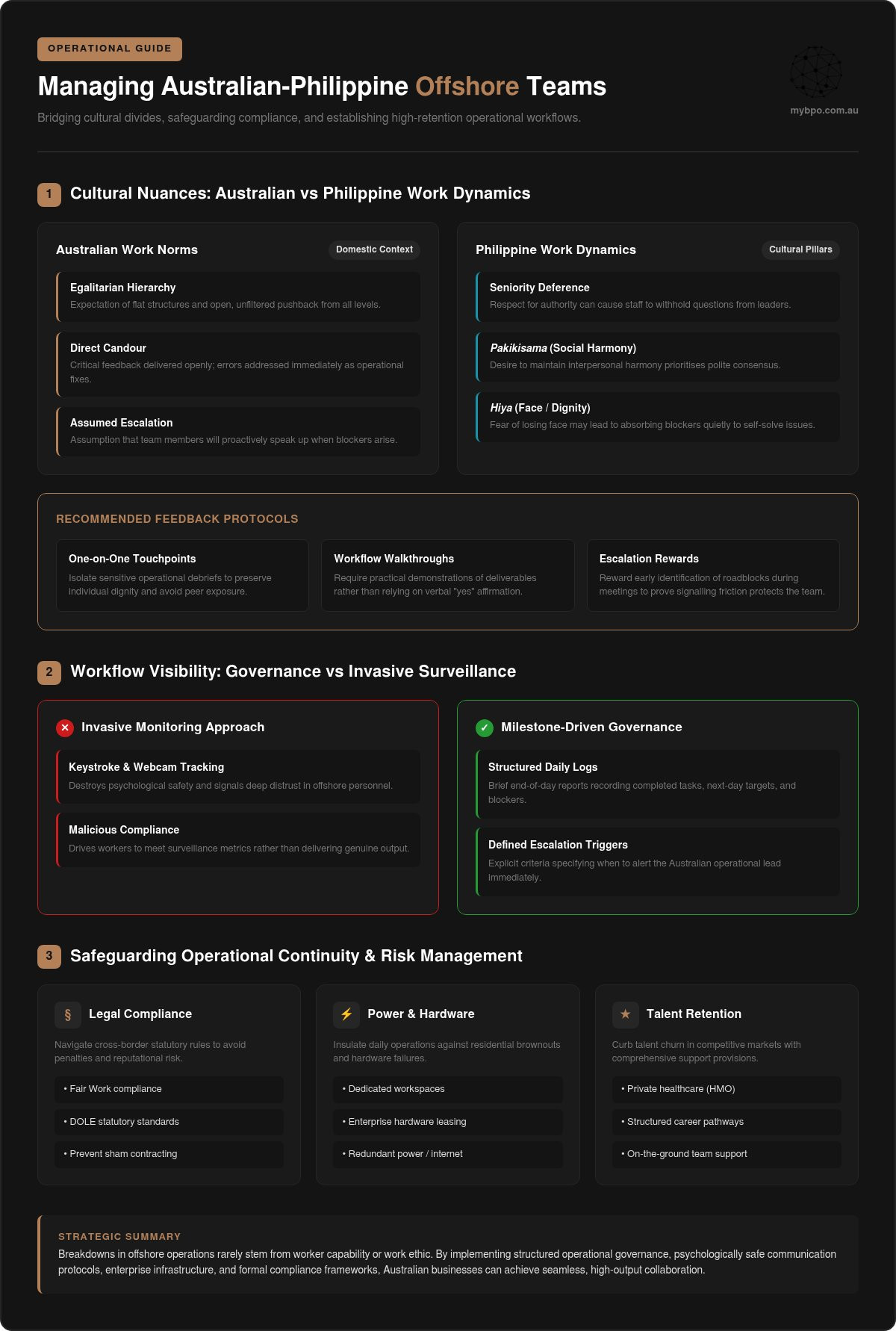
Australian operational culture thrives on egalitarianism, flat leadership hierarchies, and rapid, unfiltered pushback. By contrast, corporate environments in the Philippines are traditionally structured around deference to seniority and managerial authority. This structural contrast forms one of the foundational challenges of managing a filipino team. When offshore staff perceive leadership as an unassailable authority figure, they instinctively withhold critical questions. This creates an invisible operational bottleneck where unvoiced operational risks quietly jeopardise delivery schedules.
The Mechanics of Pakikisama and Hiya in Workplace Dynamics
Two cultural pillars govern Philippine professional engagement: pakikisama (the deliberate maintenance of social harmony) and hiya (the avoidance of shame or losing face). When Australian managers deploy unvarnished candour, offshore personnel can interpret the critique as a personal rebuke rather than a routine workflow correction. Consequently, hiya suppresses early escalation; personnel often absorb emerging blockers quietly, attempting individual fixes rather than signalling failure. If operational leadership fails to account for this dynamic, small technical impediments inevitably compound into major delivery deficits.
Reframing Feedback Protocols for Transparent Collaboration
Solving this breakdown requires leaders to abandon open-ended validation. Closing a meeting with “Does everyone understand?” inevitably elicits polite consensus. Australian managers must replace casual checks with repeatable, psychologically safe protocols:
- Isolate sensitive operational debriefs within one-on-one touchpoints to eliminate peer exposure and preserve individual dignity.
- Require personnel to demonstrate expected deliverables through practical workflow walkthroughs rather than relying on verbal affirmation.
- Reward early blocker escalation during team meetings, proving that highlighting friction protects the entire business.
Bridging the Directness Divide Between Australia and the Philippines
Operational efficiency relies on removing ambiguity from instructions. While statutory employment parameters codified in the Labor Code of the Philippines establish baseline workplace rights, daily cross-border collaboration requires proactive communication disciplines. Structure written project briefs with explicit acceptance criteria, decoupling task feedback from personal capability. By instituting dedicated bilateral review windows during weekly retrospectives, businesses resolve operational hesitation, turning the systemic challenges of managing a filipino team into a predictable, high-output collaboration.
Overcoming Operational and Workflow Visibility Bottlenecks
Cross-border operational drag rarely stems from intentional misconduct. It develops when Australian businesses apply domestic supervision tactics to offshore workflows without setting up structured accountability systems. Without clear frameworks, silent delays take root. Team members wrestle with blockers privately rather than flagging them early. This dynamic represents one of the most persistent operational challenges of managing a filipino team, turning manageable technical hiccups into missed client milestones. Implementing a cohesive operational framework—such as deploying Trinity One to integrate machine operations with people management—helps organisations establish the structured visibility required to prevent these workflow bottlenecks.
Mitigating Silent Bottlenecks and Unreported Roadblocks
Direct intervention is required to stop unescalated bottlenecks before delivery dates fail. Left unchecked, unresolved operational hurdles compound rapidly. Addressing the broader cultural challenges for managers means shifting from verbal follow-ups to documented, predictable escalation pathways:
- Mandate brief, written end-of-day logs that record completed tasks, next-day targets, and immediate operational blockers.
- Establish defined escalation triggers that specify exactly when an offshore specialist must notify their Australian operational lead.
- Acknowledge and commend early roadblock identification, reassuring personnel that raising alerts is a positive operational contribution.
Deploying Milestone-Driven Governance Without Toxic Micromanagement
Attempting to fix visibility gaps with invasive keystroke surveillance tools or webcam trackers destroys psychological safety. It drives talent toward malicious compliance rather than genuine output. Sustainable management relies on clear, milestone-driven deliverables anchored to objective business outcomes rather than logged screen minutes.
Map every recurring task directly to documented standard operating procedures (SOPs) on centralized project boards. When team members can see task dependencies, delivery stages, and explicit quality benchmarks, uncertainty disappears. For Australian businesses that want to streamline this operational structure, pairing offshore staff with professional on-the-ground management through dedicated virtual assistants establishes daily accountability while preserving operational goodwill.
Capitalising on Australian and Philippine Time Zone Alignment
The minimal two-to-three-hour time variance between Australia and the Philippines provides an exceptional operational advantage if scheduled deliberately. Organisations should partition the working day into distinct collaboration and execution phases:
- Schedule synchronous team standups, sprint reviews, and briefing sessions during overlapping morning hours.
- Reserve uninterrupted afternoon blocks for offshore personnel to concentrate on core deliverables without meeting interference.
- Standardise asynchronous handoffs at the close of the Australian trading day, ensuring pipeline momentum continues uninterrupted across jurisdictions.
Structuring your daily operating rhythms this way transforms the operational challenges of managing a filipino team into a responsive, highly disciplined cross-border asset.
Navigating Legal Frameworks, Sham Contracting, and Statutory Rules
Directly engaging overseas personnel as independent contractors creates severe regulatory vulnerabilities for Australian companies. While commercial leaders often focus on workflow alignment, regulatory compliance forms the most legally hazardous dimension among the challenges of managing a filipino team. When an organisation directs day-to-day tasks, enforces core operating hours, and provides primary tools, domestic and international authorities deem that worker an employee, irrespective of what the contractor agreement claims.
The True Exposure of Sham Contracting and Dual-Jurisdiction Liability
Australian Fair Work legislation assesses the multi-factorial reality of workplace control, not merely contractual labels. Direct contractor models regularly collapse under cross-border scrutiny, exposing businesses to retroactive benefit claims and severe penalties as outlined in sham contracting Philippines risk audits. Simultaneously, ongoing direct management can inadvertently trigger permanent establishment exposure, subjecting your Australian entity to foreign corporate taxation.
Deciphering Mandatory Philippine Statutory Benefits and Entitlements
Legitimate employment in the Philippines demands compliance with non-negotiable social safety structures. By 2026, statutory requirements mandate precise payroll administration:
- Social Security System (SSS) contributions stand at 15%, split between employer (10%) and employee (5%), capped at a ₱35,000 monthly salary credit.
- Philippine Health Insurance Corporation (PhilHealth) premiums require a 5% baseline split evenly between employer and worker.
- Pag-IBIG Home Development Mutual Fund contributions mandate ₱200 monthly allocations each from employer and employee.
- Under Presidential Decree No. 851, mandatory 13th-month pay equals one-twelfth of basic annual earnings and must disburse on or before December 24.
Administering these statutory deductions manually presents immense operational drag. Managing these liabilities requires an established payroll Philippines for Australian companies system that prevents non-compliance penalties.
Termination Vulnerabilities and Philippine Labor Code Compliance
Dismissing underperforming cross-border personnel is heavily regulated. The Australian concept of probationary at-will dismissal does not exist under the Philippine Labor Code. Terminations require substantive “just cause” alongside strict procedural due process via the mandatory twin-notice rule. An employer must issue a formal notice to explain granting a five-day response window, followed by a formal hearing before issuing any termination decision.
Failing to execute this procedural process triggers severe illegal dismissal claims. Engaging a certified employer of record Australia establishes an essential compliance shield. The EOR acts as the direct legal employer on the ground, absorbing local statutory liabilities while insulating your enterprise from cross-border employment exposures. This removes the acute legal challenges of managing a filipino team from your direct corporate risk profile.
Securing Hardware, Power Continuity, and Corporate Data Integrity
Physical and technological disruptions represent the most underestimated operational challenges of managing a filipino team. Australian executives frequently assume residential telecommunications across Southeast Asia match domestic standards. In reality, residential power brownouts, municipal grid fluctuations, and severe monsoon events can sever connectivity without warning. Relying on remote home setups without operational redundancy transforms routine weather into critical business downtime.
Mitigating Regional Power Instability and Connectivity Failures
Residential work arrangements carry systemic physical vulnerabilities. When municipal grids drop, home fibre connections fail simultaneously. Securing business operations requires robust infrastructure safeguards:
- Mandate uninterrupted power supply (UPS) hardware paired with dedicated secondary cellular failover modems for remote staff.
- Establish severe weather protocols defining operational handoff triggers well before typhoon systems disrupt local utilities.
- Transition business-critical functions out of home environments entirely by securing a dedicated workspace Philippines facility backed by commercial generators and enterprise fibre connections.
Hardware Provisioning, Endpoint Security, and Device Management
Permitting offshore personnel to operate on personal computers introduces critical vulnerabilities. Unmonitored personal devices blur data boundaries, leave security patches unmanaged, and expose proprietary corporate assets to malware. Australian organisations must enforce strict device lifecycle controls.
Deploy enterprise hardware through dedicated equipment leasing programmes that deliver encrypted, standardised machines directly to personnel. Enrol every endpoint into modern mobile device management (MDM) platforms. This allows your IT administrators to monitor patch cycles, block external storage peripherals, and enforce multi-factor authentication across every business application.
Upholding Compliance with Australian and International Privacy Principles
Cross-border data flows carry heavy regulatory responsibilities. Managing offshore specialists requires strict compliance with both the Australian Privacy Principles (APPs) and the Philippine Data Privacy Act (RA 10173). Australian organisations remain strictly accountable for overseas privacy infractions. The Philippine National Privacy Commission mandates that reportable data breaches be documented and notified within 72 hours of discovery.
To eliminate these compliance exposures, restrict core database access behind secure virtual private network (VPN) tunnels with role-based identity management. Combine this technical architecture with robust non-disclosure agreements that are legally enforceable in both Australian and Philippine courts. If you need to insulate your enterprise from these operational disruptions, partner with MyBPO to secure dedicated infrastructure that protects operational continuity and shields your critical assets.
Building High-Retention Teams: Engagement, Growth, and On-the-Ground Support
Talent attrition across Southeast Asian labour markets represents a major operational vulnerability for expanding firms. While vetting candidates effectively using AI powered employment screening ensures strong technical and cultural alignment from the outset, one of the ongoing challenges of managing a filipino team is recognising that base salary increases alone do not build organisational loyalty. Long-term workforce retention demands structural engagement, clear career pathways, and physical operational stewardship.
Comprehensive Healthcare and Wellness as the Ultimate Retention Anchor
Statutory healthcare provides a baseline, but it does not protect families against catastrophic medical debt. In Philippine culture, extended family welfare heavily influences career decisions. Offering comprehensive private Health Maintenance Organisation (HMO) coverage that includes dependents acts as the ultimate retention anchor. When an enterprise absorbs health risks for an employee’s spouse, children, or elderly parents, unplanned attrition drops significantly. It transforms a transient working arrangement into a secure, long-term commitment.
Structuring Meaningful Career Trajectories and Professional Development
High-calibre professionals quickly disengage when relegated to dead-end support tasks without professional progression. If offshore talent cannot see a future within your organisation, they seek outside opportunities. Mitigate this risk by implementing structured quarterly capability reviews linked directly to tiered skills curricula. Involve your offshore specialists in Australian planning meetings and workflow architecture. When personnel see clear pathways into senior technical leadership or operational oversight, engagement shifts from simple task compliance to active value creation.
Bridging the Distance with On-the-Ground Operational Infrastructure
Supervising remote specialists purely through video conferencing apps inevitably leaves personal distress and interpersonal friction undetected. Australian leaders cannot resolve local workplace disputes or pastoral issues effectively across thousands of kilometres. Successful cross-border operations solve this by aligning modern offshore recruitment Philippines practices with physical on-the-ground management facilities.
Maintaining a tangible operational presence provides physical human resource stewardship, local cultural mediation, and prompt in-person intervention. Having seasoned local infrastructure absorbs administrative stress, turning the conventional challenges of managing a filipino team into a stable, high-retention competitive advantage.
Transforming Cross-Border Vulnerability into Operational Strength
Resolving the multifaceted challenges of managing a filipino team requires far more than casual remote check-ins. Long-term success demands structural discipline across cross-cultural communication protocols, milestone-driven accountability, and strict statutory compliance. When Australian businesses address unvoiced operational blockers, replace vulnerable home setups with resilient infrastructure, and offer comprehensive healthcare, offshore collaboration transforms from a continuous management risk into an enduring competitive asset.
You don’t have to navigate these cross-border complexities in isolation. As a 100% Australian-owned and operated entity, MyBPO provides local advisory and direct domestic accountability, underpinned by physical operational representation and on-the-ground management facilities in the Philippines. This robust foundation establishes a comprehensive compliance shield that eliminates sham contracting exposures, satisfies local labour codes, and safeguards daily operational continuity. Take control of your international workforce strategy today: secure your offshore operations with MyBPO Employer of Record solutions and lead your global team with complete legal certainty.
Frequently Asked Questions
Why do remote Filipino team members often hesitate to speak up during team meetings?
Cultural norms around workplace hierarchy and hiya (avoiding shame or loss of face) lead Filipino professionals to prioritise group harmony over direct confrontation. In traditional settings, questioning leadership or surfacing blockers in public meetings is perceived as disrespectful. To overcome these conversational challenges of managing a filipino team, Australian managers should conduct private one-on-one catchups and ask specific questions that invite safe operational clarity.
How does an Australian company legally dismiss an underperforming employee in the Philippines?
Dismissing workers in the Philippines requires establishing substantive “just cause” under the Labor Code and strictly adhering to procedural due process via the twin-notice rule. Employers must serve an initial written notice detailing infractions with at least five calendar days to respond, convene a formal administrative conference, and issue a second written notice of termination. Skipping these steps exposes businesses to severe illegal dismissal liabilities.
Can an Australian business hire remote staff in the Philippines as independent contractors?
While engaging direct contractors is common, doing so carries severe legal risks if the worker operates under set hours, direct control, and core operational integration. Both Australian Fair Work authorities and Philippine labour bodies apply multi-factor control tests to determine true employment status. If regulatory audits determine that sham contracting occurred, your organisation faces back pay, statutory tax liabilities, and punitive cross-border penalties.
What is 13th-month pay in the Philippines and is it legally mandatory for Australian employers?
Mandated under Presidential Decree No. 851, 13th-month pay is an obligatory statutory payment equal to one-twelfth of an employee’s basic annual salary, payable on or before December 24 each year. It is not an optional performance bonus; it is an entitlement for all rank-and-file staff who have completed at least one month of service. Engaging staff through an Employer of Record ensures this mandatory calculation runs accurately.
How do Australian companies manage internet outages and power blackouts with remote staff?
Organisations protect workflow continuity by enforcing strict hardware redundancies and transitioning away from fragile residential setups. Practical steps include provisioning enterprise-grade equipment leasing, secondary cellular failover modems, and uninterruptible power supply units. For critical operational functions, Australian enterprises frequently relocate team members into secure commercial dedicated workspaces equipped with backup generators, dual commercial internet links, and strict physical security controls.
What is the best way to deliver constructive performance feedback to a Filipino worker?
The most effective approach isolates operational critique from personal character within private one-on-one discussions. Avoid abrupt public corrections, which trigger cultural withdrawal and embarrassment. Frame feedback around objective deliverables and clear standard operating procedures rather than subjective assessments. Asking team members to walk through practical next steps confirms mutual understanding while reinforcing confidence, effectively neutralising one of the subtle interpersonal challenges of managing a filipino team.
How does an Employer of Record solve management and compliance challenges for Australian firms?
An Employer of Record (EOR) serves as the legal employer of your Philippine personnel, assuming total statutory responsibility for local labour laws, social insurance, and tax withholding. This legal structure shields Australian companies from cross-border sham contracting penalties and permanent establishment risk. By providing dedicated workspaces, equipment leasing, and local operational support, an EOR allows your leadership to manage daily deliverables with complete legal protection.
Need a strategy session?
Tell us about your team and we will map out the right structure, fixed-cost quote included.
Book a call