Blog
DOLE Audit Checklist for Australian Employers: Prepare Your Philippine Workforce Records

A payroll file can look complete and still contain gaps when compared with contracts, time records or personnel information. For Australian businesses employing people in the Philippines, a DOLE audit checklist for australian employers provides a practical way to organise records and check whether details align before they are reviewed.
It can be difficult to know which Philippine employment records to assemble, particularly when payroll and workforce administration span two countries. Missing documents, mismatched details or unclear ownership can slow your response and make it harder to distinguish Philippine employment arrangements from Australian responsibilities.
This guide sets out a structured approach to reviewing employment contracts, payroll, time and attendance records, personnel files and contribution records. Use it to identify gaps, assign an owner, and record each item’s date and status rather than relying on an informal document collection. There’s no single static checklist for every situation. The goal is to build a traceable set of records and a coordinated process for responding to an inspection. We’ll also explain how an Employer of Record arrangement can clarify employment administration while Australian and Philippine responsibilities remain distinct.
Key Takeaways
- Use the DOLE audit checklist for australian employers as a preparation tool, not a legal determination of compliance.
- Organise workforce records by employee and record type, then check that employment terms, payroll information and payment evidence align.
- Assign a clear owner to maintain, review and retrieve each record so responsibilities don’t get lost across teams or borders.
- Follow a controlled review cycle: define the scope, collect and reconcile records, assign gaps, review the outcome and retain a traceable record of decisions.
- Clearly allocated EOR-supported employment administration can make records easier to manage, while Australian businesses still need to coordinate their responsibilities.
DOLE audit checklist for Australian employers: understand the scope first
Before gathering files, establish what kind of review you’re preparing for and which workers and arrangements it covers. DOLE is the Philippines’ Department of Labor and Employment. The department’s role and structure are outlined by the Department of Labor and Employment (Philippines), but an overview is not a current inspection instruction. Compare the terminology and scope in any request with the relevant, current DOLE communication or official guidance.
There is no single checklist that determines whether every employer is compliant. Treat a DOLE audit checklist for australian employers as a preparation tool: it helps organise records, identify discrepancies and establish who can retrieve evidence. Applicable requirements may depend on the employment arrangement, where the work is performed and current rules. Don’t assume that another employer’s document request or experience applies to your situation.
What does a DOLE audit checklist help an employer prepare?
Use the checklist to structure a review of records, processes and supporting evidence, not as a substitute for requirements that apply to your situation. For example, if a worker’s contract describes different terms from those shown in internal payroll information, flag the mismatch for investigation. Don’t treat either record as conclusive until the difference is understood.
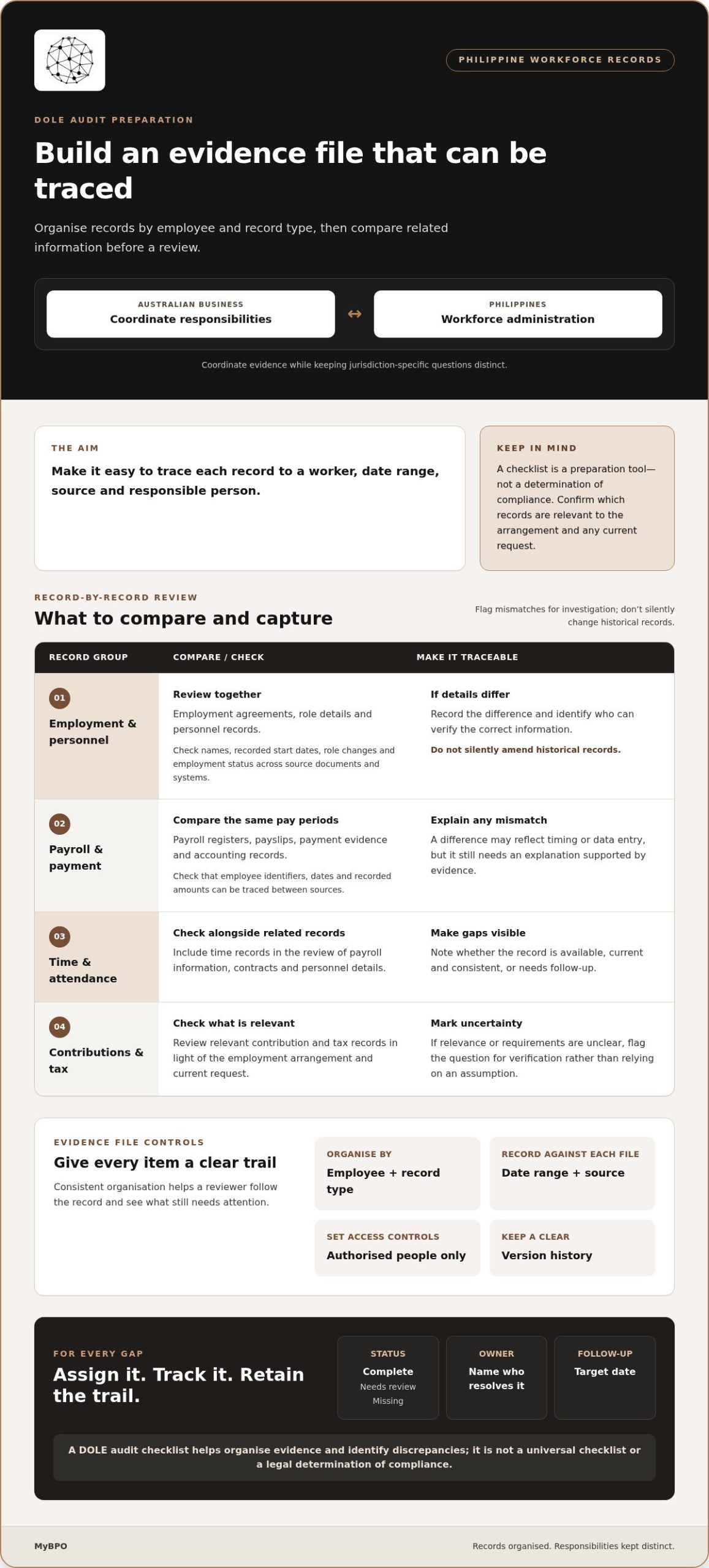
For each item, note whether it is available, current and consistent, and name the person responsible for resolving any gap. A simple status such as “complete”, “needs review” or “missing”, paired with an owner and follow-up date, makes outstanding work visible before a response is needed. It also avoids assuming that every inspection follows the same format.
Where Philippine and Australian responsibilities meet
Separate the questions by jurisdiction. For staff working in the Philippines, identify the employment arrangement and the Philippine records and rules relevant to it. Then consider whether the Australian business has separate workplace obligations to assess. The answer can depend on the facts, so don’t assume that a Philippine arrangement either creates or removes a particular Australian obligation.
The Fair Work Act offshore staff guide provides related context for Australian employers reviewing offshore work arrangements. Use it as a starting point, not a final legal conclusion. Have jurisdiction-specific questions checked against current official guidance and by a qualified adviser.
A practical scope note helps teams avoid mixing records or applying the wrong standard. Before collecting documents, record:
- which workers and employment arrangements are in scope;
- where each worker performs their work;
- the review or inspection terminology used in current communications;
- which Philippine and Australian questions need separate assessment; and
- who will verify uncertain requirements, including the source and date checked.
This first step sets boundaries for the rest of the review. It helps Australian decision-makers and Philippine workforce administrators coordinate evidence while keeping jurisdiction-specific obligations distinct. If the arrangement or applicable rule is unclear, mark it for qualified review rather than filling the gap with an assumption.
Build the DOLE audit evidence file: employment, payroll and personnel records
A useful evidence file is more than a folder of documents. It should let a reviewer trace each record to a worker, date range, source and responsible person. Organise files consistently by employee and record type, then use access controls so sensitive personnel and payroll information is available only to authorised people. Keep a clear version history. Replacing an outdated file without recording the change can make it difficult to explain which information was relied on.
The DOLE audit checklist for australian employers should guide a structured comparison, not imply that every listed record is universally required. Confirm which records are relevant to the employment arrangement and any current request. For each file, record whether it is available, current and reconciled, or needs follow-up.
Employment and personnel file checks
Review available employment agreements, role details and personnel records together. Check that names, recorded start dates, role changes and employment status align across source documents and systems. If a role change appears in one system but not another, record the difference and identify who can verify the correct information. Don’t silently amend historical records to make them appear consistent.
Turn each missing or unclear item into a specific action with a named owner and target date. This creates an accountable trail and makes unresolved gaps visible before the evidence file is finalised.
Payroll and statutory record checks
Compare payroll registers with payslips, payment evidence and accounting records for the same pay periods. Check that employee identifiers, dates and recorded amounts can be traced between sources. A mismatch may reflect a timing or data-entry issue, but it still needs an explanation supported by evidence. Review relevant contribution and tax records against current Philippine requirements, noting the source and date used for the check rather than relying on an old calculation.
For a deeper discussion of payroll records and Philippine requirements, use this Philippine payroll compliance reference. Keep detailed contribution rules and changing thresholds in that separate review, and verify current figures before applying them to a particular worker or period.
Build an evidence index alongside the files. A spreadsheet can capture:
- Worker and record type: identify the person and category without placing unnecessary personal details in the index.
- Date range and version: show the period covered and the current file version.
- Owner and storage location: state who maintains the record and where authorised staff can retrieve it.
- Review status and action: note whether it has been checked, what remains unresolved, who owns the next step and the target date.
This structure helps Australian decision-makers coordinate with Philippine workforce administrators without blurring who holds each record. For employers using an EOR, clearly allocated employment administration can make ownership and retrieval easier to manage. MyBPO provides EOR services and on-the-ground support for Philippine workforces. Explore MyBPO’s Philippine workforce support as one operating model for organising these responsibilities.
Check responsibility, record consistency and cross-border control gaps
Records can exist and still be difficult to produce if no one knows who maintains them, who checks changes or who can retrieve the latest version. For an Australian business with a Philippine workforce, map responsibilities to the actual employment arrangement rather than inferring them from a job title or an old email chain. The DOLE audit checklist for australian employers is more useful when each record has a named owner and a defined route for review and escalation.
Map accountability before an audit request arrives
Name a primary contact in Australia and a counterpart who can coordinate Philippine records. Document who approves employment-data changes, maintains each record set, checks it for consistency and retrieves it if requested. This avoids a common control gap: one team assumes another has the current file, while neither is responsible for confirming its accuracy.
A simple matrix makes the hand-offs visible:
- Maintain: who enters or updates the record and where the authoritative version is stored.
- Check: who compares changes against the relevant source information.
- Approve: who authorises changes to employment or payroll data.
- Retrieve and escalate: who assembles the record and refers unresolved questions to the appropriate decision-maker.
Administration support, including support delivered through an Employer of Record (EOR), can help organise these tasks. It doesn’t by itself settle legal questions or remove the need for the business to understand its own responsibilities. The Employer of Record Australia guide explains the operating model in more detail. Whether records are managed internally or with EOR support, define the actual division of work and keep Australian and Philippine responsibilities distinct.
Spot discrepancies before they become audit delays
Compare records using consistent identifiers and matching periods. For example, check that a worker’s name and role details align across their agreement, personnel file and payroll record. Then compare payroll period dates with attendance information and payment evidence. A mismatch isn’t proof of non-compliance, but an unexplained difference weakens traceability and can make a record harder to interpret.
Flag duplicate files, unexplained corrections, missing approvals and records with no clear owner. Keep the original evidence, note the discrepancy, and record who is investigating it and what source will help resolve it. Avoid overwriting a record or backdating an explanation. Where applicable, a documented correction should show what changed, when it was reviewed and who approved the update.
Consistent records help a reviewer follow the path from employment terms to recorded work, payroll treatment and supporting evidence. They also give decision-makers a clearer basis for answering questions without relying on memory or recreating events under time pressure. Use the responsibility matrix to assign each discrepancy, track its status and confirm that the resolution is reflected in the appropriate records. This turns a collection of files into a traceable account of how information is maintained and checked across the Australian and Philippine teams.
Run the DOLE audit checklist in a controlled review and remediation cycle
A controlled review turns preparation into a sequence of decisions, checks and documented actions. Apply the DOLE audit checklist for australian employers to the actual scope of a request and current requirements, rather than treating it as a fixed list that applies to every situation. Set an internal review date, nominate a coordinator and record the source and date for each requirement checked. This gives the Australian business and Philippine workforce administrators a shared basis for managing the work.
A practical sequence for internal readiness
Start by reading the actual notice or communication carefully. Confirm which records and periods it covers, who issued it, and any response dates stated in it. Don’t substitute an internal target date for a deadline in the notice. If a date or instruction is unclear, escalate it for confirmation against the specific communication and current official guidance.
Then move through the review in order:
- Scope: identify the workers, arrangements and periods in focus.
- Collect: retrieve records using the evidence index and check that files open, are legible and cover the stated period.
- Reconcile: compare relevant records and note inconsistencies rather than assuming they match.
- Assign gaps: record each exception, its owner, the corrective action and an internal target date.
- Review: check completed actions and retain evidence showing how each issue was resolved.
- Retain: preserve the response set, review notes and requirement references in a controlled location.
An evidence register is the audit file’s index of documents and owners. It records where each item is stored, the period it covers, its review status and any action needed.
Escalate legal and material record issues appropriately
Some gaps are administrative, such as a file stored under the wrong name or an unclear scan that can be replaced with a readable copy. Others may affect how an employment arrangement or record should be understood. Separate those questions and refer jurisdiction-specific issues for qualified Philippine legal advice rather than treating an administrative fix as a legal conclusion.
Keep the source record intact. Don’t backdate a document, alter historical information without a transparent correction trail or mark an unresolved gap as complete. If a correction is made, preserve enough context to show what changed, when, by whom and on what basis. Before sending material externally, verify response obligations and timelines against the specific notice and current official guidance.
Employment records may contain sensitive personal and payroll information. Limit access to authorised people, use controlled channels to share files, and keep a record of what was provided and when. These safeguards help reduce accidental disclosure and make the response easier to trace.
For Australian businesses coordinating Philippine employment administration, MyBPO’s Employer of Record services provide an operating model for allocating workforce administration. Build a clear review cycle around the arrangement so responsibilities and unresolved issues remain visible.
Use clear employment administration to strengthen DOLE audit readiness
Audit readiness depends not only on which records exist, but also on whether the people responsible can organise and retrieve them. Clearly allocated employment administration gives Australian decision-makers and Philippine workforce administrators a shared understanding of who maintains information, who checks it and where questions should go. That structure can make records easier to manage and review, but it doesn’t establish compliance by itself.
When EOR-supported administration may fit an Australian employer
An Employer of Record (EOR) arrangement can provide an operating structure for employing staff in the Philippines and organising employment administration. With responsibilities assigned clearly, the Australian business can coordinate with the Philippine employment arrangement on workforce records and operational questions. MyBPO provides EOR services for Australian companies employing in the Philippines, with on-the-ground workforce support.
The value is clarity, not a shortcut around obligations. An EOR doesn’t automatically remove Australian responsibilities or replace qualified legal advice on jurisdiction-specific questions. Employers still need to understand how their own arrangements work, keep appropriate oversight and coordinate records across both countries. Worker classification is a separate issue from audit-file organisation; the sham contracting risk guide explores that distinct topic.
Make the next audit-readiness actions manageable
Start with a responsibility map and a current evidence index. Use them to confirm who maintains each record, where it is stored and who can retrieve it. Then prioritise unresolved discrepancies rather than trying to close every issue at once. For each gap, document the known facts, assign an accountable owner and record the follow-up action and its status. If an issue raises a legal question, separate it from routine administration and seek qualified advice.
Keep the process active. Set a review date, update the index when employment information changes, and note the source and date whenever requirements are checked. If a request arrives, this groundwork gives the team a clearer starting point without assuming every inspection or employment arrangement is the same.
A practical next step is to test the process against one worker’s records: can the assigned people locate the relevant files, identify their versions and explain any unresolved differences? Use the result to improve the responsibility map before applying it across the workforce. For Australian employers considering a more clearly structured Philippine employment arrangement, discuss Philippine employment arrangements with MyBPO.
Make audit readiness part of your workforce process
Audit preparation is more reliable when it’s built into ordinary employment administration rather than left until a request arrives. Use the DOLE audit checklist for australian employers as a prompt to keep record ownership clear, review changes consistently and follow up unresolved issues. As your workforce or employment arrangements change, revisit who maintains the evidence and how Australian decision-makers can access it.
For some Australian businesses, an Employer of Record arrangement can provide a clearer structure for Philippine employment administration. MyBPO is an Australian-owned and operated business providing EOR services for Australian companies hiring in the Philippines, with on-the-ground workforce support. An EOR can help organise administration, but it doesn’t remove every Australian responsibility or replace qualified legal advice where needed.
If you’re considering how to structure employment administration for your Philippine workforce, discuss a structured Philippine employment arrangement with MyBPO. A clear operating model can help your team take the next steps with greater confidence and keep audit readiness on the agenda.
Frequently Asked Questions
What is a DOLE audit checklist for Australian employers?
A DOLE audit checklist for Australian employers is a working tool for preparing records and coordinating a response to a Philippine labour inspection. It isn’t a single official checklist or proof of compliance. Tailor it to the employment arrangement and any actual inspection communication. For example, record which requirements have been checked, the source used and when it was reviewed, so your team can distinguish verified information from assumptions.
Can DOLE audit an Australian company with employees in the Philippines?
Philippine employment performed in the Philippines may be subject to Philippine labour standards, but the implications for an Australian company depend on its employment arrangement and the facts. Identify who employs the workers, where they perform their work and what the arrangement provides. Then check current Philippine guidance and get qualified advice on jurisdiction-specific questions. Don’t assume that an Australian company’s location alone settles which requirements apply.
What records should an employer prepare for a DOLE audit?
Prepare records relevant to the actual request and employment arrangement, which may include agreements, personnel information, payroll records, time or attendance data and evidence relating to payments or contributions. There isn’t a universal request that applies to every employer. Check the notice for its scope, then select records that address it. Note each file’s date range and source, and avoid sending unrelated personal information unnecessarily.
How often should an Australian employer review Philippine employment records?
There’s no single review frequency that suits every workforce or arrangement. Set an internal schedule that aligns with your payroll and administration cycles, and trigger an additional check when a worker’s role, employment terms or status changes. For instance, after an approved role change, compare the updated information across relevant systems. Record the review date and unresolved issues so the next review can pick up outstanding actions rather than start from scratch.
Does using an Employer of Record remove an Australian company’s compliance responsibilities?
No. An Employer of Record can provide an operating structure for Philippine employment administration, but it doesn’t automatically remove every responsibility an Australian business may have. Responsibilities depend on the arrangement and applicable rules. Document which tasks the EOR handles and what remains with your business, including who reviews information and escalates concerns. Seek qualified advice for legal conclusions; administrative support is not a substitute for that advice.
What should an employer do if it finds missing or inconsistent records?
Record the gap accurately, preserve the source material and assign someone to investigate it. For example, if a payroll entry differs from a payment record, note the period and discrepancy, then identify what evidence could explain the difference. Don’t backdate documents or present an unresolved issue as complete. If the discrepancy raises a legal question or affects a response to an inspection, seek qualified advice and check the specific notice for relevant instructions.
Need a strategy session?
Tell us about your team and we will map out the right structure, fixed-cost quote included.
Book a call