Blog
Filipino Team Communication: 2026 Guide for Australian Firms

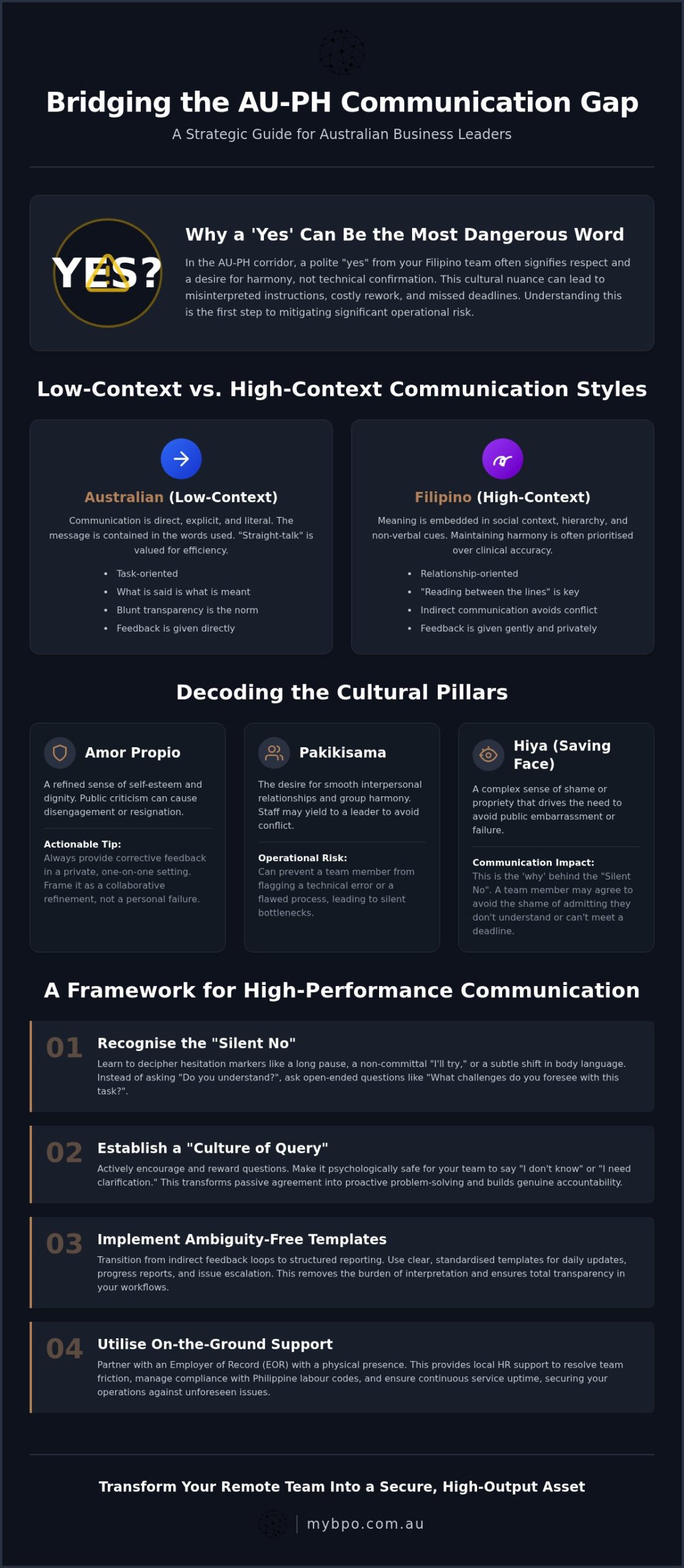
A polite “yes” from your remote staff is often the most dangerous answer an Australian business owner can receive in the AU-PH corridor. When cultural harmony is prioritised over technical clarity, the result is rarely just a missed deadline; it’s a structural risk to your operations. You’ve likely experienced the frustration of misinterpreted instructions leading to costly rework or a lack of honest feedback that leaves you flying blind. Establishing communication best practices with filipino teams is the only way to move beyond this silence and ensure your offshore staff are truly aligned with your commercial objectives.
Mastering these nuances is no longer just a soft skill for 2026. It’s a critical risk management function. This guide will show you how to transform passive agreement into proactive reporting while securing your firm against the evolving interpretations of the Fair Work Act and Philippine labour codes. We’ll outline a structured framework to mitigate operational liability, organise your workflows for total transparency, and build a high-performance culture that respects local values like hiya without compromising your Australian standards of accountability. By the end of this article, you’ll have a roadmap to turn your remote team into a secure, high-output asset.
Key Takeaways
- Decode the cultural “saving face” phenomenon to understand why an affirmative “yes” might signify respect rather than technical confirmation.
- Implement communication best practices with filipino teams to establish clear operational control and mitigate the risk of sham contracting reclassification under Fair Work.
- Transition from indirect feedback loops to a “Culture of Query” where proactive reporting is standardised through clear, ambiguity-free templates.
- Discover why high-context communication requires reading between the lines to protect your project timelines from hidden operational bottlenecks.
- Secure your operations by utilising on-the-ground infrastructure and EOR support to resolve team friction and ensure continuous service uptime.
The AU-PH Communication Gap: Why “Yes” Doesn’t Always Mean “Yes”
Australian business owners often encounter a frustrating paradox: a Filipino team member agrees to a deadline but fails to deliver, or confirms they understand a process only to produce work that requires extensive revision. This friction stems from a fundamental divergence in Filipino cultural values, where social harmony often takes precedence over clinical accuracy. While Australians pride themselves on “straight-talk” and blunt transparency, the Philippine professional environment is built on indirect communication. This is not a lack of competence; it is a sign of deep-seated respect.
For an offshore operation, these unvoiced concerns represent a significant operational risk. If a staff member perceives a flaw in your instructions but remains silent to avoid “correcting” a superior, the business absorbs the cost of that silence through rework and lost productivity. Implementing communication best practices with filipino teams starts with understanding that “Yes” is frequently a social placeholder rather than a technical commitment. You must bridge the gap between the Australian expectation of immediate feedback and the Filipino desire for smooth interpersonal relationships.
The Concept of “Amor Propio” and Professional Pride
“Amor Propio” is a refined sense of self-esteem that governs professional interactions in the Philippines. It dictates that a person’s dignity must be preserved at all costs, especially in a workplace hierarchy. If a manager delivers a sharp, public correction during a Zoom call, the consequence is often immediate disengagement or even an abrupt resignation. To secure your team’s longevity, you must adopt a framework for private feedback. Always address errors in a one-on-one setting, framing the correction as a collaborative refinement rather than a personal failure. This approach protects the individual’s pride while ensuring the technical standard is met.
Recognising the “Silent No”
Managers must learn to decipher hesitation markers that signal a “Silent No.” These often manifest as a long pause before answering, a non-committal “I’ll try,” or a subtle shift in body language during video calls. There is a critical distinction between “Yes, I understand” (meaning I hear you) and “Yes, I will do it” (meaning I have the capacity and resources). A “Silent No” is a cultural safeguard against conflict, used when an employee feels that a direct refusal would be impolite or confrontational. Recognising these cues is a core component of communication best practices with filipino teams, allowing you to intercept potential delays before they impact your bottom line.
Deciphering High-Context Culture: The Foundation of Filipino Communication
Effective cross-border collaboration requires more than just clear English; it demands an understanding of cognitive communication styles. Australia is a low-context culture where information is explicit, literal, and direct. In contrast, the Philippines is a high-context culture where meaning is frequently embedded in the social environment, hierarchy, and non-verbal cues. If you rely solely on the literal text of an email or Slack message, you will miss the subtle indicators of project risk. This is why establishing communication best practices with filipino teams involves looking beyond the words to the context of the interaction.
A central pillar of this environment is “Pakikisama,” or the desire for smooth interpersonal relationships. This value often leads staff to yield to the will of the leader to maintain group harmony. While this makes for a pleasant office atmosphere, it can be a liability if it prevents a team member from flagging a technical error. Understanding Filipino communication styles is essential for any manager who wants to move past this surface-level agreement. Building rapport is the only way to mitigate this. In the Philippines, business is personal. You cannot dive into technical tasks without first establishing a human connection. If you haven’t invested time in rapport, your team is unlikely to feel secure enough to challenge your assumptions.
The Role of Hierarchy and Respect
The “Sir/Ma’am” culture is a visible manifestation of the deep respect for hierarchy in the Philippines. While it sounds polite to Australian ears, it can create a barrier to the upward flow of critical information. An Australian manager must actively “earn” the right to receive bad news by consistently demonstrating psychological safety. You can achieve this by rewarding honesty over accuracy in the early stages of a project. Securing your offshore operations begins with these human bridges, but it is reinforced by robust local infrastructure that supports these professional standards.
Contextualising Your Instructions
Moving from “What” to “Why” is a critical shift in your management style. Providing the bigger picture ensures that your team understands how their specific task impacts the overall business objective. Never assume that “common sense” is universal. What is obvious in a Sydney boardroom may not be clear in a Manila office due to different life experiences and professional training. Use “Check-back” techniques to verify comprehension. Instead of asking “Do you understand?”, ask “Could you walk me through how you plan to approach the first three steps of this task?”. This verifies alignment without causing the employee to lose face.
Compliance-First Communication: Managing Risk under Australian Labour Laws
Managing an offshore team is not merely an operational challenge; it is a significant legal undertaking. Many Australian firms fail to realise that their daily management style can inadvertently create a sham contracting Philippines risk. If you are directing a “contractor” via Slack with the same level of granular control you apply to a local employee, you are generating a paper trail of an employment relationship. Under the Closing Loopholes Act 2025, Australian authorities have increased scrutiny on these “employee-like” arrangements. Establishing communication best practices with filipino teams requires a structured approach that maintains your operational standards without triggering a legal reclassification of your workforce.
The solution lies in using an Employer of Record (EOR) as a professional buffer. An EOR absorbs the legal liability of the employment contract while providing the framework for compliant communication. This ensures that your instructions are interpreted as service requirements rather than direct master-servant commands. Without this layer of protection, your firm remains exposed to jurisdictional complexities and potential back-pay claims that can devastate offshore ROI. Your communication strategy must be designed to prove the independence of the service provider while maintaining the quality of the output.
The “Control Test” in Modern Offshoring
Australian courts and the Fair Work Commission increasingly apply a “control test” to determine the true nature of a worker’s engagement. If an AU manager dictates exactly when, where, and how a task is performed, the worker may be deemed an employee regardless of their contract title. Utilising a specialist employer of record Australia allows you to manage output through structured reporting rather than direct intervention. This creates a clear boundary that protects your business from being identified as the “common law employer” in a foreign jurisdiction. It’s about securing your operations through distance and documentation.
Documenting Performance Legally
Performance management in the Philippines is a highly regulated process that requires strict adherence to the Philippine Labour Code (DOLE). Informal verbal warnings or casual feedback sessions carry no legal weight and can even be used against you in a grievance claim. Effective communication best practices with filipino teams involve documenting every performance milestone through your EOR partner. The EOR acts as the mediator, ensuring that all disciplinary communication follows the “due process” requirements of local law. This protective layer ensures that if a termination becomes necessary, it is legally defensible and operationally secure.
Step-by-Step: Implementing a High-Performance Communication Framework
Theory must eventually give way to a structured operational framework. Moving beyond the “Silent No” requires a deliberate shift in your management architecture. You must establish a “Culture of Query” where asking for clarification is viewed as a professional asset rather than a lack of competence. In a high-context environment, silence is the primary indicator of operational risk. By rewarding team members who flag ambiguities, you actively dismantle the barriers of hiya and amor propio that were detailed in previous sections. This isn’t just about being approachable; it’s about building a fail-safe into your daily operations.
Standardising your reporting templates is the next logical step. Ambiguity is the enemy of compliance and productivity. When you remove the need for staff to “guess” what information you require, you eliminate the stress of potential social friction. Ritualising synchronous check-ins also serves to build the personal rapport necessary for trust. These aren’t just status updates; they’re opportunities to reinforce the human connection that drives Filipino loyalty. Finally, audit your internal tools to ensure they meet Australian security standards while remaining accessible to your offshore staff.
Phase 1: The Onboarding Communication Loop
The first 30 days are critical for setting the trajectory of your collaboration. Implementing
communication best practices with filipino teams
starts with a “management user manual.” This document should explicitly outline your preferred communication channels, response times, and how you prefer to receive bad news. Use video-first communication during this period to establish non-verbal rapport and ensure that your tone isn’t misinterpreted in text. Setting the tone for offshore recruitment Philippines success requires linking these communication habits to clear, measurable KPIs from day one. This ensures that performance is judged on data rather than subjective interpretation.
Phase 2: Transitioning to Proactive Reporting
To move your team toward autonomy, you must provide tools that bypass verbal indirectness. Implementing communication best practices with filipino teams often involves “Red/Amber/Green” (RAG) status reports. A “Red” status is a binary signal that removes the emotional weight of “failing,” allowing the team to report issues without feeling they have lost face. For complex written tasks, adopt the “Three-Sentence Rule”: the first sentence defines the goal, the second outlines the immediate next step, and the third identifies the potential blocker. You can even use “Human in the Loop” AI workflows to scan your own instructions for cultural ambiguity before they reach your team. To ensure these frameworks are supported by the right physical environment, consider securing a dedicated workspace through an Australian-owned partner.
Securing Your Strategy with On-the-Ground Support and EOR Infrastructure
Communication best practices with filipino teams are often treated as purely psychological or digital exercises. This is a narrow view that ignores the physical reality of offshore operations. High-performance output is fundamentally contingent upon stable physical infrastructure. If your team is struggling with frequent power outages or unreliable home internet, no amount of cultural training will fix the communication lag. A dedicated workspace Philippines provides the redundant power and high-speed connectivity required for real-time collaboration. By securing a professional environment, you eliminate the technical friction that often masquerades as a cultural communication breakdown.
Similarly, equipment leasing ensures your staff aren’t using outdated hardware that struggles with modern video conferencing software. Lag in a video call doesn’t just disrupt a meeting; it prevents the reading of non-verbal cues, which is a critical failure in a high-context culture. MyBPO acts as the vigilant guardian of these physical assets, ensuring that the bridge between your Australian office and your Philippine team remains structurally sound. When the technical barriers are removed, your team can focus entirely on the nuances of your instructions.
The Value of Physical Presence
Having an Australian-owned partner physically present in the Philippines changes the dynamic of your offshore operation. It provides a local escalation point to resolve interpersonal friction that simply cannot be managed via a screen. When misunderstandings arise, our on-the-ground managers intervene to navigate the situation, acting as a “Safe Harbour” for your interests. We manage the local administrative hurdles and team dynamics so your managers can focus on clear output. This physical representation absorbs the operational risks that remote-only models cannot mitigate, ensuring that communication best practices with filipino teams are enforced on the floor, not just in a handbook.
Integrating Payroll and HR Communication
Team morale is the foundation of transparent communication. If payroll is delayed or mandatory contributions are mismanaged, trust evaporates and the “Silent No” returns. Payroll Philippines for Australian companies must be handled with surgical precision to maintain this trust. MyBPO absorbs the entire administrative burden of mandatory SSS, PhilHealth, and Pag-IBIG contributions. As of 2026, we ensure SSS contributions (15% of the Monthly Salary Credit) and PhilHealth premiums (5%) are calculated and paid correctly every cycle. When your team feels legally and financially secure, they communicate with greater transparency and loyalty. Secure your offshore team’s success with MyBPO’s EOR services today to bridge the gap between risk and high-performance output.
Securing Your Future in the AU-PH Corridor
Navigating the complexities of cross-border collaboration requires more than just a digital connection. You’ve seen how the divide between Australian directness and Filipino high-context culture can create operational bottlenecks if not managed with precision. By implementing communication best practices with filipino teams, your firm moves from a state of reactive troubleshooting to one of proactive, high-performance output. This transition isn’t just about productivity; it’s essential to mitigate the legal risks associated with sham contracting and evolving Fair Work interpretations in 2026.
Success in this corridor depends on where your team is supported. As an Australian-owned and operated private company, MyBPO provides the compliance shield your business needs. With on-the-ground support in Manila and Bacolod, we are specialists in AU-PH compliance and risk mitigation who absorb the administrative burden of offshore management. We bridge the physical and cultural gap, allowing you to focus on growth while we secure your operations.
Partner with MyBPO for a secure, high-performance offshore team and turn your remote operations into a resilient, long-term asset. Your firm deserves the operational freedom that comes with total regulatory safety.
Frequently Asked Questions
How do I handle a Filipino employee who says “yes” but doesn’t understand the task?
Implement a structured “check-back” process rather than accepting a binary “yes.” Ask your staff member to walk you through their planned approach step-by-step. This identifies gaps in comprehension without causing the employee to lose face. By focusing on the workflow rather than the person, you encourage transparency. This method is a cornerstone of communication best practices with filipino teams, ensuring technical alignment while respecting cultural sensitivities around direct refusal.
Is it okay to use Australian slang or “Aussie-isms” with my offshore team?
Avoid using Australian slang or colloquialisms as they often lead to confusion or misinterpretation. Expressions like “she’ll be right” or “flat out like a lizard” don’t translate well in a high-context culture like the Philippines. Stick to literal, precise language to ensure your instructions are followed accurately. Using clear English reduces the cognitive load on your remote staff and secures your operations against avoidable errors caused by linguistic barriers.
What are the best tools for communicating with a remote team in the Philippines?
Prioritise video-capable platforms such as Zoom or Microsoft Teams to capture essential non-verbal cues. Asynchronous video tools like Loom are also highly effective for providing detailed walkthroughs that staff can review repeatedly. These tools only function reliably when backed by a dedicated workspace with redundant power and high-speed internet. This physical infrastructure ensures that your communication remains consistent and your team stays connected during critical project phases.
Does the Fair Work Act apply to how I communicate with my Filipino staff?
Recent legal decisions, including Sanderson v Brightest Australia Pty Ltd, suggest that the Fair Work Act can apply to overseas employees depending on where the contract was formed. If your daily communication demonstrates a level of granular control similar to a local employee, you risk being classified as a common law employer. This exposure can lead to significant liability regarding back-pay and entitlements. Utilising an EOR structure allows you to manage output while the EOR absorbs the legal risks.
How can I give constructive feedback without offending my Filipino employees?
Deliver all constructive feedback in private, one-on-one settings to protect the employee’s sense of “amor propio.” Frame the discussion as a collaborative effort to improve a specific process rather than a personal critique. Start with positive reinforcement before addressing the error, and conclude with a clear plan for support. This protective approach maintains team morale and ensures your staff remain engaged and productive without feeling publicly shamed or losing their professional dignity.
What is the role of an EOR in managing team communication?
An EOR functions as a professional mediator and a compliance shield for your business. They manage the formal HR and disciplinary communication required by the Philippine Labour Code, ensuring all processes are legally defensible. By absorbing these administrative complexities, the EOR allows your firm to focus on technical delivery. They are instrumental in establishing communication best practices with filipino teams by providing an on-the-ground escalation point for resolving local team friction or cultural misunderstandings.
Why is rapport-building so important in Filipino work culture?
Building rapport is the foundation of trust in a high-context society where personal relationships dictate professional loyalty. Without a human connection, Filipino staff may feel hesitant to voice concerns or report project delays due to the cultural value of “hiya.” Investing time in regular check-ins and personal interest encourages a culture of transparency. This trust is what ultimately allows your team to move beyond polite agreement toward proactive reporting and genuine operational autonomy.
Can I manage my team entirely through email and messaging apps?
Managing a remote team solely through text-based apps is a high-risk strategy that often leads to misinterpreted instructions. Written text lacks the tone and facial expressions that are vital for clarity in the AU-PH corridor. While Slack is useful for quick updates, critical tasks should always be discussed via video to ensure total alignment. Over-reliance on messaging apps increases the likelihood of rework and operational bottlenecks that could be avoided with synchronous communication.
Need a strategy session?
Tell us about your team and we will map out the right structure, fixed-cost quote included.
Book a call