Blog
Offshore Talent Acquisition Australia: 2026 Hiring Guide

A strong offshore hire is shaped before the first CV arrives. For Australian businesses, offshore talent acquisition australia works best when the role, selection criteria and employment structure are clear before sourcing begins.
Distance can make candidate assessment feel harder, and a promising hire can raise questions about the right employment arrangement. Treat recruitment and employment setup as connected but distinct stages. Define the work, assess how the candidate will contribute to your team, then confirm how they’ll be engaged in the Philippines.
This guide sets out a repeatable process for hiring offshore talent, from scoping the role and evaluating candidates to planning the employment handover and onboarding. It also explains what to look for in a recruitment provider, including experience supporting Australian and Philippine hiring, and access to on-the-ground workforce support. You’ll finish with a clearer basis for building an offshore team without leaving hiring quality or employment responsibilities to chance.
Key Takeaways
- Make offshore talent acquisition australia more repeatable by turning the role’s workload, decision rights and success measures into clear selection criteria.
- Use a consistent assessment sequence to compare job-related evidence, interview responses and references instead of relying on résumé presentation alone.
- Understand how recruitment, direct hiring and an Employer of Record arrangement differ in responsibilities, control and operational readiness.
- Use a practical checklist to document who manages each hiring stage, how issues are escalated, and what security and onboarding steps are needed.
- Prepare for a smoother first week with a named manager, written priorities, regular check-ins and measurable expectations for the new team member.
Offshore talent acquisition in Australia starts with a well-defined role
Offshore talent acquisition is the planned process of defining, finding and assessing people in another country for roles that support an Australian business. It involves more than advertising a vacancy overseas. A job ad can attract applicants, but it won’t clarify what the role owns, how success will be measured or how the selected candidate will be engaged. Offshore talent acquisition australia is more reliable when those decisions come before sourcing.
Offshoring describes where work is performed; outsourcing describes a business practice of outsourcing work or functions to an external party. An Australian business hiring a person directly in the Philippines is not automatically outsourcing the role. Define the intended working relationship, responsibilities and employment structure before recruitment begins.
Start with the business goal. If the need is a defined set of recurring responsibilities, one individual may be suitable. If the work requires deep expertise, specify the specialist capabilities needed. If success depends on several complementary capabilities or shared coverage, consider whether the need is team-based. In every case, clarify workload, decision rights, dependencies and who will manage the work. Without that design, candidates may be assessed against assumptions rather than the actual job.
Turn a business need into a candidate-ready role brief
Describe the role in practical terms: core responsibilities, required skills, expected working hours, reporting relationships and decisions the person can make independently. Separate essential capabilities from preferences. Making every desirable tool or industry background mandatory can narrow the candidate pool without improving the match.
Set observable outcomes for the first three to six months, such as completing an agreed workflow, maintaining accurate records or taking ownership of a defined process. These are examples, not universal benchmarks. Choose measures that reflect the actual role and give candidates a fair basis for explaining how they would deliver.
Decide whether offshore hiring suits the work
Assess whether tasks can be completed remotely, which information and systems the person needs, and how much collaboration the work requires. Map dependencies on Australian staff, customers, business hours and internal approvals. Then check whether the manager has enough capacity to set priorities, answer questions and review work.
Before sourcing, identify sensitive data, access controls and any role-specific regulatory questions. Requirements depend on the work and circumstances, so take questions to an appropriately qualified professional rather than making assumptions. If critical access, oversight or collaboration needs can’t be resolved, redesign the role or reconsider the hiring approach before proceeding.
How to source and assess offshore talent for an Australian business
Once the role criteria are set, use the same evidence-based process for every applicant. This reduces the risk of choosing someone on presentation alone and makes decisions easier to explain and review. A practical sequence for offshore talent acquisition australia is:
- Choose sourcing channels. Select channels that reach people with the required skills and experience. If you use a provider, clarify how candidates are sourced and what screening has already taken place.
- Screen evidence. Compare applications with the agreed requirements. Look for specific examples of relevant work, tools used and outcomes achieved. A polished résumé is not proof of capability, and an unfamiliar career path is not, by itself, a reason to rule someone out.
- Interview consistently. Ask shortlisted candidates the same core questions about the work. Invite them to explain how they would approach realistic responsibilities, then ask follow-up questions to clarify their reasoning.
- Check references. With the candidate’s permission, ask relevant referees about responsibilities, work quality and collaboration. Record what was confirmed and any gaps that remain.
- Make and document a decision. Compare each candidate’s evidence with the role criteria. Note unresolved questions instead of treating a strong impression as a substitute for evidence.
Build a fair, repeatable candidate assessment
Use a practical task only when it reflects real responsibilities, such as prioritising a sample inbox for an administrative role or reviewing a fictional data set for an analytical role. Explain the task, assessment criteria and expected time commitment in advance. Score each result against the same criteria, and avoid exercises that request substantial unpaid work unrelated to assessing capability.
A simple assessment record can list each essential requirement, the evidence provided, the interviewer’s notes and any follow-up needed. This gives the hiring team a consistent basis for comparison and helps distinguish a genuine skill gap from an unanswered question.
Check communication and working arrangements
Discuss how the role requires the person to communicate, including written updates, escalation of blockers, handovers and collaboration with Australian colleagues. Confirm availability against the actual schedule and the times when the team needs to work together. Don’t assume a candidate’s working pattern or availability based on their location.
Assess whether the candidate communicates clearly for the tasks, not whether their accent or personality resembles the existing team. Use consistent, job-related criteria and give each person the same opportunity to explain how they handle feedback, ambiguity and competing priorities.
For more detail on sourcing and vetting, read the offshore recruitment Philippines buying guide. Australian businesses considering recruitment support can also review MyBPO recruitment services as one option for connecting candidate selection with the next stage of the hiring plan.
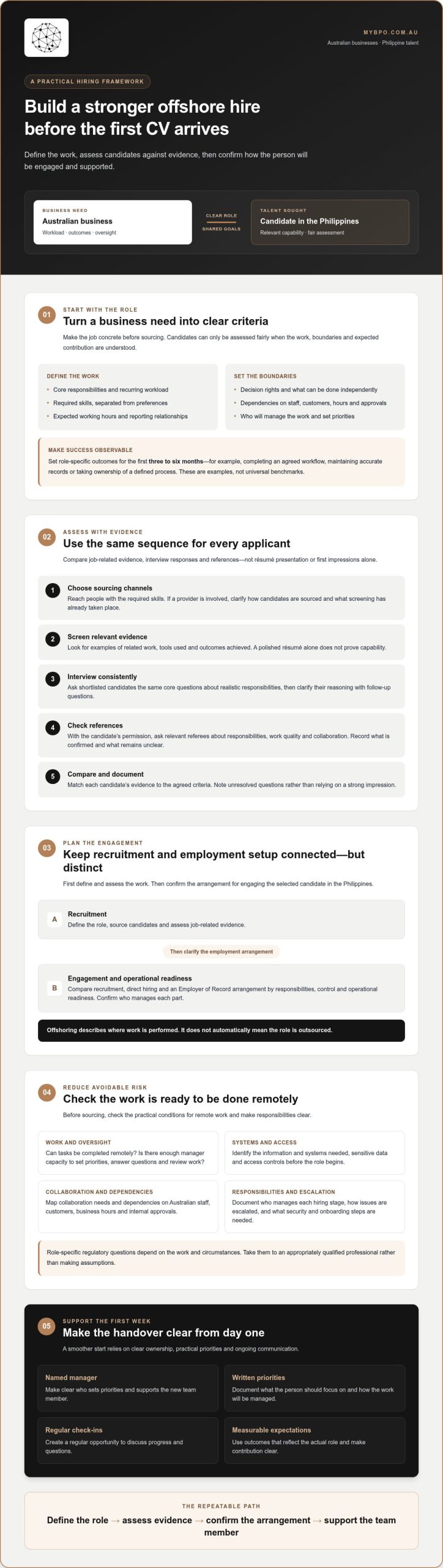
Compare recruitment, direct hiring, and an Employer of Record arrangement
Candidate selection and employment setup solve different problems. Recruitment identifies and assesses potential hires. The employment arrangement determines how the selected person is engaged, who carries particular responsibilities and what operational processes need to be in place. Treating recruitment as the whole hiring process can leave questions about documentation, payroll and compliance unanswered.
Compare the options against your business’s control requirements and readiness to employ someone in the Philippines:
- Recruitment support: A recruitment provider can help source and assess candidates. Confirm where its work ends, what screening it completes and who takes responsibility for the offer, employment documentation and onboarding. Recruitment alone doesn’t establish an employment arrangement.
- Direct hiring: Your business engages the worker directly. This may suit an organisation prepared to manage the required local employment and payroll processes, but the appropriate structure and obligations depend on the circumstances. Confirm these with qualified advisers and authoritative sources.
- Employer of Record (EOR): An EOR service may be relevant when a business wants a provider to support the employment setup for a cross-border hire. Responsibilities vary by agreement, so establish who is the employer, which obligations the provider handles, and how your business directs day-to-day work.
No model suits every Australian business. Consider your workforce plans, desired level of operational control, internal capacity and the jurisdiction-specific obligations that apply. For a deeper explanation, see the Employer of Record Australia guide.
What changes after selecting a candidate?
Map the handover before making an offer. Identify who prepares and issues it, gathers and checks documentation, arranges payroll setup, confirms the employment structure and coordinates onboarding. Ask the provider to document which party owns each step, what information must be supplied and how exceptions or delays are escalated. Check those allocations against the relevant agreements.
A recruitment service may identify a suitable candidate, but that does not, by itself, determine who employs them or who manages payroll and applicable employment obligations. Keep the recruitment decision separate from approval of the proposed employment setup.
When might an EOR structure be relevant?
An EOR arrangement may be worth assessing if you want to engage a worker in the Philippines but need a provider to support employment administration. Review the proposed division of responsibility, your intended control over the role and whether the structure fits your longer-term workforce plan. EOR scope and suitability depend on the agreement and circumstances.
For Philippine employment-law questions, check authoritative sources or seek advice from a suitably qualified professional. Businesses assessing this option can also review MyBPO Employer of Record services, alongside the responsibilities set out in the proposed arrangement.
Reduce offshore hiring risk with a practical acquisition checklist
A checklist makes offshore talent acquisition australia easier to manage because it turns assumptions into decisions that can be checked before an offer is made. Keep a written record of who owns each step, what evidence is required and how a problem will be escalated.
- Role definition: Confirm responsibilities, workload, reporting line, working hours and success measures. Check that the manager has capacity to guide the work.
- Selection evidence: Record how each candidate was sourced and assessed, which requirements they met, and any unresolved questions from interviews or references.
- Employment setup: Confirm the proposed arrangement and responsibilities for documentation, payroll and employment administration. For payroll-specific considerations, consult the Philippine payroll compliance reference.
- Security and equipment: Identify the systems, information and equipment required for the role. Ask relevant internal privacy, IT or security specialists to review access, confidentiality and data-handling requirements before access is granted.
- Onboarding: Prepare written priorities, name a manager, arrange first-week access and plan check-ins. Confirm who will address operational questions after the hire starts.
Questions to ask a recruitment or EOR provider
Ask how candidates are sourced, screened, assessed and presented against your role criteria. Then clarify what the proposed service includes and what remains your responsibility. Discuss recruitment, employment setup, payroll, equipment and workforce support separately rather than assuming one service covers everything.
Request a written responsibility map. It should identify the contact for each stage, escalation routes, information or approvals your business must provide, and service boundaries. If an answer is unclear, resolve it before proceeding and record the agreed position.
Prepare the business before making an offer
Assign an Australian manager who can provide direction and timely feedback. Agree who approves the offer and how decisions will be communicated. Prepare role-specific system permissions, equipment requirements and secure onboarding steps, giving access only where it is needed for the work.
Before confirming the arrangement, take unresolved legal, tax, privacy or employment questions to the relevant qualified adviser. A provider can explain its operational responsibilities, but that conversation should not replace advice tailored to your circumstances. For recruitment and employment setup options, review MyBPO’s offshore hiring services.
From offshore candidate selection to a supported Philippine team
Candidate acceptance is a handover point, not the finish line. The hiring plan should connect the person’s decision to proceed with a confirmed employment arrangement, completed documentation, payroll preparation and first-week readiness. If ownership of any step is unclear, the new hire may face avoidable delays or start without the access and direction needed to contribute.
For offshore talent acquisition australia to lead to a stable working relationship, keep responsibilities distinct but connected. Recruitment helps identify a suitable candidate. Employment setup determines how they’re engaged, while onboarding prepares them to perform the agreed role. Confirm who coordinates each transition and how questions will be raised.
Structure the first weeks for clarity and accountability
Give the new team member a named manager, written priorities and clear decision-making boundaries. Agree how often you’ll check in, which channel to use for updates and how to escalate a blocker. Plan introductions, required system access, equipment and role-specific training before the start date where possible.
Set early feedback milestones against the role brief. Review whether the work, expectations and level of support match what was agreed during recruitment. If they don’t, clarify responsibilities promptly rather than allowing uncertainty to become a performance issue.
Choose the next step for your offshore hiring plan
Before speaking with a provider, prepare a concise brief covering the role, essential candidate criteria, intended timing and any unanswered employment or payroll questions. This helps focus the discussion on the support you need and the decisions that still require qualified advice.
MyBPO is an Australian-owned offshore staffing specialist serving Australian companies hiring directly in the Philippines. Its recruitment services and Employer of Record services are distinct options: recruitment supports candidate identification, while EOR may support the transition into employment, depending on the agreed arrangement. MyBPO also has physical representation in Australia and the Philippines, with on-the-ground support for Philippine workforces.
Use your role brief and employment questions to identify the right next step. Discuss your Philippine hiring requirements with MyBPO.
Build your offshore hiring plan with confidence
Reliable offshore talent acquisition australia starts with a role designed around real business needs. Clear responsibilities and measurable expectations make it easier to assess candidates on relevant evidence, while a consistent selection process helps reduce the risk of a mismatch.
Recruitment and employment setup are connected, but they serve different purposes. Decide who will manage the handover, clarify responsibilities for the employment arrangement, and prepare the manager, systems and onboarding plan before the new team member starts. Where legal, tax, privacy or employment questions arise, seek advice suited to your circumstances.
MyBPO is an Australian-owned and operated private company with physical representation in Australia and the Philippines. Its recruitment services and Employer of Record services are distinct options for Australian businesses hiring in the Philippines, with on-the-ground workforce support. The right next step depends on your role, hiring needs and preferred employment structure.
Discuss your offshore hiring requirements with MyBPO and identify a practical path from candidate selection to employment. With a clear plan and responsibilities in place, you can build an offshore team with greater confidence.
Frequently Asked Questions
What does offshore talent acquisition mean for an Australian business?
Offshore talent acquisition is the process of defining a role, finding and assessing candidates in another country, then arranging an appropriate way to engage the successful person. For an Australian business hiring in the Philippines, it involves more than advertising a vacancy overseas. Role requirements, candidate evidence, employment setup and onboarding need to connect. Recruitment identifies candidates; it doesn’t, by itself, determine who employs them or manage payroll.
How can an Australian company recruit employees in the Philippines?
An Australian company can define the role and source candidates directly or use recruitment services to support sourcing and assessment. Set essential criteria, use consistent interviews and practical assessments, and check relevant references. Before making an offer, decide how the person will be engaged and confirm who handles documentation, payroll and onboarding. Check Philippine employment requirements with authoritative sources or qualified advisers, as the appropriate arrangements depend on the circumstances.
What should Australian employers assess when interviewing offshore candidates?
Assess candidates against the actual duties and essential capabilities in the role brief. Ask each shortlisted person consistent questions, use a relevant practical task with clear criteria, and record evidence and outstanding questions. Discuss written communication, escalation habits, availability and collaboration needs against the role’s real schedule. Don’t treat accent, personality similarity or résumé polish as proof of capability. This evidence-based approach helps make offshore talent acquisition australia more consistent and reduces reliance on informal impressions.
Can an Australian business hire a Philippine employee without setting up a local entity?
An Employer of Record arrangement may allow an Australian business to engage a worker in the Philippines without establishing its own local entity, depending on the arrangement and circumstances. The provider’s responsibilities and the business’s responsibilities should be clearly documented, including employment administration and payroll. Don’t assume every structure is suitable. Confirm the proposed setup and applicable Philippine requirements with authoritative sources or appropriately qualified advisers before proceeding.
When should an Australian business consider an Employer of Record for offshore hires?
Consider assessing an Employer of Record when you’ve selected a candidate in the Philippines and need to determine how the employment relationship will be established and administered. It may be relevant if your business isn’t set up to manage the required local employment processes itself. Compare the EOR’s responsibilities with your own, including payroll and employment documentation, and check whether the arrangement suits your control needs and workforce plans.
How do you onboard offshore employees into an Australian team?
Prepare onboarding before the employee’s start date. Name a manager, provide written priorities and clarify decision-making boundaries, working hours and communication expectations. Arrange appropriate system access, equipment and role-specific training, then schedule regular check-ins and early feedback. Make sure the employee knows how to raise questions or escalate blockers. Review whether their responsibilities and support match the role brief, and adjust expectations if the original plan needs clarification.
What is the difference between offshore recruitment and an Employer of Record?
Offshore recruitment helps a business source, assess and select candidates in another country. An Employer of Record is an employment service that may support the hiring arrangement after candidate selection, including agreed employment administration. They address different stages of a hiring plan and aren’t interchangeable. Confirm what each provider is responsible for, where its service ends, and who handles the offer, employment documentation, payroll and onboarding.
Need a strategy session?
Tell us about your team and we will map out the right structure, fixed-cost quote included.
Book a call