Blog
Direct Hire Philippines vs BPO: The 2026 Australian Business Guide

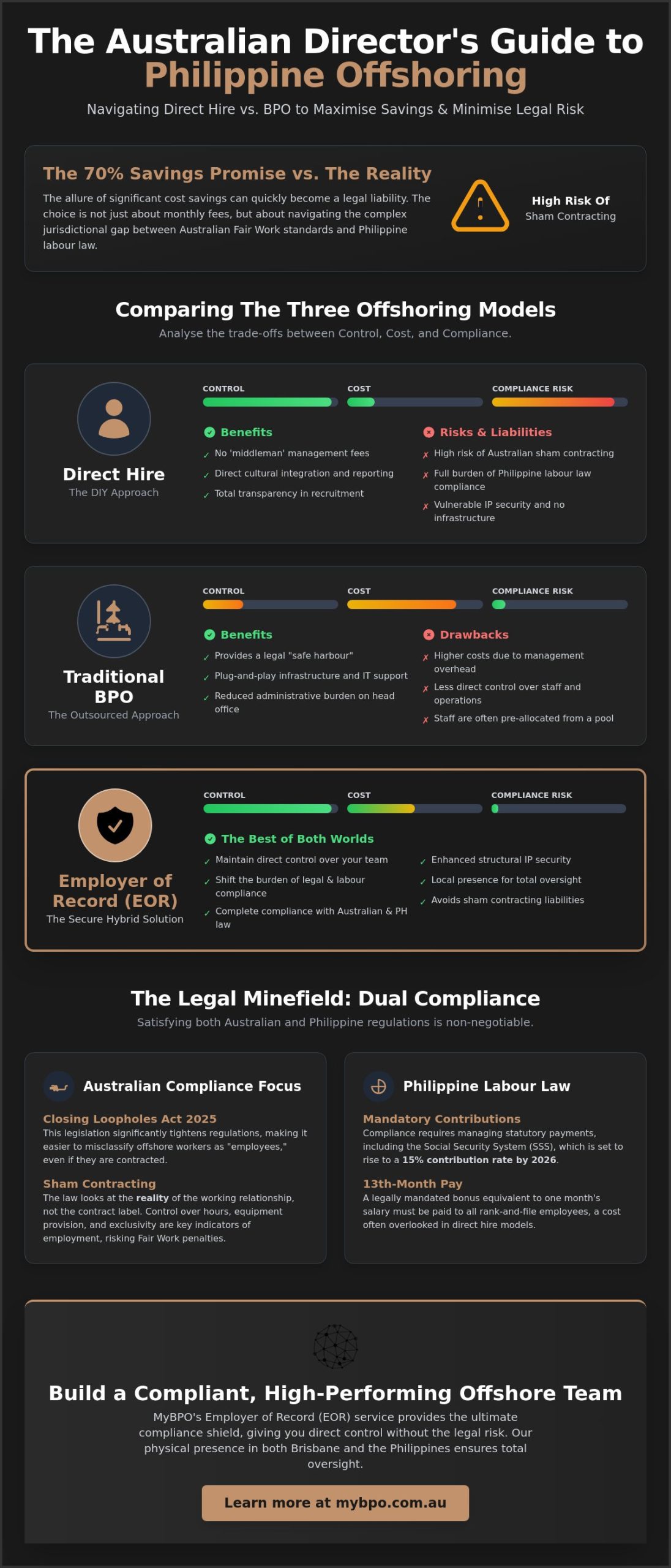
The 70% savings promised by offshoring can quickly transform into a legal liability if your employment structure fails to account for the tightening grip of Australian sham contracting regulations. While the debate of direct hire Philippines vs BPO usually centres on monthly fees, the real risk lies in the jurisdictional gap between Australian Fair Work standards and Philippine mandatory contributions. You likely want a high-performing team that feels like a local asset, yet the fear of losing intellectual property or facing penalties for non-compliance often creates a paralysis in your growth strategy.
This guide provides the precise clarity required to navigate these complexities and secure a team that functions as a protected extension of your business. We’ll examine the 2026 regulatory landscape, including the 15% SSS contribution rates and mandatory 13th-month pay, to ensure your operations remain legally sound. You’ll learn how to bridge the gap between operational control and cross-border compliance, allowing you to build a stable workforce while mitigating the inherent risks of foreign labour codes.
Key Takeaways
- Understand the critical operational trade-offs of direct hire Philippines vs BPO to avoid the hidden traps of unmanaged jurisdictional risk.
- Identify how the Closing Loopholes Act 2025 and Australian sham contracting laws create new liabilities for businesses engaging offshore contractors.
- Assess your intellectual property security by comparing the structural integrity of managed models against the inherent vulnerabilities of digital freelance marketplaces.
- Explore how Employer of Record (EOR) services provide a hybrid solution, maintaining direct control while shifting the burden of legal and labour compliance.
- Discover why a physical presence in both Brisbane and the Philippines is essential for maintaining total oversight of your remote operations.
The Great Philippine Talent Dilemma: Direct Hire vs BPO
Australian businesses are increasingly looking north to the Philippines to solve local talent shortages and rising operational costs. This shift is driven by a need for high-quality, English-proficient professionals who can integrate seamlessly into Australian workflows. However, the choice between direct hire Philippines vs BPO is rarely a simple binary. Most directors view this as a choice between “doing it yourself” or “outsourcing the problem,” but this oversimplification often leads to operational friction or significant legal exposure. A comprehensive overview of the Philippine BPO industry shows a sector that has grown to employ over 1.5 million people, yet many Australian SMEs still struggle to find the right balance between control and compliance.
Direct hiring involves engaging staff through freelance platforms or independent contracts. In this scenario, you act as your own recruitment, HR, and payroll department across international borders. Conversely, Business Process Outsourcing (BPO) involves partnering with a third party to manage specific business functions. When weighing up direct hire Philippines vs BPO, many Australian directors prioritise the bottom line without assessing the structural integrity of their chosen model. If you fail to understand the jurisdictional boundaries, you risk substantial penalties under both Australian and Philippine law.
The Appeal of the Direct Hire Model
The primary draw of direct hiring is the removal of management fees. By eliminating the “middleman,” you can often secure talent at a lower price point while ensuring the staff member receives a higher take-home pay. This model encourages direct cultural integration; your team aligns with your specific Australian business values because they report directly to you. You maintain total transparency in the recruitment process, hand-picking every individual based on your unique requirements rather than accepting a pre-allocated resource from a BPO pool.
The Traditional BPO Value Proposition
Navigating the Legal Minefield: Australian and Philippine Compliance
The legal landscape for offshore staffing has shifted significantly with the implementation of the Closing Loopholes Act 2025. For Australian directors, the choice of direct hire Philippines vs BPO is no longer just about cost; it’s about jurisdictional liability. If you engage a Philippine worker as an “independent contractor” while exercising control over their hours, providing their equipment, and requiring their exclusive service, you may be in breach of Australian sham contracting laws. These regulations look past the label of your contract to the reality of the working relationship. Failing this test can result in heavy Fair Work penalties and back-pay orders that quickly erase any initial savings.
A thorough Philippine BPO industry overview reveals a sector built on strict adherence to local labour codes, yet direct hiring often bypasses these protections. To remain compliant, a business must satisfy the Department of Labor and Employment (DOLE) requirements in the Philippines while simultaneously meeting Australian standards. This dual-layered responsibility is why local Australian ownership of your partner company serves as a critical security feature. It ensures your provider is accountable under Australian law, providing a “compliance shield” that digital-only platforms cannot offer.
The Reality of Sham Contracting Offshore
Misclassifying employees as contractors is a high-stakes gamble. Australian courts use an “indicia of employment” test to determine the true nature of a role. If your Philippine virtual assistant performs work under your direction and is integrated into your business, they are likely an employee in the eyes of the law. You can read more about how to identify and mitigate this sham contracting Philippines risk to protect your entity from regulatory scrutiny. Ignoring these boundaries doesn’t just invite fines; it creates a fragile operational foundation that can be dismantled by a single compliance audit. Before assuming a standard service agreement offers adequate protection, it is worth examining the risks of hiring contractors in the Philippines that many Australian firms dangerously underestimate.
Mandatory Philippine Employee Benefits
Philippine labour law is protective and highly regulated. Every legitimate employee is entitled to mandatory contributions that must be managed with precision. As of 2026, the SSS contribution rate is 15% of the Monthly Salary Credit, with the employer absorbing a 10% share. Additionally, you must calculate PhilHealth premiums at 5% and Pag-IBIG contributions at 2% for the employer’s portion. Perhaps most importantly, the 13th-month pay is a non-negotiable legal requirement that must be paid by December 24th. Managing payroll Philippines for Australian companies requires a deep understanding of these cycles to avoid industrial disputes. If you’re looking to secure a compliant team, these statutory obligations must be the starting point of your strategy, not an afterthought.
Comparing the Models: Control, Compliance, and Cost
Evaluating the choice between direct hire Philippines vs BPO requires a cold analysis of your risk appetite. In a direct hire arrangement, you hold the reins of daily activity, yet you lack the physical infrastructure to enforce standards. If your staff member works from a home office with unstable power or hardware, your business continuity is compromised. Managed partnerships, while requiring a management fee, provide the structural integrity needed for long-term scalability. The Philippine government provides extensive data through Official Overseas Filipino Worker Statistics, highlighting the vast talent pool available, but accessing this talent without a robust management framework often leads to the “turnover trap.” Understanding how to hire in Philippines legally is the essential first step before committing to any engagement model, as the wrong structure can expose your Australian entity to significant director liability.
Intellectual Property and Data Security
Intellectual property protection is a significant hurdle in the direct hire model. Enforcing an Australian IP clause against an individual freelancer in a foreign jurisdiction is practically impossible and prohibitively expensive. Managed models and Employer of Record (EOR) services act as a jurisdictional bridge, providing a local corporate entity that can be held accountable. Beyond legal contracts, physical security is paramount. Utilising dedicated workspace Philippines solutions ensures that data never leaves a controlled environment, mitigating the risk of breaches that occur in unmonitored home settings. IP theft is a silent killer of offshore success; you must secure your assets at the source.
The Cost of Turnover vs Management Fees
Traditional BPO models often rely on “seat lease” arrangements where your staff are just another number in a massive facility. This leads to high turnover, with industry averages often exceeding 50% in large-scale call centres. Conversely, direct hire turnover is also elevated, frequently caused by the professional isolation of working from home without local support. A managed offshore team provides the social and professional framework that keeps high-performing staff engaged. When you calculate the true ROI, you must account for the cost of retraining a new hire every six months versus paying for the stability of a managed service.
When comparing direct hire Philippines vs BPO through the lens of cost, don’t ignore the recruitment fees and equipment leasing requirements. DIY hiring requires you to source, vet, and provide hardware for your staff across international borders. A managed partnership integrates these elements into a single, predictable line item. This allows your business to scale without the friction of constant administrative intervention, ensuring that your team remains a productive asset rather than a management burden.
The Third Way: Employer of Record (EOR) for Australian Firms
The traditional binary choice between direct hire Philippines vs BPO often leaves Australian directors caught between two undesirable extremes: total administrative exhaustion or a complete loss of operational control. There is, however, a sophisticated middle ground that secures your business against jurisdictional risk while allowing you to hand-pick your team. The Employer of Record (EOR) model functions as a hybrid solution, providing the structural protection of a corporate entity while leaving the day-to-day management in your hands. This approach effectively absorbs the employer liability that would otherwise fall on your Australian entity, creating a robust “safe harbour” for your international operations.
Choosing an Australian-owned EOR is a critical security feature. It ensures that your provider is not just a digital platform, but a physical partner accountable under the same legal standards you respect at home. While the debate of direct hire Philippines vs BPO usually focuses on cost, the EOR model focuses on structural integrity. It allows you to build a team that is culturally aligned with your Brisbane or Sydney office, while a local specialist navigates the complexities of the Philippine Department of Labor and Employment (DOLE) on your behalf. Australian professional services firms can further refine this process by partnering with recruitment experts like tarino.au to ensure they secure the right offshore talent.
Direct Control Without the Administrative Burden
The EOR model allows you to maintain your unique company culture without becoming an expert in foreign tax law. You manage the workflow and set the performance standards, while the EOR manages the intricate requirements of the Philippine labour code, including the 15% SSS contributions and mandatory 13th-month pay. By utilising offshore recruitment Philippines specialists, you ensure that every hire is vetted for both technical skill and cultural fit. This structure prevents the professional isolation often found in direct-hire models, as your staff remain part of a supported professional community even as they report directly to you.
Mitigating Jurisdictional Risk
An EOR acts as a “Compliance Shield” that stands between your Australian business and foreign regulators. This protection extends beyond payroll; it includes the physical and digital infrastructure required to keep your data secure. Ensuring all staff have access to professional equipment leasing Philippines and dedicated IT support is essential for maintaining uptime and meeting Australian data privacy standards. An Employer of Record is the legal entity that employs your staff locally in the Philippines while you retain full operational management and direct workflow control. To secure your offshore operations with a partner that absorbs your administrative risk, explore our Employer of Record services today.
Securing Your Philippine Strategy with MyBPO
Securing your offshore strategy requires more than a digital login; it demands a physical presence that bridges the gap between Brisbane and the Philippines. While the debate over direct hire Philippines vs BPO often focuses on the immediate cost of labour, the long-term success of your team depends on the structural integrity of your partner. MyBPO operates as an Australian-owned and operated specialist, providing a “compliance shield” that protects your business from the complexities of international employment. By maintaining a physical footprint in Brisbane, Manila, and Bacolod, we ensure that your team is not just a collection of remote icons, but a managed extension of your local office.
Our Employer of Record (EOR) model is specifically engineered to mitigate the sham contracting risks introduced by the Closing Loopholes Act 2025. If you currently manage staff through freelance platforms, you are likely carrying unhedged jurisdictional risk. We absorb this liability by becoming the legal employer in the Philippines, ensuring every statutory contribution is met with 2026 precision. This allows you to transition from a “cheap VA” mindset to building a high-performance offshore team that is fully integrated into your corporate culture and protected by professional management standards.
Why Local Representation Matters
Retention is the silent engine of offshore ROI. When you engage staff directly, they lack the local support systems that foster long-term loyalty. MyBPO provides on-the-ground support in our Manila and Bacolod centres, offering your Philippine workforce a professional community and physical infrastructure that goes beyond a digital-only platform. This presence ensures data security and uptime that home-based setups cannot guarantee. You gain direct access to Australian-based management for strategic planning, ensuring your offshore operations remain aligned with your domestic growth objectives. If your current model relies on unmonitored home offices, you are vulnerable to operational volatility that a managed presence effectively eliminates.
Your Pathway to Compliant Expansion
Auditing your current offshore arrangements is the first step toward securing your business against future regulatory scrutiny. For a deeper analysis of how to structure your team for maximum protection, consult our employer of record Australia pillar guide. This resource provides the definitive framework for navigating the direct hire Philippines vs BPO landscape with total compliance. Don’t leave your intellectual property or your Australian entity exposed to avoidable legal risks. To ensure your team is built on a foundation of legal and operational excellence, organise a compliance audit with the MyBPO team today.
Securing Your Competitive Advantage Through Compliant Offshoring
Building a global workforce is no longer just about finding the lowest price point; it’s about establishing a resilient, legally sound operation. The tension between direct hire Philippines vs BPO is resolved when you prioritise structural integrity over short-term savings. By moving beyond unmanaged freelance arrangements, you protect your intellectual property and insulate your Australian entity from the rising tide of sham contracting scrutiny. A successful offshore strategy relies on the balance of direct operational control and the robust protection of a local corporate presence.
As an Australian-owned and operated specialist, MyBPO provides the necessary on-the-ground support in Manila and Bacolod to ensure your team remains stable and compliant. We act as your vigilant guardian, absorbing the administrative risks of the Philippine labour code so you can focus on scaling your core business. You’ve now seen the roadmap for 2026; the next step is to solidify your foundation.
Secure your offshore team with MyBPO EOR services and transform your Philippine operations into a high-performance, risk-mitigated asset. We’re ready to help you build a bridge to a more secure and profitable future.
Frequently Asked Questions
Is direct hiring in the Philippines legal for Australian companies?
Direct hiring is legal but requires strict adherence to both Philippine and Australian regulations. If you hire directly without a local entity, you must register with the Securities and Exchange Commission (SEC) and the Bureau of Internal Revenue (BIR) in the Philippines. Most Australian firms fail to complete these steps, which leaves them operating in a legal vacuum and creates significant jurisdictional risk for the business owners. For a comprehensive walkthrough of the registration requirements and compliance obligations, review the 2026 Australian business guide on how to hire in Philippines legally before proceeding with any direct engagement.
What are the main risks of using a BPO for my offshore team?
The primary risks involve high staff turnover and a lack of direct operational control. Traditional BPOs often manage multiple clients simultaneously, which can dilute the focus on your specific business processes and culture. This environment frequently leads to attrition rates exceeding 50%, resulting in a constant cycle of retraining that destabilises your business continuity and erodes the cost benefits of offshoring.
How does the Fair Work Act affect workers in the Philippines?
The Fair Work Act applies if a worker is deemed an employee of your Australian entity under the “indicia of employment” test. If you control their daily tasks, provide their equipment, and require exclusive service, Australian regulators may classify them as an employee rather than a contractor. This classification triggers obligations for Australian minimum standards and leave entitlements, regardless of the worker’s physical location.
Can I use an Australian employment contract for a Filipino direct hire?
Using a standard Australian contract is ineffective and often unenforceable in the Philippines. To be legally sound, a contract must comply with the Philippine Labour Code, including specific provisions for the 13th-month pay and statutory contributions. Relying on an Australian document leaves you with no practical legal recourse if a dispute arises or if there is a breach of confidentiality within the Philippines.
What is the difference between an EOR and a traditional BPO?
The difference lies in who manages the daily workflow and the staff’s performance. In the direct hire Philippines vs BPO comparison, an EOR acts as the legal employer of record to handle payroll and compliance, while you retain total management of the individual’s tasks. A traditional BPO typically manages the entire function, often providing a supervisor who stands between you and the staff performing the work.
How do I ensure my intellectual property is protected in the Philippines?
IP protection requires a combination of local legal contracts and physical security measures. You should engage staff through a local corporate entity that can enforce IP clauses within the Philippine court system. Additionally, moving staff from unmonitored home environments into a managed workspace ensures that sensitive data remains within a controlled, enterprise-grade IT infrastructure that prevents unauthorised access or distribution.
What mandatory benefits must I pay to Filipino staff?
You must pay the 13th-month pay, which is a non-negotiable bonus equivalent to one month’s salary. Additionally, as of 2026, you are responsible for the employer’s share of SSS (10%), PhilHealth (2.5%), and Pag-IBIG contributions. These benefits are mandatory for all rank-and-file employees, and failing to remit these payments can lead to severe penalties and the suspension of your right to hire in the region.
Why is sham contracting a concern when hiring offshore?
Sham contracting is a major concern due to the Closing Loopholes Act 2025, which empowers Fair Work to penalise businesses that misclassify employees as independent contractors. If your “contractor” in the Philippines works exclusively for you and follows your direct instructions, they may be reclassified as an employee. This reclassification often results in back-payment orders for unpaid entitlements and significant civil penalties for the Australian company. To understand the full scope of these liabilities, reviewing the common myths Australian firms hold about the risks of hiring contractors in the Philippines can help you avoid costly misclassification errors.
Need a strategy session?
Tell us about your team and we will map out the right structure, fixed-cost quote included.
Book a call