Blog
Employer of Record vs BPO: Which Model Suits Your AU Business?

Scaling your Australian business into the Philippines isn’t just a matter of finding talent; it’s a high-stakes navigation of jurisdictional boundaries where a single structural error can trigger a Fair Work investigation. You likely already know that the cost efficiencies of the Philippines are transformative, yet the fear of sham contracting penalties or losing your intellectual property often keeps you tethered to local hiring. Understanding the fundamental difference between Employer of Record and Business Process Outsourcing is the only way to ensure your expansion doesn’t become a legal liability.
This guide will clarify the critical structural and legal distinctions between EOR and BPO to secure your offshore operations while mitigating Australian regulatory risks. We will examine how each model handles Philippine mandatory benefits like SSS and PhilHealth, the security of your IP, and the 2026 Closing Loopholes Act updates. By the end, you’ll know exactly which framework provides the necessary compliance shield to protect your company culture and your bottom line. Whether you need a high-performing Philippine team or a simple task-based solution, choosing the right model is the first step toward a secure international presence.
Key Takeaways
- Identify the fundamental difference between Employer of Record and Business Process Outsourcing to determine whether your business requires direct operational control or task-based efficiency.
- Learn how an EOR model serves as a compliance shield by absorbing legal liability and managing complex Philippine mandatory benefits, including SSS and PhilHealth.
- Evaluate the impact of the 2026 Closing Loopholes Act on offshore worker classification to ensure your organisation remains protected from sham contracting penalties.
- Discover why physical infrastructure, such as dedicated workspaces and equipment leasing, is critical for securing intellectual property and fostering a high-performing team culture.
- Assess which outsourcing framework provides the most robust protection for your specific growth stage and long-term strategic objectives in the AU-PH corridor.
Navigating the Offshore Landscape: Why the EOR vs BPO Choice Matters
The Australian-Philippine business corridor has underwent a significant transformation in 2026. Australian firms no longer treat “outsourcing” as a generic, catch-all term for sending tasks overseas. Instead, sophisticated operators recognise that the structural framework they choose dictates their long-term security. The fundamental difference between Employer of Record and Business Process Outsourcing lies in the level of operational control you maintain and the legal liability you carry. Choosing the wrong model often leads to a disconnect between your domestic culture and your offshore output.
If your organisation selects a model that doesn’t align with its strategic goals, the consequences are rarely just financial. You face legal friction under updated Fair Work standards, cultural dilution as staff feel disconnected from your mission, and operational bottlenecks when processes don’t mesh. You must decide early whether you are buying a finished result from a third party or building a dedicated team that functions as a genuine extension of your Australian office.
The Strategic Shift in Australian Offshore Staffing
Modern Australian businesses are moving beyond simple cost-cutting to embrace value-driven global expansion. They want to ensure that their offshore staff are not just “cogs in a machine” but high-performing contributors. Implementing an employer of record Australia framework allows you to maintain this high standard of talent while the EOR provider absorbs the complex local compliance burdens. This shift reduces the management bandwidth required to monitor external vendors, as you manage the people while the partner secures the legal perimeter.
Identifying Your Business Maturity and Needs
Your business maturity and specific workflow requirements should dictate your choice. Start-ups often require the agility of a dedicated virtual assistant who understands their specific brand voice, while established firms might look to outsource entire non-core departments to a BPO. To make an informed decision, you must first understand What is an Employer of Record (EOR)? and how it differs from traditional task-based outsourcing. For businesses integrating AI-driven workflows, the “Human in the Loop” requirement makes direct control over day-to-day processes a non-negotiable factor. If you need to dictate exactly how a task is performed, the EOR model provides the necessary oversight that a BPO typically restricts.
The Employer of Record (EOR) Model: Securing Your Own Philippine Team
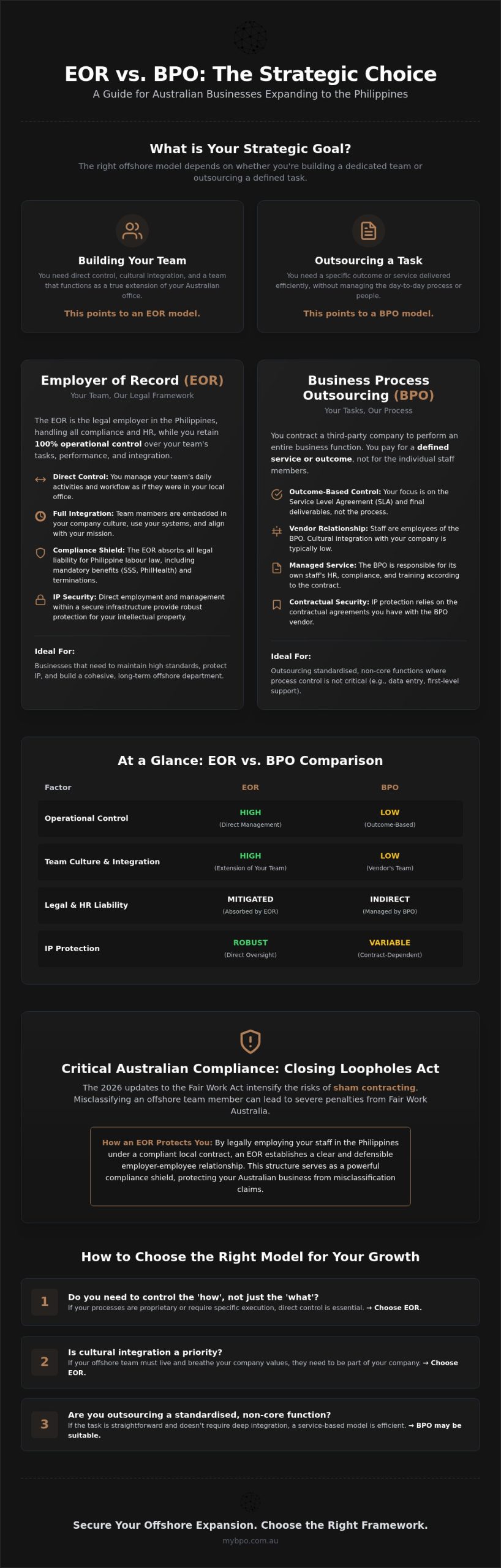
An Employer of Record (EOR) functions as your organisation’s legal anchor in a foreign jurisdiction. Under this model, the EOR provider becomes the registered employer on paper, while you retain absolute functional control over the staff member’s daily activities, output, and integration. This structural difference between Employer of Record and Business Process Outsourcing is pivotal for Australian firms that want to build a genuine offshore department rather than just purchasing a standardised service. While Understanding Business Process Outsourcing (BPO) is useful for task-based needs, the EOR model is designed for those who value human capital as a core asset.
By using an EOR, your business effectively bypasses the need to establish a local Philippine entity, which is a complex and costly legal process. For Australian firms weighing their options, understanding the full burden of setting up a local entity in the Philippines — including significant capital lock-up requirements and ongoing DOLE compliance obligations — reveals why the EOR model is often the more practical and secure alternative. The EOR provider absorbs all statutory liabilities, ensuring that every aspect of the employee lifecycle is managed within the strict confines of Philippine labour law. This includes everything from the initial contract stage to the sensitive process of how to hire in the Philippines legally, and eventually, managing terminations without exposing your Australian company to foreign litigation.
Anatomy of an EOR Partnership
The EOR framework operates on a clear division of responsibilities. Your partner manages the administrative “back office,” which includes the precise calculation and remittance of Philippine mandatory benefits such as SSS (Social Security System), PhilHealth, and Pag-IBIG (Home Development Mutual Fund). They also secure the 13th-month pay, a mandatory requirement that many Australian firms inadvertently overlook. This arrangement provides a “compliance shield,” protecting your Australian operations from the risks of worker misclassification. Furthermore, because the staff work directly for you, your Intellectual Property (IP) remains secure within your own internal systems and protocols rather than being handled by a third-party vendor’s staff.
The Benefits of the Dedicated Team Approach
Choosing an EOR allows you to cultivate a dedicated team that mirrors your Australian office culture. Unlike BPO staff who may juggle multiple clients, your EOR team members are 100% focused on your business. This direct line of communication fosters accountability and allows for customised training that aligns with your specific operational standards. Because the staff feel like true members of your organisation, engagement levels are typically higher, which significantly reduces turnover. If you’re looking to scale while maintaining high standards, our EOR services offer the physical and legal infrastructure to make it happen safely.
Business Process Outsourcing (BPO): Outsourcing Tasks and Outcomes
While the EOR model focuses on the individual, Business Process Outsourcing (BPO) centres on the delivery of a specific outcome or service. Under a BPO arrangement, you contract a third-party provider to handle a defined business function, such as high-volume data entry or tier-one customer support. The primary difference between Employer of Record and Business Process Outsourcing is the location of operational authority. In a BPO, the provider manages the staff, the technology, and the workflow, delivering a finished product or service based on agreed metrics. As noted by Forbes on Business Process Outsourcing, this model allows firms to leverage external expertise for non-core functions, effectively offloading the entire burden of that department.
This “set and forget” approach appeals to Australian firms looking to reduce management overhead. Because you aren’t managing the individual performance of offshore staff, your internal teams can focus on higher-level strategy. However, this convenience comes with a distinct trade-off: you lose direct visibility into the day-to-day processes. You are essentially buying a result, which means you have limited influence over how that result is achieved or who specifically is performing the work. If your business requires high levels of precision or specific cultural alignment, the lack of direct oversight can become a significant operational hurdle.
When to Choose the BPO Model
BPO is often the most efficient choice for non-core business functions or handling seasonal spikes in volume. If your requirement is purely transactional, such as processing payroll or managing a generic help desk, the BPO provider’s existing software and training frameworks provide immediate scalability. You don’t need to worry about recruitment or equipment leasing because the BPO handles the entire infrastructure. The relationship is governed by Service Level Agreements (SLAs), making it easier to hold the provider accountable for specific outputs rather than managing human variables. This model works best when the tasks are standardised and don’t require deep integration into your Australian office culture.
The Limitations of Traditional BPO
The primary risk with traditional BPO is the “black box” effect, where you lose control over the quality of execution. In a massive call centre environment, your business risks becoming just another client among hundreds. This often leads to challenges in maintaining a consistent Australian brand voice or cultural nuance, as staff follow rigid scripts rather than understanding your specific business mission. If your processes need to pivot quickly due to market changes, the contractual nature of a BPO can create friction. You may find it difficult to implement rapid changes when you don’t have a direct line to the people doing the work, leading to a disconnect between your Australian headquarters and the offshore execution.
EOR vs BPO: A Comparative Framework for Australian Risk Mitigation
The decision to offshore is no longer just about hourly rates; it’s about jurisdictional safety. For an Australian company, the difference between Employer of Record and Business Process Outsourcing determines who carries the weight of legal liability when things go wrong. While many firms are tempted by the simplicity of a B2C marketplace, the risks of hiring contractors in the Philippines include severe penalties for sham contracting and a total lack of enforceable intellectual property protection. Without a formal structure, your business remains exposed to the whims of foreign labour courts and Australian regulatory scrutiny.
The Compliance Shield: Protecting Your Australian Entity
The 2026 updates to the Closing Loopholes Act have intensified the focus on correct worker classification. Australian regulators are increasingly vigilant regarding “employee-like” workers, and the penalties for misclassification have never been higher. An EOR provider acts as a compliance shield by ensuring that your Philippine staff are legally employed under local labour codes, receiving mandatory benefits like SSS and PhilHealth. This structure mitigates the risk of your business being flagged for permanent establishment, which can trigger unexpected tax liabilities in the Philippines. Working with an Australian-owned partner provides an extra layer of security. They understand the specific Fair Work complexities and ensure your offshore team isn’t classified as a “sham” arrangement that could haunt your domestic entity. For a deeper analysis of how these two models stack up against modern compliance risks, our comprehensive guide on EOR vs BPO for global hiring decisions examines the critical distinctions Australian directors need to understand.
Operational Control and Scalability
Control is the ultimate differentiator between these two models. In a BPO “managed service” framework, the provider owns the process. This often leads to “scope creep” and hidden costs when you need to pivot your strategy. Conversely, the EOR “direct hire” approach allows you to own the workflow entirely. When evaluating the difference between Employer of Record and Business Process Outsourcing for scalability, the EOR model typically offers greater flexibility for high-growth firms.
This is crucial for long-term Intellectual Property (IP) security. Because the EOR staff member is a dedicated part of your organisation, the chain of ownership for every line of code or creative asset is direct and legally transparent. If you need to scale or change direction, the EOR model allows for faster pivots. You aren’t renegotiating a complex SLA with a third-party vendor every time your requirements evolve. To ensure your business remains fully protected while growing, you can secure your offshore expansion with a framework built for Australian standards.
Strategic Alignment: Selecting the Right Model for Your Business Growth
Selecting the right model is a decision that defines your operational freedom for years to come. While we have explored the functional difference between Employer of Record and Business Process Outsourcing, the ultimate choice depends on your specific growth trajectory and the level of control you require. For high-growth Australian firms, MyBPO advocates for the EOR model because it prioritises cultural alignment and long-term asset protection. You aren’t just buying hours; you’re building an offshore department that understands your brand’s DNA. This level of integration is often impossible in a traditional BPO setup where staff turnover is high and process visibility is intentionally limited.
Beyond the legal contract, you must consider the physical reality of offshore work. Many providers offer digital platforms but ignore the ground-level infrastructure. Securing a dedicated workspace in the Philippines is essential for maintaining productivity and data security. Without a controlled environment, you risk internet outages and hardware failures that halt your momentum. By providing physical desks and high-specification hardware, we ensure your team operates with the same professional rigour as your Australian office, mitigating the risks associated with unmanaged home-office environments.
The MyBPO Advantage: An Australian Bridge to the Philippines
Our physical presence across the AU-PH corridor provides a unique “safe harbour” for your operations. Having an Australian-owned partner means your operational anxiety is absorbed by specialists who understand both local expectations and Fair Work requirements. We provide expert on-the-ground support through our centres in Manila and Bacolod, ensuring your workforce is managed by a team that understands the local culture. We don’t just find talent; we provide equipment leasing to ensure every staff member has the high-specification tools required to succeed safely. This tangible presence allows us to offer human accountability that generic, cloud-based EORs simply cannot match. It ensures your team is supported by a local ally who remains accountable to Australian standards.
Your Next Steps to Secure Expansion
Securing your business for 2027 requires a proactive approach to risk management today. If you currently rely on a BPO or an informal contractor model, your first step should be a comprehensive risk audit to identify potential compliance gaps and intellectual property vulnerabilities. Transitioning to a secure EOR framework can be managed methodically to avoid operational downtime or staff friction. We invite you to book a consultation to design a bespoke Philippine staffing strategy that balances cost-efficiency with total legal protection. Designing a compliant, high-performing team is a strategic investment that protects your intellectual property and ensures your offshore expansion is built on a foundation of long-term stability.
Securing Your Global Future: The Path to Compliant Expansion
Deciding how to scale your organisation in the Philippines involves balancing operational control with legal security. We’ve examined how the difference between Employer of Record and Business Process Outsourcing determines your level of management oversight and your exposure to Fair Work risks. While BPO provides a task-based solution, the EOR model offers the dedicated culture and IP protection required for sustainable, high-value growth.
By choosing a framework that prioritises physical infrastructure and local compliance, you ensure that your offshore team remains a high-performing asset rather than a regulatory liability. MyBPO stands as your compliance shield, being Australian-owned and operated for total peace of mind. We provide expert on-the-ground support in Manila and Bacolod, ensuring vigilant compliance with both Australian and Philippine labour laws at every stage of the employee lifecycle.
Take the next step toward a more secure and integrated international workforce. Secure your offshore team with MyBPO’s Australian-owned EOR services today and build the foundation your business needs to thrive in 2027 and beyond. Your expansion deserves the protection of a partner who understands the high stakes of cross-border employment.
Frequently Asked Questions
What is the primary difference between an EOR and a BPO for an Australian company?
The fundamental difference between Employer of Record and Business Process Outsourcing centres on operational control. An EOR acts as the legal employer, allowing you to manage the staff member’s daily tasks and integrate them into your culture. In contrast, a BPO manages the entire process and its outcomes, delivering a finished service based on agreed metrics. This means EOR is for building a team, while BPO is for offloading a department.
How does an EOR help Australian businesses avoid sham contracting risks?
An EOR model mitigates sham contracting risks by establishing a formal, legal employment relationship under Philippine labour law. This structure ensures that workers are classified as employees rather than independent contractors, which is a key focus of the 2026 Closing Loopholes Act. By providing mandatory benefits like SSS and PhilHealth, the EOR provider absorbs the legal liability, protecting your Australian entity from penalties associated with misclassifying employee-like workers.
Is an EOR more expensive than a traditional BPO service?
Cost comparisons between these models depend on your long-term goals rather than just the initial fee. While a BPO might seem cheaper for high-volume, transactional tasks, it often carries hidden costs through scope creep and a lack of process visibility. An EOR model typically offers a more transparent fee structure. It provides better value for high-growth firms because it reduces turnover and ensures your intellectual property remains secure within your own managed team.
Do I still need to manage the staff if I use an Employer of Record?
Yes, you maintain absolute functional management of your staff when using an Employer of Record. While the EOR provider handles the back-office administrative tasks, such as payroll, taxes, and statutory compliance, you dictate the daily workflow, set performance standards, and provide specific training. This arrangement allows you to treat the offshore staff member as a genuine extension of your Australian office, ensuring they remain aligned with your specific business objectives.
Which model is better for protecting my company’s intellectual property?
The EOR model is superior for protecting intellectual property because it creates a direct chain of ownership between you and the staff member. Since the individual works exclusively for your organisation, they use your internal systems and follow your specific security protocols. In a BPO model, your data is often handled by a third-party vendor’s staff who may manage multiple clients simultaneously, which increases the risk of cross-contamination or IP theft.
Can I move from a BPO model to an EOR model later on?
You can transition from a BPO model to an EOR model, though it requires a methodical approach to avoid operational downtime. This shift is common for businesses that have outgrown the managed service approach and now require more direct control over their processes. A successful transition involves conducting a risk audit and ensuring that staff are migrated into a compliant EOR framework that secures their tenure and benefits under Philippine law.
Does the Fair Work Act apply to staff hired through a Philippine EOR?
Technically, the Fair Work Act does not have jurisdiction over Philippine citizens working in the Philippines. However, Australian regulators use the Closing Loopholes legislation to scrutinise how Australian companies engage with offshore workers. If your offshore arrangement looks like sham contracting, your Australian entity could face domestic legal consequences. Using an EOR ensures that you are following local Philippine laws, which serves as a compliance shield against Australian regulatory investigations.
What physical support does MyBPO provide that generic EORs do not?
MyBPO provides tangible infrastructure that generic, digital-only EORs ignore. We offer dedicated workspaces in Manila and Bacolod, ensuring your team has a secure, professional environment with reliable internet uptime. Additionally, we provide equipment leasing for high-specification hardware, ensuring your staff have the tools required to succeed safely. Our Australian-owned status means we provide local accountability and on-the-ground support that bridges the cultural and regulatory gap between Australia and the Philippines.
Need a strategy session?
Tell us about your team and we will map out the right structure, fixed-cost quote included.
Book a call