Blog
How to Hire Employees in the Philippines from Australia: The 2026 Compliance Guide

A single error in jurisdictional classification can expose your Australian company to Fair Work penalties and tax liabilities that far outweigh the cost savings of offshoring. It’s a high-stakes environment where a lack of local knowledge becomes a significant financial liability. You’re likely already aware that the Philippines holds a world-class talent pool, yet the complexity of mandatory contributions and remote data security can feel like a regulatory minefield that prevents you from scaling safely.
This 2026 guide clarifies exactly how to hire employees in the philippines from australia by establishing a compliant, low-risk framework that acts as a shield for your business. We’ll provide the professional gravity needed to navigate these waters, ensuring you understand everything from the AUD 79,499 TSMIT threshold to the latest SSS and PhilHealth contribution rates. By the end of this article, you’ll have a clear, sequential path to securing high-quality talent while maintaining total operational integrity and peace of mind.
Key Takeaways
- Recognise the strategic alignment of the Manila-Australia time zone to maintain real-time operational control without the friction of traditional offshoring.
- Mitigate the risk of “sham contracting” and personal director liability by understanding the intersection of Fair Work Australia and the Philippine Labour Code.
- Evaluate the high capital requirements of setting up a local entity against the protective framework of an Employer of Record (EOR) model.
- Learn how to hire employees in the philippines from australia using a structured vetting process that prioritises data security and physical infrastructure.
- Establish a “safe harbour” for your business through an Australian-owned partner that absorbs the administrative burden of mandatory 2026 Philippine contributions.
Understanding the AU-PH Hiring Landscape: Opportunities and Risks
Understanding how to hire employees in the philippines from australia requires more than a recruitment strategy; it demands a total risk management framework. The geographic proximity between Australia and the Philippines creates a unique operational advantage. Unlike traditional offshoring to Europe or South Asia, the two-to-three-hour time difference ensures your teams work in synchronisation. This isn’t just a convenience. It’s a structural requirement for businesses that demand high-velocity communication and immediate accountability.
This proximity can mask the inherent jurisdictional risk. Hiring across borders involves navigating two distinct legal frameworks simultaneously. If an Australian director fails to account for Philippine labour codes, the resulting compliance breach can lead to severe financial penalties in both territories. The Australia-Philippines Strategic Partnership provides the diplomatic foundation for these economic ties, but the burden of operational compliance remains firmly on the employer. In 2026, the economic outlook for offshore staffing remains robust, with the Philippine BPO sector now serving as a primary engine for Australian SME growth.
Why Australian Businesses Choose the Philippines
The decision to look north is driven by the high English proficiency and Western-aligned education system found in the Philippines. With a literacy rate of 95% and over 500,000 tertiary graduates entering the workforce annually, the talent pool is both deep and specialised. When considering how to hire employees in the philippines from australia, you must weigh the cost-to-quality ratio. You can often achieve savings of up to 70% compared to local Australian recruitment without sacrificing the professional standards your clients expect. The maturity of the local sector means infrastructure for remote work is no longer an experiment but a proven, industrialised standard.
The Evolution of Offshore Staffing in 2026
The market has shifted significantly. We’ve moved beyond simple task-based virtual assistants. Australian SMEs are now integrating Filipino professionals into core business functions such as aged care management, complex logistics, and financial analysis. This maturity is supported by a sector that now employs over 1.5 million people, providing a robust infrastructure for remote operations. A modern offshore team is a strategic asset designed for growth, not a temporary cost-cutting measure. By treating these roles as integral to your corporate structure, you secure a competitive advantage that is difficult for domestic-only competitors to replicate.
Navigating the Legal Intersection: Fair Work Australia and the Philippine Labour Code
The primary risk when expanding your workforce into the Philippines is the legal misclassification of workers. Many Australian businesses mistakenly believe that labelling a worker an “independent contractor” or “freelancer” absolves them of local and international employment obligations. If the functional reality of the relationship resembles employment, you face the severe threat of “sham contracting” penalties under the Fair Work Act. Australian directors are not immune to these consequences. You remain personally vulnerable to litigation and back-pay claims if the worker is deemed an employee by Australian or Philippine authorities.
The Department of Labor and Employment (DOLE) in the Philippines is a vigilant regulator. It ensures that foreign engagements do not bypass the strict protections afforded to Filipino citizens. As noted in the Australian Government’s Philippines Country Brief, while the economic relationship is strong, businesses must operate within the specific regulatory frameworks of both nations. Failure to do so doesn’t just result in fines. It compromises your entire operational security and reputation within the local talent market.
The Fair Work Act and Offshore Workers
The “Closing Loopholes” legislation has fundamentally tightened the criteria for what constitutes an employee in Australia. This has direct implications for how to hire employees in the philippines from australia. If you dictate specific working hours, provide a laptop, and exercise direct control over how tasks are performed, Australian courts may classify that worker as an employee. This triggers entitlements such as superannuation and leave. The “right to disconnect” laws now influence how you manage offshore staff. You cannot simply ignore these standards because a staff member is based in Manila. Implementing a compliant hiring structure is the only way to mitigate these jurisdictional risks effectively.
Mandatory Philippine Contributions and 13th Month Pay
The Philippine Labour Code mandates a specific suite of benefits that must be managed with precision. These are often referred to as the “Big Three” contributions:
- Social Security System (SSS): As of 2026, the contribution rate is 15% of the Monthly Salary Credit, with the employer responsible for a 10% share.
- PhilHealth: This health insurance contribution is 5% of the monthly basic salary, shared equally (2.5% each) between you and the employee.
- Pag-IBIG Fund: This housing fund requires a 2% employer contribution based on a Maximum Fund Salary of PHP 10,000.
Beyond these monthly obligations, the 13th Month Pay is a non-negotiable legal requirement. You must pay all rank-and-file employees 1/12th of their basic annual salary by December 24th each year. Non-compliance leads to DOLE intervention and potential blacklisting from hiring within the country. It’s a binary outcome: you are either compliant or you are exposed.
Evaluating Your Hiring Options: Contractors vs. Entities vs. EOR
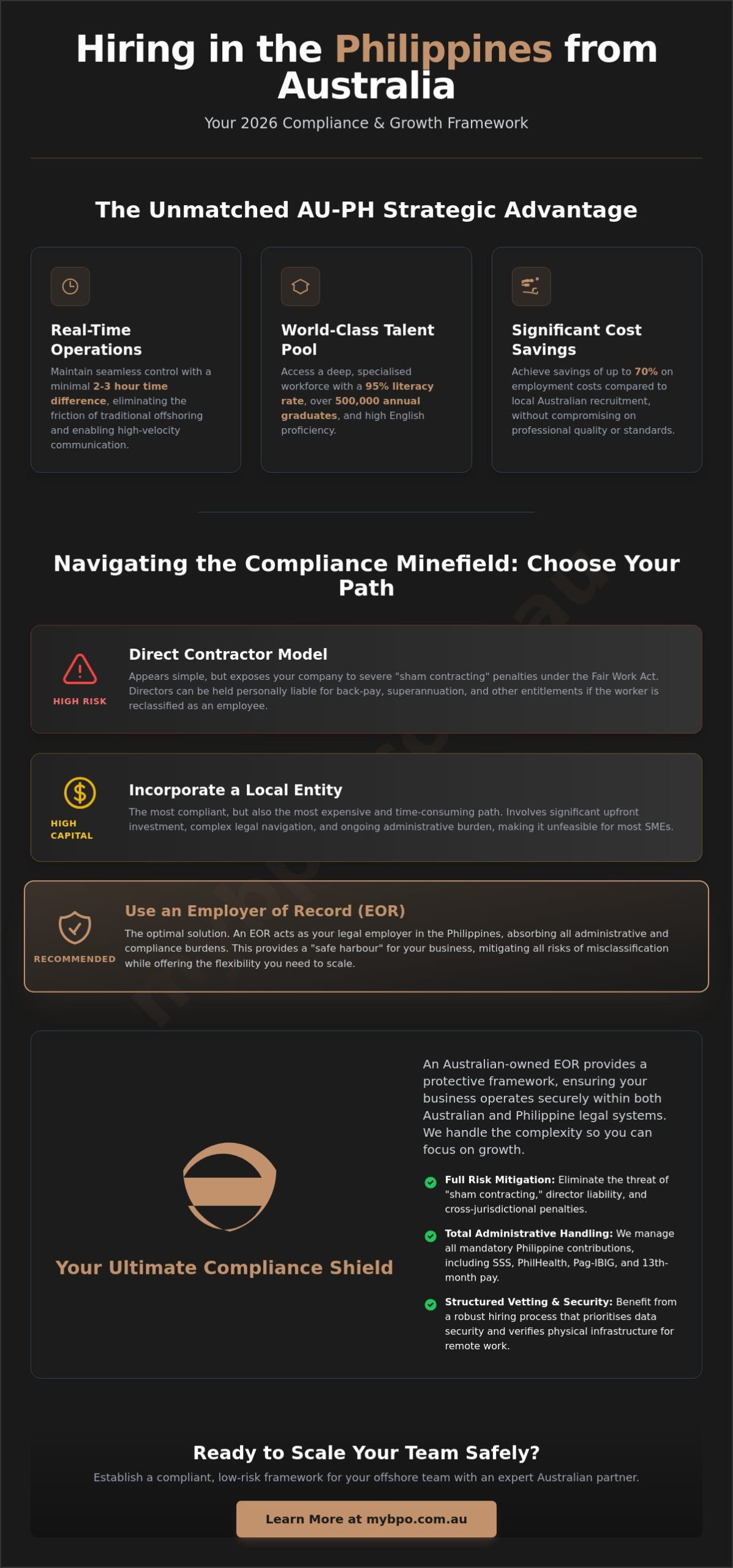
Choosing the correct structural framework is a critical decision when determining how to hire employees in the philippines from australia. There are three primary pathways available, each with distinct levels of risk and administrative burden. You can engage workers as direct contractors, establish your own SEC-registered entity, or utilise an Employer of Record (EOR) service. While the direct contractor model appears simple, it often creates significant legal vulnerabilities. Conversely, establishing a local Philippine corporation involves substantial hidden costs, including legal fees, minimum capital requirements, and ongoing corporate taxation compliance that can overwhelm an Australian SME.
A dedicated EOR service differs from a generic BPO by focusing on the legal and administrative integrity of the employment relationship. While a BPO might manage specific tasks, an EOR acts as the formal employer, ensuring that all payroll and regulatory obligations are met. This model allows you to maintain full operational control over your staff without the necessity of managing a foreign corporate entity.
The Pitfalls of the Direct Contractor Model
The informal nature of contractor agreements often leaves Australian businesses exposed. Intellectual property (IP) protection is notoriously difficult to enforce across international borders when no formal employment structure exists. If a dispute arises, enforcing a non-compete clause in a foreign jurisdiction is practically impossible for most small businesses. There is also the “permanent establishment” tax risk. If the Australian parent company is deemed to be operating a fixed place of business in the Philippines through these contractors, it may trigger unexpected corporate tax liabilities with the Philippine Bureau of Internal Revenue. This creates a complex tax nexus that can lead to double taxation and forensic audits.
Why an EOR is the Safest Pathway for Australians
The EOR model provides a clear division of responsibility. The EOR serves as the “Legal Employer,” while you remain the “Operational Manager.” This structure ensures that the EOR absorbs all local liability and administrative burdens, from managing 2026 contribution rates to handling termination procedures under the Philippine Labour Code. Choosing an Australian-owned EOR provides a secondary layer of protection. It establishes a local point of contact within the Australian legal system for dispute resolution, ensuring that your how to hire employees in the philippines from australia strategy is backed by a partner who understands both your business culture and your regulatory requirements. For a comprehensive evaluation of your options, the offshore recruitment Philippines 2026 buying guide provides an in-depth breakdown of how to select the right model for your specific business needs.
Executing the Hire: From Talent Sourcing to Physical Infrastructure
Executing a successful offshore strategy requires a transition from theoretical compliance to physical operational security. The process begins with precise role definition and salary benchmarking against the 2026 Philippine market. While the daily minimum wage in the National Capital Region (NCR) is approximately PHP 695 for non-agricultural workers, skilled professional roles require a more sophisticated valuation to attract top-tier talent. If your salary offer fails to align with current market expectations, you risk high turnover and the loss of critical institutional knowledge. Once the role is defined, you must implement a multi-stage vetting process that includes mandatory NBI clearance to verify criminal records, ensuring your Australian business remains protected from internal fraud or security breaches.
The final stages of execution involve securing the employment contract through a compliant EOR framework and provisioning the necessary hardware. This is where many Australian companies falter by allowing “Bring Your Own Device” (BYOD) policies. Using personal hardware for business operations creates an unmitigated risk to data security and intellectual property. Provisioning enterprise-grade equipment through an integrated leasing model ensures hardware consistency and maximum uptime. This methodical approach to how to hire employees in the philippines from australia concludes with a structured offshore staff onboarding Philippines process, which bridges the cultural gap and integrates the new staff member into your corporate values from day one.
Recruitment Strategies for High-Performance Teams
Recruitment in the Philippines demands a focus on values-alignment rather than just technical proficiency. Filipino professionals often prioritise long-term stability and a clear career path, which makes the recruitment phase the ideal time to establish your company’s culture. An Australian-led recruitment team is essential here; they act as a filter, ensuring that candidates possess the English fluency and professional temperament required for an Australian work environment. Rigorous background checks are not optional. Verifying previous employment and educational credentials secures your business against the liability of a “bad hire” in a foreign jurisdiction.
Securing Your Assets: Equipment and Workspaces
Data protection is the cornerstone of a successful offshore operation. Relying on a staff member’s home internet or personal laptop exposes your sensitive client data to unsecured networks and malware. You can mitigate this risk by utilising dedicated workspaces and equipment leasing services that provide a controlled, professional environment. While Work From Home (WFH) models offer flexibility, dedicated workspaces provide superior productivity and security through redundant power supplies and business-grade fibre internet. If your operations involve handling sensitive financial or personal information, the physical security of a managed office space becomes a non-negotiable requirement for Australian regulatory compliance.
Why an Australian-Owned EOR is Your Ultimate Compliance Shield
The complexity of cross-border employment requires a partner that functions as a physical bridge between two distinct legal systems. MyBPO provides this through a dual-presence model, operating as a registered Australian entity and a fully compliant Philippine corporation. This structure is fundamentally different from global digital platforms that offer generic services without local accountability. When you determine how to hire employees in the philippines from australia through our framework, you aren’t just engaging a service provider; you are securing a local ally that understands the professional gravity of Australian industrial relations. We manage the entire lifecycle of your offshore staff, from initial recruitment and contract execution to the daily administration of 2026 mandatory contributions and physical infrastructure management.
Our on-the-ground presence in the Philippines ensures that your staff are supported by a tangible management team. This human presence is vital for maintaining productivity and resolving local grievances before they escalate into legal disputes. By acting as the legal employer of record, we absorb the operational risks and administrative burdens that typically prevent Australian SMEs from scaling. This allows your leadership team to maintain full operational control while we provide the structural integrity required to secure your offshore investment.
The Advantage of Local Australian Accountability
Having a local Australian point of contact is essential for operational peace of mind. If a compliance issue arises or a contract requires adjustment, you deal with an Australian-owned entity subject to Australian business standards and time zones. MyBPO absorbs the jurisdictional risk by ensuring all employment practices meet both the Philippine Labour Code and the heightened expectations of Australian data privacy and security protocols. We implement Australian-standard security measures across all dedicated workspaces, ensuring that your intellectual property remains protected within a secure, monitored environment. This local accountability transforms the process of how to hire employees in the philippines from australia from a risky venture into a controlled, professional expansion.
Building Long-Term Value with MyBPO
Our model is designed to facilitate sustainable growth. We assist your business in scaling from a single dedicated virtual assistant to a multi-role department, providing the physical infrastructure and recruitment expertise needed at every stage. Retention is a critical component of this value; by providing dedicated workspaces and enterprise-grade equipment leasing, we foster a professional company culture that encourages long-term staff loyalty. This physical reality contrasts sharply with the high turnover rates often seen in unmanaged remote settings. We provide the stability your business needs to treat your Philippine team as a core strategic asset.
Secure your offshore team today with MyBPO’s EOR services and eliminate the regulatory risks associated with international hiring.
Securing Your Australian Business with a Compliant Offshore Strategy
Mastering the complexities of cross-border employment requires more than just finding talent; it demands a rigorous adherence to the legal intersection of Fair Work Australia and the Philippine Labour Code. Prioritising a structured EOR model ensures your company avoids the severe penalties associated with sham contracting and misclassification. You gain the assurance that every hire is backed by verified NBI clearances and supported by the physical security of dedicated workspaces and enterprise-grade hardware.
Understanding how to hire employees in the philippines from australia shouldn’t be a source of regulatory anxiety. As an Australian-owned and operated specialist with physical offices in both nations, MyBPO acts as your vigilant guardian in these unfamiliar waters. We absorb the administrative burden and legal liability, which allows you to focus on scaling your operations with total peace of mind.
Book a Compliance Consultation with our Australian Specialists today to secure your offshore future. Your journey toward a high-performance, low-risk international team starts with a partner who prioritises your protection above all else.
Frequently Asked Questions
Can I hire an employee in the Philippines without a local business entity?
Yes, you can engage staff without establishing a local corporation by utilising an Employer of Record (EOR). Under Philippine law, direct hiring of Filipino citizens by foreign entities is generally prohibited to protect worker welfare. An EOR acts as the legal employer on the ground, absorbing all local compliance, payroll, and tax responsibilities while you maintain full operational control over your team’s daily tasks.
What are the mandatory employer contributions in the Philippines for 2026?
For 2026, the employer is responsible for three primary statutory contributions. The Social Security System (SSS) rate is 15% of the Monthly Salary Credit, with a 10% employer share. PhilHealth is 5% of the basic salary, shared equally at 2.5% each. Pag-IBIG requires a 2% employer contribution based on a maximum fund salary of PHP 10,000. Failing to remit these payments correctly can lead to severe penalties from the Department of Labor and Employment.
How does the Australian Fair Work Act apply to my offshore staff?
The Fair Work Act applies if the functional reality of the relationship resembles employment rather than a genuine business-to-business contract. If you exercise significant control over the worker’s hours, methods, and equipment, you risk “sham contracting” penalties under the “Closing Loopholes” legislation. Australian directors can be held personally liable for back-pay and entitlements if the staff member is deemed an employee under Australian standards.
What is the 13th month pay, and is it compulsory for Australian employers?
The 13th month pay is a non-negotiable legal requirement in the Philippines, equivalent to 1/12th of an employee’s basic annual salary. It must be paid to all rank-and-file employees by December 24th each year. This is a mandatory benefit regardless of whether the employer is an Australian company. Engaging staff through an EOR ensures this payment is calculated and distributed according to local labour codes.
Is it better to hire a contractor or use an Employer of Record (EOR)?
Utilising an EOR is the superior pathway for risk mitigation and structural integrity. While hiring a direct contractor might appear cost-effective initially, it leaves your business exposed to intellectual property theft and jurisdictional legal challenges. An EOR provides a compliant framework for how to hire employees in the philippines from australia, ensuring all local taxes, benefits, and labour laws are managed with professional precision.
How do I ensure my intellectual property is protected when hiring in the Philippines?
Securing intellectual property requires enforceable local employment contracts and controlled physical infrastructure. Informal agreements with remote contractors are notoriously difficult to enforce in Philippine courts. By using an EOR and dedicated workspaces, you establish a clear legal chain of custody for your data. This ensures all work is performed on managed, enterprise-grade hardware rather than unsecured personal devices.
What happens if I need to terminate an employee in the Philippines?
Termination in the Philippines is strictly regulated and requires either “just cause” or “authorised cause” as defined by the Labour Code. Employers must follow the “twin-notice rule,” which involves a formal notice of the charge followed by a second notice of the decision after a fair hearing. An EOR manages this complex process on your behalf, protecting your company from expensive illegal dismissal claims and local litigation.
Do I need to pay Australian Superannuation for staff based in the Philippines?
Generally, you aren’t required to pay Australian Superannuation for staff who are not Australian residents and perform all work outside of Australia. However, if the worker is misclassified and deemed an employee under the Fair Work Act, you may become liable for unpaid superannuation and other statutory entitlements. Using a compliant EOR model effectively mitigates this specific financial risk by establishing a clear, foreign employment relationship.
Need a strategy session?
Tell us about your team and we will map out the right structure, fixed-cost quote included.
Book a call