Blog
EOR vs AOR: Which Global Hiring Model Suits Your AU Business?

If you believe a simple freelance contract protects your Australian firm from a $99,000 Fair Work penalty, you’re operating on borrowed time. As the “Closing Loopholes” era intensifies, the distinction between an employee and a contractor has shifted from what’s written on paper to the practical reality of the daily routine. Deciding between EOR vs AOR isn’t just a matter of administrative preference; it’s a fundamental choice about who absorbs the legal liability for your offshore team.
We recognise the anxiety that comes with managing Philippine mandatory contributions like SSS and PhilHealth while trying to secure your intellectual property. You want the scale that international talent provides, but you can’t afford the catastrophic risks of sham contracting or labour-only violations. This article provides a clear risk-mitigation strategy to ensure your hiring model remains bulletproof under both Australian and Philippine laws. We’ll examine the structural integrity of each framework, helping you build a high-performance team that operates with the same compliance and dedication as your local office.
Key Takeaways
- Identify the fundamental legal distinctions in the EOR vs AOR debate to ensure your offshore structure withstands Australian regulatory scrutiny.
- Safeguard your business from sham contracting penalties by aligning worker classification with the Fair Work Commission’s “Closing Loopholes” standards.
- Recognise the mandatory Philippine labour obligations, such as 13th-month pay and SSS contributions, required to avoid costly local liability.
- Develop a robust risk-mitigation strategy that secures your intellectual property while building a high-performance, integrated offshore team.
- Evaluate the “Total Cost of Employment” beyond simple hourly rates to choose a model that provides a genuine compliance shield.
EOR vs AOR: Navigating the Alphabet Soup of Offshore Hiring
For Australian businesses expanding into the Philippines in 2026, the choice between hiring models often feels like a descent into confusing jargon. Understanding the nuance of EOR vs AOR is a prerequisite for any director who values their company’s legal standing and operational continuity. While both models facilitate international growth, they represent fundamentally different legal architectures. One creates a formal employment relationship, while the other manages a service-based engagement with an independent contractor. If you fail to distinguish between the two, you risk building your offshore team on a foundation of regulatory sand.
For directors looking to apply these growth strategies in other regions, you can learn more about Pactum Global to understand how company formation and legal structuring differ in markets like Brazil, Portugal, or the United States.
The distinction is critical because the Philippine labour market is highly regulated. Australian firms cannot simply “hire” a Filipino worker directly without a local entity. You must choose a partner to act as the bridge. The decision rests on the level of control you require and the amount of risk you’re willing to retain. In the current regulatory climate, the “substance over form” principle applies; it’s not what the contract says, but how the relationship functions that determines your liability.
What is an Employer of Record (EOR)?
An Employer of Record (EOR) serves as the formal legal entity for your Philippine-based staff. Under this model, the EOR provider becomes the worker’s legal employer for all tax and compliance purposes. They absorb the entirety of the local employment liabilities, including the administration of mandatory benefits, payroll taxes, and statutory insurance. This is the gold standard for Australian companies seeking high-performance teams that are deeply integrated into their local operations.
By using an EOR, you secure a “compliance shield” that protects your Australian company from foreign litigation. The provider handles everything from the 13th-month pay to SSS and PhilHealth contributions. Because the EOR model establishes a clear, legal employment bond, it’s the preferred choice for long-term roles where you intend to manage the daily output and culture of the staff. It provides the structural integrity needed to scale without the headache of Philippine labour law disputes.
What is an Agent of Record (AOR)?
An Agent of Record (AOR) acts as a compliance layer specifically designed for engaging independent contractors or freelancers. Unlike an EOR, an AOR doesn’t employ the worker. Instead, they manage the administrative burden of paying the contractor and verifying their status. They ensure that the invoices are processed correctly and that the contractor is technically classified as a business-to-business engagement under local rules.
This model is appropriate for short-term, project-based tasks where you require low levels of direct control. If you’re hiring a developer for a three-month sprint or a designer for a single campaign, an AOR can reduce the administrative friction. However, it’s a lighter touch. An AOR manages the classification to reduce risk, but it doesn’t eliminate it. If the “contractor” begins to function like a full-time employee, the AOR model can quickly become a liability under the “Closing Loopholes” framework back in Australia. It’s a tool for specific, low-risk scenarios, not a strategy for building a permanent offshore department.
Ultimately, the choice in the EOR vs AOR debate depends on your strategic intent. If you want a team that feels like your own, an EOR provides the necessary legal safety. If you only need a temporary resource, an AOR might suffice, provided you understand the boundaries of contractor engagement.
The Legal Mechanics: Liability, Labour Laws, and the Philippine Corridor
Operating within the Philippine corridor requires a granular understanding of the Department of Labor and Employment (DOLE) regulations. For an Australian director, the primary legal challenge is not just paying staff, but ensuring the structure of that payment doesn’t trigger “labour-only contracting” violations. Under DOLE Department Order 174, if your local provider lacks sufficient capital or registration, the law views your Australian firm as the direct employer. This shift in status makes you immediately liable for all back-pay and benefits, effectively dissolving the protective barrier you intended to build.
When evaluating EOR vs AOR, you must decide who will stand before a labour tribunal if a dispute arises. An AOR model typically leaves the Australian business exposed because the relationship is built on a service agreement with an individual. If that individual is later “deemed” an employee by authorities, the AOR doesn’t have the legal framework to absorb the resulting penalties. Conversely, a robust EOR provider acts as a jurisdictional firewall. They take full accountability for the employee vs. contractor distinction, ensuring that the worker’s status is ironclad under both Philippine and Australian standards.
Managing Philippine Statutory Benefits
Philippine labour law is prescriptive regarding worker entitlements. Contributions to the Social Security System (SSS), PhilHealth, and Pag-IBIG are non-negotiable statutory requirements. A common failure in AOR models is the assumption that contractors will manage these obligations independently. However, if these are missed, the worker loses essential health and housing protections, which often leads to “constructive dismissal” claims. An EOR ensures 13th-month pay compliance, which is a mandatory payment equivalent to one-twelfth of the basic salary, due by December 24 each year. Failing to provide this is a fast track to a DOLE audit.
Intellectual Property and Data Security
Protecting your proprietary data offshore requires more than a digital signature on a PDF. EOR contracts provide superior IP protection because they are governed by local employment statutes that recognise the “work for hire” principle within a formal corporate structure. In many AOR or freelance arrangements, enforcing IP theft claims across international borders is prohibitively expensive and legally fragile. By securing your workforce through a compliant EOR framework, you gain the benefit of physical oversight and local legal recourse. A provider with a tangible presence in the Philippines can secure your data through controlled workspaces and equipment leasing, moving beyond the “set and forget” myth of remote payroll.
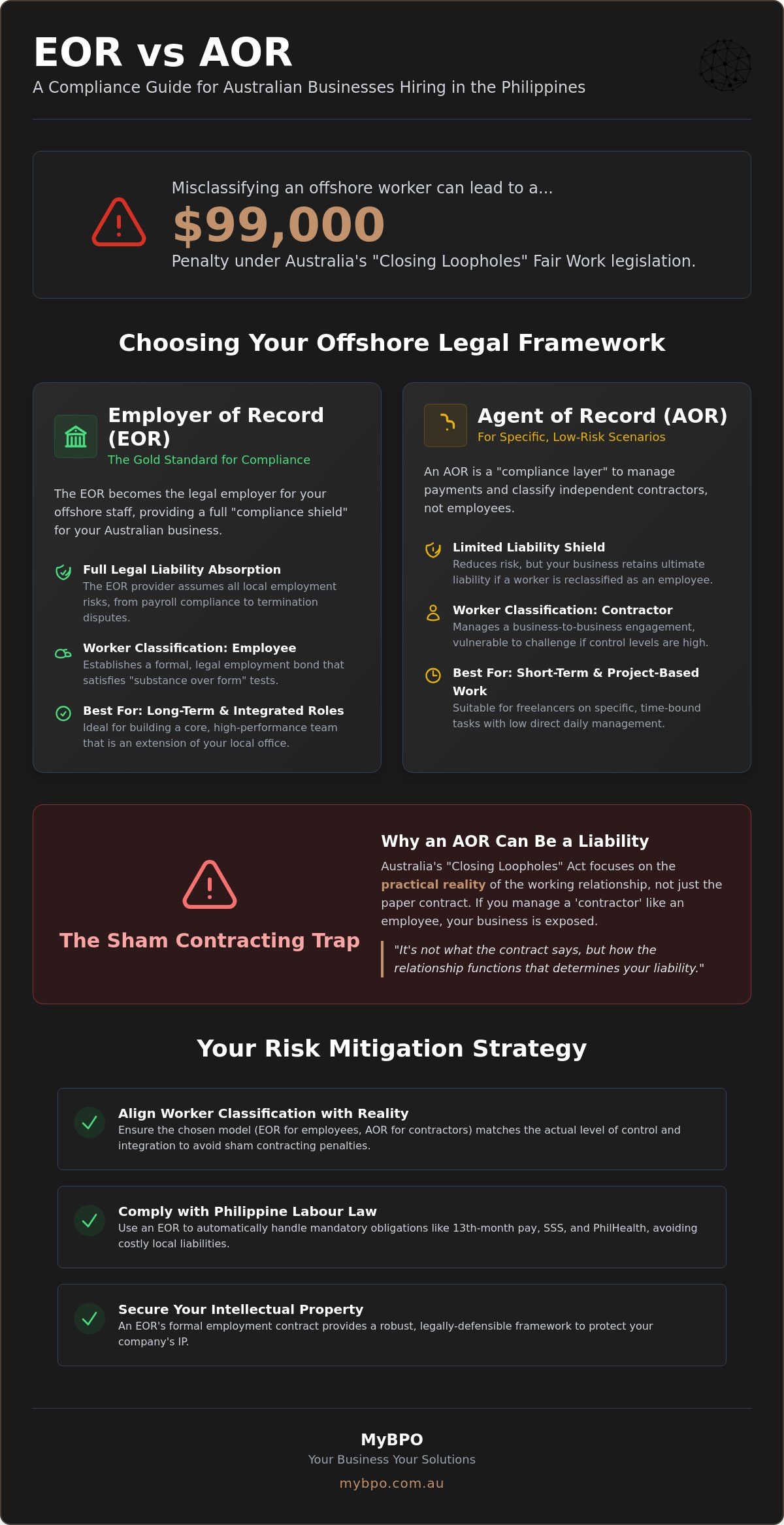
Exposing the Sham Contracting Trap: Why AOR Might Not Be Enough
The most pervasive misconception in the EOR vs AOR debate is the belief that an offshore address serves as a jurisdictional shield against Australian industrial relations law. Many directors assume that engaging a Philippine worker through an Agent of Record (AOR) as an “independent contractor” satisfies their compliance obligations. This is a strategic error. Sham contracting risk for Australian firms hiring in the Philippines is the legal exposure created when a worker is classified as a contractor despite the relationship functionally resembling permanent employment.
The financial consequences of misclassification are no longer just a cost of doing business. As of March 2026, civil penalties for sham contracting have reached $99,000 per breach for companies. For “serious contraventions,” these fines escalate to $495,000 per worker. Perhaps more critically, since January 1, 2025, intentional wage theft, which includes the deliberate misclassification of staff to avoid entitlements, is a criminal offence in Australia. This carries a maximum penalty of 10 years imprisonment and corporate fines of up to $8.25 million, or three times the underpayment amount.
The Australian “Closing Loopholes” Act and Offshore Staff
The “Closing Loopholes” framework has fundamentally changed how the Fair Work Commission evaluates employment status. It has moved away from the primacy of the written contract to a “substance over form” approach. If your Philippine staff member works exclusively for you, uses your systems, and follows your direct supervision, the law may deem them an employee regardless of their location. The FWC now prioritises the practical reality and true nature of the relationship over the label on a document. You should read our detailed guide on Exposing the Sham Contracting Philippines Risk to understand how these laws reach across borders to protect worker rights.
The “Control Test” in Philippine Labour Law
The risk isn’t confined to Australian shores. In the Philippines, the Department of Labor and Employment (DOLE) applies a “four-fold test” to determine the existence of an employer-employee relationship, with “control” being the most decisive factor. If you provide the equipment, set specific working hours, and manage the methodology of the work, the relationship is legally one of employment. Under the AOR model, you lack the corporate structure to manage this control safely. An EOR, however, legitimises this control by acting as the legal employer. It absorbs the risk of reclassification and the subsequent demand for years of back-paid benefits and 13th-month pay. Choosing the right path in the EOR vs AOR comparison is the only way to exercise the high level of control required for high-performance teams without inviting a regulatory disaster.
Choosing the Right Model for Your Australian Business Strategy
A strategic expansion into the Philippines requires a framework that balances operational agility with structural security. When evaluating EOR vs AOR, you must look beyond the immediate hourly rate and consider the “Total Cost of Employment”. This calculation includes the hidden expenses of staff turnover, the administrative burden of managing individual contractor disputes, and the potential cost of a Fair Work audit. For Australian firms, the decision usually rests on how deeply the offshore team is integrated into the core business functions.
Your choice of model directly dictates the culture you build offshore. A high-performance team requires a sense of belonging and stability, which is difficult to maintain under a transient contractor arrangement. If your offshore staff are treated as external service providers rather than integral team members, you will likely face higher attrition rates and a lack of long-term commitment. Australian-owned firms that prioritise intellectual property and operational continuity generally find that the protective layer of an EOR is the only viable path for core business roles.
When to Opt for an AOR (Contractor) Model
The Agent of Record (AOR) model is ideal for one-off projects or niche technical tasks that have a clearly defined end date. If you’re managing short-term surges in workload, such as a specific software development sprint or a three-month marketing campaign, the AOR framework provides the necessary flexibility. It allows you to engage specialists for their output without the long-term commitments of employment.
However, the limitations of AOR become apparent when staff become “part of the furniture” in your business. If a contractor starts attending your weekly strategy meetings and managing other team members, the risk of misclassification increases. In these instances, you should plan a transition from a contractor model to an EOR employee structure to maintain compliance as you scale. Relying on AOR for permanent, high-control roles is a tactical error that leaves your business exposed to the sham contracting traps discussed earlier.
When the EOR (Employee) Model is Non-Negotiable
An Employer of Record (EOR) is essential for any role involving customer-facing interactions, management responsibilities, or the handling of sensitive company data. These positions require a level of oversight and loyalty that a contractor agreement cannot legally or practically provide. Many Australian firms partner with Scale Up Staff to build these dedicated offshore teams for marketing and sales while maintaining full compliance. By using an EOR, you ensure that your staff have access to the full suite of mandatory Philippine benefits, which is a major factor in talent retention.
The psychological benefit for Philippine staff cannot be overstated. In the local market, the security of formal employment is highly prized. Workers who are hired through an EOR feel like a permanent part of your organisation, which leads to higher engagement and lower turnover. If you’re ready to build a secure, long-term department, you should consult our Employer of Record Australia: The Definitive Guide for a deeper dive into secure offshore expansion. To secure your business with a customised compliance shield, contact our specialist team at MyBPO today.
Securing Your Offshore Operations with a Local EOR Partner
The final decision in the EOR vs AOR debate often comes down to the level of accountability you require from your partner. While global digital platforms offer automated onboarding and sleek interfaces, they frequently lack the physical infrastructure and jurisdictional alignment that Australian directors need for total peace of mind. Navigating the Philippine labour market from a desk in Sydney or Melbourne requires more than just software; it requires a partner who understands the specific cultural and legal friction points between these two nations.
A local EOR specialist acts as a bridge between your Australian business objectives and the practical realities of Philippine operations. By moving beyond simple payroll administration, a dedicated partner secures your interests through on-the-ground management and physical oversight. This approach transforms your offshore department from a remote experiment into a stable, high-performance extension of your local organisation. At MyBPO, we position ourselves as your “compliance shield,” absorbing the operational risks so you can focus on growth.
The Value of Australian Ownership
Partnering with an Australian-owned EOR provider ensures a level of accountability that international platforms cannot replicate. When you deal with a company governed by the same legal standards and business ethics as your own, the “trust gap” in offshore hiring vanishes. You have the security of knowing that your partner is answerable to the same regulatory frameworks you are, providing a familiar layer of protection for your corporate reputation.
Direct communication is the cornerstone of this relationship. You avoid the frustrations of time-zone barriers or cultural misunderstandings at the management level. If a complex compliance issue arises in the Philippines, you can discuss the resolution with an Australian specialist who understands your specific concerns regarding the Fair Work Act and Australian tax obligations. This alignment ensures that your offshore strategy remains consistent with your domestic corporate governance.
Infrastructure and Equipment Leasing
The physical environment of your offshore team is just as critical as their legal status. Providing dedicated workspaces in the Philippines is a vital step in maintaining data security and operational uptime. When staff work from a controlled, professional centre rather than a home office, you mitigate the risks of power outages, poor internet connectivity, and unauthorised data access. Physical infrastructure is the final piece of the compliance puzzle, ensuring that your IP remains secure within a professional perimeter.
Equipment leasing further strengthens this security framework. By providing company-sanctioned hardware, you maintain total control over the software environment and security protocols your team uses. This reduces the vulnerability of your proprietary data and ensures that your offshore operations meet the same rigorous standards as your Australian office. In the EOR vs AOR comparison, only the EOR model, supported by physical infrastructure, provides the holistic protection required for a modern, secure, and high-performing international workforce.
Securing Your Growth in the AU-PH Corridor
Expanding your business into the Philippines is a significant strategic move, but it requires a foundation of legal certainty. You’ve learned that the choice of EOR vs AOR is the difference between a secure, integrated team and an exposed contractor arrangement. While an AOR handles basic payments, only an EOR provides the comprehensive compliance shield needed to navigate the “Closing Loopholes” legislation and Philippine labour codes. Accountability is the only way to protect your firm from sham contracting penalties while securing your intellectual property through physical oversight.
MyBPO is an Australian-owned and operated specialist in the AU-PH compliance corridor. With physical offices in Brisbane, Manila, and Bacolod, we provide the on-the-ground support and dedicated workspaces required for a high-performance offshore department. Don’t leave your international reputation to chance. Secure your offshore team with MyBPO’s Australian-owned EOR services and build your global workforce with confidence. You’re now equipped to scale safely and successfully.
Frequently Asked Questions
What is the main difference between EOR and AOR for Australian companies?
The primary distinction lies in the legal classification of the worker and who holds the employer liability. Under an EOR, the worker is a full-time employee of the local provider, whereas an AOR manages independent contractors. This choice in EOR vs AOR determines whether you’re engaging a service or building a permanent, legally protected workforce with full statutory benefits.
Is an EOR legally responsible for my staff in the Philippines?
Yes, the EOR acts as the formal legal employer and assumes all statutory obligations within the Philippine jurisdiction. This includes managing payroll, tax withholding, and compliance with the Department of Labor and Employment (DOLE) standards. By absorbing these liabilities, the EOR provider creates a protective barrier that shields your Australian company from foreign labour disputes.
Can I be fined in Australia for misclassifying a Philippine contractor?
Yes, the Fair Work Commission can impose significant civil penalties if an offshore contractor arrangement is deemed sham contracting. As of March 2026, companies face fines up to $99,000 per breach, while serious contraventions can reach $495,000. Australian law prioritises the practical reality of the working relationship, regardless of where the worker is physically located.
Does an AOR handle Philippine taxes like SSS and PhilHealth?
Generally, an AOR does not manage mandatory Philippine contributions like SSS, PhilHealth, or Pag-IBIG because the worker is classified as an independent contractor. Contractors are typically responsible for their own tax and benefit payments. If these obligations remain unpaid, it significantly increases the risk of the worker being reclassified as a “deemed employee” under local labour laws.
Which model is better for protecting my company’s intellectual property?
The EOR model provides superior protection for intellectual property because it operates under a formal employment contract that recognises the “work-for-hire” principle. This structure is more easily enforceable in Philippine courts than individual contractor agreements. When combined with dedicated workspaces and leased equipment, an EOR provides the most robust security for your proprietary data.
What happens if a Philippine worker wants to sue for wrongful dismissal?
If the worker is hired through an EOR, the provider manages the legal defence and any resulting settlements as the registered employer of record. If you use an AOR or hire directly, your Australian firm may be held directly liable in a Philippine labour tribunal. Without a local legal entity, defending such claims is exceptionally difficult and carries high financial risk.
Is EOR more expensive than hiring a contractor directly?
While the service fee for an EOR is higher than a simple payment platform, it’s often more cost-effective when evaluating the “Total Cost of Employment”. Direct hiring involves hidden costs from high staff turnover and potential legal penalties for misclassification. An EOR delivers long-term value by securing a compliant, high-performance team that feels like an extension of your local office.
How does the Closing Loopholes Act affect my offshore team?
The Closing Loopholes Act mandates that the “true nature of the relationship” determines worker status, regardless of the contract’s label. If your offshore team functions like employees—following your direct supervision and using your systems—they must be treated as such to avoid sham contracting risks. This legislation makes the EOR vs AOR decision a critical part of your Australian compliance strategy.
Need a strategy session?
Tell us about your team and we will map out the right structure, fixed-cost quote included.
Book a call