Blog
Hidden Costs of Offshoring to the Philippines: A 2026 Guide

The cheapest offshore salary can become an expensive hire if the budget stops at the payslip. The hidden costs of offshoring to the philippines can include employer obligations, recruitment and onboarding, equipment, workspace, training and the management time needed to maintain quality. For Australian businesses, these costs are harder to compare when different hiring structures assign responsibilities differently.
Offshoring can reduce labour costs, but a salary-only estimate won’t show the full cost of employing and supporting someone in the Philippines or the operational work that may sit with your Australian team. If responsibility for training, administration or rework is unclear, the apparent saving can narrow.
This 2026 guide explains how to build a total-cost view beyond wages, compare direct hiring, contractor and Employer of Record arrangements using consistent assumptions, and identify key cost drivers before you commit. It also shows how recruitment, equipment, dedicated workspaces and local workforce support can fit into a realistic budget.
Key Takeaways
- Look beyond salary to account for employment, recruitment, equipment, workspace and oversight costs.
- Compare direct hiring, contractor arrangements and EOR using the same role scope and assumptions.
- Include the hidden costs of offshoring to the philippines in your budget, and verify which employment contribution obligations apply to the role.
- Record one-off, recurring, variable and risk-related costs in a worksheet so assumptions and responsibilities are visible before hiring.
- Define the scope, cost assumptions and ownership of key tasks before expanding your Philippine workforce.
Why the headline cost of offshoring to the Philippines can mislead
A worker’s pay is only one part of the cost of employing and supporting them. An offshore role also needs an appropriate employment arrangement, tools, workspace and management. Depending on the structure, these inputs may be handled by different parties.
The total cost of offshoring is the combined cost of employing, equipping and managing an offshore worker under a specific hiring and operating arrangement. There is no universal figure. The relevant cost categories and their amounts depend on the role, workforce needs and agreed responsibilities.
What does the total cost of an offshore hire include?
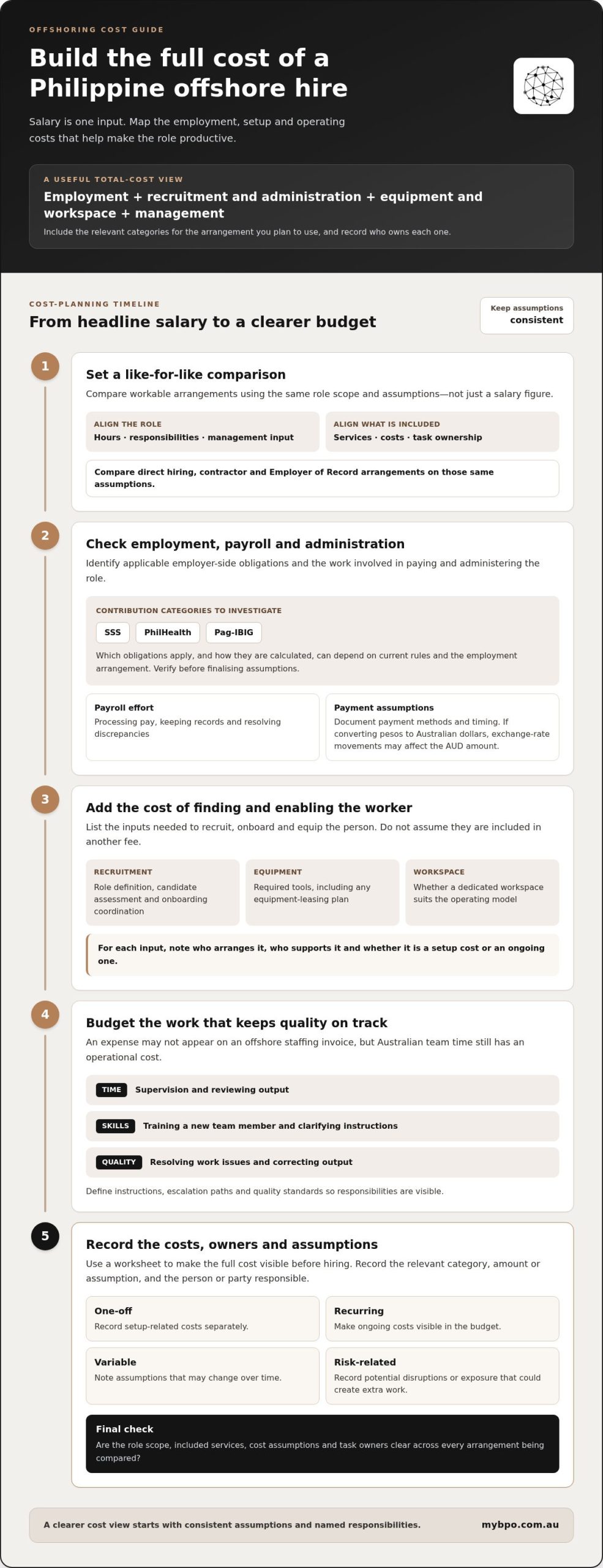
Separate direct employment costs from the inputs needed to make the role productive. Pay and any applicable employer-side obligations belong in the first group. Recruitment, employment administration, equipment, workspace, onboarding and supervision are costs of finding, enabling and managing the worker. Some arrangements bundle certain inputs; others leave them with your business. Include the relevant categories and name who owns each one.
An expense can be absent from an invoice without being absent from your budget. If an Australian manager spends time resolving work issues, training a new team member or reviewing output, that time has an operational cost even if it isn’t recorded as an offshore staffing fee. The Philippines’ business process outsourcing sector includes different operating setups, as outlined in Business Process Outsourcing in the Philippines. Use that context as background, then model the arrangement your business actually plans to use.
Why do headline salary comparisons fall short?
A salary-only comparison can omit employer-side obligations and the practical costs of getting work done. It may also compare unlike arrangements: one estimate might include recruitment or equipment, while another counts only pay. Before comparing figures, align the role, hours, responsibilities, management input and included services. Otherwise, the apparent difference may reflect exclusions rather than the true cost.
For example, comparing a Philippine worker’s salary with the full cost of an Australian employee is not like for like. Nor is it useful to compare a direct hire that needs internal administration with an arrangement where some administration is handled externally, without accounting for those different responsibilities. The hidden costs of offshoring to the philippines are easy to miss when assumptions vary between options.
Build the comparison around questions such as:
- Which employment and operating costs are included in each estimate?
- Who supplies equipment and workspace, and who manages recruitment and onboarding?
- How much supervision, training and quality review will your Australian team provide?
- Which responsibilities or potential disruptions could create additional work or exposure?
There’s no sound basis for assuming offshoring is automatically cheaper or more expensive. Compare the full cost of each workable arrangement using consistent assumptions, and record who owns each task. This gives decision-makers a clearer view of planned expenditure and responsibilities that could otherwise fall between teams.
Which hidden offshoring costs should Australian businesses account for?
A realistic budget captures more than the amount paid to the worker. Map costs across employment obligations, recruitment, administration, equipment, workspace and ongoing oversight, then assign an owner to each. The hidden costs of offshoring to the philippines often become apparent when a task has no clear owner or a recurring expense sits outside the headline salary estimate.
Employment, payroll and administration costs
Assess employer-side obligations and the effort required to administer employment and payroll, but don’t assume every estimate applies to every role. In the Philippines, SSS (Social Security System), PhilHealth (Philippine Health Insurance Corporation) and Pag-IBIG (Home Development Mutual Fund) are relevant contribution categories to investigate. Which obligations apply, and how they’re calculated, can depend on current rules and the employment arrangement.
Payroll also involves coordination and record-keeping. Budget for the work involved in processing pay, maintaining records and resolving discrepancies, and document how payments will be made. If costs are converted between Philippine pesos and Australian dollars, exchange-rate movements may affect the AUD amount over time. Payment methods and timing can also shape administration. Verify current obligations and processes before finalising your assumptions. The Philippines payroll compliance reference provides further detail on payroll obligations for Australian companies.
Recruitment, equipment, workspace and management costs
Recruitment costs more than any external fee. Australian staff may spend time defining the role, assessing candidates and coordinating onboarding. Then consider the equipment required, whether a dedicated workspace is appropriate, and who will arrange access and ongoing support. List each input rather than assuming it is included.
Infrastructure choices affect how work is organised and supported. A dedicated workspace in the Philippines may suit the operating model, while equipment leasing can form part of an equipment plan. Record who is responsible for each and whether the expense is a setup cost or an ongoing one.
Give oversight its own line in the budget. Unclear instructions, escalation paths or quality standards can lead to extra time spent correcting work, answering repeated questions or resolving delays. These demands can build gradually and be easy to overlook. Set out the expected supervision and review process, then revisit the estimate once the role is operating.
Every cost line needs a named owner and a documented assumption. A practical register can include the category, expected frequency, currency, responsible party and basis for the estimate. This makes gaps visible before they become disputes or unplanned work. MyBPO’s Philippines workforce support can be part of the operating plan for Australian businesses structuring employment administration and local support for their Philippine workforce.
How do hiring structures change the true cost of offshoring?
The same role can have a different cost profile depending on who engages the worker and who handles employment administration. Direct hiring may give your business more control, but it can also leave more setup and ongoing work with your own team. Contractor arrangements and Employer of Record (EOR) services allocate tasks differently. None automatically removes liability, ensures compliance or guarantees a lower total cost.
Direct hiring, contracting and EOR: what changes in the cost model?
Compare each structure by the work it leaves with your business, not just its visible charge. Direct hiring may involve internal coordination of recruitment, employment administration and workforce support. Contractor arrangements may shift some processes, but classification remains a risk consideration. The label alone doesn’t determine how a working relationship should be treated, so review current rules for the specific arrangement. The Philippine sham contracting risk guide explores that issue in more detail.
| Structure | Setup effort | Administration ownership | Cost visibility | Responsibility allocation |
|---|---|---|---|---|
| Direct hiring | Business coordinates the hiring setup | More tasks may remain in-house | Internal time and operating costs need to be tracked | Responsibilities sit across the business and local arrangements |
| Contractor arrangement | Terms and working processes need to be established | Tasks depend on the agreed arrangement | Payment may be visible, while internal oversight still needs costing | Classification and day-to-day responsibilities require careful assessment |
| EOR | Arrangements are established with the EOR | Defined employment administration can be centralised | Service fee can be identified alongside retained costs | Allocation depends on the agreed scope and operating model |
Use the table as a comparison prompt, then review the actual terms of each arrangement. The hidden costs of offshoring to the philippines can sit in work retained internally, such as supervision, recruitment coordination or equipment provision, even when another party handles defined administration.
When can an EOR make costs easier to assess?
An EOR can bring defined employment administration into an agreed service arrangement. This can make certain responsibilities easier to identify, but the service fee is only one budget line. Compare it with internal administration time, recruitment effort, equipment, workspace and oversight using the same assumptions for each model. The Employer of Record Australia guide explains the broader structure.
Before comparing totals, document what the EOR handles, what your business retains and which operating inputs sit outside the service scope. MyBPO provides EOR services for Australian companies hiring directly in the Philippines, alongside on-the-ground support for their Philippine workforce. MyBPO’s Philippines EOR approach is one structure to assess against your role requirements and responsibility model.
How can you calculate and control the full cost before hiring?
A useful comparison includes every cost over the same timeframe. Choose a consistent period and role scope for each option, then build the estimate from your hiring, operating and management inputs. This lets you compare structures without relying on invented salary benchmarks, provider prices or industry averages.
Build a like-for-like offshore staffing cost model
Keep the model practical. Record which figures are known, estimated or not yet priced. For amounts paid in Philippine pesos, note the currency, exchange-rate assumption and payment timing. Rather than treating an exchange rate as fixed, test how a change could affect the AUD budget.
- Define the role. Set out the responsibilities, expected workload, required skills and reporting arrangements. Use the same scope for every hiring option.
- Choose the comparison period. Use one timeframe for recurring costs, and include setup costs that fall outside it so they don’t disappear from the comparison.
- List the cost categories. Capture employment and administration, recruitment, onboarding, equipment, workspace, payment processes and management input where relevant.
- Assign an owner. Record who pays, who performs the task and whether it is handled internally or through an agreed service arrangement.
- Document assumptions and test scenarios. Mark each entry as confirmed, estimated or unpriced. Compare a baseline with reasonable changes to role scope, operating needs or exchange-rate assumptions, without presenting unsupported forecasts as facts.
A simple worksheet can use the following cost columns, alongside the item, currency, estimate status, owner and assumption:
- One-off: recruitment effort, onboarding and initial equipment or workspace setup.
- Recurring: pay, applicable employment-related obligations, administration, workspace and regular supervision.
- Variable: costs that may change with workload, payment timing, equipment needs or exchange-rate movements.
- Risk-related: potential costs that are difficult to price upfront, such as additional rework or continuity arrangements. Describe the exposure and responsible owner rather than assigning an unsupported figure.
Reduce avoidable costs through clear ownership
Unassigned work often becomes an unplanned management burden. Name the person or party responsible for recruitment, onboarding, payroll coordination, equipment, day-to-day direction and performance management. Then choose practical measures, such as time spent supervising, quality review requirements, productivity against agreed role expectations, retention and service continuity. These measures won’t remove uncertainty, but they help show whether the original cost assumptions still reflect how the role operates.
Review the model when the role changes, headcount grows or operating requirements shift. A new responsibility may call for different equipment, more training or closer oversight. Record the reason for each revision so decision-makers can distinguish a genuine cost change from a gap in the original estimate.
MyBPO’s Employer of Record services are one option for Australian businesses assessing an EOR arrangement as part of Philippines workforce planning.
How MyBPO EOR can fit a more transparent Philippines offshoring plan
An Employer of Record (EOR) arrangement is one structure Australian companies can consider when hiring directly in the Philippines. It can bring defined employment administration into an agreed service arrangement, while your business retains its role in directing work and managing operational priorities. The value of the model depends on clear boundaries, not on an assumption that every task or cost is covered.
MyBPO is an Australian-owned and operated offshore staffing specialist providing EOR services for Australian companies hiring directly in the Philippines. It also provides on-the-ground support for those companies’ Philippine workforce. Compare these services with other structures using the same role scope and a clear record of retained responsibilities.
What to clarify when planning an EOR arrangement
Before expanding a workforce, map the roles and planned headcount. Define which employment administration tasks sit within the EOR arrangement and which remain with your business. Identify internal management needs, including who sets priorities, provides role-specific training and reviews performance. This keeps the employment structure distinct from day-to-day operational management.
List costs included in the model separately from items budgeted outside it, such as recruitment, equipment, workspace or additional internal oversight where relevant. Record the assumptions behind each line, including the responsible party and review point. The allocation depends on the agreed scope, so make it explicit rather than relying on a broad label such as “EOR”.
Move from cost estimate to informed decision
Take a practical comparison into planning discussions: role and headcount, employment-related costs, administration, recruitment, equipment, workspace, payment processes and management time. For each item, note whether it is included, separately budgeted or still uncertain. Set a review process so assumptions can be revisited if workforce needs, responsibilities or operating requirements change.
Review performance against the original plan to identify where actual requirements differ. If the role needs more onboarding or supervision than anticipated, update the assumptions and clarify who owns that work. This doesn’t remove uncertainty, but it gives Australian decision-makers a more reliable basis for adjusting the budget and responsibilities as the team develops.
The hidden costs of offshoring to the philippines are easier to assess when employment administration and local workforce support have clear boundaries. MyBPO’s EOR services and on-the-ground support are an option for Australian businesses planning a Philippine workforce. Compare the arrangement with your requirements, documented cost categories and responsibility allocation before committing to expansion.
Explore MyBPO’s EOR services as part of planning a more transparent Philippines hiring arrangement.
Make your next hiring decision with clearer assumptions
Turn your cost model into a decision tool. Before approving a hire or expanding a team, identify which assumptions matter most, where uncertainty remains and who will review the plan as the role develops. This helps your business respond to change without losing sight of the responsibilities behind the budget.
The hidden costs of offshoring to the philippines aren’t a reason to rule out offshore hiring. They’re a reason to make the operating model visible before committing, then revisit it as your workforce and requirements change. A considered structure gives your Australian team a clearer basis for planning and accountability.
For Australian companies hiring directly in the Philippines, MyBPO provides EOR services and on-the-ground workforce support. Assess the service alongside your documented assumptions and responsibilities.
Explore MyBPO’s Employer of Record services and take the next step towards a more informed offshore hiring plan.
Frequently Asked Questions
What are the hidden costs of offshoring to the Philippines?
The hidden costs of offshoring to the philippines can include obligations and work that don’t appear in a worker’s pay figure. A new role, for example, may require recruitment coordination, specialised equipment or additional review by an Australian manager. These items won’t apply equally to every hire. Assess each against the proposed role and arrangement, then record who owns the cost and whether the amount is confirmed or estimated.
Is offshoring to the Philippines always cheaper for Australian businesses?
No. A lower salary figure alone can’t show whether an offshore arrangement will cost less overall. Compare the same responsibilities, expected output and management support across each option. If one arrangement includes a defined administrative service while another relies on your internal team, account for both the service and your team’s time. The result depends on the role and how the work is organised.
How much does it cost to hire staff in the Philippines from Australia?
There’s no single amount that applies to every role or hiring arrangement. Build an estimate from current, role-specific inputs and show the figures in Australian dollars for comparison. Where a cost is set or paid in Philippine pesos, document the conversion assumption and payment timing separately. Distinguish initial recruitment or setup expenses from ongoing costs to see how the budget may change as the role continues.
Can an Employer of Record reduce the hidden costs of offshoring?
An Employer of Record may make defined employment administration easier to allocate, but it doesn’t automatically remove costs or guarantee savings. Review the service scope and identify tasks your business still performs, such as directing work or reviewing output. Then compare the EOR service fee with the internal time and operating inputs required under another structure. This like-for-like view helps clarify whether the arrangement suits your needs.
What should an offshore staffing cost comparison include?
Include both the cost of engaging the worker and the resources needed to make the role function. A customer support role, for example, may require training on your systems and processes, while a specialist role may need particular equipment. Record these as separate assumptions rather than burying them in a general allowance. Note the estimate date and review it if the role, working arrangements or payment process changes.
Are Philippine employee contributions included in an offshore hiring budget?
They may need to be included, depending on the employment arrangement and current requirements. SSS, PhilHealth and Pag-IBIG are Philippine institutions associated with contribution categories to assess, but don’t assume a fixed rate or that every category applies to every situation. Verify current employer obligations for the proposed arrangement before using figures in a budget. Where the treatment is uncertain, obtain advice from an appropriately qualified professional.
How can Australian businesses avoid unexpected costs when hiring in the Philippines?
Reduce budget surprises by setting a clear approval process for changes to the role or operating arrangement. Require an updated estimate when responsibilities expand, equipment needs change or extra management time becomes necessary. Keep a record of actual costs alongside the original assumptions, including the reason for any variance. This creates a useful history for future hiring decisions and helps identify which estimates need closer review.
Need a strategy session?
Tell us about your team and we will map out the right structure, fixed-cost quote included.
Book a call