Blog
Calculate Offshore Team ROI by Comparing Costs and Benefits

Small practices can track an offshore team’s ROI early, rather than waiting for a year-end review. To calculate ROI for an offshore team, subtract total costs from measurable benefits, divide the net return by total costs, then multiply by 100. Include productivity and quality in the benefits assessment: lower staffing costs alone don’t show whether the arrangement is delivering useful work.
It’s sensible to be cautious about projected savings. Onboarding, management time, equipment and rework all affect the result. If output improves gradually, early returns may differ from longer-term performance. Track costs alongside operational measures for a clearer picture than a headline estimate alone.
This guide explains how to calculate ROI for an offshore team by comparing costs with business benefits, accounting for productivity and quality, and tracking measurable returns. You’ll learn which metrics show whether the team is meeting business needs, how to interpret early results and how Australian businesses can make a grounded decision about their offshore staffing investment.
Key Takeaways
- Compare the full cost of offshore staffing with the business value it creates, including management, training, equipment and rework.
- Account for onboarding and output quality so projected savings reflect productive work, not just lower staffing costs.
- Track early results against a baseline, then use the ROI formula to assess whether measurable benefits exceed total investment.
- Choose practical metrics tied to business goals, such as completed work, error rates, turnaround times and customer satisfaction.
- Review cost reduction alongside service quality and productivity to understand whether the arrangement is delivering sustainable value.
Comparing offshore development costs with business benefits
Compare the offshore team’s full costs with the value of its completed software work, using an equivalent Australian in-house team as the baseline. Australian tax, employment and compliance rules also affect the calculation through the hiring structure, tax treatment, administration and records required.
Including Additional Offshore Costs
Additional offshore costs are expenses beyond wages or service charges, such as travel, training and infrastructure. Include them in your calculation: excluding setup and operating costs can make the apparent savings larger than the actual return.
For a practical comparison, record each expense against the project and period it supports. Separate one-off travel or onboarding from recurring software, equipment and infrastructure overhead. If a training cost supports several projects, allocate it consistently rather than charging it to only one. This gives Australian businesses a clearer view of the investment required to deliver each project.
Assessing Recurring Costs and Benefits
Recurring costs and benefits continue throughout a project, such as ongoing staffing expenses and reduced development spending. Track them because a one-off saving doesn’t show whether the arrangement remains worthwhile over time.
Compare costs and benefits over the same period, then calculate ROI as net return divided by investment cost, multiplied by 100%. For ongoing work, use consistent annual reporting or rolling 12-month periods. Include recurring benefits only while they are measurable, such as maintained output or reduced rework. This keeps the comparison aligned with the project’s actual operating cycle.
Tracking Costs, Savings and Compliance
Cost and compliance tracking records project expenses, savings and obligations relevant to the hiring arrangement. Unrecorded administration or employment-related work can distort your comparison and weaken oversight.
Maintain a project ledger that separates staffing, travel, training, infrastructure and management time. Record relevant Australian tax and employment considerations alongside the engagement structure and required documentation. These factors affect total costs and the work needed to manage the arrangement. Review the ledger when the team’s responsibilities or structure change.
Compare offshore and in-house development based on equivalent work, not salary alone. Match the role scope, expected deliverables, review effort and project duration. Then set the offshore team’s actual costs beside the Australian baseline. This shows whether savings come from lower spending, increased capacity or both.
Track savings as costs avoided or reduced, separately from revenue gains. For example, if offshore developers complete planned work with less rework, record the reduction in rework separately from any additional product revenue. This prevents the same benefit from being counted twice in your ROI calculation.
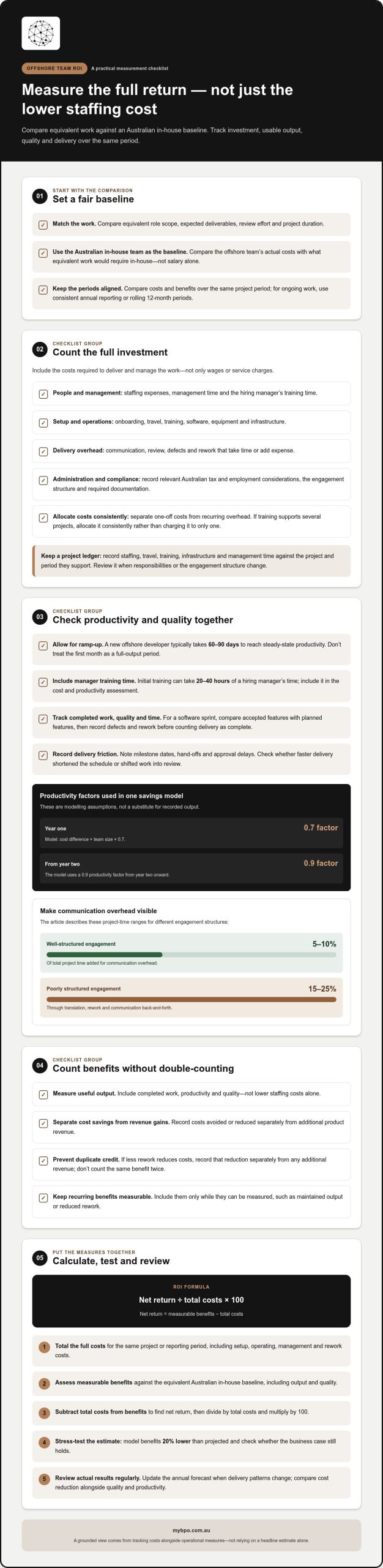
Test the estimate against a less favourable outcome: model benefits 20% lower than projected. If the result still supports the business case, the decision is less dependent on optimistic assumptions. Review actual costs and benefits at regular reporting intervals, then update the annual forecast when delivery patterns change.
Accounting for productivity and quality differences
Lower labour costs don’t automatically produce a higher return. Compare completed work, quality and delivery time with the output expected from an equivalent in-house role. A new offshore developer typically takes 60-90 days to reach steady-state productivity, so treating their first month as a full-output period can inflate projected savings.
Allow for ramp-up and integration
Ramp-up is the period when a new team member learns your systems, standards and workflows. It matters because training and coordination reduce available delivery time before steady output develops. Initial training can take 20-40 hours of a hiring manager’s time, which belongs in the productivity and cost assessment.
Use a realistic productivity factor in the year-one calculation. One model estimates first-year offshore savings by multiplying the cost difference by team size and a 0.7 productivity factor. From year two onward, it uses a 0.9 factor. These adjustments recognise that integration takes time; they’re assumptions for modelling, not a substitute for recorded output.
Measure delivery and quality together
Track completed tasks, work quality and time taken for each task. These measures show whether the team produces usable work on schedule, rather than simply recording activity. For a software sprint, compare accepted features with planned features, then record defects and rework before counting delivery as complete.
Quality affects productivity directly. If a task is returned for correction, count the rework time and its effect on later deadlines. A well-structured offshore engagement may add 5 to 10 percent of total project time for communication overhead. Poorly structured engagements can add 15 to 25 percent through translation, rework and communication back-and-forth. These percentages make communication and review effort visible in the comparison.
Assess time to market and team integration
Compare the offshore project schedule with the time required for equivalent in-house development. Record milestone dates, hand-offs and approval delays, then assess whether the offshore team shortened delivery or shifted work into review. Faster delivery creates business value only if the product meets the client’s acceptance criteria.
For a practical review, average results across comparable tasks instead of relying on one unusually fast or slow outcome. Separate delays caused by unclear requirements from execution delays. Then update the productivity factor using observed delivery, quality and coordination data. This makes your ROI estimate more defensible as the team integrates and its output changes.
How do firms calculate offshore ROI in the first few months?
Calculate offshore team ROI by subtracting total investment from measurable benefits, dividing by total investment, then multiplying by 100%. In early analysis, use actual costs and delivered value to date, rather than assuming a full year of benefits.
Applying the Basic ROI Formula
The basic formula is ROI = (benefits − investment cost) ÷ investment cost × 100%. It matters because it expresses the net return as a percentage of the resources committed.
For example, an investment that returns 1.3 times its cost produces 30% ROI. A result of 0% means benefits equal costs; a negative result means recorded benefits haven’t yet covered investment. Use consistent periods and include only benefits that the offshore work helped deliver.
Accounting for Total Investment
Total investment includes every cost required to establish and operate the offshore arrangement during the measurement period. Include these items because a wage-only calculation can overstate the return.
Bring together staffing, software, tools, infrastructure, travel, management time, recruitment and initial training costs. Separate one-off setup costs from recurring expenses. For example, include training in the first-year investment, then retain relevant ongoing costs in later calculations. This makes the formula reflect the resources committed to the work, not just visible staffing expenses.
Comparing Year-One and Ongoing ROI
Year-one ROI includes setup and ramp-up costs alongside benefits delivered during the first year. Ongoing ROI measures recurring costs and benefits after the initial investment period. Keep them distinct because early costs can weigh heavily before recurring savings accumulate.
Use the same formula for both periods, but match each period’s costs with its benefits. For ongoing performance, calculate rolling 12-month ROI to see whether returns persist. To annualise ROI across a holding period, use (1 + ROI)1 ÷ years − 1, with ROI expressed as a decimal. This allows comparisons across different timeframes.
Interpreting ROI Results
ROI shows the net return relative to investment, but not when benefits arrived. That distinction matters when a project incurs initial training costs before delivering its expected value.
Review early results against delivery expectations, and update your analysis as actual costs and benefits emerge. A positive percentage means measured benefits exceeded investment for that period. Basic ROI doesn’t account for the time value of money or investment risk, so consider those separately for longer-term decisions. For example, compare project cash-flow timing alongside the percentage before judging whether returns meet business expectations.
Setting specific, measurable ROI metrics
Set metrics that connect offshore team performance to business goals, then compare actual results with a defined baseline. Benchmarks vary by role, country and industry because tasks, labour costs and measures of value differ. Compare like-for-like roles and deliverables, such as software development with software development, rather than applying one benchmark to every team.
Choosing Metrics and Data
ROI metrics are measurable indicators of whether the team’s work creates business value. A positive cost comparison alone cannot show whether quality, delivery or customer outcomes meet expectations.
Choose a small set of metrics tied to the role, and capture each consistently. For software work, record completed tasks, quality and time taken. Customer satisfaction can help show whether delivered products meet customer needs. Compare results with your baseline and project goals, not an unrelated industry average.
Keep source data traceable. Link task records to accepted deliverables and match recorded costs to the same reporting period. If the business goal is faster product delivery, measure milestone completion and time to market. If it is fewer errors, record defects and rework. This helps distinguish genuine improvements from activity that doesn’t affect outcomes.
Tracking Results in an ROI Dashboard
An ROI dashboard presents selected metrics and their movement against baselines in one view. It helps Australian business owners assess cost, output and quality together instead of relying on a single positive figure.
Organise the dashboard around business goals and use a consistent reporting period. Show actual spending beside the approved budget, then pair it with completed work, quality results and customer satisfaction. Note changes in scope or training so readers can interpret shifts accurately.
- Cost: track actual offshore team costs against the comparable in-house baseline.
- Output: record completed and accepted tasks against planned work.
- Quality: monitor defects, rework and customer feedback.
- Delivery: compare milestone dates with the project schedule and time-to-market target.
Use the same definitions in every reporting period. For example, count a software task as complete only after acceptance, not when development stops. This keeps output and quality measures aligned.
Review dashboard movements alongside the reason for each change. If completed tasks rise while rework also increases, output alone may overstate improvement. If costs fall but customer satisfaction declines, the apparent saving may conflict with the business goal. Record the cause, assign a follow-up action and compare the next reporting period against the same baseline.
Keep ROI and operational metrics distinct but connected. ROI summarises return against investment; task completion, quality and customer satisfaction help explain the result. Together, they give decision-makers a clearer basis for adjusting scope, training or workflows as team performance develops.
Calculating cost reduction and ROI
Cost reduction compares the actual offshore team investment with the cost of equivalent work in-house. Remote staffing estimates often cite 50-70% savings against domestic hiring, but Australian businesses should calculate their own baseline using comparable roles, responsibilities and output. A headline percentage isn’t a substitute for a direct comparison of actual costs.
Build the comparison around one reporting period. For an annual view, include each employee’s staffing cost, equipment, software, management time, training and rework. If you convert hourly rates into annual estimates, use the same working-week assumption for both teams. One calculator annualises using 52 working weeks per year, which keeps the calculation consistent when applied to both sides.
Use the basic formula: ROI = (measurable benefits − total investment) ÷ total investment × 100%. Cost reduction can be one benefit, but it isn’t the only one. Include measurable value from additional output or faster delivery when your records show those outcomes. Keep cost savings separate from revenue gains, so each benefit appears only once in the analysis.
Test the result against an alternative scenario. Recalculate ROI with benefits 20% lower than projected, then compare that outcome with the original estimate. This stress test shows how dependent the strategy is on expected productivity or savings. If the lower-benefit case changes the decision, identify which assumptions drive the difference and monitor those items closely.
A positive ROI means recorded benefits exceed investment for the period measured. It doesn’t automatically establish success: basic ROI excludes the time value of money and doesn’t inherently account for investment risk. A project returning the same percentage over different periods may not offer equivalent value. For multi-year work, report rolling 12-month results alongside the full-period figure, so decision-makers can see whether returns persist.
Keep a clear audit trail for your calculation. Store the in-house baseline, offshore invoices, payroll or staffing records, equipment costs and output measures in one reporting file. Match each cost to the period and work it supports. For example, separate recurring employee costs from one-off onboarding expenses, then show how each affects year-one and ongoing ROI. Consistent records make changes easier to explain during budget reviews.
- Direct costs: compare equivalent roles, overhead and project expenses.
- Benefits: record reduced costs, accepted output and time saved.
- Review: compare actual results with the forecast and the lower-benefit scenario.
For Australian businesses assessing cross-border hiring structure alongside the numbers, discuss your offshore staffing structure.
MyBPO: Employer of Record (EOR) Services
MyBPO provides Employer of Record (EOR) Services for Australian businesses hiring directly in the Philippines. It’s a practical next step when your ROI analysis supports a dedicated offshore role and you need an employment structure for that cross-border hire. With EOR, you can focus on the role’s objectives, output and performance measures while MyBPO employs the team member locally and manages HR and payroll.
MyBPO also offers Recruitment Services to help find people for suitable roles. Keep your financial assessment grounded in the agreed role, expected deliverables and actual costs, then track performance against your business metrics. This connects the hiring decision to the ROI framework used throughout this guide.
To discuss your offshore staffing requirements, visit mybpo.com.au.
Turn your ROI analysis into a confident next step
Your ROI model is most useful when it informs a practical hiring decision. Before moving forward, define success for the role, how you’ll review performance and who will manage day-to-day decisions. These details turn a spreadsheet forecast into an operating plan your business can assess over time.
As you calculate ROI for an offshore team, keep assumptions visible and revisit them as actual delivery data comes in. This helps identify where the arrangement creates value and where the role, workflow or expectations need adjustment. A measured approach supports both the business case and the quality of the work.
MyBPO offers Employer of Record (EOR) Services, Recruitment Services and Equipment Leasing for Australian businesses building offshore teams. If you’re ready to discuss how those services may fit your plans, discuss your offshore plans with MyBPO.
Start with a clear business need, then build the team and measurement approach around it. A well-grounded decision gives you a stronger foundation for sustainable growth.
Frequently Asked Questions
Can small practices benefit from early ROI tracking for outsourcing?
Yes. A small practice can track a few role-specific measures without building a complex finance system. For example, record the time spent clearing a work queue, corrections needed and deadlines met. Compare these results with the same workflow before outsourcing. This helps owners spot capacity issues and adjust task instructions early, before a process gap affects client service or staff workloads.
How soon can firms expect to see positive offshore ROI?
Some estimates place offshore team break-even at 3 to 4 months after an engagement starts. Early ROI depends on when the role begins delivering useful output and how quickly benefits offset setup and recurring costs. Track actual results during the first 30 to 90 days, but distinguish an early operating signal from a full-period return. Delayed onboarding or rework can shift the point at which benefits exceed investment.
What is ROI?
ROI, or return on investment, measures the net benefit of an investment relative to its cost. For an offshore role, it helps show whether measurable value exceeds the resources committed. A practice might compare the role’s cost with the value of completed work and capacity freed for other tasks. Use the same reporting period and include only benefits linked to the investment.
What is Return on Investment (ROI)?
Return on Investment is the full name for ROI, a percentage used to assess an investment’s financial result. For an offshore staffing decision, it can help compare a proposed role with other uses of the practice’s budget. Read the percentage alongside the underlying figures: a small investment can produce a high ROI percentage while delivering less total value than a larger investment.
What costs should be included when calculating offshore team ROI?
Include the costs needed to recruit, employ, equip and manage the offshore role. Depending on the arrangement, these may include salary, employment administration, training, software, equipment, travel, infrastructure and review time. Separate one-off setup expenses from recurring costs. For instance, a laptop purchase affects the initial investment differently from a software subscription renewed throughout the measurement period.
How do offshore team salaries and operating costs compare with Australian hiring costs?
Offshore salary and operating costs vary from Australian hiring costs by role, skills, location and employment structure. Compare equivalent work, not salary alone. Your Australian baseline should include relevant employment costs and overhead, then be compared with the offshore role’s full operating cost, including tools, management and expected output. A lower salary doesn’t establish savings if the role requires substantial extra supervision or rework.
How should you account for recruitment, onboarding, management, and communication costs?
Record recruitment and onboarding as setup expenses, then track ongoing management and communication effort during operation. Initial remote-staff training is estimated at 20-40 hours of the hiring manager’s time, while ongoing management can take 2-5 hours per week. Use actual time records where available. Separate these hours from delivery work so the ROI calculation reflects both the cost of establishing the role and its continuing oversight. For teams wanting additional perspective on how corporate hiring pipelines and interview steps operate, Job Hunt Mode Blog provides detailed breakdowns of major employers’ recruitment stages.
What hidden costs and risks can reduce offshore team ROI?
Unrecorded rework, unclear requirements, communication delays and extra management can reduce returns by consuming time without adding accepted output. If a worker is found to be an employee, misclassification can lead to back-pay of superannuation, leave, tax and interest.
Need a strategy session?
Tell us about your team and we will map out the right structure, fixed-cost quote included.
Book a call