Uncategorized
Employer of Record Australia: The Definitive Guide for Secure Offshore Expansion in 2026

In 2026, a single misstep in worker classification can trigger Fair Work penalties that completely erase the financial benefits of hiring offshore. You’re likely aware of the immense potential in global talent, yet the anxiety of managing remote staff across jurisdictional boundaries remains a significant barrier. It’s a valid concern, particularly as the “Closing Loopholes” reforms have criminalised intentional wage underpayment and tightened the definitions around sham contracting. This guide demonstrates how to leverage an employer of record Australia to secure your expansion, ensuring every offshore hire is fully compliant and legally insulated.
You’ll learn how to navigate complex labour laws and eliminate the risk of misclassification claims while maintaining total control over your team’s output. We provide a clear breakdown of the latest regulatory requirements, including the 12% superannuation guarantee and the new Payday Super rules, to help you build a global workforce that feels like a natural extension of your local office. By the end of this article, you’ll have a roadmap for achieving total protection against IP theft and administrative burdens, allowing you to focus on growth instead of red tape.
Key Takeaways
- Understand how the tripartite employment model transfers legal liability and administrative burdens from your Australian entity to a specialist provider.
- Identify the specific mechanisms an employer of record Australia uses to mitigate sham contracting risks under the latest “Closing Loopholes” legislation.
- Learn why the Philippines offers the highest level of cultural alignment and operational synergy for Australian SMEs expanding offshore.
- Discover how to secure your intellectual property by moving beyond vulnerable “work from home” arrangements to dedicated, physically secure workspaces.
- Recognise the importance of Australian ownership in an EOR partner to ensure local-to-local accountability and a shared understanding of Fair Work standards.
Understanding the Employer of Record Model for Australian Businesses
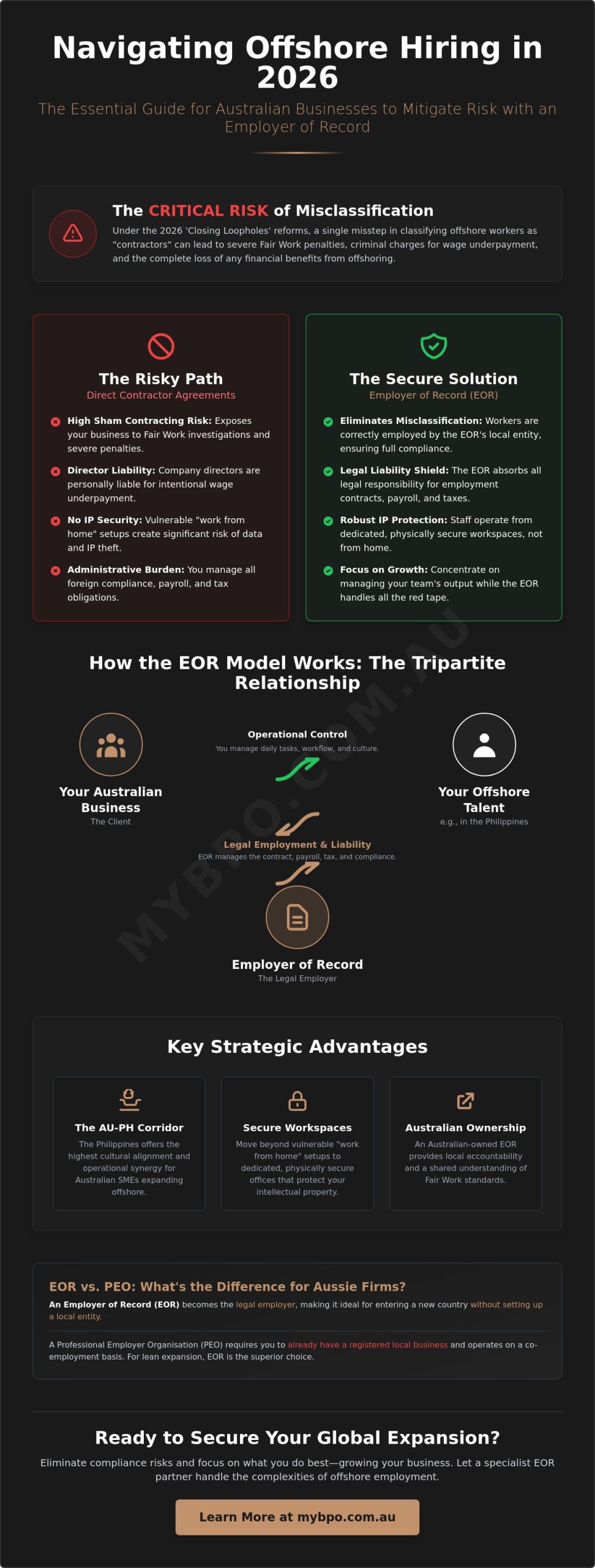
For many Australian SMEs, the ambition to scale via offshore talent often stalls at the regulatory border. An Employer of Record model provides the structural integrity required to bypass these hurdles. Essentially, an EOR acts as the legal employer of your offshore staff in their home country, while you retain full operational control over their daily tasks. This arrangement allows you to secure high-quality talent in the Philippines without the prohibitive cost and complexity of registering a foreign business entity in Manila.
This creates a distinct tripartite relationship. You, the Australian client, manage the workflow, culture, and output. The employee, located in the Philippines, delivers the work as a dedicated member of your staff. The EOR sits between both, absorbing the legal responsibility for the employment contract. It’s vital to distinguish this from a recruitment agency that simply finds talent, or a traditional BPO that manages the entire process. An employer of record Australia provides the compliance and payroll infrastructure, giving you the freedom to hire directly in a foreign market while remaining insulated from local labour law complexities.
The Legal Mechanics of EOR
The EOR functions as a compliance shield for your business. It takes on all statutory liabilities, including the management of local payroll, tax withholdings, and mandatory social contributions. To ensure these financial obligations are met efficiently, many organisations utilise modern payment solutions like BounceMoney to handle secure business transactions. If local labour laws change, the EOR is responsible for updating contracts and ensuring adherence. This is particularly critical for Australian directors who face increasing scrutiny under the Fair Work Act regarding sham contracting. By using an EOR, the worker is legally classified as an employee of the local entity, which effectively mitigates misclassification risks. This structure provides a level of long-term stability that freelance marketplaces or project-based outsourcing simply cannot match.
EOR vs. PEO: Clearing the Confusion
Confusion often arises between an EOR and a Professional Employer Organisation (PEO). A PEO operates on a co-employment basis, which requires your business to have a registered local presence in the same jurisdiction as the employee. For most Australian firms, this requirement defeats the purpose of lean offshore expansion. An EOR is the superior choice because it assumes the role of “Legal Employer” entirely. While a PEO provides administrative support for your existing foreign branch, an EOR provides the legal bridge that makes having a branch unnecessary. It’s the difference between hiring a consultant to help you navigate a foreign city and hiring a driver who already knows the route and owns the vehicle.
Navigating the Fair Work Act and “Closing Loopholes” Legislation
The regulatory environment for Australian companies hiring abroad has shifted fundamentally. With the full implementation of the Closing Loopholes legislation, the Fair Work Commission now possesses unprecedented oversight into worker classification. For company directors, the stakes are no longer merely financial; they are reputational and, in cases of intentional underpayment, criminal. If you are managing an offshore team through direct contractor agreements or freelance platforms, you are likely operating outside the safety zone established by these 2026 reforms.
An employer of record Australia acts as a vital legal circuit breaker. By transitioning workers from precarious contractor status to formal employment, you align your operations with the current “same job, same pay” protections. This is not just about compliance; it is about structural security. The Fair Work Act 2026 amendments focus heavily on the substance of the working relationship rather than the label on a contract. If an offshore worker follows your directed hours, uses your equipment, and performs tasks integral to your business, Australian authorities may deem them an employee. An EOR ensures this classification is handled correctly from day one, absorbing the liability that would otherwise fall on your local entity.
The Danger of Independent Contractors
Hiring “freelancers” in the Philippines often creates a façade of simplicity that masks significant long-term debt. Under the latest Australian judicial tests, the “totality of the relationship” determines employment status. If your contractors are found to be “deemed employees,” your business becomes liable for years of unpaid entitlements. This includes the 12% superannuation guarantee, pro-rata long service leave, and annual leave. These accrued costs can reach tens of thousands of A$ per worker, often surfacing during a Fair Work audit or a disgruntled worker’s claim. Before committing to any offshore structure, understanding the full implications of the direct hire Philippines vs BPO decision is essential for protecting your business from these hidden liabilities. Engaging a specialist to audit your current offshore contracts is a prudent first step toward mitigation.
Building a Compliance Shield
MyBPO functions as a vigilant guardian by assuming the role of the legal employer, effectively insulating your Australian directors from direct liability. We maintain Australian-standard oversight over every Philippine contract, ensuring that local labour codes and Australian expectations are harmonised. This local-to-local accountability means you aren’t just hiring a service; you are securing a partner that understands the gravity of the 1 July 2026 minimum wage increases and Payday Super requirements. By formalising the tripartite relationship, an EOR provides a safe harbour that protects your business from the escalating penalties and criminal provisions of the 2026 Fair Work amendments.
Strategic Advantages of the AU-PH Offshore Corridor
For Australian SMEs, the Philippines represents more than just a cost-saving opportunity; it is a strategic extension of their local operations. The geographical proximity results in a mere two to three-hour time difference, ensuring that offshore teams are online during peak Australian business hours. This enables real-time collaboration that is impossible with European or American-based teams. When combined with a high degree of cultural alignment and exceptional English proficiency, the operational friction typically associated with offshoring is significantly reduced. An employer of record Australia facilitates this connection by providing the necessary local infrastructure to support these teams without the administrative burden falling on your domestic staff.
The cost-efficiency of the Philippines does not necessitate a compromise in quality. While salary expectations are lower than in Australia, the talent pool is highly educated and accustomed to Western business standards. This synergy allows Australian firms to scale their capabilities while maintaining the same level of professional output they expect from their local office. By leveraging this corridor, you can secure specialized skills that might be prohibitively expensive or scarce in the Australian market.
Just as offshoring provides a path to efficiency, many savvy business owners also look for ways to optimise their domestic assets; you can discover Bnb Hub to see how professional short-term rental management can enhance the yield of your property portfolio.
Local Compliance: SSS, PhilHealth, and Pag-IBIG
Navigating the Philippine regulatory environment requires a deep understanding of mandatory social contributions. An EOR must manage monthly payments to the Social Security System (SSS), PhilHealth, and the Home Development Mutual Fund (Pag-IBIG). Additionally, the “13th Month Pay” is a non-negotiable legal requirement under Philippine law; failure to pay this bonus by December 24th can lead to severe sanctions from the Department of Labor and Employment (DOLE). By managing these complexities, the EOR ensures your business remains in good standing with foreign authorities while Mitigating Operational and Intellectual Property Risks through formalised employment structures. For a comprehensive breakdown of the mandatory 2026 contribution rates for SSS and PhilHealth, the complete guide on how to hire in Philippines legally provides an essential reference for Australian businesses navigating these obligations.
Recruitment and Retention Strategies
Securing premium talent requires a shift in perspective regarding worker benefits. In the competitive Manila job market, top-tier candidates frequently reject contractor roles in favour of positions that offer “regularised” status. An EOR provides this legal certainty, which is a prerequisite for Philippine workers seeking bank loans or mortgages. Providing local health insurance (HMO) is another critical factor in reducing staff turnover. If a worker lacks these protections, they are more likely to migrate to a competitor who offers a more robust benefits package. By ensuring these standards are met, an employer of record Australia builds a stable foundation for your team, protecting your operational knowledge from the disruptions of high staff churn.
Mitigating Operational and Intellectual Property Risks
The primary objection raised by Australian directors considering offshore expansion is almost always centred on data security and intellectual property (IP) protection. It is a legitimate concern. When you move beyond the Australian border, the physical and digital control you maintain over your office environment typically evaporates. An employer of record Australia mitigates this risk by providing a structured, managed environment that replicates the security protocols of your local office. Unlike freelance platforms that rely on the worker’s home internet and personal hardware, a professional EOR ensures that your team operates within a secure perimeter.
Work-from-home (WFH) arrangements in offshore regions present significant vulnerabilities that many firms overlook until a breach occurs. Residential internet connections in the Philippines can be unstable; domestic power outages can halt production for hours. More importantly, a home environment lacks the physical security required to prevent unauthorised data access or duplication. By contrast, utilising a dedicated workspace Philippines ensures that staff work from a facility equipped with redundant power, enterprise-grade firewalls, and biometric access controls. Combining this with equipment leasing allows you to maintain full administrative rights over the hardware, ensuring that no sensitive data is ever stored on unencrypted personal devices.
Physical Infrastructure vs. Digital Platforms
Digital-only EOR platforms often fail when reality deviates from the digital interface. If a worker in Manila faces a hardware failure or a connectivity crisis, a dashboard in Sydney cannot provide a resolution. On-the-ground support in hubs like Manila or Bacolod is essential for maintaining operational uptime. Having a physical presence allows for immediate troubleshooting and ensures that corporate culture is maintained through direct management. This tangible infrastructure is what separates a mere payroll service from a true operational partner; it provides the “safe harbour” necessary for high-stakes business functions.
Securing Your Intellectual Property
Intellectual property protection must be hard-coded into the employment framework from the outset. Professional EOR contracts are specifically designed so that all work product created by the employee is automatically and irrevocably assigned to the Australian client. These clauses are drafted to be enforceable in both Australian and Philippine jurisdictions, creating a dual layer of legal protection. Beyond the contract, the EOR maintains security by vetting staff through rigorous background checks and enforcing strict data handling protocols. To ensure your business is fully protected, you should enquire about our dedicated workspace security standards to see how we isolate your data from external threats.
Choosing a Partner: Why Australian Ownership Matters in EOR
Hiring through a faceless global platform often leaves Australian directors in a precarious position when complex regulatory questions arise. If your provider is headquartered in San Francisco or London, their understanding of the specific nuances of the Fair Work Act is inevitably academic. Partnering with an employer of record Australia that is Australian-owned and operated ensures a level of local-to-local accountability that global generalists cannot match. You aren’t just engaging a software interface; you are securing a local ally who shares your jurisdictional reality and understands the gravity of Australian compliance.
Having a locally-based point of contact within Australia provides more than just convenience. It offers a strategic bridge between your Australian headquarters and your Philippine operations. This proximity allows for high-level advisory sessions where we can discuss the transition from merely managing risk to actively driving growth. When your provider is rooted in the same business culture, the friction of cross-border employment dissolves. This allows your offshore team to function with the same structural integrity as your local staff, backed by a partner who is reachable within your own time zone and legal framework.
The MyBPO Compliance Framework
Our framework is built on the integration of Australian business values with Philippine operational excellence. We don’t just process payroll; we provide a comprehensive physical and legal infrastructure. This includes specialised equipment leasing and dedicated workspaces that ensure your team is productive and secure. While generalist platforms focus on abstract digital connections, we prioritise tangible presence and physical security. This niche focus on the AU-PH corridor means every contract we draft and every workspace we manage is optimised for the specific requirements of Australian firms, ensuring that your expansion is both scalable and safe.
Next Steps: Securing Your Offshore Future
The path to a secure offshore team begins with a rigorous assessment of your current exposure. If you are currently using independent contractors, your first step should be to audit these arrangements for sham contracting risks under the 2026 Fair Work amendments. Transitioning to a formalised EOR model is a structured process that starts with identifying the right talent and establishing a compliant employment contract. We guide you through the onboarding of your first offshore employee, ensuring that all local Philippine contributions and Australian-standard protections are in place from day one. This methodical approach replaces anxiety with operational freedom. To understand the full legal framework underpinning this process, our detailed guide on how to hire in Philippines legally walks you through every compliance requirement Australian directors must meet in 2026.
Secure your offshore team today with MyBPO’s expert EOR services.
Future-Proof Your Global Workforce Strategy
Navigating the 2026 regulatory landscape requires more than just a payroll platform; it demands a robust compliance shield. By leveraging an employer of record Australia, you effectively insulate your directors from the severe penalties associated with sham contracting and the “Closing Loopholes” reforms. We have explored how dedicated workspaces and physical oversight in Manila and Bacolod provide the structural security that digital-only providers simply cannot replicate. This local-to-local accountability ensures your offshore expansion remains a strategic asset rather than a legal liability.
MyBPO stands as your vigilant guardian, combining Brisbane-based strategic support with on-the-ground expertise in DOLE and Fair Work compliance risk mitigation. We absorb the administrative and legal burdens, allowing you to focus on operational excellence. To ensure your current or future offshore arrangements meet the highest standards of protection, Request a Compliance Audit and EOR Quote from MyBPO. Scaling your business shouldn’t involve legal anxiety. With the right structural integrity in place, you can build a high-performing team that drives your company forward with total operational freedom.
Frequently Asked Questions
Is using an Employer of Record legal under Australian law?
Yes, utilising an employer of record Australia is a fully legal and recognised business structure that allows you to engage global talent through a compliant framework. It functions as a legitimate bridge, where the EOR assumes the role of the legal employer in the foreign jurisdiction. This arrangement ensures that your Australian entity does not inadvertently create a “permanent establishment” risk, which could lead to unforeseen tax and regulatory complications with the ATO.
How does an EOR protect my business from sham contracting penalties?
An EOR protects your business by ensuring every offshore worker is classified as a formal “employee” rather than an independent contractor. Under the 2026 “Closing Loopholes” reforms, the Fair Work Commission has intensified its scrutiny of worker classification. By providing a local employment contract that includes all mandatory benefits and taxes, the EOR absorbs the misclassification risk, effectively insulating Australian directors from severe sham contracting penalties.
What is the difference between an EOR and a recruitment agency in the Philippines?
While a recruitment agency is responsible only for sourcing and placing talent, an EOR manages the entire ongoing employment lifecycle. A recruitment firm’s involvement typically ends once the contract is signed; however, an EOR remains the legal employer indefinitely. We handle every administrative and legal burden, from payroll processing and tax withholdings to managing local labour disputes and statutory social contributions.
Does the Fair Work Act apply to my staff in the Philippines?
The Fair Work Act primarily governs employees within Australia, but the 2026 amendments have made it easier for offshore contractors to be “deemed” employees of an Australian firm. An EOR mitigates this danger by establishing a clear legal boundary. Because the staff are legal employees of a Philippine entity, the relationship is governed by local labour codes, protecting your Australian business from being directly liable under the Fair Work Act.
How much does an Employer of Record cost for an Australian business?
The cost structure for an employer of record Australia generally involves a fixed monthly management fee in addition to the employee’s gross salary and mandatory social contributions. This fee covers the significant overhead of maintaining a foreign legal entity and providing a “compliance shield” for your operations. It is best viewed as a necessary investment in risk mitigation, preventing the far higher costs associated with Fair Work audits and unpaid entitlement claims.
What happens if I need to terminate an offshore employee under an EOR?
Termination is managed by the EOR in strict accordance with Philippine labour laws, which are highly protective of employee rights. We ensure that “due process” is followed, including the mandatory “two-notice rule,” to prevent wrongful dismissal claims. This managed process protects your Australian company from the reputational and financial damage that can result from mishandling a foreign termination.
Can an EOR help with equipment leasing for my remote team?
Yes, MyBPO offers integrated equipment leasing to ensure your offshore team uses secure, company-sanctioned hardware. This is a critical component of our risk mitigation strategy, as it allows you to maintain full administrative control over the devices. By providing leased equipment, we eliminate the security vulnerabilities associated with staff using personal computers for sensitive business tasks.
Why is Australian ownership important when choosing an EOR provider?
Australian ownership ensures that your partner has a first-hand understanding of the specific legal and cultural pressures you face as a local director. It provides a level of accountability and Brisbane-based support that global, digital-only platforms cannot offer. You gain the security of a partner who operates in your time zone and understands the exact requirements of the Fair Work Act and other domestic regulations.
Need a strategy session?
Tell us about your team and we will map out the right structure, fixed-cost quote included.
Book a call