Blog
Secure Data Management for Philippine EOR Staff

Would you risk a $50 million penalty on the assumption that a home-office setup in the Philippines meets Australian privacy standards? Most directors understand that under the Privacy Act 1988, your legal accountability doesn’t end at the border. If a breach occurs offshore, the Office of the Australian Information Commissioner views it as your responsibility. Effectively managing data security with Philippine EOR staff requires more than just a signed contract. It demands the physical and digital oversight that only a vigilant local partner like MyBPO can provide.
You’ll learn how to establish a legally enforceable security framework that protects your intellectual property and ensures total compliance with the Notifiable Data Breaches scheme. We’ll examine why hardware control through equipment leasing and the use of managed workspaces are the only ways to truly mitigate risk in a cross-border environment. By the end of this guide, you’ll have a clear roadmap for scaling your team without compromising your data integrity or your reputation.
Key Takeaways
- Understand how the Australian Privacy Act 1988 applies to offshore operations and the severe financial implications of failing to meet Notifiable Data Breaches scheme requirements.
- Discover why the Employer of Record (EOR) model acts as a robust liability shield by absorbing local employment risks while protecting your firm’s intellectual property.
- Learn the necessity of moving beyond “Bring Your Own Device” (BYOD) to managed equipment leasing to maintain physical and digital control over your offshore assets.
- Establish a framework for managing data security with Philippine EOR staff that bridges the gap between Australian privacy principles and Philippine regulatory mandates.
- Recognise the security advantages of dedicated workspaces in Manila or Bacolod over unmanaged home offices to ensure a controlled and auditable work environment.
The Data Security Challenge: Offshoring to the Philippines in 2026
The operational landscape of 2026 presents a higher standard of digital vigilance than any previous era. For Australian businesses, the Philippines offers a deep talent pool, yet the environment is fraught with sophisticated threats that target the integrity of your business. Intellectual property theft and unauthorised data access are no longer peripheral concerns; they are central risks that can dismantle a company’s reputation and financial stability. Under the current Notifiable Data Breaches (NDB) scheme, Australian firms face intensified scrutiny. The Office of the Australian Information Commissioner makes it clear that accountability cannot be outsourced. If your offshore team handles sensitive customer data, the legal liability remains firmly with your headquarters in Brisbane.
Successfully managing data security with Philippine EOR staff requires moving beyond the “perceived risk” that often causes operational paralysis. Instead, leaders must transition to “managed risk” through a multi-layered security framework. This approach doesn’t just hope for compliance; it enforces it through physical and digital barriers. It’s about creating a safe harbour where data integrity is the baseline, rather than a secondary consideration.
Why Australian Firms are Vulnerable
Most Australian companies rely heavily on cloud-based ecosystems, which are inherently secure until they reach the “last mile”. This refers to the physical environment where your staff member accesses that data, often the weakest link in the chain. Many firms fall into the trap of using independent contractors to reduce overheads. However, the risks of hiring contractors in the Philippines include a total lack of data oversight and no enforceable way to prevent local data downloads. Without a structured oversight mechanism, you have no visibility into whether a worker is using a public Wi-Fi network or if unauthorised individuals have access to their screen in a home-office setting.
The EOR as a Security Partner
Utilising an Employer of Record model provides a centralised point of accountability that a freelance marketplace simply cannot match. An EOR acts as your local guardian on the ground in Manila or Bacolod, ensuring that Australian security standards are daily operational requirements. This model allows for the implementation of strict protocols, such as endpoint detection and managed hardware, which are essential for managing data security with Philippine EOR staff. We define the “Compliance Shield” as the precise intersection where Australian legal liability meets rigorous Philippine on-the-ground operations. This structure ensures that every staff member operates within a controlled environment, effectively absorbing the risks that would otherwise fall solely on your shoulders.
Regulatory Alignment: Privacy Act 1988 vs. Philippine Data Privacy Act
Aligning two distinct legal jurisdictions is the most critical hurdle when managing data security with Philippine EOR staff. While the Philippine Data Privacy Act of 2012 (RA 10173) provides a robust framework for processing information, it serves merely as the baseline for Australian businesses. Australian directors must understand that being “DPA compliant” in the Philippines does not automatically satisfy the rigorous demands of the Australian Privacy Act 1988. If a breach occurs, Australian regulators won’t care if local Philippine laws were followed; they will measure your conduct against the Australian Privacy Principles (APPs).
The Australian Privacy Act and Offshore Staff
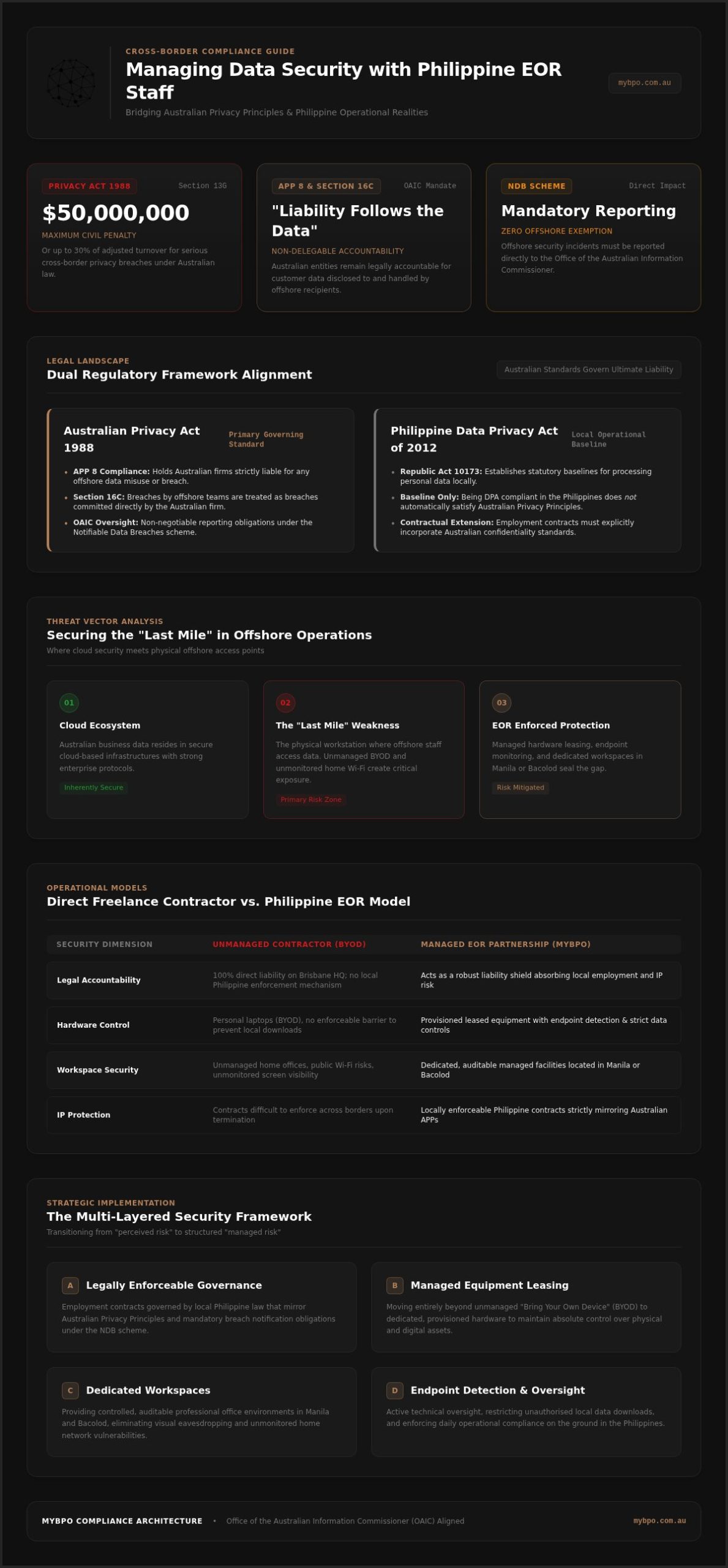
Under APP 8 and Section 16C, an Australian entity remains legally accountable for data disclosed to an offshore recipient. This “liability follows the data” principle means that if your Philippine team mishandles sensitive information, your company is deemed to have committed the breach itself. With maximum civil penalties under Section 13G now reaching $50,000,000 or 30% of adjusted turnover, the stakes are absolute. Engaging a professional employer of record Australia specialist ensures that your offshore operations are governed by contracts that strictly mirror Australian confidentiality and reporting obligations. This creates a legally enforceable link between your Brisbane headquarters and your team in Manila or Bacolod.
Philippine Data Privacy Act (DPA) Essentials
The National Privacy Commission (NPC) in the Philippines enforces strict mandates, including a mandatory 72-hour notification rule for high-risk breaches. For grave infractions, the NPC can levy administrative fines between 0.5% and 3% of a violator’s annual gross income. MyBPO acts as the “Personal Information Processor” on your behalf, ensuring every staff member undergoes mandatory security awareness training and DPA certification. This dual-layered approach ensures that your team respects the rights of data subjects while adhering to the technical and organisational security measures required by both nations. We bridge the gap by maintaining physical oversight that remote freelance marketplaces simply cannot provide.
Effectively managing data security with Philippine EOR staff requires a bridge between these two worlds. We ensure that employment contracts are not generic templates; they are precision-engineered to include specific data handling protocols and audit rights. This allows you to scale with confidence, knowing your “Compliance Shield” is fully operational. To explore how we can secure your offshore team, you can consult with our Brisbane-based experts today.
The Liability Shield: Why EOR is Superior to Direct Hiring
Direct hiring in the Philippines creates a significant liability gap that many Australian SMEs fail to recognise until a security incident occurs. When you engage a freelancer or an independent contractor directly, your legal recourse is virtually non-existent. If that individual mishandles sensitive data or intentionally exfiltrates intellectual property, an Australian court order holds little weight in a local Philippine jurisdiction. Effectively managing data security with Philippine EOR staff requires a structure where accountability is physically present in both countries. An Employer of Record (EOR) doesn’t just manage payroll; it acts as a robust liability shield by absorbing the local employment risks that would otherwise leave your business exposed.
By utilising an EOR, your primary legal relationship remains with a corporate entity that possesses the standing to enforce security protocols. This structure is essential for meeting the requirements for cross-border disclosure under APP 8, as it provides a documented chain of custody and clear lines of responsibility. Without this, your data is essentially floating in a regulatory vacuum.
Contractual Enforceability in the Philippines
A Non-Disclosure Agreement (NDA) signed by a remote freelancer is often “toothless” in practice. For an Australian business to pursue a local individual for a breach, the legal costs and jurisdictional hurdles are usually prohibitive. In contrast, an EOR like MyBPO is a registered Philippine corporation with substantial capitalisation. We hold the direct employment contract, which means we have the legal authority to take immediate action on the ground if a breach occurs. This level of protection is a primary differentiator when comparing direct hire Philippines vs BPO models. We ensure that every staff member’s contract includes stringent, enforceable confidentiality clauses that mirror Australian standards.
Australian Ownership and Peace of Mind
The value of partnering with a Brisbane-based company cannot be overstated. When managing data security with Philippine EOR staff, you need a partner who speaks your language and understands the Australian regulatory environment. MyBPO’s dual-country presence, with physical offices in Manila and Bacolod, allows us to bridge the gap between your Brisbane headquarters and your offshore team. This physical presence ensures that we aren’t just a digital platform; we are a tangible infrastructure that you can audit. For industries handling high-risk data, such as finance or health, this level of transparency is non-negotiable. It allows you to maintain the “Compliance Shield” necessary to satisfy both your board and your clients that their data is being guarded by a specialist who understands the high stakes involved.
Physical and Technical Security Protocols for EOR Staff
Software solutions alone cannot guarantee compliance if the physical hardware remains outside your control. Many organisations fail when managing data security with Philippine EOR staff because they rely on “Bring Your Own Device” (BYOD) policies. This approach creates an unmanaged entry point into your network. Transitioning to managed equipment leasing ensures that every laptop used by your offshore team is a corporate asset. These devices are hardened with enterprise-grade security before they ever reach a desk in Manila or Bacolod.
A robust technical stack must include Endpoint Detection and Response (EDR) to provide real-time visibility into potential threats, with organisations often leveraging dedicated MXDR partners like cyberone.security. We implement Zero-Trust architecture. This means no user or device is trusted by default, regardless of their location. This is reinforced by Multi-Factor Authentication (MFA) and encrypted VPN tunnels. These measures secure the “last mile” of connectivity between the Philippines and your Australian servers.
Equipment Leasing and Hardware Control
Leasing managed hardware is a fundamental pillar of our security framework. If a staff member uses a personal laptop, you have no authority to audit the device or ensure it’s free from malware. MyBPO manages the entire procurement and maintenance lifecycle. We provide you with the ability to remotely wipe devices instantly if a contract is terminated or a device is reported stolen. This level of hardware control is essential for protecting sensitive Australian data and maintaining intellectual property integrity.
Network and Software Security
Secure remote access requires more than just a password. We advocate for continuous monitoring and logging of data access points. This allows your IT team to track file access without infringing on the personal privacy of the staff member. Regular security audits and simulated phishing exercises are also mandatory. These ensure your Philippine team remains as vigilant as your onshore staff, creating a unified culture of security across your organisation.
The physical environment is just as critical as the digital one. While remote work is popular, a dedicated workspace in the Philippines offers a controlled setting with CCTV, clean-desk policies, and restricted access. This significantly reduces the risk of unauthorised data viewing that often occurs in unmanaged home-office environments. To secure your offshore operations with managed hardware and professional workspaces, contact MyBPO to discuss our equipment leasing options.
Implementing Your Security Strategy with MyBPO
Executing a cross-border security strategy requires a partner that understands both the Australian boardroom and the Philippine shop floor. While previous sections have established the legal and technical requirements, the success of your offshore team depends on the rigour of your daily implementation. MyBPO serves as the critical link, ensuring that the high standards you set in Brisbane are physically enforced in Manila and Bacolod. We don’t just provide a platform; we provide a managed environment where risk is mitigated through constant vigilance. Effectively managing data security with Philippine EOR staff means moving from theoretical compliance to practical, on-the-ground enforcement.
The Onboarding Security Checklist
Security begins long before a staff member’s first login. Our onboarding process is designed to filter out risk and establish a culture of accountability from day one. This structured approach includes:
- Mandatory Background Checks: Much like organisations utilise pre-employment screening specialists such as Elevated Background Checks to protect their domestic workforce, we conduct comprehensive NBI clearances, the Philippine equivalent of an Australian police check, to verify the integrity of every candidate.
- Digital Perimeter Configuration: Before the staff member starts, we configure their leased hardware with your specific VPN, EDR, and MFA requirements. No device enters the workspace without being hardened to your standards.
- Security and IP Induction: Every staff member undergoes a mandatory briefing on Australian privacy standards and the specific intellectual property protections required by your business.
Different sectors require tailored controls. For instance, a fintech firm might require strict data masking to meet PCI DSS standards, whereas a healthcare provider needs rigorous access controls to satisfy Australian Health Privacy Principles. We customise these protocols to ensure that managing data security with Philippine EOR staff aligns perfectly with your specific industry mandates.
Continuous Monitoring and Support
Security isn’t a “set and forget” task; it’s a continuous cycle of monitoring and improvement. Our local managers in Manila and Bacolod provide the physical oversight that remote platforms lack. They ensure that clean-desk policies are followed and that the physical work environment remains secure. Furthermore, we facilitate annual compliance reviews. These reviews ensure your offshore operations stay aligned with evolving Australian laws, such as the recent updates to the Privacy Act. This proactive stance allows you to focus on growth while we absorb the burden of regulatory risk.
For risk-averse Australian firms, MyBPO represents the logical conclusion to the offshoring challenge. We provide the physical infrastructure, legal framework, and local expertise needed to secure your most valuable assets. Secure your offshore expansion today. Contact MyBPO to discuss your security requirements and let us build your compliance shield.
Future-Proofing Your Offshore Data Strategy
Scaling your business into the Philippines shouldn’t be a gamble with your legal standing or customer trust. We’ve established that relying on unmanaged contractors or home-office setups creates a liability gap that Australian directors can no longer ignore. By implementing managed hardware and professional workspaces, you transform data protection from a vulnerability into a strategic asset. Effectively managing data security with Philippine EOR staff requires a partner who understands the high stakes of cross-border compliance.
MyBPO provides the structural integrity your organisation needs. As an Australian-owned specialist with our head office in Brisbane and physical representation in Manila and Bacolod, we act as your local guardian on the ground. We bridge the regulatory divide between the Privacy Act 1988 and Philippine mandates, ensuring your intellectual property remains secure. It’s time to move forward with the confidence that your offshore team is protected by a robust compliance shield.
Secure your offshore operations with MyBPO’s Australian-managed EOR services and scale your team without compromising your security standards.
Frequently Asked Questions
Is my intellectual property safe with staff in the Philippines?
Your intellectual property is protected when you use a structured Employer of Record framework. MyBPO ensures that IP protection clauses are embedded in locally enforceable contracts that mirror Australian standards. We act as the legal bridge, ensuring that workers are bound by the same confidentiality requirements as your onshore team. Our physical presence in Manila and Bacolod provides an additional layer of oversight to prevent unauthorised data exfiltration.
What is the Philippine Data Privacy Act and does it affect my Australian business?
The Philippine Data Privacy Act of 2012 (RA 10173) governs the processing of all personal information within the Philippines. It affects your business because it mandates that any Data Processor, including your offshore staff, must implement specific technical and organisational security measures. Failure to comply can lead to significant administrative fines from the National Privacy Commission, which could disrupt your operations and damage your corporate reputation.
Can I enforce an Australian NDA on a Philippine EOR employee?
You cannot easily enforce an Australian contract on an individual residing in the Philippines. An EOR solves this by creating a mirror contract under Philippine law that includes your specific confidentiality requirements. MyBPO ensures that the staff member’s local employment agreement is legally actionable within their own jurisdiction. This structure provides you with genuine recourse in the event of a breach, which a simple freelance agreement cannot offer.
Why is equipment leasing better than BYOD for data security?
Equipment leasing provides total hardware control, whereas BYOD leaves your network vulnerable to unmanaged devices. By leasing managed hardware through MyBPO, you ensure that every laptop is equipped with enterprise-grade security and Zero-Trust architecture. Managing data security with Philippine EOR staff is significantly more effective when you possess the ability to remotely wipe a device if it is lost, stolen, or if a contract is terminated unexpectedly.
How does MyBPO handle background checks for Philippine staff?
We conduct rigorous screening that includes mandatory NBI clearances, which are the Philippine equivalent of an Australian police check. Our recruitment team also performs detailed employment history verification and character reference checks. This multi-layered vetting process ensures that only individuals with a proven track record of integrity are introduced to your organisation. We mitigate internal security risks before the staff member even begins their first day of work.
What happens if there is a data breach with my offshore team?
If a breach occurs, the 72-hour notification rule under Philippine law is immediately triggered. MyBPO’s local management team initiates an incident response protocol to contain the leak and identify the source of the vulnerability. Because we maintain physical offices in Manila and Bacolod, we can conduct immediate on-site investigations. This physical intervention is a critical advantage that remote-only platforms or freelance marketplaces simply cannot facilitate during a crisis.
Do I need to report a Philippine data breach to the Australian Privacy Commissioner?
Yes, you must report the breach if it involves personal information of Australian individuals and meets the “serious harm” threshold. Under Section 16C of the Privacy Act, your Australian entity remains legally accountable for data handled by offshore agents. Managing data security with Philippine EOR staff involves strict adherence to the Notifiable Data Breaches (NDB) scheme. You are required to notify the OAIC even if the incident occurred in another jurisdiction.
Is a managed office more secure than a home-based staff member?
A managed office provides a controlled environment that a home office cannot replicate. Dedicated workspaces in Manila or Bacolod feature clean-desk policies, CCTV monitoring, and restricted physical access to workstations. These layers of security prevent unauthorised third parties, such as family members or visitors, from viewing sensitive data on screens. This significantly reduces the risk of accidental data exposure that is inherent in unmanaged remote work settings.
Need a strategy session?
Tell us about your team and we will map out the right structure, fixed-cost quote included.
Book a call