Blog
Total Cost of Ownership for an Offshore Team: 2026 Guide

What if the offshore option with the lowest headline rate ends up costing more? A search for “total cost of ownership offshore team” should lead to a broader question: who pays for recruitment, employment administration, equipment and day-to-day oversight, and who carries the compliance risk? Those responsibilities can change the cost comparison between staffing models.
It’s reasonable to expect offshore hiring to reduce costs, but salary alone won’t show what your business will spend over time. Unclear responsibilities, staff turnover and extra recruitment or training work can all affect the total.
This guide explains how to compare offshore staffing models on a like-for-like basis and build a forecast with clear assumptions. You’ll consider employment, equipment, workspace, management and compliance costs, then assess how each model distributes responsibility and control. The aim is not simply to find the lowest rate, but to understand the full cost of employing, equipping and managing an offshore team, and choose an approach that fits your business.
Key Takeaways
- Set a clear timeframe and include setup, recurring and internal management costs to make your forecast useful.
- Use the total cost of ownership offshore team framework to capture less-visible expenses and contingent risks, not just salary and service fees.
- Compare EOR, direct employment and BPO by who employs the worker, administers payroll and manages day-to-day work.
- Check current Philippine employment and payroll obligations against official requirements before adding them to your cost model.
- Use a decision checklist to test whether your business has the capacity to manage recruitment, employment administration, equipment and performance.
What total cost of ownership means for an Australian offshore team
Total cost of ownership for an offshore team is the combined setup, recurring and management cost of employing, equipping and operating that team over a defined period. Setting a timeframe is essential: without one, setup expenses and ongoing charges can’t be compared fairly. The definition also reflects the broader Total cost of ownership (TCO) principle of accounting for direct and indirect costs, not only the amount on an invoice.
Visible costs include compensation, recruitment charges and service fees. Less visible costs include the time your Australian team spends selecting candidates, onboarding staff, managing payroll information, providing equipment, supervising work and correcting errors. There may also be contingent costs, such as replacement recruitment or disruption if a team member leaves. These costs aren’t guaranteed, but excluding them can make your forecast less useful.
A salary or service fee alone doesn’t establish comparative value. Two providers may quote similar rates while covering different responsibilities. One may include employment administration or equipment, while another leaves those tasks to your business. Compare what each fee covers, what remains your responsibility and how much internal time the model requires. Offshore staffing isn’t automatically cheaper than local hiring. The result depends on the full scope and the assumptions in your comparison.
Why a headline staffing rate is not the whole cost
Separate worker compensation from the cost of employing, equipping and managing the team. A rate for a worker’s time, for example, may not cover recruitment, workspace, technology, internal supervision or the administration required by the chosen model. List each cost and identify who pays for it. This helps reveal gaps in a quote before they become operating costs.
Set a fair comparison period and baseline
Compare roles with similar responsibilities, working hours, expected output and service scope. Then choose a consistent forecast period, such as 12 months for an annual budget, and record why it fits the decision. A total cost of ownership offshore team calculation is only as reliable as its assumptions. Note team size, expected utilisation, turnover assumptions and the exchange-rate basis used to convert Philippine peso costs into Australian dollars. Apply the same assumptions to every model.
Keep the baseline visible and update it when the scope changes. If one option includes equipment while another requires your business to source it, record that difference rather than treating the headline rates as equivalent. This gives decision-makers a clearer view of cost, accountability and the internal capacity each model requires.
Which costs belong in an offshore team ownership model?
A useful cost model captures every expense needed to recruit, employ, equip and manage the team, including work that remains with your Australian business. Checklist: include one-off recruitment and setup costs, recurring employment and service charges, equipment and workspace, currency conversion, and internal oversight. Record each item once, identify who is responsible for it, and note whether it is a confirmed cost or an estimate.
- Recruitment and setup: candidate sourcing, selection, onboarding and initial access or workspace arrangements.
- Employment and service fees: compensation, payroll administration, required employer contributions and any fee for employment or workforce support.
- Equipment and workspace: hardware, software access, secure systems and workspace charges, where applicable.
- Internal oversight: manager time for communication, quality assurance, performance processes and coordination.
- Currency conversion: the effect of converting Philippine peso expenses into Australian dollars, including any conversion charges your business incurs.
Invoices and payroll records can support some costs. Others, such as internal management time, need a reasonable estimate based on hours and the relevant staff member’s cost to the business. Keep contingent risks separate from routine expenses. You can model possible disruption or replacement costs as scenarios, but don’t enter speculative penalties as though they were standard charges.
Employment, payroll and service administration
Confirm who processes payroll, maintains employment records and manages applicable employer contributions. Responsibilities vary by arrangement, so don’t assume a provider fee includes every task or obligation. Before adding Philippine payroll items to your forecast, check current requirements with official sources and use this Philippines payroll compliance reference as a starting point for your review. To understand how responsibilities may differ under an employment structure, see this Employer of Record Australia guide.
Recruitment, equipment and operating support
Include the time needed to recruit and onboard staff, plus any ongoing effort for retention or replacement if it becomes necessary. Check whether equipment, secure access, workspace and technical support are included, charged separately or managed internally. Then estimate manager hours for communication, quality checks and performance processes. Once your assumptions are clear, you can discuss your offshore staffing requirements with MyBPO.
These line items form the working basis of your total cost of ownership offshore team model. Clear categories make it easier to compare arrangements without mistaking a narrower quote for a lower overall cost.
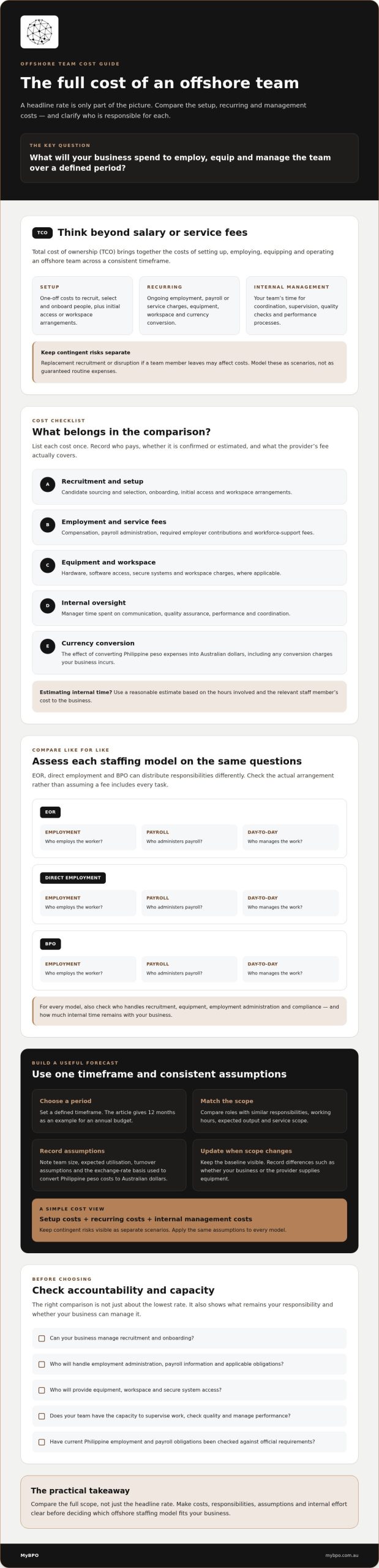
How do EOR, direct employment and BPO compare on total cost?
These models allocate employment, administration and day-to-day work differently. For a fair comparison, separate the worker’s compensation from service fees, setup requirements and the internal effort your business retains. The table outlines common arrangements to investigate, but actual responsibilities depend on the contract and service scope.
| Cost and responsibility | Employer of Record (EOR) | Direct employment | Business Process Outsourcing (BPO) |
|---|---|---|---|
| Who employs the worker? | The EOR is generally the local employer on your behalf. | Your business employs the worker through its local structure. | The provider generally employs the team delivering the service. |
| Who administers payroll? | The EOR may manage payroll administration. Confirm the contracted scope and exclusions. | Your business or its appointed local support manages payroll. Confirm the arrangements. | The provider generally administers pay for its own team. |
| Who manages daily work? | Your business typically directs the worker’s day-to-day tasks. | Your business manages the employee directly. | The provider generally manages the team and delivery of the agreed service. |
| What should the cost model test? | Service fees, retained management time and included employment administration. | Potential entity setup, ongoing administration and internal employment workload. | Service fees, defined outputs, service boundaries and provider-managed operations. |
Use the table as a starting point, not a substitute for checking the agreement. The lowest visible fee may exclude tasks your team must perform, shifting costs into internal hours or additional operating expenses. A broader service fee may cover responsibilities you would otherwise need to organise. Compare the full allocation, not just the invoice line.
Compare EOR and direct employment responsibilities
For each arrangement, confirm who handles payroll processing, employment records, required contributions and other administration. Direct employment may involve establishing a local entity, but the need, setup and ongoing requirements depend on your circumstances and the jurisdiction. Treat these as items to investigate, not automatic costs. If you’re assessing that route, consult this Philippines entity setup guide.
Compare dedicated staffing with a BPO service
A dedicated team member working under your direction is different from purchasing a defined outsourced service. Compare expected outputs, who sets priorities, how much oversight you must provide and what the agreement says about service boundaries and continuity. A model with less direct control may require less daily management, while a dedicated arrangement may suit work that needs close integration. Neither is universally preferable. Match responsibilities to the work.
To calculate the total cost of ownership offshore team across these options, apply the same role, forecast period and output assumptions, then include fees and internal workload under each model. Once you’ve documented those assumptions, you can discuss your offshore staffing requirements with MyBPO and clarify which responsibilities and support are in scope.
How to calculate offshore team total cost of ownership
Use the same steps for every model: define the role and period, list each cost, gather evidence for each estimate, then calculate the total. The formula is straightforward: total ownership cost = setup costs + recurring costs + internal oversight over the chosen period. Apply it consistently to build a like-for-like view of the total cost of ownership offshore team options you’re assessing.
Model outputs depend on the assumptions declared and the costs or risks excluded. Record the forecast period, team size, expected workload, service scope and currency basis beside the result. That context matters as much as the final figure.
Build a transparent cost worksheet
Give each cost its own row. Separate supplier charges from Australian internal labour so management time doesn’t disappear inside a broad estimate. For each item, record whether it is one-off or recurring, who owns it and what evidence supports the estimate.
- Cost item: [insert item]
- Timing: [one-off or recurring, and frequency]
- Responsible party: [business, provider or other]
- Evidence: [quote, contract, payroll record or internal estimate]
- Estimate: [amount and currency]
For foreign-currency items, note the currency, conversion rate and date used, as well as how often you’ll refresh the assumption. Include internal hours for recruitment, onboarding, management and quality checks, with the basis for valuing that time. Don’t treat an unverified estimate as a confirmed charge.
Test scenarios without overstating savings
Build conservative, expected and higher-cost scenarios using the same role, service scope and forecast period. Change only the assumptions being tested, then show how the total responds. This makes uncertainty visible without presenting a favourable case as a guaranteed outcome.
- Team size and utilisation: test the planned headcount and how much of each person’s capacity is expected to be used.
- Currency movement: model a reasonable range around your chosen conversion assumption.
- Onboarding and replacement timing: check the effect of a delayed start or a replacement recruitment cycle.
- Workload changes: assess whether higher demand adds internal oversight or changes the service scope.
Keep legal or compliance exposure qualitative unless reliable, current evidence supports a defensible estimate. Record the issue, who should verify it and whether it is included in the calculation. If you’re setting assumptions for a Philippine team, discuss your offshore staffing requirements with MyBPO.
Choose a cost-controlled offshore team model with clear accountability
A sound decision depends on more than the forecast total. Check who is accountable for each task, what support is included and which responsibilities remain with your business. The total cost of ownership offshore team estimate is useful only if it reflects the work and oversight your chosen arrangement actually requires.
Before committing, use this checklist to test each provider’s proposal:
- Scope: Ask for a written schedule of inclusions, exclusions, setup tasks and recurring charges. Check whether recruitment, employment administration, equipment and workspace are included or separate.
- Accountability: Confirm who handles employment administration, payroll coordination and day-to-day performance processes. Identify the person or party responsible for each handover and issue.
- Support: Clarify what on-the-ground workforce support covers, who provides it and how it fits with your own management responsibilities.
- Cost assumptions: Request the currency and exchange-rate basis, how scope changes affect charges, and which costs may vary over time.
- Continuity: Ask how replacement processes and service continuity are addressed in the agreement. Don’t assume these are included unless the written terms say so.
Assess your own capacity as well. If your team has limited time to recruit, coordinate employment administration, arrange equipment and manage performance, a model that leaves those tasks with you may carry more internal workload than its fee suggests. Where a worker is treated as an independent contractor but operates as an integrated team member, classification risks deserve careful assessment. This sham contracting risk guide can help frame questions to investigate. Seek appropriate professional advice for your circumstances.
When MyBPO EOR may suit an Australian business
MyBPO provides Employer of Record services for Australian businesses hiring directly in the Philippines, alongside on-the-ground workforce support. EOR may be worth assessing if you want to hire a team member directly while considering how employment administration and local support are allocated. It isn’t a guaranteed lowest-cost option. The right fit depends on the agreed scope, responsibilities and your internal capacity.
Compare the proposed inclusions and exclusions against your cost worksheet before deciding. If you’ve established your staffing requirements and assumptions, discuss an offshore team with MyBPO to assess scope, responsibilities and costs.
Make your offshore team decision with confidence
A reliable comparison looks beyond salaries and headline fees. It accounts for setup, ongoing costs and internal oversight over a consistent period, then checks who is responsible for employment administration, equipment and day-to-day management. Clear assumptions help you compare EOR, direct employment and BPO without treating different scopes as equivalent.
Your total cost of ownership offshore team forecast should support a decision, not disguise uncertainty. Confirm current obligations, document what each provider includes and consider whether your business has the capacity to manage the work that remains in-house. The right model balances cost, control and accountability for your requirements.
MyBPO is Australian-owned and operated, with physical representation in Australia and the Philippines and on-the-ground support for Philippine workforces. If you’ve established your assumptions and want to explore your hiring needs, discuss your Philippine hiring requirements with MyBPO.
A careful assessment gives you a stronger basis for moving forward. With responsibilities and costs made clear, you can plan your offshore team with greater confidence.
Frequently Asked Questions
What is the total cost of ownership for an offshore team?
It’s the combined cost of setting up, employing, equipping and managing a team over a defined period. A total cost of ownership offshore team calculation may include recruitment, payroll administration, service fees, equipment, workspace and internal management time. The categories depend on the staffing model. State your assumptions and exclusions so you can compare options fairly, including which party is responsible for each task and cost.
How do you calculate the total cost of an offshore team?
Start by defining the roles, team size and period you want to compare. Add one-off setup costs to recurring employment, service and operating costs, then include the internal time needed to manage the team. Record your currency assumptions and exclusions. Compare scenarios using the same scope and responsibilities. Keep uncertain legal or compliance exposure separate from predictable costs unless reliable, current evidence supports a quantified estimate.
Is an offshore team cheaper than hiring in Australia?
It can reduce some labour or operating costs, but the result depends on the role, service scope, management effort and staffing model. Recruitment, payroll administration, equipment and turnover can all affect the comparison. A headline rate alone can’t provide a reliable answer. Compare equivalent responsibilities over the same period, include internal oversight and document your assumptions before deciding whether an offshore arrangement offers value for your business.
What costs are often overlooked when hiring an offshore team?
Commonly overlooked items include recruitment and onboarding effort, manager time, equipment, workspace, payroll administration, currency conversion and replacement work. Some costs may be included in a provider’s service scope, while others may remain with your business. Ask for written inclusions and exclusions, then record who owns each task and cost in your comparison. This helps reveal whether a lower quote shifts work or expenses back to your team.
How does an Employer of Record affect offshore team costs?
An Employer of Record arrangement can change who manages employment administration and related processes, as well as the fees and responsibilities involved. It doesn’t automatically make a team cheaper or remove every obligation from your business. Check the exact service scope, exclusions and internal workload against other models. Verify current requirements before relying on payroll or compliance assumptions, and assess whether the allocation of responsibilities fits your team’s capacity.
Should I include exchange-rate movements in an offshore team cost forecast?
Yes, if some expenses are denominated in a currency other than Australian dollars. Record the currency, conversion assumption and date it was set, then test how a change could affect your forecast. Don’t treat one exchange rate as certain or assume movements will follow a particular direction. Make the currency exposure visible and refresh the assumption at a frequency that suits your planning process.
How can I compare an EOR with a BPO service fairly?
Compare the work and responsibilities, not just the fees. Confirm who employs the worker, what management and service support are included, how output is defined and how much internal oversight your business must provide. A dedicated team member working under your direction differs from purchasing a defined outsourced service. Align the scope, expected output and comparison period first, then assess each model’s full costs and operational responsibilities.
Need a strategy session?
Tell us about your team and we will map out the right structure, fixed-cost quote included.
Book a call