Blog
Philippines Labour Law: 2026 Guide for AU Businesses

Hiring a worker in the Philippines raises two separate questions: which country’s employment rules apply, and who is responsible for meeting them? For Australian businesses, Philippines labor law compliance Australia starts with understanding the worker’s location and engagement structure, then separating local employment duties from Australian business-side considerations.
It may seem straightforward to assume that Philippine rules govern a worker based in the Philippines. That is often the starting point, but the hiring structure matters. A contractor label or overseas arrangement does not, by itself, settle the parties’ responsibilities. Misclassification, payroll errors and incomplete records can create avoidable risk.
This guide covers key Philippine employment areas Australian businesses should understand, including worker classification, wages, statutory contributions, leave and records. It also explains when Australian obligations may need separate consideration, what to review before hiring and during employment, and how an Employer of Record (EOR) can provide local employment and operational support. MyBPO provides EOR services for Australian companies hiring directly in the Philippines, with on-the-ground support for their Philippine workforce.
Key Takeaways
- Build a Philippines labor law compliance Australia process around the worker’s location, engagement structure and actual working relationship.
- Map responsibilities across the employment lifecycle. Assign clear owners for documents, payroll inputs, approvals and issue escalation.
- Assess Philippine employment duties separately from Australian business-side considerations. The rules that apply depend on the facts of the arrangement.
- An Employer of Record can provide a local employment model, but responsibilities depend on the arrangement and do not automatically disappear for the Australian business.
Philippines Labour Law: What’s at Stake for AU Firms?
Philippines labour law compliance means meeting the local employment obligations that apply from recruitment and hiring through day-to-day work and separation. Start by identifying where the worker performs their duties and how the relationship is structured. A Philippine-based worker employed through a local arrangement raises different considerations from a contractor engaged directly by an Australian business.
Where it applies, Philippine law governs local employment duties. Australian business oversight is a separate, connected responsibility. Keeping those questions distinct helps teams plan without assuming that one country’s rules automatically displace the other’s. The position depends on the facts, including work location, engagement structure and the real working relationship.
Which laws and institutions shape Philippine employment?
The Labor Code of the Philippines is a foundational framework for employment and labour relations. It sits alongside other laws, implementing rules and official guidance that may affect employment terms, working conditions and worker protections. Start by identifying requirements relevant to the role rather than treating a general summary as a complete compliance plan.
The Department of Labor and Employment (DOLE) administers labour matters in the Philippines, including labour standards. Its issuances and guidance can help employers understand how requirements apply in practice. Rules can change, so use current official information when setting up or reviewing an employment arrangement. A checklist helps organise the work, but it cannot resolve every legal question for every case.
Why does compliance matter before the first hire?
Early decisions shape the employment process. If no one has agreed who issues employment documents, maintains records, provides payroll inputs and handles workplace concerns, tasks can fall between the Australian business and the local employment arrangement. The worker may be unclear about their terms or entitlements, and the business may struggle to show how decisions were made.
For example, an Australian manager might set hours and direct daily work while a separate local entity handles some administration. If responsibilities are not documented, a change to pay, leave or working arrangements may not reach the person responsible in time. That can lead to corrections, delays and friction for both the worker and the business. Clear ownership will not settle every legal issue, but it makes gaps easier to identify and address.
Before recruitment begins, write down who approves the role, issues and stores employment documents, supplies accurate payroll information and receives escalated concerns. Review that allocation when the role or arrangement changes. Pay processes deserve particular attention because errors can affect records and entitlements. The guide to payroll compliance in the Philippines covers those obligations in more detail.
This overview is not legal advice, and a general guide cannot resolve a fact-specific question. For Philippines labor law compliance Australia, use this framework to identify responsibilities and issues to review, then verify current requirements against official sources and obtain qualified advice where appropriate.
Which Philippine employment obligations should Australian firms understand?
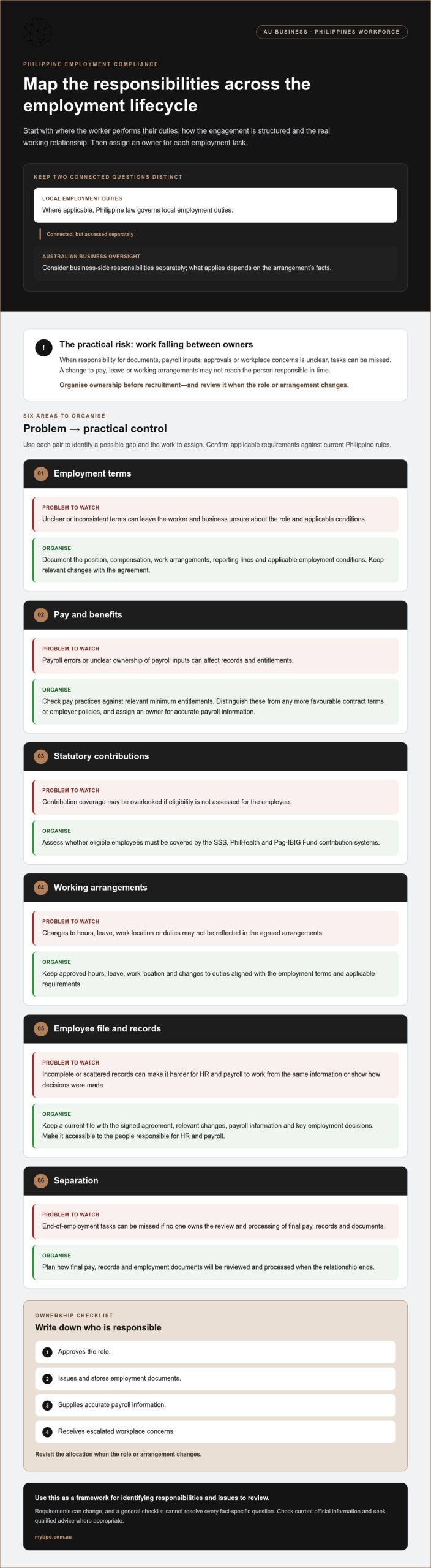
Manage obligations across the employment lifecycle, not just at payroll time. Assign clear ownership for the role, employment terms, pay and benefits, working arrangements, records and separation. For Philippines labor law compliance Australia, this lifecycle view helps Australian firms find gaps early and keep processes consistent as roles change.
- Terms: Document the role, compensation, reporting arrangements and applicable employment conditions.
- Pay and benefits: Check pay practices against relevant minimum entitlements, and distinguish these from any more favourable contract terms or employer policies.
- Contributions: Assess whether eligible employees must be covered by SSS, PhilHealth and Pag-IBIG Fund contribution systems.
- Working arrangements: Keep approved hours, leave, work location and changes to duties aligned with the employment terms and applicable requirements.
- Separation: Plan how final pay, records and employment documents will be reviewed and processed when a relationship ends.
What should an employment agreement and employee file cover?
Use clear, consistent terms for the employee’s position, compensation, work arrangements, reporting lines and applicable conditions. Keep a current employee file containing the signed agreement, relevant changes, payroll information and records of key employment decisions. Make the file accessible to the people responsible for HR and payroll so they can work from the same information. Verify contract requirements and retention periods against current Philippine rules rather than assuming one standard applies to every case.
Which pay, leave and contribution areas need ongoing attention?
SSS, PhilHealth and Pag-IBIG Fund are key contribution systems to assess for eligible employees. 13th month pay is also a Philippine employment entitlement. Confirm its coverage, calculation and payment deadlines against current official guidance. Review eligibility and payroll treatment for the actual employment arrangement rather than relying on a generic checklist.
Minimum entitlements are a baseline. A contract or employer policy may provide more favourable terms, which need to be reflected in payroll and day-to-day practice. Assign responsibility for checking pay inputs, leave balances and contribution records, then reconcile them regularly. Keep payroll calculations within a controlled process. The guide to average pay in the Philippines discusses pay benchmarking, not statutory obligations.
For reliable administration, assign an owner to each stage: maintaining employment terms, supplying payroll changes, reviewing records and coordinating separation steps. MyBPO’s Employer of Record services provide a local employment model for Australian businesses hiring in the Philippines, with on-the-ground workforce support. This helps organise responsibilities alongside internal processes, with the specific allocation shaped by the arrangement. Explore MyBPO’s Employer of Record services as a local employment support option.
Does Australian employment law apply to staff working in the Philippines?
There is no safe, universal answer based only on the worker’s nationality or the address on a contract. The rules that apply can depend on where the work is performed, how the engagement is structured, the parties’ relationship and other facts. A Philippine-based worker under a local employment arrangement generally requires a different analysis from an employee based in Australia, but location alone is not a complete jurisdictional test.
Cross-border hiring requires assessing the actual arrangement, not relying on labels alone. For Philippines labor law compliance Australia, separate local employment responsibilities from Australian business-side considerations, then assess how they interact in the particular arrangement.
Philippine employment duties
Assess local requirements that apply to the worker’s employment, including the terms and administration of the relationship in the Philippines. Identify which entity engages the worker and who carries out employment-related functions.
Australian business-side considerations
Review the Australian company’s role in directing and managing the work, its contractual arrangements and any Australian obligations that may be relevant. Do not assume these considerations replace local duties or apply in the same way to every overseas engagement.
How should businesses think about the Fair Work Act?
The Fair Work Act 2009 (Cth) contains rules about its reach, but a broad summary cannot determine whether it applies to a particular worker or arrangement. A person employed and working in the Philippines is not automatically in the same position as an employee based in Australia. Equally, an Australian business should not assume that overseas work rules out every Australian consideration. Review the complete facts and seek current legal advice for a specific case.
Why can contractor labels create a separate compliance risk?
Calling someone a contractor in an agreement does not, by itself, settle the nature of the relationship. Consider how the work operates in practice: who sets priorities and hours, how closely the person is supervised, whether they perform an ongoing role within the business, and how the parties work together day to day. Assess these indicators in context rather than using any one of them as a stand-alone test.
If a role functions like employment but is treated as contracting, the business may be uncertain about its obligations and whether its documents reflect the working reality. Review the arrangement when duties or management practices change. A contract label is not a substitute for classification analysis. The discussion of sham contracting risks in the Philippines explores this issue in more detail.
As a practical safeguard, document the work location, engagement structure, who directs the work and how responsibilities are divided. Have the actual arrangement assessed against current requirements in both jurisdictions where relevant. This creates a clearer basis for managing cross-border responsibilities without assuming one country’s rules provide a complete answer.
How can Australian businesses organise a practical Philippine compliance review?
A documented review turns scattered tasks into a controlled process. A repeatable approach to Philippines labor law compliance Australia should begin before recruitment and continue through employment and separation. Assign an owner to each action, record the evidence and schedule reviews for recurring obligations and changes to Philippine rules.
- Define the role. Record the work location, duties, reporting relationship and intended engagement structure. Compare the proposed arrangement with how the work will operate in practice before deciding how to engage the worker.
- Assess classification and responsibilities. Identify the parties involved and who will make employment decisions, manage documents and provide payroll information. Escalate uncertainty about the relationship for appropriate review instead of relying on a contract label alone.
- Prepare the employment file. Confirm written terms, onboarding records and a process for handling worker information. Assign responsibility for approving and storing documents, and updating them when agreed conditions change.
- Verify requirements and deadlines. Check obligations relevant to the role against current official Philippine sources. Name owners for payroll inputs, approvals and statutory processes, and set a clear route for raising discrepancies or missing information.
- Monitor and close out. Schedule regular checks of employment records, payroll processes and applicable requirements. At separation, document the steps taken and verify final entitlements before processing the exit.
What should be checked before employment begins?
Before the worker starts, confirm that the role description, work location and reporting arrangements match the intended engagement. Make sure the written terms and onboarding process reflect the agreed conditions, and assign responsibility for maintaining the employee file. Verify applicable obligations and deadlines using current official Philippine sources. Record the date and source of the review so the business can revisit its assumptions when requirements or working arrangements change.
What should be reviewed during employment and at separation?
During employment, reconcile payroll and statutory contribution processes against current rules and employee records. Review the file when duties, supervision or working arrangements change, and include relevant requirements in a documented review calendar. At separation, follow a planned process and check final entitlements before taking action. If the facts or proposed steps are uncertain, seek qualified advice rather than treating an internal checklist as a legal determination.
Pre-engagement checklist:
- Role, work location and reporting relationship recorded
- Engagement structure and actual working arrangement assessed
- Written terms, onboarding and information-handling responsibilities assigned
- Applicable requirements and deadlines checked against current official sources
- Owners named for payroll inputs, approvals and issue escalation
- Ongoing review dates and separation steps documented
An Employer of Record can provide a local employment model and on-the-ground workforce support, with responsibilities shaped by the specific arrangement. Explore MyBPO’s Employer of Record services to structure Philippine employment responsibilities alongside your Australian business processes.
How can an Employer of Record support Philippine labour compliance?
An Employer of Record (EOR) is an employment model in which a local entity formally employs a worker in the Philippines while the Australian business works with that person under an agreed arrangement. It can provide a structured route to local employment without the Australian company establishing its own Philippine entity. The allocation of duties depends on the arrangement, applicable law and contract.
An EOR can help organise employment administration and local workforce coordination, but it does not remove every responsibility from the Australian business. The business may still direct the work, supply accurate information, approve changes and manage day-to-day priorities. Clear reporting lines matter. If each party assumes the other is responsible for a task, documents, payroll inputs or worker concerns can be missed.
MyBPO provides EOR services to Australian companies hiring in the Philippines, with physical representation in Australia and the Philippines and on-the-ground workforce support. This local presence helps connect Australian business processes with Philippine employment administration. It is an operational support model, not legal representation or a guarantee against liability. Understand the contract, responsibilities and escalation pathways before relying on the arrangement.
What responsibilities can an EOR help administer?
Depending on the agreement, an EOR arrangement can provide a local employment structure for matters such as employment documentation, payroll administration and statutory processes. Before engagement, set out who supplies and checks information, approves changes to pay or terms, responds to worker issues and escalates unresolved matters. Keep those responsibilities aligned with actual working practices. A written allocation is useful only if both parties follow it and review it when circumstances change.
When should a business review its hiring structure?
Review the model before the first Philippine hire, as the team grows, or when duties, supervision or working arrangements materially change. A structure that suited one role may not fit a larger team or a different operating model. Reassess worker classification, employment terms, decision-making authority and compliance processes at each significant change. If a concern emerges, record it and determine who owns the next step rather than letting assumptions persist.
For Philippines labor law compliance Australia, an EOR is one part of a wider process: understand the employment relationship, document responsibilities and maintain oversight. It can provide local employment and operational support, while the Australian business remains responsible for understanding its own role in the arrangement. Assess the hiring model before expanding the team, and explore Employer of Record support to structure Philippine employment with local support.
Make your next hiring decision with confidence
Turn compliance into an operating habit, not a one-off review. Before adding a role or changing how a worker is engaged, make sure the employment model, responsibilities and escalation process still match how the work is done. This gives your team a clearer basis for growth while keeping local duties and Australian oversight in view.
For businesses assessing Philippines labor law compliance Australia, an Employer of Record arrangement can provide a local employment structure and practical workforce support. MyBPO is Australian-owned and operated, with physical representation in Australia and the Philippines and on-the-ground support for the Philippine workforce. The right arrangement depends on its terms and responsibilities, so treat it as an operating choice, not a substitute for understanding your obligations.
Assess your hiring model before your next Philippine hire or expansion. Explore Employer of Record support for hiring in the Philippines and take the next step towards a more structured employment approach.
Frequently Asked Questions
Does Philippine labour law apply to Australians hiring staff in the Philippines?
Philippine employment requirements are often relevant when a worker lives and works in the Philippines under a local employment arrangement, regardless of the Australian business’s nationality. Assess Philippines labor law compliance Australia against the actual hire, not the business’s location alone. Identify where the worker performs their duties and which entity employs them. If the arrangement includes overseas work or multiple entities, seek advice on the specific facts.
Do Australian businesses have to follow the Philippine Labor Code?
Australian businesses hiring employees in the Philippines may need to account for the Labor Code and other applicable Philippine requirements. Relevant duties depend on the worker’s status, work location and employment structure, so the Code is not a one-size-fits-all checklist. Before making an offer, map the intended arrangement and verify current rules through official Philippine sources. Contract wording alone may not settle which requirements apply.
What is DOLE’s role in Philippine labour law compliance?
DOLE, the Department of Labor and Employment, administers labour matters and has a role in enforcing labour standards in the Philippines. Its official issuances and advisories can help employers understand current requirements and how rules are applied. For a practical review, record the source and date used for each requirement, then revisit it when guidance changes. DOLE information can guide compliance planning, but it does not determine every fact-specific legal issue.
Do Philippine employees receive 13th month pay?
Eligible rank-and-file employees in the Philippine private sector are generally entitled to 13th month pay if they have worked for at least one month during the calendar year. The general calculation is one-twelfth of total basic salary earned during that year, with payment due by 24 December. Check current official guidance for coverage and treatment in an individual case, particularly where employment began or ended during the year or pay components are in question.
Does the Fair Work Act cover employees working in the Philippines?
It may be relevant in some cross-border circumstances, so an Australian business should not assume the Fair Work Act either always applies or never applies to a person working overseas. The worker’s location, employment relationship and engagement structure all matter. A Philippine-based employee under a local arrangement is not automatically in the same position as an employee working in Australia. For a specific hire, have the complete facts assessed and seek current Australian legal advice.
Can an Australian company hire a Philippine worker as an independent contractor?
Yes, if the working relationship is genuinely one of independent contracting and the arrangement is structured accordingly. Calling someone a contractor in the agreement is not conclusive. Consider the practical relationship, including who directs and supervises the work, how the role operates day to day and whether the person works as part of the business. Reassess if the role changes. A shift towards ongoing, closely managed work may warrant a fresh classification review.
Can an Employer of Record guarantee compliance in the Philippines?
No. An Employer of Record can provide a local employment structure and administer agreed employment processes, but it should not be presented as a guarantee against non-compliance or liability. The contract and actual operating arrangement determine how responsibilities are allocated. The Australian business still needs to provide accurate information, understand its role and follow agreed escalation processes. Treat an EOR as part of a managed hiring model, not a substitute for oversight or legal advice.
Need a strategy session?
Tell us about your team and we will map out the right structure, fixed-cost quote included.
Book a call