Blog
Strategic Offshore Staffing Strategies for Australian Business Growth in 2026

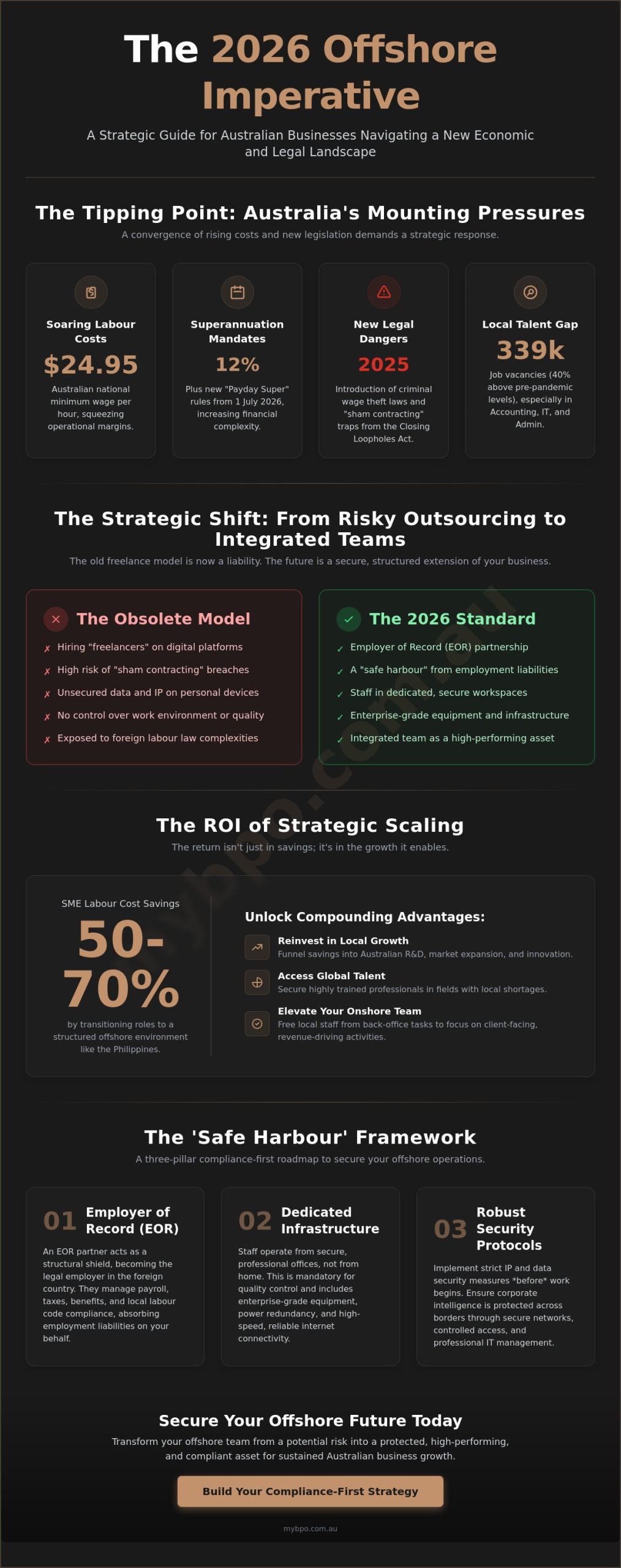
With the Australian minimum wage now at $24.95 an hour and the “Payday Super” mandate taking effect on 1 July 2026, the financial pressure on local enterprises has reached a tipping point. Many directors realise that traditional hiring can no longer sustain the margins required for expansion. Implementing robust offshore staffing strategies for Australian business growth is no longer a luxury for the adventurous; it is a structural necessity for survival. However, the introduction of criminal wage theft laws in 2025 means that the old ways of simply “hiring a freelancer” now carry severe personal and corporate risks.
You likely recognise that your business needs the agility of a global workforce but feel hesitant about the complexities of the Fair Work Act or potential data breaches. This article provides a clear roadmap to scaling your operations securely by prioritising compliance, risk mitigation, and operational excellence. We will examine how a “safe harbour” framework, built on Employer of Record (EOR) services and dedicated infrastructure, allows you to reduce overheads without surrendering control or quality. We’ll show you how to transform offshore teams from a distant experiment into a protected, high-performing asset.
Key Takeaways
- Understand why the 2026 economic climate requires a transition from simple task outsourcing to a strategic, integrated offshore workforce.
- Identify the specific “offshorable” functions within your business to build a compliance-first roadmap that prioritises structural integrity.
- Discover how to deploy offshore staffing strategies for Australian business growth that avoid the high-risk “sham contracting” traps created by the Closing Loopholes Act.
- Learn why professional dedicated workspaces and enterprise-grade equipment leasing are mandatory for maintaining data security and quality control in 2026.
- Gain a “safe harbour” from Australian employment liabilities by utilising an Employer of Record service that manages foreign labour codes on your behalf.
The 2026 Landscape: Why Offshore Staffing is Essential for Australian Growth
The 2026 Australian economic climate presents a dual challenge for local directors. On one side, the national minimum wage has climbed to $24.95 per hour. On the other, the superannuation guarantee has reached 12%. These rising costs, combined with the “Payday Super” mandate starting 1 July 2026, mean that local overheads are no longer just a line item; they are a direct threat to corporate scalability. Consequently, “growth at all costs” has been replaced by a disciplined focus on growth through efficiency. The margin is the mission.
This shift has transformed Business Process Outsourcing (BPO) from a tactical cost-cutting exercise into a core pillar of corporate strategy. Australian businesses are no longer merely “outsourcing tasks” to stay afloat. Instead, they are integrating specialised offshore teams as permanent, high-value assets. The Philippines has emerged as the primary corridor for this professional talent, offering a cultural and linguistic alignment that abstract digital platforms cannot replicate. If a business fails to integrate these global resources, it risks being outpaced by leaner, more agile competitors who have already secured their talent pipelines.
Addressing the Local Talent Shortage
As of May 2025, Australia recorded 339,400 job vacancies, which is roughly 40% higher than pre-pandemic levels. Many of these roles, particularly in accounting, IT, and specialised administration, remain unfillable within the domestic market. By implementing offshore staffing strategies for Australian business growth, companies can secure this talent in the Philippines, where the professional workforce is highly trained in Western business standards. This hybrid structure allows your local team to stop drowning in back-office administration and start focusing on client-facing revenue drivers. It’s about moving your onshore staff up the value chain.
The ROI of Strategic Scaling
Small and medium enterprises (SMEs) report labour cost savings of between 50% and 70% when transitioning specific roles offshore. However, the true return on investment isn’t found in the saved dollars alone. It’s found in what those dollars enable. When you reduce operational friction, you can reinvest that capital into local research and development or market expansion, such as establishing a professional online presence with Good Budget Website. We must move beyond the myth of the cheap, unmanaged worker. In 2026, value-based staffing is about building a secure, high-performing extension of your Australian office. If you choose an employment model that prioritises structural integrity over the lowest possible price, the long-term ROI becomes a compounding advantage for your business.
Developing a Compliance-First Offshore Staffing Strategy
Building a team in 2026 requires more than a fast internet connection and a job posting. To truly leverage offshore staffing strategies for Australian business growth, you must adopt a compliance-first framework that prioritises legal safety over immediate convenience. This isn’t about finding the cheapest labour; it’s about building a structured, resilient extension of your local operations. If your foundation is weak, the risks of data breaches or regulatory penalties will eventually outweigh any initial cost savings.
The first step involves a rigorous audit of your internal workflows. You shouldn’t just offshore a problem; you should offshore a process. Once you’ve identified these functions, the choice of employment model becomes paramount. While direct hiring might seem cost-effective on paper, it often leaves you exposed to local labour law complexities in a foreign jurisdiction. An Employer of Record (EOR) model absorbs this liability, acting as a structural shield for your Australian entity. This is followed by the establishment of strict IP and data security protocols. You must ensure that your corporate intelligence remains secure across borders before the first contract is signed.
Finally, you must secure physical infrastructure. Remote staff working from home or cafes can introduce significant risks to uptime and professional standards. In 2026, the standard for operational excellence requires staff to work from dedicated, secure environments. This ensures your team has the hardware, power redundancy, and high-speed connectivity needed to function as a seamless part of your business. If you’re ready to secure your operations, you can explore our EOR and workspace solutions to build a protected workforce.
Identifying Growth-Critical Roles
The demand for a dedicated virtual assistant Philippines has surged as executives look to offload complex scheduling and project management. Beyond admin, technical departments are scaling through offshore IT support and QA testers. Back-office excellence in accounting and bookkeeping remains the most common entry point for Australian firms. Moving these roles offshore ensures that your Australian-based directors can focus on high-level strategy rather than reconciling ledgers or managing basic support tickets.
Vetting for Quality and Longevity
Speed of hire is a dangerous metric if it ignores cultural alignment. A high-quality offshore recruitment Philippines process must go beyond technical skills to assess communication and initiative. You need staff who understand the “Australian way”, which includes the nuance of our professional tone and the expectation of proactive problem-solving. Retention is equally vital. Longevity is secured through professional physical infrastructure and a supportive work culture that mirrors your onshore office. When staff feel like integrated team members rather than temporary contractors, your business gains a permanent competitive advantage.
Navigating Fair Work and the Closing Loopholes Act 2026
The regulatory environment for Australian directors has fundamentally shifted. Following the review of the Fair Work Legislation Amendment (Closing Loopholes) Act in June 2026, the Fair Work Commission has increased its scrutiny on how offshore workers are classified. If you treat an offshore worker as an independent contractor when they function as an integrated employee, you risk falling into the “sham contracting” trap. This is no longer merely a civil administrative error; since January 2025, criminal wage theft laws have made misclassification a matter of potential criminal liability for Australian business owners.
Relying on a direct freelance arrangement in the Philippines creates a jurisdictional vacuum. If a dispute arises, an Australian firm often finds itself with zero legal recourse in Manila while remaining fully exposed to the Fair Work Ombudsman at home. To implement effective offshore staffing strategies for Australian business growth, you must establish a legal firewall. Utilising a professional employer of record Australia allows you to outsource the employer-employee relationship itself. The EOR absorbs the local employment risks, manages the complex tax filings, and ensures your business doesn’t inadvertently create a “Permanent Establishment” that triggers unexpected corporate tax liabilities with the ATO.
EOR vs. Independent Contractors: A Risk Comparison
The differences between these models are structural. Under an EOR framework, the provider manages mandatory Philippine labour standards, including SSS (Social Security), PhilHealth, and Pag-IBIG contributions. They also secure the non-negotiable 13th-month pay, which is a statutory requirement in the Philippines. If you hire a contractor directly, you are personally responsible for navigating these foreign codes. Failure to meet these standards doesn’t just damage your reputation; it creates a compliance gap that can be exploited during a Fair Work audit or an ATO transfer pricing review.
Securing Your Intellectual Property
Intellectual property is the lifeblood of your expansion. However, a contract signed with a freelancer in Manila is notoriously difficult to enforce from a boardroom in Sydney or Melbourne. Structural protection is the only reliable solution. By using an EOR framework, your IP is protected through a chain of custody that involves an Australian-owned entity. We ensure that data security protocols are not just written into a contract but are physically enforced through secure VPNs and monitored workspaces. This approach secures your trade secrets within a “safe harbour” that abstract digital platforms cannot provide.
Operational Excellence: Beyond the Laptop and Internet Connection
Many Australian firms mistakenly treat offshore staffing as a purely digital exercise. They assume that providing a login and a laptop is sufficient to maintain operational standards. This is the “Cafe Worker” myth, and it’s a significant risk to the structural integrity of your business. In the Philippines, residential infrastructure often lacks the redundancy required for enterprise-grade performance. Frequent brownouts and unstable internet connections can cripple your productivity if your staff are working from home. To execute offshore staffing strategies for Australian business growth effectively, you must prioritise a physical presence.
Professional dedicated workspace Philippines is not a luxury; it’s a mandatory requirement for security and uptime. These facilities provide the redundant power and high-speed fibre connections that residential areas lack. Additionally, equipment leasing ensures your team isn’t using outdated personal hardware. Secure VPNs and enterprise-grade computers are essential to prevent data leaks. When your staff work in a managed environment, you gain a level of oversight that remote “freelance” models cannot offer. If you want to secure your team’s performance, get in touch with our local experts today.
Operational excellence also depends on human management. On-the-ground support is vital for performance management and staff morale. It’s much harder to maintain an Australian work culture when your team feels isolated. By providing a professional office environment, you signal that they are valued, permanent members of your organisation. This physical grounding reduces the “out of sight, out of mind” friction that often leads to quality decline. It ensures that your offshore team remains as disciplined and focused as your onshore staff.
Infrastructure as a Growth Lever
A dedicated office environment acts as a productivity multiplier. When staff have a quiet, professional space, turnover drops significantly. The psychological impact of “going to work” shouldn’t be underestimated; it fosters a sense of accountability and pride. Managed facilities provide 99.9% uptime through backup generators and multiple internet service providers. This level of reliability ensures that your Australian office never loses touch with its offshore support, regardless of local infrastructure challenges. You aren’t just buying labour; you are securing a functional department.
The Australian-Owned Advantage
Having an Australian partner on the ground bridges the cultural and regulatory gap. You need someone who understands the nuance of Australian business values and can translate them to a Filipino workforce. Accountability is the primary benefit here. If something goes wrong in Manila or Bacolod, you don’t want to be chasing a digital platform. You want to call a local partner who shares your jurisdictional reality. This physical presence transforms a distant service into a secure, transparent partnership that can scale alongside your Australian growth targets.
Scaling for Success: How MyBPO Secures Your Offshore Future
MyBPO operates as a specialised partner rather than a generic service provider. Being Australian-owned means we speak your language and understand the specific regulatory pressures of the Australian market. When you refine your offshore staffing strategies for Australian business growth, you aren’t just looking for lower costs; you’re looking for a protected expansion. We’ve built our model around this need for security, ensuring that every offshore team member is integrated into a framework that prioritises Australian standards of accountability. We don’t just provide talent; we provide a “safe harbour” for your expansion.
Our Employer of Record (EOR) services provide the ultimate legal buffer. While you maintain direct control over your staff’s daily tasks and output, MyBPO absorbs the jurisdictional liability. We manage the complexities of Philippine labour law, from statutory benefits to local tax compliance. This allows you to scale without the administrative burden or the risk of misclassification that often haunts direct-hire models. By choosing this structured approach, you ensure that your offshore staffing strategies for Australian business growth are built on a foundation of total compliance.
Our Guardian Model of Staffing
We act as your compliance shield on the ground. Unlike “cloud-only” platforms that leave you to manage remote staff in a vacuum, we maintain physical offices in Manila and Bacolod. This physical presence is vital for maintaining professional standards and staff morale. We provide transparent reporting and manage payroll to Australian expectations, ensuring that your financial oversight remains absolute. When your team works from our managed facilities, you gain the peace of mind that comes with enterprise-grade security and reliable infrastructure.
Ready to Start Your Growth Journey?
Success begins with identifying the right roles for initial impact. We typically recommend starting with three key functions, such as executive support, bookkeeping, or technical QA, to establish a high-performing core. Our 30-day onboarding roadmap ensures a seamless transition, providing structured training and cultural integration from day one. We take the guesswork out of global hiring, allowing you to focus on your primary business objectives while we secure your offshore operations.
The path to sustainable, high-margin growth in 2026 requires a partner who understands both the Australian boardroom and the Philippine talent market. Don’t leave your expansion to chance or unmanaged freelancers. Secure your offshore growth with MyBPO today and build a workforce that is as resilient as it is cost-effective.
Securing Your Competitive Advantage Through Structural Integrity
The economic pressures of 2026 have made global talent integration a necessity for any enterprise seeking to maintain its margins. However, the shift in regulatory scrutiny means that your approach must be anchored in legal and operational security. Moving beyond the “freelancer” model is the only way to protect your entity from the criminal liabilities of the Fair Work Act while ensuring your intellectual property remains within a secure Australian-managed framework.
By implementing professional offshore staffing strategies for Australian business growth, you transform a distant resource into a high-performing, integrated department. This requires more than just a laptop; it demands the structural shield of an Employer of Record and the reliability of dedicated physical workspaces. MyBPO stands as your vigilant guardian in this space. We are Australian-owned and operated, with a physical presence in Brisbane, Manila, and Bacolod to ensure total accountability. We specialise in navigating both Fair Work and DOLE compliance so you can focus on expansion without the burden of cross-border risk.
Scale your business securely with MyBPO’s Australian-owned EOR services and build a team that is prepared for the challenges of the coming decade. Your growth doesn’t have to come at the expense of your security.
Frequently Asked Questions
Is offshore staffing legal under the new Australian Fair Work changes?
Offshore staffing remains entirely legal, provided the arrangement complies with the updated worker classification standards. The 2026 review of the Closing Loopholes Act and the 2025 criminal wage theft laws have made “sham contracting” a significant risk. Using an Employer of Record (EOR) ensures your workers are legally employed under local labour codes, which protects your Australian directors from the liabilities associated with misclassifying staff as independent contractors.
What is the difference between a BPO and an Employer of Record (EOR)?
A BPO typically manages a specific business process or task on your behalf, often with their own management layer. An EOR acts as the legal employer for staff you manage yourself. The EOR absorbs jurisdictional liability and handles payroll, tax, and mandatory benefits while you retain direct control over daily operations and output. This model provides the highest level of structural protection for Australian firms expanding into the Philippines.
How do I ensure my data is secure with an offshore team in the Philippines?
Data security is maintained through a combination of physical infrastructure and enterprise-grade technology. You should avoid home-based “freelance” models and instead utilise dedicated workspaces in Manila or Bacolod. These facilities enforce strict security protocols, including secure VPNs, hardware monitoring, and physical oversight. This structural approach mitigates the risk of IP theft and data breaches that abstract digital platforms cannot prevent.
Do I need to pay the 13th-month pay to my offshore staff?
Yes, the 13th-month pay is a non-negotiable statutory requirement under Philippine labour law. It is equivalent to one month’s salary and must be paid to all rank-and-file employees before 24 December each year. If you use an EOR, this benefit is managed as part of the local compliance framework. Failing to provide this payment can lead to severe legal penalties and reputational damage within the Philippine jurisdiction.
Can I hire a dedicated virtual assistant for my small business through an EOR?
Yes, SMEs can secure a dedicated virtual assistant through an EOR framework to ensure total compliance. This is a vital part of offshore staffing strategies for Australian business growth, allowing small businesses to scale without the legal risks of direct international hiring. An EOR provides your assistant with a professional workspace and equipment, ensuring they function as a reliable extension of your local office.
What happens if an offshore staff member underperforms?
Underperformance is managed through your direction in coordination with the EOR’s local HR specialists. Because the EOR is the legal employer, they navigate the specific Philippine labour codes regarding performance improvement plans and termination. This process ensures that any disciplinary actions are legally sound. It protects your Australian entity from direct legal claims while maintaining the high performance standards required for your business operations.
How does MyBPO handle Philippine tax and mandatory benefits for my staff?
MyBPO acts as the local employer, absorbing the entire administrative burden of tax and benefits management. We handle all mandatory contributions, including SSS, PhilHealth, and Pag-IBIG, alongside the statutory 13th-month pay. We ensure all filings meet the standards of the Philippine Bureau of Internal Revenue. This provides you with a transparent compliance record and ensures your staff are fully protected under local law.
Why is an Australian-owned staffing partner better than a local Philippine agency?
An Australian-owned partner understands the specific pressures of the Fair Work Act and the ATO’s compliance priorities. We act as a bridge between two different legal systems, providing a “compliance shield” that a local agency cannot offer. This ensures your offshore staffing strategies for Australian business growth are managed with local accountability. You gain a partner with a physical presence in both countries, ensuring clear communication and structural integrity.
Need a strategy session?
Tell us about your team and we will map out the right structure, fixed-cost quote included.
Book a call