Blog
Average Pay in the Philippines: A 2026 Guide for Australian Businesses

An incorrect calculation of the average pay in the philippines is no longer just a minor budget oversight; it’s a direct invitation for a Fair Work investigation or a Department of Labor and Employment (DOLE) compliance audit. You likely recognise that offshoring offers a significant competitive edge, yet the fear of accidental “sham contracting” or losing your best talent to a higher bidder keeps you cautious. It’s a delicate balance between cost-efficiency and the stringent regulatory frameworks that govern cross-border employment in 2026.
We understand the anxiety that comes with navigating foreign labour codes and fluctuating PHP to AUD conversions. This guide provides the clarity you need to master Philippine wage structures, ensuring your offshore team is competitively paid and your Australian entity remains fully protected. We’ll examine current daily minimums, mandatory statutory contributions like SSS and PhilHealth, and the specific benchmarks required to secure high-performing professionals while mitigating every layer of operational risk.
Key Takeaways
- Understand how the current average pay in the philippines serves as a macroeconomic baseline rather than a fixed hiring rate, especially when accounting for the 5.5% wage inflation projected for 2026.
- Learn to benchmark salaries across critical sectors like IT and digital marketing to ensure you attract high-tier talent without overextending your operational budget.
- Calculate the true cost of employment by factoring in mandatory statutory contributions and the non-negotiable 13th-month pay required under Philippine labour law.
- Identify the legal pitfalls of worker misclassification and how Australian “Closing Loopholes” legislation impacts your offshore payroll compliance and liability.
- Discover how an Australian-owned Employer of Record (EOR) acts as a compliance shield, absorbing jurisdictional risks while securing your local operations in Manila and Bacolod.
Understanding the 2026 Philippine Wage Landscape for Australian Employers
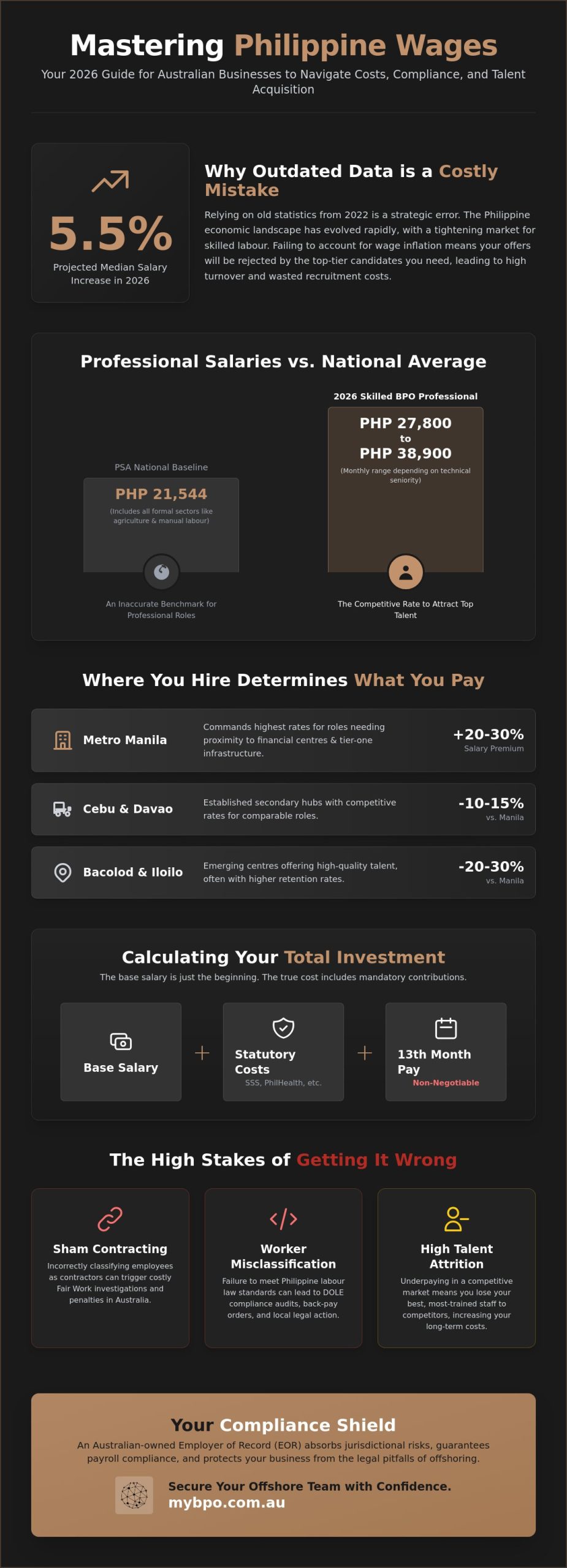
Relying on outdated 2022 statistics to determine the average pay in the philippines is a strategic error that leads to talent attrition and compliance failures. While some sources still quote figures from four years ago, the Philippine economic landscape has evolved rapidly, driven by robust domestic growth and a tightening market for skilled labour. Australian businesses must distinguish between the national macroeconomic average, which includes agricultural and manual labour, and the professional benchmarks required for high-tier offshoring. If you fail to account for the 5.5% median salary increase projected for 2026, your offers will likely be rejected by the top 10% of candidates you actually want to hire, leaving you with high turnover and recruitment costs.
The 2026 Macro-Economic Context
The stability of the AUD to PHP exchange rate has provided a predictable environment for Australian payroll planning, but domestic factors in the Philippines are driving costs upward. As the nation approaches upper-middle-income status, employee expectations for “livable wages” have shifted from basic survival to professional sustainability. This shift is particularly evident in the BPO sector, where competition for specialised skills is fierce. Based on 2024 PSA baselines and projected 5.5% annual increments, the 2026 average professional wage for skilled BPO roles is expected to sit between PHP 27,800 and PHP 38,900 per month depending on technical seniority.
Regional Variations: Manila, Cebu, and Beyond
Location remains the primary driver of wage disparity across the archipelago. Metro Manila continues to command a 20-30% premium over provincial hubs due to the significantly higher cost of living and the density of multinational headquarters. If your operations are office-based, you’ll need to absorb these higher rates to ensure your staff can afford urban housing and transport. While you support your team’s local stability, you may also be looking to secure your own property assets in Australia; for those based in Queensland, Brisbane City Home Loans provides expert mortgage services tailored to business owners. Conversely, hubs like Bacolod offer a strategic middle ground where lower overheads don’t necessarily equate to lower quality. Infrastructure quality varies by region, and a fair pay rate must reflect whether the employee is expected to provide their own high-speed redundancy or if they are working from a secure, dedicated workspace in a tier-one building.
To maintain a competitive edge, consider these regional benchmarks when structuring your 2026 payroll:
- Metro Manila: Commands the highest rates; essential for roles requiring physical proximity to major financial centres and tier-one infrastructure.
- Cebu & Davao: Established secondary hubs with competitive rates, typically sitting 10-15% lower than the capital for comparable roles.
- Bacolod & Iloilo: Emerging centres offering high-quality talent at a 20-30% discount compared to Manila, often with higher retention rates due to lower local competition.
Underestimating the average pay in the philippines by ignoring these regional nuances creates a significant risk. If your salary offers don’t align with the local cost of living in the specific city where your talent resides, you won’t just struggle to hire; you’ll struggle to keep the people you’ve already trained.
Benchmarking Average Salaries by Industry and Seniority
Establishing a competitive salary offer requires a granular understanding of industry-specific benchmarks rather than relying on broad national data. While the broad market average pay in the philippines is reported at PHP 21,544 by the PSA, this figure represents a baseline for the formal sector and does not reflect the reality of the high-skill professional market. To secure talent that can integrate seamlessly into Australian operations, your benchmarking must account for global demand and the specific technical requirements of the role. The official minimum wage rates provide the legal floor, but professional services operate in a separate, globally competitive stratosphere.
Information Technology and Tech Stack Premiums
The tech sector continues to see the most aggressive wage inflation in the region. While a junior developer might enter the market with a base salary, specialized roles in AI, data analytics, and cybersecurity are experiencing annual growth rates of 10-15% as of June 2026. For these roles, five or more years of experience often doubles the base salary. You aren’t merely competing with local firms; you’re competing with remote-first companies from the US and UK who are willing to pay a significant premium for the same talent pool. If your offer fails to reflect this tech stack premium, you risk high turnover as staff are headhunted by international competitors.
Professional Services and Virtual Assistants
There is a distinct difference between a general administrative assistant and a dedicated Virtual Assistant with executive-level experience. Executive VAs who manage complex scheduling, stakeholder communication, and project coordination command a much higher benchmark than general data entry staff. Similarly, bookkeeping and accounting roles require specific premiums, especially when staff are CPA-qualified and familiar with Australian tax standards and Xero/MYOB ecosystems. Ensuring your staff are remunerated correctly for their specific expertise is vital for maintaining high retention. Our recruitment services specialise in finding these high-calibre professionals who meet rigorous Australian operational standards.
Customer support and creative services also show rising averages. As the BPO sector evolves from basic call handling to high-value customer experience (CX), the demand for high-EQ, English-proficient staff has pushed salaries for senior support roles into the PHP 35,000 to PHP 45,000 range. In the creative space, senior graphic designers and digital marketers with experience in the Australian market expect a salary that reflects their understanding of our local consumer nuances. By aligning your pay scales with these industry-specific realities, you protect your business from the hidden costs of constant recruitment and retraining. Competitive remuneration is only one piece of the puzzle; implementing effective filipino employee engagement strategies is equally critical to reducing the high turnover rates that plague the BPO sector.
Beyond the Basic Salary: The Total Cost of Employment
Australian businesses often make the fundamental mistake of equating the basic salary with the total cost of employment. If you only budget for the base average pay in the philippines, you’ll likely face a significant financial shortfall by the end of your first financial year. In the Philippine context, the total cost of a professional employee typically requires a 20-30% loading on top of the base salary to account for mandatory legal requirements, statutory funds, and retention-focused benefits. Failing to calculate these “on-costs” accurately doesn’t just hurt your bottom line; it creates a risk of non-compliance with local labour laws that can lead to costly legal disputes. To ensure your overall financial strategy remains robust, ASAP Solutions can help you manage your small business accounting and tax obligations effectively.
The 13th-Month Pay and Bonuses
The 13th-month pay is a non-negotiable legal obligation, not a discretionary performance bonus. It’s calculated by taking the total basic salary earned by an employee within a calendar year and dividing it by 12. For Australian firms, this means you must accrue for this expense monthly to avoid a significant cash-flow shock in December. Presidential Decree No. 851 mandates that all rank-and-file employees must receive their 13th-month pay on or before 24 December each year. While you may choose to offer additional performance-based bonuses to drive productivity, these are separate from and in addition to this statutory debt.
Statutory Benefits and Insurance
Beyond the 13th-month pay, employers must navigate a complex landscape of mandatory government contributions that function similarly to Australian payroll tax and superannuation. As of June 2026, the Social Security System (SSS) contribution rate is 15% of the monthly salary credit, with the employer absorbing a 10% share. PhilHealth contributions have reached 5% of the monthly basic salary, split equally between employer and employee. These funds are critical for the national social safety net, and World Bank data on the Philippines indicates that such structured contributions are vital for maintaining domestic economic stability amidst global inflation.
You also need to account for the Home Development Mutual Fund (Pag-IBIG), which requires a 2% employer contribution. While the 2026 Philippine Payroll Compliance Reference provides a deeper dive into these specific contribution tables, you should also consider private health insurance (HMO). In the competitive BPO sector, providing an HMO card is often the deciding factor for top-tier talent choosing between two identical salary offers. Finally, don’t overlook Service Incentive Leave (SIL); Philippine law requires a minimum of five days of paid leave after one year of service, though most professional firms offer 12-15 days to remain competitive. By structuring your budget around these total costs rather than just the average pay in the philippines, you secure your operations against both talent loss and regulatory scrutiny.
The Risk of Underpayment: Avoiding Sham Contracting and Legal Pitfalls
Targeting the lowest possible average pay in the philippines might look attractive on a spreadsheet, but it often creates a massive liability under the Australian Fair Work Act. The introduction of the Closing Loopholes Act 2025 has fundamentally changed how offshore labour is perceived by Australian regulators. If the substance of your relationship with an offshore worker mirrors that of an employee, yet you pay them as a “contractor” without statutory benefits, you are at high risk of a sham contracting claim. Fair Work Australia no longer accepts “market rate” as a valid excuse for avoiding the legal obligations of an employment relationship.
Hiring through B2C marketplaces or freelance platforms often exacerbates this risk. These platforms typically lack the infrastructure to manage Philippine labour codes, specifically Department of Labor and Employment (DOLE) Department Order No. 174. This regulation prohibits “labour-only contracting,” where a worker performs activities directly related to your main business without the protection of a legitimate employer. If your offshore staff are misclassified, your Australian entity could be held liable for unpaid entitlements, taxes, and significant penalties. Secure your business with our Employer of Record (EOR) Services to eliminate these liabilities and ensure full jurisdictional compliance.
Sham Contracting and the Fair Work Act
Determining whether your offshore staff are employees or contractors requires a multi-factor test. Regulators look at the level of control you exert, who provides the equipment, and whether the worker is truly running their own independent business. If you dictate their daily schedule and provide their laptop, they are likely employees. Australian directors face personal liability and heavy fines when these relationships are misclassified. Our guide on Exposing the Sham Contracting Philippines Risk provides a detailed framework for identifying these vulnerabilities within your current team structure.
Protecting Intellectual Property through Proper Pay
Underpayment isn’t just a legal risk; it’s a critical security vulnerability. Staff who are paid significantly below the professional average pay in the philippines often lack the financial stability required to maintain a secure home office environment. There is a direct correlation between competitive remuneration and the protection of your intellectual property. When staff are fairly compensated and legally protected through an EOR, their commitment to your data security protocols increases. A legitimate employment contract, enforceable in both jurisdictions, ensures that your IP remains secure while providing your team with the stability they need to perform at a high level. Beyond pay, Australian managers who invest in culturally aligned filipino employee engagement strategies report significantly stronger adherence to data protection protocols and confidentiality agreements.
Implementing a Compliant Payroll Strategy with an Australian EOR
Managing the average pay in the philippines requires more than just a currency converter; it demands a robust infrastructure that bridges two different legal jurisdictions. For Australian businesses, the most secure path forward is partnering with an Australian-owned Employer of Record (EOR). This model ensures that while your team is physically located in Manila or Bacolod, your contractual and financial interactions remain within a familiar Australian framework. We absorb the complexities of local labour laws, allowing you to focus on output rather than regulatory minutiae.
Currency fluctuations and unpredictable invoicing can often undermine the cost-savings of offshoring. By utilising an EOR, you secure AUD-based invoicing that provides budget predictability and protects your margins from the volatility of the PHP. A proactive approach to managing exchange rate risk in Employer of Record arrangements is essential to ensuring your staff receive stable, fair wages regardless of AUD/PHP market shifts. This structured approach moves the burden of risk from your directors to our local entity, ensuring that every cent paid aligns with both the average pay in the philippines for professional roles and the statutory requirements of the Philippine government.
The MyBPO Advantage: Local Presence, Global Protection
Physical representation in both Australia and the Philippines is vital for maintaining operational security. MyBPO manages the entire recruitment-to-payroll lifecycle, providing a “compliance shield” that abstract digital platforms simply cannot offer. We often hear the objection: “Why not just pay via PayPal?” The reality is that paying through unregulated digital channels provides zero protection against sham contracting claims and offers no mechanism for enforcing intellectual property rights. If a dispute arises, an Australian business paying via a freelance marketplace has no legal standing in a Philippine labour court. Our on-the-ground presence ensures that your contracts are enforceable and your team is supported by a legitimate corporate structure.
Scaling Your Team with Confidence
Successful offshoring often begins with a single virtual assistant and evolves into a dedicated department. As you scale, the requirements for security and infrastructure increase. Transitioning your team into dedicated workspaces provides a level of data protection and professional oversight that home-office environments cannot match. We facilitate this growth by providing equipment leasing and recruitment services that ensure your new hires are vetted and remunerated according to the 2026 benchmarks we’ve established. This methodical progression allows you to expand your offshore footprint without increasing your exposure to jurisdictional risk. Secure your offshore team today with MyBPO EOR services and ensure your business is protected by a partner that understands the high stakes of international employment.
Securing Your Competitive Advantage in 2026
Successfully navigating the average pay in the philippines requires a shift from simple cost-saving to long-term risk management. You’ve seen that a competitive 2026 salary package must account for regional premiums and the total cost of employment, including mandatory 13th-month pay and statutory contributions. Failing to structure these payments within a compliant framework doesn’t just risk talent loss; it exposes your Australian directors to significant liability under modern Fair Work regulations.
MyBPO acts as your compliance shield, bridging the gap between our Brisbane headquarters and our physical offices in Manila and Bacolod. As an Australian-owned and operated specialist, we absorb the operational risks of cross-border employment, ensuring your offshore team is both legally secure and highly motivated. Don’t leave your expansion to chance or unregulated marketplaces. Book a Compliance Consultation with MyBPO today to secure a transparent, predictable, and fully compliant payroll strategy. You can scale your operations with the confidence that your business is protected by local experts who understand the high stakes of international labour law.
Frequently Asked Questions
What is the minimum wage in the Philippines for 2026?
As of June 2026, the daily minimum wage in the National Capital Region (NCR) is PHP 695.00 for the non-agriculture sector. For agriculture and retail establishments with 15 or fewer workers, the rate is set at PHP 658.00 per day. These figures represent the absolute legal floor; however, professional BPO roles typically require a much higher benchmark to remain competitive in the local market.
Do I have to pay my Philippine staff in AUD or PHP?
You must ensure your staff are paid in Philippine Pesos (PHP) to comply with local labour laws and facilitate accurate statutory contributions. While your Australian business may budget in AUD, the actual payroll disbursement and the average pay in the philippines are calculated in the local currency. Using an EOR allows you to pay a fixed AUD invoice while ensuring your team receives their full PHP entitlements without exchange rate friction. For a deeper understanding of how to protect your budget from AUD/PHP volatility, our guide on managing exchange rate risk in Employer of Record arrangements outlines a structured approach to achieving payroll stability.
Is the 13th-month pay mandatory for independent contractors?
Legally, 13th-month pay is only mandatory for rank-and-file employees and not for genuine independent contractors. However, if the Department of Labor and Employment (DOLE) determines that your “contractor” is actually an employee based on the level of control you exert, you will be liable for this payment. Misclassifying staff to avoid this statutory requirement is a high-risk strategy that often leads to legal disputes and back-pay orders.
How does the Australian Fair Work Act view offshore employees?
The Australian Fair Work Act, particularly following the Closing Loopholes Act 2025, scrutinises the substance of the working relationship rather than the contract title. If an offshore worker performs duties under your direct supervision and control, regulators may classify them as an employee. This classification makes your Australian entity vulnerable to sham contracting penalties if you haven’t provided the equivalent protections and benefits required by law.
What are the mandatory employer contributions in the Philippines?
Employers are legally required to contribute to the Social Security System (SSS), PhilHealth, and the Pag-IBIG Fund. In 2026, the employer’s share for SSS is 10% of the monthly salary credit, while PhilHealth requires a 2.5% contribution. These funds are essential for the employee’s healthcare and retirement, and failing to remit these payments is a criminal offence in the Philippines that can result in the blacklisting of your business operations.
Can I lose my IP if I underpay my offshore staff?
Underpayment significantly increases the risk of intellectual property loss and data security breaches. When staff receive a salary well below the professional average pay in the philippines, they often lack the financial security to maintain a dedicated, secure workspace. Fairly compensated employees are statistically more likely to respect confidentiality agreements and adhere to the rigorous data protection protocols required by Australian firms.
What is the “Night Shift Differential” and when does it apply?
The Night Shift Differential is a mandatory 10% premium paid to employees for work performed between 10:00 PM and 6:00 AM. If your Australian business hours require your Philippine team to start before 6:00 AM local time, you must apply this premium to those early morning hours. This is a non-negotiable component of Philippine labour law and must be factored into your total cost of employment calculations.
How much does it cost to use an EOR in the Philippines compared to direct hiring?
While direct hiring through freelance platforms may seem cheaper at face value, it leaves your business exposed to significant tax and legal liabilities. An EOR charges a service fee that covers the “heavy lifting” of payroll, tax compliance, and local labour law adherence. When you factor in the cost of potential Fair Work penalties and the high turnover associated with unmanaged staff, the EOR model provides a more cost-effective and secure path for sustainable expansion.
Need a strategy session?
Tell us about your team and we will map out the right structure, fixed-cost quote included.
Book a call