Blog
New Victorian WFH Laws: Key Guide for AU Employers

By 1 September 2026, the traditional office mandate will cease to be a matter of management discretion and instead become a high-stakes issue of statutory compliance. The New Victorian Work From Home Laws represent a fundamental shift that strips away employer autonomy, effectively creating a “rigidity trap” for businesses across the state. If your organisation employs 15 or more people, you’re now facing a legislated mandate where “unreasonable” denials can lead directly to costly VCAT conciliation processes and increased legal liability.
You likely recognise that while flexibility is a modern necessity, these new mandates introduce a layer of regulatory complexity that threatens your operational control. This guide provides a clear roadmap to navigate the technicalities of Victoria’s statutory right to work from home while identifying strategies to mitigate your exposure. We will examine the specific criteria for refusal and how diversifying into offshore structures can help you maintain the cost-efficiency and flexibility that domestic regulations now jeopardise.
Key Takeaways
- Understand the legal triggers of the New Victorian Work From Home Laws and how they shift the burden of proof onto employers when refusing remote work requests.
- Identify the specific stages of the VCAT dispute resolution framework to minimise legal exposure and avoid protracted conciliation processes.
- Discover how diversifying with offshore EOR services can restore operational flexibility and management control over core working hours.
- Learn how the Employer of Record model absorbs jurisdictional liability, acting as a compliance shield for your Australian business entity.
- Evaluate the strategic “Hybrid Workforce” model to balance local expertise with the scalability and cost-efficiency of a dedicated offshore team.
What are the New Victorian Work From Home Laws for 2026?
The introduction of the Equal Opportunity Amendment (Work from Home) Bill 2026 (Vic) marks a definitive end to the era of employer-led flexibility. Under the New Victorian Work From Home Laws, eligible employees possess a statutory entitlement to perform their roles from home for up to two days per week. This isn’t a mere suggestion or a “right to request” that can be dismissed with a generic email. By anchoring these reforms within the Equal Opportunity Act 2010 (Vic), the Victorian Government has reclassified remote work as a matter of individual right rather than industrial negotiation.
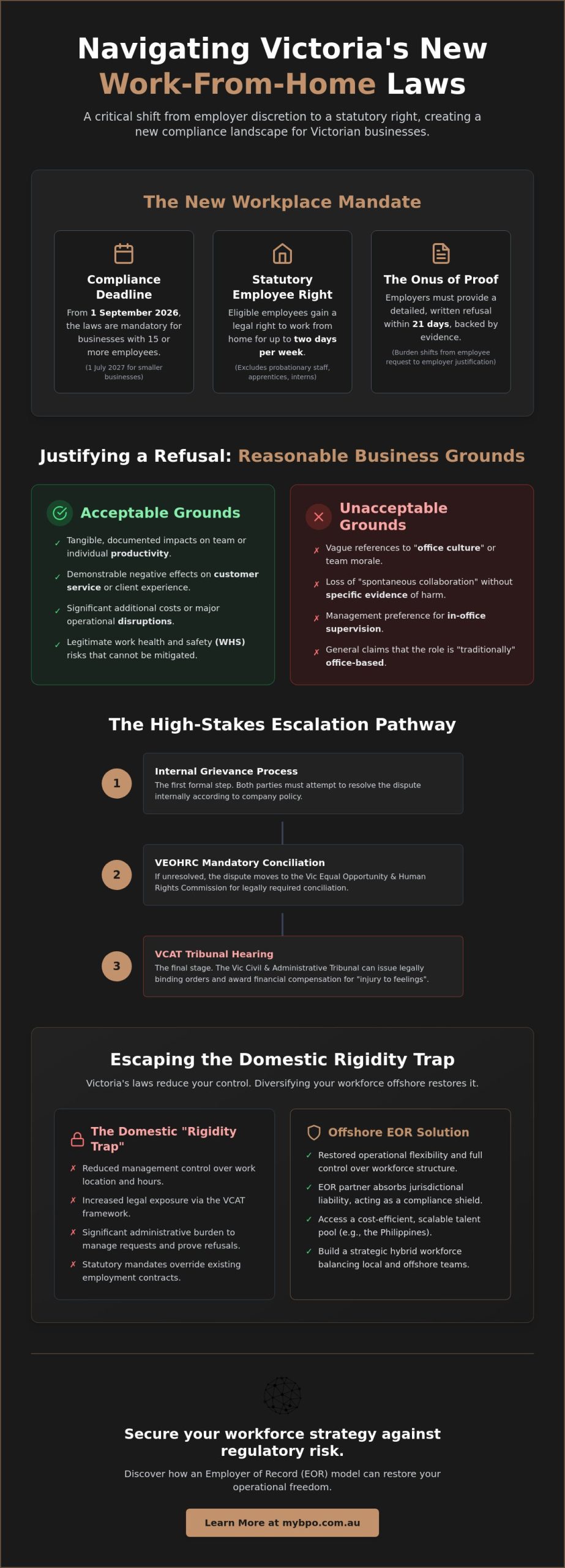
Large and medium-sized firms with 15 or more employees must reach full compliance by 1 September 2026. Smaller enterprises have slightly more breathing room, with a commencement date set for 1 July 2027. Regardless of the timeline, the core challenge remains the same: the burden of proof has shifted. If you refuse a request, you must demonstrate “reasonable business grounds” based on role requirements or tangible productivity impacts. Failure to provide a detailed, written refusal within 21 days can trigger immediate external scrutiny and potential litigation.
Key Entitlements and Eligibility Criteria
The legislation applies to most Victorian employees, excluding those in their probationary period or specific training roles like apprentices and interns. For the vast majority of knowledge workers, the default assumption is now that their roles are capable of being performed remotely. This creates a significant conflict with existing employment contracts that mandate five days in a central office. Because statutory rights typically override private contractual terms, many businesses will find their current hybrid policies legally unenforceable. Even small businesses are not exempt from the underlying principles; they simply have a longer runway to adjust their operational structures before the mandate takes effect.
The Shift from Discretion to Statutory Right
Historically, managing where work occurred was a core management prerogative. These New Victorian Work From Home Laws effectively dismantle that authority. While the Fair Work Act 2009 provides a federal framework for requesting flexible arrangements, the Victorian mandate goes much further by establishing a “right to have” for eligible staff. This state-based intervention creates a more rigid environment than the national standard, leaving employers with less room to move. Complementing these changes is the Right to Disconnect, a regulation that prohibits employers from penalising staff who refuse to monitor communications outside of their designated working hours. Together, these laws form a protective shield around the employee, significantly increasing the administrative and legal risks for those who fail to adapt.
Compliance Burdens and the VCAT Dispute Resolution Framework
The path from a simple remote work request to a legally binding tribunal order is remarkably short under the New Victorian Work From Home Laws. If an employer denies a request, the legislation mandates a three-step escalation process that places significant administrative pressure on the business. Initially, parties must engage in a formal internal grievance process. If this fails to produce a resolution, the matter moves to the Victorian Equal Opportunity and Human Rights Commission (VEOHRC) for mandatory conciliation. This is a critical juncture where the Victorian Government announcement on WFH rights confirms that the focus is on employee entitlement rather than management preference. If conciliation remains unsuccessful, the dispute reaches the Victorian Civil and Administrative Tribunal (VCAT), which possesses the authority to award financial compensation for “injury to feelings” or “lost opportunity.”
Navigating the VEOHRC Conciliation Process
Preparation for VEOHRC conciliation requires more than just a list of preferences. You must present objective, documented evidence to justify a refusal. General claims regarding “office culture” or “spontaneous collaboration” rarely satisfy the commission’s standards for “reasonable business grounds.” Instead, you must prove tangible impacts on productivity, health and safety, or customer service. For many SMEs, the cost of legal representation during these sessions represents a significant unbudgeted expense. If your evidence doesn’t meet the high bar of “reasonableness,” you risk a public VCAT hearing that could damage your employer brand and set a rigid precedent that limits your future operational flexibility.
The Hidden Costs of Domestic Employment Disputes
Beyond the threat of penalties, the management time lost to these disputes is a substantial hidden cost. Preparing for and attending VCAT hearings can drain dozens of hours from your senior leadership team, diverting focus from core business growth. Some organisations might attempt to bypass these New Victorian Work From Home Laws by misclassifying staff as independent contractors, but this significantly increases the sham contracting Philippines risk if the relationship isn’t structured with precision. To avoid these domestic entanglements and the associated litigation risks, many forward-thinking firms are choosing to secure their operations through established offshore frameworks that exist entirely outside this state-based regulatory environment.
Operational Impact: Domestic Rigidity vs Offshore Flexibility
The New Victorian Work From Home Laws create what many directors describe as a “rigidity trap.” While the Equal Opportunity Act 2010 (Vic) now mandates specific remote work entitlements, it simultaneously erodes the management control necessary to maintain peak operational efficiency. This domestic statutory constraint stands in stark contrast to the contractual clarity provided by an offshore Employer of Record (EOR) model. When you engage staff within the Victorian jurisdiction, you’re bound by state-specific mandates that can be contested at VCAT; conversely, an offshore structure allows you to define precise availability and adherence to core Australian business hours without the threat of domestic legislative interference.
Maintaining a central Melbourne office has become a complex cost-benefit equation. If your local workforce is legally entitled to be absent from the physical office for 40% of the working week, the overhead of premium CBD floor space becomes increasingly difficult to justify. As businesses adapt their physical footprints, consulting with Your Australian Property Buyers Agents can help in identifying strategic property opportunities within the Melbourne area. Furthermore, the “Flexibility Gap” created by these laws makes scaling your domestic team a high-risk endeavour. Every new Victorian hire now represents a potential VCAT dispute if their WFH expectations don’t align with your operational requirements. Moving remote-capable roles offshore allows you to scale up or down with agility, bypassing the domestic “right to have” mandates that now complicate the Victorian employment landscape.
Why ‘Right to Work From Home’ Doesn’t Apply Offshore
Victorian state laws and the Fair Work Act possess clear jurisdictional boundaries that stop at the Australian border. When you utilise an employer of record Australia service to hire in the Philippines, your workforce is governed by the Department of Labor and Employment (DOLE) rather than Victorian statutes. This provides a robust “compliance shield,” absorbing the impact of local regulatory shifts. Philippine labour law offers a structured yet flexible framework where remote work is a matter of clear mutual agreement rather than a statutory right that can be weaponised in a tribunal. This legal separation ensures your Australian entity remains insulated from the evolving complexities of Victorian employment mandates.
Productivity and Performance Management
Concerns regarding “out of sight, out of mind” often stem from a lack of structured management rather than the location of the staff. Dedicated offshore structures in the Philippines frequently demonstrate higher levels of engagement in remote-first environments because the infrastructure is purpose-built for it. By shifting from an “hours-at-desk” mentality to a KPI-driven, output-based management style, you can secure higher productivity levels than a fragmented hybrid domestic team. Offshore teams operate under strict professional standards and dedicated management oversight, ensuring that your core operational requirements are met without the distractions or entitlement issues currently surfacing in the Victorian workforce.
Strategic Risk Mitigation: Diversifying with Philippine EOR Services
The New Victorian Work From Home Laws shouldn’t be viewed merely as a compliance hurdle, but rather as a catalyst for structural diversification. By adopting a “Hybrid Workforce” model, Australian firms can maintain their core strategic leadership in Melbourne while delegating operational execution to a dedicated offshore team. This approach doesn’t just reduce costs; it fundamentally de-risks your business by spreading your workforce across different regulatory environments. When you rely 100% on a single jurisdiction, you’re vulnerable to every legislative shift that occurs within that state’s borders.
Utilising an Employer of Record (EOR) service allows your Australian entity to transfer the legal liability of employment to a specialist provider. The EOR acts as the direct employer in the Philippines, absorbing the administrative burden of payroll, local taxes, and complex labour codes. This setup provides a “compliance shield,” ensuring that your domestic business remains insulated from the rising costs and litigation risks associated with Victorian industrial relations. The Philippines offers a unique advantage for this model, combining high English proficiency with a deep cultural alignment to Australian business practices and a robust infrastructure designed specifically for remote-capable roles.
Protecting Your Business from Legislative Volatility
Relying solely on a Victorian workforce exposes your organisation to significant state-based regulatory shocks. The long-term trend in Australia is clearly moving towards “employee-centric” legislation, which can erode profit margins and operational control without warning if not managed proactively. Diversifying into the Philippines allows you to maintain consistent service levels regardless of domestic mandates. EOR services allow for rapid scaling without the overhead of Australian HR compliance. This geographic separation protects your profit margins from the mounting “compliance overhead” that now characterises the Victorian employment landscape.
Maintaining Culture and Security in a Global Team
MyBPO maintains a vigilant approach to data security and IP protection, ensuring that offshore staff operate within a secure digital environment that mirrors your Australian standards. We provide physical representation and on-the-ground support to ensure your company values are integrated into your offshore team’s daily operations. This is particularly effective for roles that are now high-risk for mandatory WFH disputes in Victoria, such as Data Entry, Customer Support, and IT support. By moving these operational roles to a secure Philippine EOR structure, you eliminate the risk of VCAT disputes while maintaining high performance. To begin building your compliance shield, you can explore our EOR and recruitment services today.
Securing Your Workforce Strategy with MyBPO
As the 1 September 2026 deadline approaches, the necessity for a resilient workforce strategy has never been more urgent. MyBPO operates as a vigilant guardian for Australian firms navigating these domestic regulatory shifts, providing the structural integrity required to withstand legislative shocks. We don’t merely offer staffing services; we provide a structured path to operational safety. Our comprehensive EOR process is designed to absorb the complexities of international employment, handling everything from targeted recruitment and seamless onboarding to the management of payroll and total jurisdictional compliance. This allows your leadership team to focus on high-level strategy while we secure the operational foundation offshore.
Our unique perspective is rooted in being an Australian-owned entity that understands the Fair Work Act and the specific nuances of the New Victorian Work From Home Laws as deeply as you do. This local presence ensures that we speak the same language of risk and responsibility. We recognise that the transition to an offshore model is not just about cost-efficiency; it’s about protecting your organisation from the “rigidity trap” of domestic mandates. By shifting remote-capable functions to a dedicated offshore structure, you effectively insulate your business from the administrative and legal burdens that now characterise the Victorian employment landscape.
Why an Australian-Owned EOR Makes the Difference
Dealing with a partner that has a physical presence in both Australia and the Philippines provides a level of security that digital-only platforms cannot match. We bridge the gap between Australian management expectations and Philippine operational excellence, ensuring that your company culture is maintained across borders. Because we are rooted in the same business culture, we understand the stakes of a potential VCAT dispute or a VEOHRC conciliation process. You can request a workforce audit from our specialist team to identify which of your Victorian-based roles are best suited for an offshore transition, allowing you to mitigate risk before the New Victorian Work From Home Laws take full effect.
Next Steps for Victorian Employers
Preparation is the only effective defence against legislative volatility. Before these mandates reach their commencement date, you should conduct a comprehensive “capability audit” for every role in your organisation. This process involves an objective assessment of role requirements to determine which functions are most vulnerable to statutory remote-work requests. Simultaneously, it is vital to update your internal HR policies to reflect new statutory rights while building in robust protections for your business interests. By integrating dedicated virtual assistants and utilising our EOR services, you can reclaim the operational flexibility that state-based mandates have eroded. Contact MyBPO today to review your 2026 workforce plan and explore a secure, compliant, and cost-effective offshore staffing strategy.
Future-Proofing Your Victorian Workforce Strategy
The transition to a legislated hybrid model represents a permanent shift in the Australian industrial landscape. Understanding the New Victorian Work From Home Laws is the first step, but true protection lies in diversifying your workforce structure before the 2026 mandates take full effect. By separating core strategic functions from remote-capable operational roles, you mitigate the risk of costly VCAT disputes and maintain the management control necessary for growth.
MyBPO stands as a specialised ally in this transition. As an Australian-owned and operated firm with a physical presence in Brisbane, Manila, and Bacolod, we provide the cross-border compliance expertise you need to navigate these changes safely. We absorb the burden of jurisdictional risk, allowing you to focus on your primary business objectives with absolute confidence. It’s time to build a resilient workforce that thrives regardless of domestic regulatory shifts.
Secure your business against regulatory risk with MyBPO’s EOR services
Frequently Asked Questions
Do the new Victorian WFH laws apply to my small business if I have fewer than 15 staff?
Yes, the legislation applies to all Victorian employers regardless of their workforce size. However, small businesses with fewer than 15 employees have a delayed commencement date of 1 July 2027. This provides a longer window to audit your roles and update your internal policies before the statutory right becomes enforceable for your staff.
Can I still fire an employee in Victoria if they refuse to come into the office?
Terminating an employee for refusing office attendance is now a high-liability action that requires extreme caution. If an eligible worker has submitted a formal work from home notice, you cannot penalise or dismiss them without first demonstrating “reasonable business grounds” for your refusal. Proceeding with a dismissal without following the mandated 21-day response and conciliation process could lead to significant VCAT penalties.
What are ‘reasonable business grounds’ for refusing a work from home request in 2026?
Reasonable grounds must be based on objective facts rather than management preference. Valid reasons include the inherent requirements of a role that necessitates a physical presence, documented evidence of a loss in productivity, or clear health and safety risks at the employee’s home. You must also consider the impact on customer service and the financial burden of providing secure remote access when drafting your refusal.
How does the Victorian Equal Opportunity Act interact with the Fair Work Act for WFH disputes?
These legal frameworks operate concurrently, meaning Victorian employers must satisfy both. While the federal Fair Work Act provides a “right to request” flexible work for specific groups, the New Victorian Work From Home Laws create a broader statutory entitlement for most employees. If a dispute arises, it may be heard by the Victorian Equal Opportunity and Human Rights Commission (VEOHRC) under state law, even if federal standards are met.
Will my offshore staff in the Philippines be entitled to the same WFH rights as Victorian staff?
No, your offshore team remains outside the jurisdiction of Victorian state legislation. Staff engaged in the Philippines are governed by local labour codes and the Department of Labor and Employment (DOLE). This jurisdictional separation is a primary reason why the New Victorian Work From Home Laws do not impact the operational flexibility of your offshore workforce, as they aren’t Victorian employees.
What happens if a conciliation at the VEOHRC fails?
If the mandatory conciliation process at the VEOHRC doesn’t reach a resolution, the employee can escalate the matter to VCAT. At this stage, the tribunal has the authority to conduct a formal hearing and issue legally binding orders. These orders can include forcing the employer to grant the work from home request or awarding financial compensation to the employee for lost opportunities or injury to feelings.
How can an Employer of Record (EOR) help me avoid VCAT disputes?
An EOR acts as a compliance shield by becoming the legal employer of your offshore staff in their home country. Because these workers are engaged under Philippine law rather than Victorian statutes, they have no standing to bring a dispute before VCAT regarding remote work entitlements. This structure allows you to maintain total management control over working locations and hours without the risk of domestic litigation.
Is there a ‘Right to Disconnect’ included in the new Victorian legislation?
The Right to Disconnect is a federal regulation under the Fair Work Act rather than a specific component of the Victorian WFH Bill. However, it functions as a complementary rule that protects employees from being penalised for not monitoring communications outside of core hours. Victorian employers must manage both the state-based WFH entitlements and these federal disconnection rights to remain fully compliant.
Need a strategy session?
Tell us about your team and we will map out the right structure, fixed-cost quote included.
Book a call