Blog
How to Transfer Offshore Hires to EOR Arrangements
Your current offshore payment structure is no longer just an administrative choice; it’s a significant liability risk for Australian directors under the 2026 Fair Work guidelines. With sham contracting penalties for larger businesses now exceeding $495,000, the old approach of treating foreign workers as simple contractors has become a dangerous gamble. You’ve likely spent years finding the right talent in the Philippines, so the anxiety of losing them during a compliance overhaul is entirely valid.
We understand that you want to protect your business without sacrificing the productivity of your remote team. This guide demonstrates how transfering direct offshore hires to EOR arrangements provides a robust legal firewall, ensuring you meet both ATO expectations and Philippine DOLE standards. We’ll walk you through the transition process, explain how to navigate local labour codes, and show you how to secure your workforce within a structure that simplifies your payroll while eliminating the threat of regulatory scrutiny.
Key Takeaways
- Identify why standard independent contractor agreements are failing 2026 ATO audits and how to detect vulnerabilities in your current offshore structure.
- Discover the strategic advantages of transfering direct offshore hires to EOR arrangements to establish a robust legal firewall between your Australian firm and Philippine labour laws.
- Learn a proven 5-step transition framework designed to retain your best talent by framing the compliance shift as a professional promotion.
- Understand how a dedicated EOR absorbs local employer liability by managing mandatory contributions like SSS, PhilHealth, and Pag-IBIG on your behalf.
- See how physical representation in both Brisbane and the Philippines provides the “safe harbour” needed to navigate complex Fair Work and DOLE regulations.
The Risk of Direct Offshore Hires in 2026
For years, Australian small-to-medium enterprises (SMEs) have relied on direct contractor agreements to manage Philippine talent. This model is now failing under the weight of 2026 regulatory updates. The “Direct Hire” trap occurs when a business treats an offshore worker as a contractor for tax purposes while managing them as an employee in daily operations. If your offshore staff member uses your company email, follows your set hours, and performs core tasks, a written contract stating they are a “contractor” won’t survive a Fair Work audit.
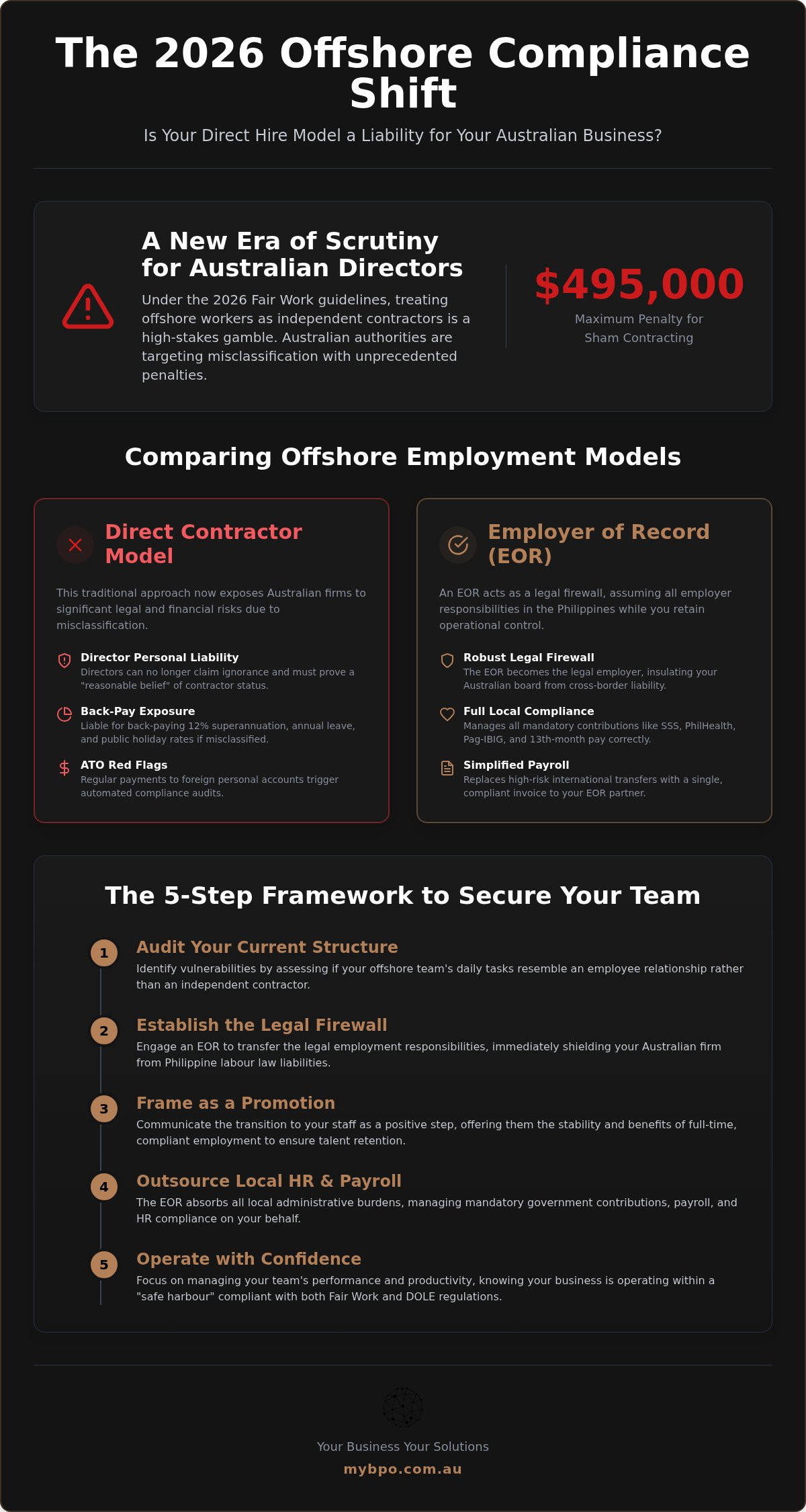
The financial consequences of misclassification are severe. Under current March 2026 guidelines, sham contracting penalties have reached $19,800 for individuals and $99,000 for small businesses. For companies with 15 or more staff, the penalty is the greater of $495,000 or triple the underpayment amount. This is why many firms are now proactively transfering direct offshore hires to EOR arrangements to mitigate these liabilities before they attract official notice.
ATO 2026 and the scrutiny of foreign payments
The Australian Taxation Office (ATO) has prioritised the characterisation of payments to foreign individuals in its 2026 compliance roadmap. Regular, recurring transfers that resemble a standard salary trigger automated red flags, especially when those payments are made directly to personal bank accounts in the Philippines. Auditors no longer focus on the wording of your contract; they look at the “substance of the relationship” to determine if PAYG withholding should have been applied. A permanent establishment risk occurs when an Australian firm’s continuous business activities in the Philippines through a direct hire trigger local corporate tax obligations for the Australian parent entity.
Sham contracting penalties in the Australian context
The Fair Work Ombudsman investigates over 12,000 businesses for misclassification annually. If an offshore worker is deemed an employee, the Australian firm is liable for back-paying the 12% Superannuation Guarantee, unpaid annual leave, and public holiday rates. The “control test” is the primary tool used here: if you control how, when, and where the work is done, the law views that person as an employee. To resolve this, engaging an Employer of Record (EOR) creates a legal barrier. By transfering direct offshore hires to EOR arrangements, the EOR becomes the legal employer in the Philippines, absorbing the statutory risks while you retain operational control.
The Closing Loopholes reforms have shifted the burden of proof for Australian directors. You can no longer claim you were simply unaware of the worker’s legal status; you must prove you “reasonably believed” the worker was a genuine contractor. This shift toward personal liability makes the transition to a compliant structure an urgent priority for anyone managing a remote Philippine workforce.
What is an EOR Arrangement and How Does it Shield You?
An Employer of Record (EOR) serves as a robust legal firewall in a foreign jurisdiction. When transfering direct offshore hires to EOR arrangements, you’re effectively outsourcing the legal identity of the employer. MyBPO acts as the registered entity in the Philippines, assuming all statutory responsibilities under the Department of Labour and Employment (DOLE). You retain full control over daily tasks, KPIs, and performance management, but the legal liability for the worker’s employment status shifts entirely to us.
This tripartite relationship bridges the gap between Australian business expectations and Philippine labour law. Without this bridge, Australian firms often find themselves vulnerable to criminal, civil, and/or administrative judgments when foreign hiring practices are scrutinised by global or local authorities. By utilising an EOR, you move from a high-risk “service agreement” to a compliant employment contract that is recognised and protected by both jurisdictions. It is the most effective way to maintain a Philippine team while keeping your Australian board insulated from cross-border liability.
The mechanics of the Employer of Record
The transition involves replacing vague international service agreements with locally compliant employment contracts. In the Philippines, this means mandatory contributions to SSS, PhilHealth, and Pag-IBIG are handled at the source. We ensure that the mandatory 13th-month pay is calculated accurately and administered on time, preventing the common payroll errors that often trigger DOLE audits. If you want to secure your team’s future, exploring a structured EOR model is the most logical step for long-term stability.
Why a “Safe Harbour” matters for your board
For an Australian board, the primary concern is risk mitigation. Transferring staff to an EOR arrangement means the risk of wrongful dismissal claims or labour disputes is absorbed by the local entity. We also provide robust intellectual property protections within the local contracts, ensuring your proprietary data remains secure under Philippine law. This proactive approach helps you avoid the sham contracting Philippines risk that currently threatens many direct-hire models. By transfering direct offshore hires to EOR arrangements, you establish a “safe harbour” that protects both your intellectual capital and your financial standing.
Comparing Direct Hire vs. EOR Arrangements
The perceived cost savings of a direct hire model often evaporate when businesses account for the administrative overhead and the inherent risks of non-compliance. While a direct contractor might appear cheaper on a monthly invoice, this “lean” approach leaves Australian firms responsible for every facet of local management. By transfering direct offshore hires to EOR arrangements, you trade the unpredictability of manual management for a fixed, transparent service structure. This transition shifts the burden of operational security from your internal HR team to a dedicated local partner.
Scalability remains the most significant hurdle for firms stuck in the direct hire trap. Managing one or two contractors via bank transfers is manageable, albeit risky; however, scaling to a team of ten or twenty requires a level of local infrastructure that most Australian SMEs cannot justify building themselves. An EOR arrangement provides the only secure pathway for rapid expansion, offering a plug-and-play model where new staff can be onboarded within a fully compliant framework in days rather than months.
The hidden costs of direct offshore management
Direct management involves significant internal hours spent on manual international payroll and the constant navigation of currency fluctuations. Beyond the hours lost, there is the tangible cost of turnover. Philippine talent increasingly seeks the security of local benefits, including health insurance and pension contributions. When these are absent, high-performing staff often migrate to competitors who offer formal employment. Understanding how to manage payroll Philippines for Australian companies is critical, as it involves more than just sending a net salary; it requires precise calculation of statutory tax and social security obligations.
Infrastructure and physical presence
Data security is a primary concern in the direct hire model, where the “Bring Your Own Device” (BYOD) approach is common. A staff member working from a laptop in a bedroom lacks the enterprise-grade security, redundant internet, and power backups found in a professional environment. The difference between this isolated setup and a dedicated workspace Philippines is profound. By transfering direct offshore hires to EOR arrangements, you can often access equipment leasing and on-the-ground IT support. This physical presence doesn’t just protect your data; it fosters a professional culture that significantly improves staff retention and long-term productivity.
The 5-Step Process for Transferring Staff to an EOR
Successfully transfering direct offshore hires to EOR arrangements requires a methodical approach that balances legal precision with clear communication. This is not a mere administrative swap; it is a migration from a high-risk contractor model to a formalised employment structure. To ensure a clean break from previous liabilities, Australian firms should follow a structured five-step framework.
- Audit and Assessment: Review all existing contractor agreements to identify vulnerabilities, such as “control test” failures or lack of intellectual property protection.
- Consultation: Engage with your Philippine staff to explain the transition. Framing this as a “promotion” to formal employment helps maintain morale and retention.
- Documentation: Issue new, Philippine-compliant employment contracts and NDAs that honour local labour codes while protecting your Australian business interests.
- Onboarding: Integrate staff into the EOR’s local payroll system, ensuring all statutory contributions are registered with the correct government agencies.
- Go-Live: Finalise the termination of the old service agreement and commence the new tripartite arrangement, establishing your legal firewall.
If you are ready to secure your workforce against future audits, request a compliance audit from our Brisbane office to begin your transition.
Communicating the change to your Philippine team
The success of transfering direct offshore hires to EOR arrangements often hinges on how the change is perceived by the workers. For most Philippine professionals, moving from a “freelance” status to formal employment is a significant upgrade. You should highlight the immediate benefits, such as access to HMO (health insurance), security of tenure, and the peace of mind that comes with correct statutory contributions. While some staff may have concerns about tax withholding impacting their take-home pay, explaining the long-term benefits of the 13th-month pay and retirement savings usually resolves these anxieties.
Administrative handover and data migration
The technical phase of the migration involves gathering essential employee data for Philippine government filings. This includes SSS, PhilHealth, and Pag-IBIG numbers, along with updated tax identification details. We work with you to set up a new payroll schedule that aligns with your Australian business cycles while remaining compliant with local semi-monthly pay requirements. It is also a critical time to verify that all intellectual property and confidentiality clauses are robustly defined in the new local contracts, ensuring your proprietary data remains protected under both Australian and Philippine jurisdictions.
Why MyBPO is the Safe Harbour for Australian Firms
MyBPO operates as a vigilant guardian for Australian businesses navigating the complexities of international employment law. Unlike global platforms that rely on abstract algorithms and automated support tickets, we maintain a physical presence in both Brisbane and the Philippines. This dual-jurisdiction footprint ensures that when you’re transfering direct offshore hires to EOR arrangements, you have local accountability at both ends of the operation. We understand the specific intersection of Australian Fair Work standards and Philippine DOLE regulations, providing a specialised “compliance shield” that generic providers cannot match.
Our position as a specialist in the employer of record Australia market allows us to speak your language and understand the legal pressures you face as an Australian director. We don’t just facilitate payments; we absorb the local employer liability in the Philippines, allowing you to focus on growth while we secure your operational integrity. If you fail to establish this legal firewall, your business remains exposed to the full weight of 2026 sham contracting penalties.
The MyBPO difference: Local accountability
In a regulatory crisis, having an Australian director to call makes the difference between a resolved issue and a legal catastrophe. We provide on-the-ground support in Manila and Bacolod, ensuring your workforce is managed within a professional environment that respects local customs while upholding Australian corporate standards. We handle the heavy lifting of Philippine labour law, from managing mandatory SSS contributions to navigating complex termination protocols. This hands-on approach mitigates the risk of local labour disputes that often plague direct-hire models, providing a level of security that digital-only portals simply cannot provide.
Next steps for your offshore team
Securing your business against 2026 ATO and Fair Work scrutiny begins with a clear understanding of your current exposure. We recommend requesting a confidential compliance audit to evaluate the status of your existing hires and identify any hidden vulnerabilities in your current contractor agreements. A typical transition when transfering direct offshore hires to EOR arrangements takes between two to four weeks, depending on the size of your team and the complexity of your current setup. This timeline is designed to ensure zero downtime for your operations while providing total regulatory immunity. Contact our Brisbane office today to discuss your 2026 risk mitigation strategy and discover how we can provide the safe harbour your business requires for secure offshore expansion.
Secure Your Philippine Workforce for the Long Term
The 2026 regulatory environment has fundamentally changed the rules for managing remote talent. Relying on outdated independent contractor agreements now exposes Australian directors to significant financial penalties and personal liability under the Closing Loopholes Act. By transfering direct offshore hires to EOR arrangements, you replace these vulnerabilities with a robust legal firewall that satisfies both the ATO and Philippine labour authorities. This strategic shift ensures your business remains insulated from the complexities of cross-border employment law.
As an Australian-owned and operated specialist with physical offices in Brisbane, Manila, and Bacolod, MyBPO provides the local oversight necessary to navigate these shifting jurisdictional boundaries. We are specialists in 2026 ATO compliance, managing the heavy lifting of payroll, statutory contributions, and local labour codes on your behalf. This allows you to retain your high-performing talent while eliminating the operational risks associated with direct offshore payments.
Don’t leave your offshore operations to chance in an era of increased scrutiny. Secure your offshore team with MyBPO EOR services today and establish the safe harbour your business needs to thrive. We are ready to help you protect your assets and your people with the confidence of a seasoned compliance partner.
Frequently Asked Questions
Is it legal to hire staff in the Philippines as independent contractors?
It is only legal to hire Philippine staff as contractors if the worker meets strict criteria for genuine independent contracting under both Australian and Philippine law. In practice, most remote roles fail this test because the Australian firm exercises significant control over the worker’s daily tasks and methods. If the relationship functions like employment, the law views it as employment regardless of what the contract title says.
How much does it cost to transfer a direct hire to an EOR arrangement?
The cost of transfering direct offshore hires to EOR arrangements typically involves a service fee on top of the worker’s gross salary and statutory contributions. While we don’t provide fixed pricing without a specific audit, the investment is offset by the elimination of potential Fair Work penalties and the reduction in internal administrative hours. This structure replaces unpredictable risks with a transparent, fixed monthly management cost.
Will my staff lose their seniority or benefits if we switch to an EOR?
No, staff generally gain superior benefits and can retain their seniority through a properly structured transition. We often frame the move as a promotion to a formalised role that includes mandatory health insurance (HMO) and pension contributions. This transition actually increases staff retention by providing the long-term security and tenure that a standard freelance agreement lacks.
Does the Fair Work Act apply to my staff in the Philippines?
Yes, the Fair Work Act can extend to offshore workers if the employment contract was formed in Australia or if the worker is deemed an employee of an Australian entity. Recent 2026 guidelines suggest that the substance of the relationship takes precedence over the worker’s physical location. This makes a compliant EOR structure essential for mitigating domestic legal risks and Fair Work Ombudsman scrutiny.
What are the penalties for sham contracting with offshore workers in 2026?
As of March 2026, civil penalties for sham contracting are $19,800 for individuals and $99,000 for small businesses with fewer than 15 employees. Larger organisations face fines of at least $495,000 or triple the underpayment amount. Intentional wage theft can also lead to criminal penalties of up to 10 years imprisonment, making the risk of direct hire models untenable for Australian directors.
How does an EOR handle the Philippine 13th-month pay?
An EOR manages the calculation and timely disbursement of the 13th-month pay as a mandatory statutory requirement under Philippine law. This payment, which is equivalent to one month’s basic salary, must be paid to employees by 24 December each year. We ensure this is factored into your regular billing to prevent unexpected year-end cash flow issues for your Australian firm.
Can an EOR help with equipment leasing and office space for my team?
Yes, MyBPO provides integrated equipment leasing and dedicated workspaces in Manila and Bacolod as part of our core service suite. Moving staff from a home-based setup to a professional, secure office environment significantly improves data security and productivity. It also ensures your team has redundant internet and power, which are critical for maintaining operational stability in the Philippines.
What happens if a labour dispute arises in the Philippines under an EOR?
The EOR absorbs the legal responsibility for the dispute as the registered employer of record in the Philippines. We navigate the local Department of Labour and Employment (DOLE) protocols and mediation processes on your behalf. This provides a compliance shield that protects your Australian directors from being personally drawn into foreign legal proceedings or complex wrongful dismissal claims.
Need a strategy session?
Tell us about your team and we will map out the right structure, fixed-cost quote included.
Book a call