Blog
Cost to Hire a Full-Time Employee in the Philippines: The 2026 Australian Guide

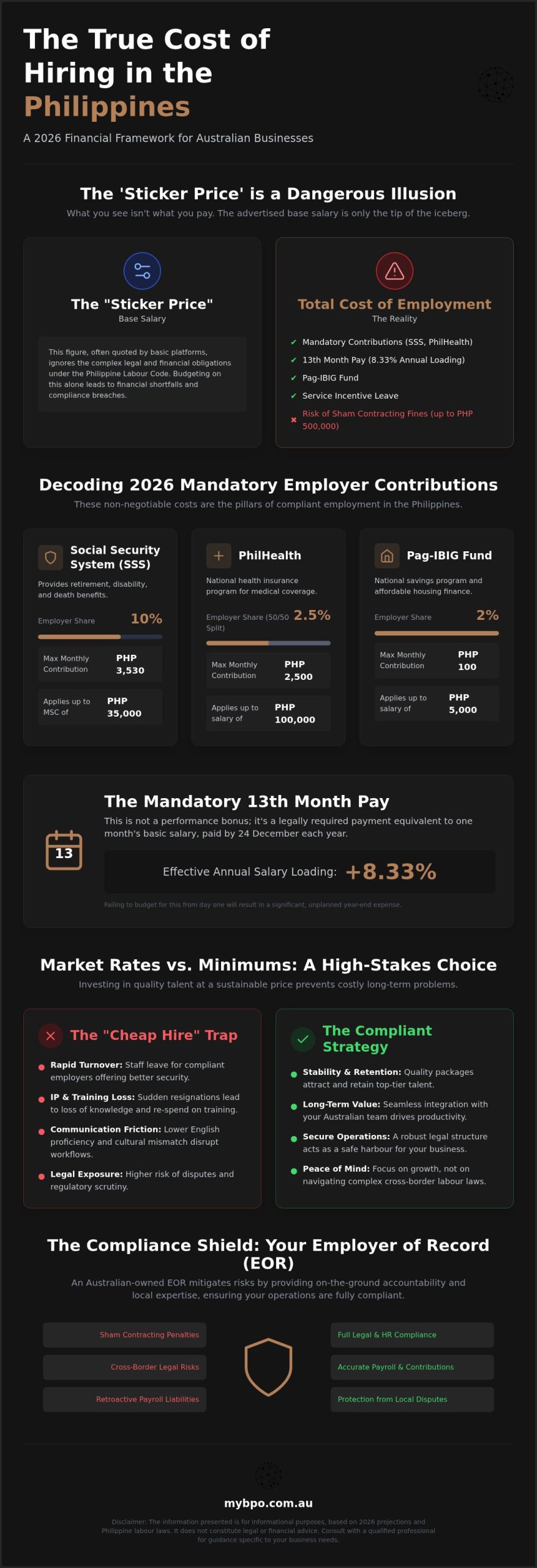
The “sticker price” of offshore labour is often a dangerous illusion that leaves Australian directors exposed to severe legal liabilities. If you’re calculating your budget based solely on a base salary, you’ve likely overlooked the mandatory 10% employer SSS contribution and the 13th-month pay requirements that are non-negotiable under Philippine law. Miscalculating these figures doesn’t just hurt your bottom line; it invites regulatory scrutiny and potential penalties for sham contracting that can reach up to PHP 500,000 per violation.
We understand the pressure to scale your Australian business efficiently without triggering Fair Work penalties or falling into the trap of hidden BPO markups. This guide delivers a definitive financial framework for the cost to hire a full time employee in philippines in 2026, providing the clarity you need to secure high-quality talent while maintaining a robust compliance shield. We’ll break down the specific employer contributions, from PhilHealth premiums to Pag-IBIG funds, and outline how a specialised Employer of Record structure protects your Australian entity from cross-border risks.
Key Takeaways
- Distinguish between the advertised base salary and the actual Total Cost of Employment (TCOE) to ensure your financial forecasts remain accurate and sustainable.
- Access the 2026 mandatory contribution rates for SSS, PhilHealth, and Pag-IBIG to precisely calculate the cost to hire full time employee in philippines.
- Identify the legal triggers for sham contracting and learn how to mitigate the risk of retroactive payroll liabilities and Australian Fair Work penalties.
- Factor in essential Philippine benefits like 13th-month pay and service incentive leave to build a transparent and legally compliant remuneration package.
- Leverage an Australian-owned Employer of Record (EOR) model to secure your offshore operations with on-the-ground accountability and local expertise.
Why the ‘Sticker Price’ of Philippine Labour is Only Half the Story
Relying on daily minimum wage figures is the fastest way to compromise your offshore strategy. While some platforms cite rates as low as 610 PHP per day, these figures apply to agricultural or entry-level retail roles that don’t align with the skilled professional services Australian firms require. The legal framework established by the Philippine Labour Code dictates that employment is more than just a simple exchange of hours for cash; it’s a structured relationship with built-in financial obligations that many Australian directors fail to recognise until a dispute arises.
The 2026 economic landscape for offshore staffing is defined by a flight to quality. As the Philippine market matures, the gap between “cheap” labour and “compliant” labour has widened. Investing in a robust legal structure isn’t an unnecessary overhead; it’s a “Compliance Premium” that protects your Australian entity from the fallout of local labour disputes. When you calculate the cost to hire full time employee in philippines, you aren’t just buying hours. You’re securing a legal safe harbour for your operations.
The Distinction Between Basic Pay and Gross Compensation
A standard Philippine offer letter is far more complex than its Australian counterpart. It often includes a mix of basic salary and de minimis benefits, which are small, non-taxable allowances designed to cover rice, laundry, or medical expenses. While these allowances are tax-efficient for the employee, they still form part of your total cash outlay. You must also account for the 13th-month pay, which is a mandatory statutory requirement equivalent to one month’s salary, not a discretionary performance bonus. If your budget doesn’t account for this 8.33% annual loading from day one, your financial forecasts will be fundamentally flawed.
Market Rates vs. Statutory Minimums
Hiring at the absolute bottom of the market is a high-risk strategy that almost always results in recruitment re-spend. In 2026, professional benchmarks for VAs, accountants, and developers are driven by global demand rather than local minimums. There’s a direct correlation between salary levels and English proficiency; top-tier talent expects a package that reflects their ability to integrate seamlessly with Australian teams. Choosing a “cheap” hire often leads to:
- Rapid turnover as staff leave for compliant employers.
- Loss of intellectual property during sudden resignations.
- Hidden costs in training and onboarding replacements.
- Poor communication that creates friction in your Australian workflow.
Securing high-quality staff at a sustainable price requires a transparent Total Cost of Employment (TCOE) framework that prioritises stability over the lowest possible hourly rate.
Mandatory Statutory Contributions: Decoding the Philippine Labour Code
The legal framework for employment in the Philippines is designed around mandatory social protections that every Australian employer must respect. Unlike the Australian superannuation system, where contributions are often handled through a single clearing house, the Philippine system requires monthly remittances to three distinct government agencies. Failing to manage these correctly doesn’t just disrupt your staff’s access to healthcare; it creates a significant liability for your business. The cost to hire full time employee in philippines must account for these three pillars to ensure your operations remain above board.
SSS, PhilHealth, and Pag-IBIG: The 2026 Rates
The Social Security System (SSS) is the most substantial contribution. As of 2026, the total contribution rate is 15% of the Monthly Salary Credit (MSC). The employer share is fixed at 10%, with a maximum monthly employer contribution capped at PHP 3,530. This cap applies when an employee reaches the maximum MSC of PHP 35,000. If your staff earn above this threshold, your contribution remains capped, but you must still remit the full amount on time to avoid penalties.
Healthcare is managed through the Philippine Health Insurance Corporation (PhilHealth). For 2026, the premium rate is 5% of the monthly basic salary, which is split equally between the employer and the employee. With an income ceiling of PHP 100,000, your maximum monthly liability for PhilHealth is PHP 2,500. Finally, the Home Development Mutual Fund (Pag-IBIG) requires a 2% employer contribution. This is capped at a maximum fund salary of PHP 10,000, making your monthly obligation a modest but mandatory PHP 200.
The 13th-Month Pay and Bonus Structures
One of the most common budget oversights for Australian firms is the 13th-month pay. This is not a discretionary performance bonus; it’s a statutory requirement under the National Wages and Productivity Commission guidelines. You must pay every rank-and-file employee 1/12th of their basic annual salary on or before 24 December each year. For budgeting purposes, you should accrue this at a rate of 8.33% of the basic salary every month. If you hire someone mid-year, they are still entitled to a pro-rata payment based on the months they have served.
Beyond these cash payments, you must factor in Service Incentive Leave (SIL). Employees who have rendered at least one year of service are entitled to five days of paid leave. While many professional firms offer more generous packages to remain competitive, these five days are the legal minimum. Managing these complex calculations requires precision; our Australian-owned EOR services absorb this administrative burden, ensuring every cent is accounted for and every deadline is met.
The Hidden Financial Sting of Sham Contracting and Misclassification
Paying an offshore worker via PayPal or a freelance marketplace might seem like a streamlined shortcut, but it creates a dangerous “shadow payroll” for your Australian organisation. In 2026, the Australian “Closing Loopholes” legislation has significantly narrowed the definition of an independent contractor, focusing on the practical reality of the working relationship rather than the label on the contract. If your Philippine staff work exclusively for you, use your equipment, and follow your set hours, the Fair Work Commission likely views them as employees. This misclassification doesn’t just skew your cost to hire full time employee in philippines; it creates a direct line of liability to your Australian directors.
The “sticker price” of a freelancer often ignores the catastrophic costs of a regulatory audit. When you bypass a formal Employer of Record (EOR) structure, you leave your business exposed to jurisdictional gaps where neither Australian nor Philippine labour laws are fully satisfied. This lack of structural integrity is a significant operational risk that can lead to the freezing of offshore operations during a legal dispute. Protecting your bottom line requires more than just a low hourly rate; it requires a compliance shield that absorbs these cross-border complexities.
Australian Regulatory Reach: The Fair Work Factor
The Fair Work Factor is no longer limited by geographic borders. Australian courts are increasingly willing to look through offshore arrangements to identify sham contracting. If a worker is deemed an employee under Australian law, you’re liable for unpaid entitlements, including superannuation and leave, regardless of where the staff member is physically located. The financial penalties for sham contracting are severe, often reaching hundreds of thousands of dollars per violation. For a deeper look at these specific dangers, read our specialist guide on Exposing the Sham Contracting Philippines Risk.
The Cost of Litigation and Back-Pay
Disputes often arise when a relationship ends, and the financial fallout is rarely limited to a single jurisdiction. If a terminated “contractor” files a claim with the Philippine Department of Labor and Employment (DOLE), you may be forced to pay years of retroactive contributions to the Social Security System (SSS), PhilHealth, and Pag-IBIG. These back-payments are often accompanied by administrative fines of up to PHP 500,000 per breach.
Beyond payroll, there’s the catastrophic risk of Intellectual Property (IP) theft. If your contract is deemed invalid because the underlying employment relationship was illegal, your ownership of the code, designs, or sensitive data your staff produced is on shaky ground. An unenforceable contract is a hidden cost that can devalue your entire Australian entity. Securing your IP requires a compliant EOR framework that ensures all work-for-hire provisions are legally binding in both the Philippines and Australia.
Calculating Total Cost of Employment (TCOE): A 2026 Framework
To accurately forecast the cost to hire full time employee in philippines, Australian directors must move beyond the basic salary and adopt a comprehensive Total Cost of Employment (TCOE) framework. A common error is budgeting solely in Australian Dollars without accounting for the volatility of the Philippine Peso. If the AUD weakens, your fixed offshore costs in local terms effectively rise, potentially squeezing your margins or leading to salary dissatisfaction if the staff’s purchasing power drops. A resilient 2026 budget accounts for this fluctuation by setting a buffer for exchange rate movement.
The TCOE formula is a logical sequence: Basic Salary + Statutory Contributions + De Minimis Benefits + Infrastructure + Management Overhead. Amortising the initial recruitment and onboarding costs over the first twelve months provides a more realistic view of the investment. This structured approach ensures that you aren’t just hiring a worker but securing a sustainable operational unit that integrates seamlessly with your Australian team.
Infrastructure and Equipment Leasing
Providing your staff with consumer-grade hardware is a false economy. Consumer laptops lack the necessary security features and durability for professional remote work, leading to increased downtime and data breaches. To mitigate this risk, enterprise-grade equipment leasing ensures your team has the tools required for high-stakes professional services. Physical security is equally paramount; a dedicated workspace in the Philippines provides the controlled environment needed to protect sensitive Australian client data and ensure consistent “uptime” regardless of local infrastructure challenges.
Management and Support Overhead
The “Management Tax” is the often-ignored cost of your Australian team’s time spent on foreign HR, payroll, and administrative disputes. If your senior managers are busy navigating Philippine labour laws instead of growing your business, the true cost of your offshore hire is significantly higher than any payroll figure suggests. A professional Employer of Record (EOR) absorbs this administrative burden, providing on-the-ground HR support that secures the relationship between you and your staff. This local presence ensures that operational issues are resolved before they escalate into legal liabilities or lead to high turnover.
To secure a transparent and predictable budget for your offshore expansion, you can request a detailed TCOE breakdown from our Australian specialist team today.
Securing Your Bottom Line with a Compliant EOR Partnership
The decision to expand into the Philippines shouldn’t be a gamble on regulatory compliance or budget predictability. An Employer of Record (EOR) serves as a vital circuit breaker between your Australian entity and the complexities of foreign employment law. By engaging a specialised partner, you effectively transfer the operational and legal risks of international staffing. This model ensures that the cost to hire full time employee in philippines remains a fixed, transparent line item in your monthly accounts rather than a fluctuating liability prone to statutory surprises.
A professional EOR partnership absorbs the administrative burden of payroll, tax remittances, and mandatory benefit management. If a regulatory change occurs in 2026, it’s the EOR’s responsibility to implement those changes and ensure total compliance. This proactive risk mitigation acts as a form of insurance, protecting your Australian directors from the personal liability associated with labour breaches or misclassification. You gain the freedom to focus on strategic output while your partner secures the structural integrity of your offshore team.
The MyBPO Advantage: Australian Ownership
Navigating cross-border employment requires a partner that speaks both languages of business: Australian regulatory expectations and Philippine operational reality. Our Australian-owned and operated structure simplifies every aspect of legal and tax communication. You aren’t dealing with an abstract digital platform; you’re partnering with a local ally that understands the high stakes of Australian business culture. For a deeper analysis of how this structure facilitates secure growth, consult our Employer of Record Australia Guide.
Moving from Cost-Centric to Value-Centric Offshoring
True ROI in offshore staffing is found in workforce stability and high-performance output. When your Philippine staff feel secure, well-supported, and legally protected, their productivity increases and turnover drops. This stability eliminates the hidden costs of constant recruitment and knowledge loss. A compliant EOR partnership transforms your offshore operation from a simple cost-saving exercise into a value-centric engine for Australian business growth. By providing dedicated workspaces and enterprise-grade equipment leasing, we ensure your team has the physical and digital security required to excel.
Ready to secure your offshore expansion with a transparent financial framework? Contact MyBPO for a customised Philippine hiring cost breakdown and discover the true value of a compliant, high-performance workforce.
Future-Proofing Your Offshore Strategy in 2026
Navigating the AU-PH corridor requires a shift from simple cost-saving to long-term structural security. You now understand that the true cost to hire full time employee in philippines includes mandatory statutory contributions and the essential 13th-month pay. Neglecting these details or misclassifying staff under Australian “Closing Loopholes” legislation creates a shadow payroll that puts your entire organisation at risk. By adopting a Total Cost of Employment framework, you protect your directors and ensure your offshore team remains stable and productive.
MyBPO acts as your Australian-owned compliance shield, providing the physical on-the-ground support and specialised EOR expertise necessary for secure expansion. We manage the complexities of local labour codes and equipment leasing so you can focus on scaling your business with confidence. It’s time to move beyond the uncertainty of unregulated hiring and build a high-performance workforce that is legally sound and financially transparent. Secure your offshore expansion with a MyBPO cost analysis today and take the first step toward a more resilient business model.
Frequently Asked Questions
Is the 13th-month pay mandatory for all employees in the Philippines?
Yes, the 13th-month pay is a non-negotiable statutory requirement for all rank-and-file employees who have worked for at least one month. It’s equivalent to one-twelfth of the employee’s basic salary earned within a calendar year. You must complete this payment by 24 December. It isn’t a discretionary performance bonus, so failing to include this 8.33% loading in your annual budget will lead to significant financial and legal friction.
How much should I budget for Philippine statutory contributions in 2026?
For 2026, you must factor in three primary contributions. The employer’s share for SSS is 10%, capped at PHP 3,530 monthly. PhilHealth premiums are 5% of the basic salary, with the employer paying half, capped at PHP 2,500. Pag-IBIG requires a 2% employer contribution, capped at PHP 200. These mandatory payments are essential components when calculating the total cost to hire full time employee in philippines for your 2026 financial forecasts.
Can I pay my Philippine staff in Australian Dollars (AUD)?
While you might prefer paying in AUD, Philippine labour laws generally require payroll to be processed in Philippine Pesos (PHP) to facilitate accurate statutory deductions. Paying in AUD exposes your staff to exchange rate volatility, which can lead to salary dissatisfaction if the peso strengthens. A compliant Employer of Record structure typically allows you to pay a single AUD invoice while they manage the local currency conversion and tax remittances on your behalf.
What happens if I misclassify a Philippine employee as a contractor?
Misclassification carries severe financial and legal consequences. You face administrative fines from the Department of Labor and Employment of up to PHP 500,000 per violation. Additionally, you’re liable for retroactive payments of all missed SSS, PhilHealth, and Pag-IBIG contributions, plus back wages. Corporate officers may also face criminal liability and imprisonment. This “shadow payroll” risk makes using a compliant EOR far more cost-effective than attempting to manage contractors via digital platforms.
Do Australian Fair Work laws apply to staff working in the Philippines?
Yes, Australian Fair Work laws can apply if the “Closing Loopholes” legislation deems the relationship to be employment rather than contracting. Australian courts focus on the practical reality of the work performed, such as control over hours and use of equipment. If a worker is deemed an employee under Australian law, you may be liable for unpaid superannuation and leave entitlements, regardless of their physical location in the Philippines.
What is the average salary for a Virtual Assistant in the Philippines in 2026?
Professional Virtual Assistant salaries in 2026 depend heavily on specialised skills and English proficiency. While entry-level roles exist at lower rates, experienced VAs who can integrate with Australian professional services firms expect competitive packages that reflect their value. You must budget for more than just the base salary; the cost to hire full time employee in philippines includes the 13th-month pay and statutory contributions that top-tier talent requires for long-term stability.
Are there hidden taxes when sending money to the Philippines for payroll?
Hidden costs often include intermediary bank fees and unfavourable exchange rate spreads that erode the value of the transfer. There are also administrative costs associated with filing monthly tax returns and remittances to multiple Philippine government agencies. Without a local entity or an EOR partner to consolidate these processes, these small fees and the time spent on manual compliance can significantly increase your total operational overhead beyond the base payroll amount.
How does an Employer of Record (EOR) simplify the cost of hiring?
An EOR simplifies your financial landscape by consolidating all payroll, tax, and statutory obligations into a single, predictable monthly fee. They act as the legal employer on the ground, absorbing the risks of misclassification and handling all local compliance requirements. This structure provides your Australian business with legal certainty and on-the-ground accountability, ensuring that your offshore expansion is protected from the complexities of foreign labour codes and administrative bottlenecks.
Need a strategy session?
Tell us about your team and we will map out the right structure, fixed-cost quote included.
Book a call