Blog
Bringing Your Philippine Team to Australia: A Visitor Guide

Bringing your offshore team to your home office is a powerful strategic lever for cohesion, but a single administrative oversight can transform a morale-boosting visit into a regulatory nightmare. Many Australian directors find themselves asking, can you philippine team visting your australian office without inadvertently breaching Department of Home Affairs regulations or triggering unforeseen tax liabilities? You likely recognise that face-to-face interaction is the most effective way to align company culture, yet the legal stakes of cross-border movement require a vigilant and protective approach.
This guide provides a structured roadmap to help you navigate the complexities of the Subclass 600 Business Visitor stream while shielding your enterprise from accidental Permanent Establishment risks. We will detail the essential visa pathways, current 2026 processing timelines, and the specific compliance strategies needed to secure a seamless transition. By understanding the jurisdictional boundaries and the AUD250.00 application requirements, you can mitigate operational friction and ensure your team’s visit remains a secure platform for collaboration rather than a source of liability.
Key Takeaways
- Identify the Subclass 600 Business Visitor stream as the primary legal pathway for conducting meetings and training without breaching Department of Home Affairs regulations.
- Address the core compliance query, “can you philippine team visting your australian office,” by distinguishing between permitted business visitor activities and prohibited local employment.
- Protect your enterprise from accidental “Permanent Establishment” tax triggers and Fair Work liabilities through rigorous cross-border compliance planning.
- Optimise the visit’s impact by designing a structured itinerary that focuses on professional development and building cultural bridges between your offices.
- Leverage an Employer of Record (EOR) framework to absorb jurisdictional risks and secure a safer, more predictable experience for your offshore staff.
Is it Possible for Your Philippine Team to Visit Australia? The Short Answer
The short answer is a definitive yes. Philippine staff can visit your Australian premises for legitimate business purposes, provided the engagement is structured within the correct regulatory framework. Many directors find themselves asking, can you philippine team visting your australian office without legal blowback? While the process is straightforward for those who prepare, it requires a vigilant approach to compliance. Australia and the Philippines share a long history of bilateral cooperation, which facilitates these commercial exchanges. However, the Department of Home Affairs and the Australian Taxation Office (ATO) maintain strict oversight. If a visit is misclassified or poorly documented, the Australian entity faces significant liability and potential scrutiny.
The Strategic Value of an Australian Office Visit
Distance often creates a digital wall that obscures company culture and slows down complex projects. Bringing offshore staff to your Australian headquarters effectively breaks this barrier. It allows for high-intensity training and knowledge transfer that digital platforms cannot replicate. During these visits, teams can even access formal vocational development through the Apeiro Institute to further align their skills with Australian standards. Physical presence fosters genuine team culture and builds a level of trust that Zoom calls simply don’t afford. When staff feel like integral, recognised members of the local team, retention rates improve. It’s an investment in human capital that pays dividends in long-term operational stability. You aren’t just flying in a contractor; you’re integrating a vital part of your organisation’s engine into its home base.
Defining “Business Visitor” Activities
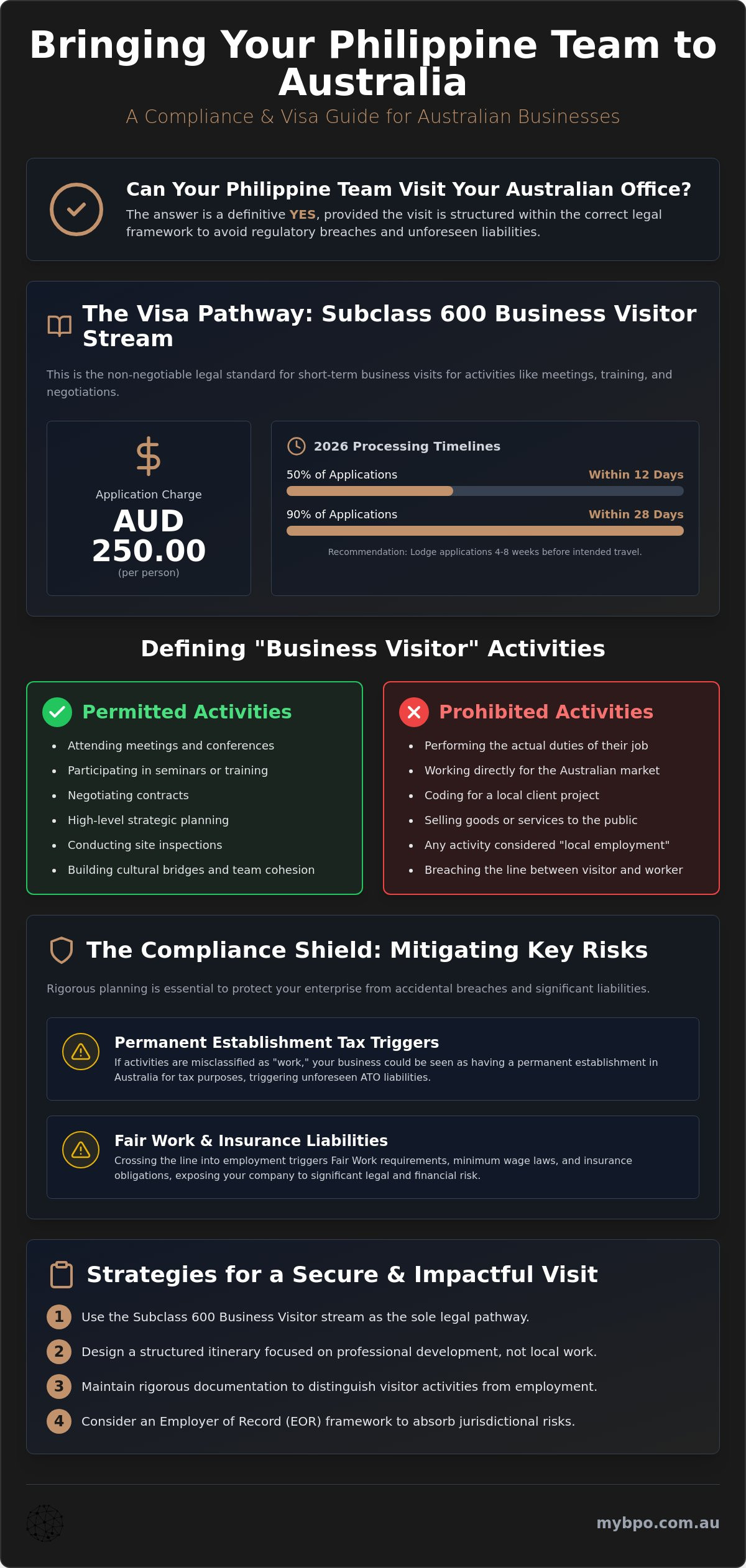
The distinction between a visitor and a worker is sharp and non-negotiable. A business visitor is permitted to attend meetings, negotiate contracts, or participate in seminars and trade fairs. They can also engage in site inspections or high-level strategic planning. They must not perform the actual duties of their job for the Australian market while on the ground. If an offshore developer starts coding for a local client while sitting in a Melbourne office, they’ve crossed the line into work. This triggers Fair Work requirements and potential tax issues. Precise definitions are the only way to secure your compliance shield. You must ensure the itinerary reflects only permitted activities to avoid triggering accidental employment liabilities. If you are questioning, can you philippine team visting your australian office, you must first verify that their planned activities align with these strict definitions.
By establishing clear jurisdictional boundaries, you protect both the business and the individual. The goal is to facilitate a productive visit that remains entirely compliant with Australian law. This requires a sequential approach to visa selection and documentation, which we will explore in the following sections.
Navigating the Visa Landscape: The Subclass 600 Business Visitor Stream
Securing the right entry permit is the most critical hurdle in the travel process. For Australian directors asking, can you philippine team visting your australian office, the Subclass 600 Business Visitor visa is the non-negotiable standard. This specific stream is designed for short-term stays where the primary purpose is to engage in business activities like meetings, negotiations, or attending seminars. As of early 2026, the base application charge is AUD250.00 per person. While the process is structured, it is not guaranteed. Success hinges on providing definitive proof that the visitor has a genuine intention to stay temporarily and possesses strong incentives to return to the Philippines after the visit.
Current 2026 data indicates that processing times have stabilised, with 50% of applications decided within 12 days and 90% within 28 days. Despite these efficient windows, you should lodge applications at least four to eight weeks before the intended travel date. Refusals for Philippine applicants often stem from a perceived lack of “genuine temporary entrant” status. This occurs when the Department of Home Affairs is not convinced of the applicant’s financial stability or their ties to their home country. A formal, detailed Letter of Invitation from your Australian entity is the most powerful tool to mitigate this risk. It must clearly outline the professional necessity of the visit and the specific activities planned.
Step-by-Step Visa Application Process
The application begins with collating evidence of the staff member’s employment status and personal circumstances in the Philippines. You must draft a compliant invitation letter that serves as a protective document, detailing a day-to-day itinerary that strictly avoids “work” activities. All documentation is managed through the online ImmiAccount portal, where precision in data entry is vital. Additionally, you must ensure each applicant has adequate health insurance for their stay. Australian medical costs are high, and ensuring coverage is a basic requirement of your duty of care as a responsible employer.
The Role of the EOR in Visa Documentation
Managing this process alone often leads to administrative friction and increased risk. A specialist employer of record Australia provides the necessary employment verification that carries weight with immigration authorities. By leveraging a local Philippine presence, an EOR can assist staff with their biometric appointments and ensure all Philippine labour laws are respected during the travel period. This partnership acts as a compliance shield, absorbing the logistical burden and ensuring that when you ask, can you philippine team visting your australian office, the answer is supported by a secure, legal framework. If you are unsure about the current jurisdictional requirements, seeking guidance from a local ally like MyBPO can prevent costly application errors.
The Compliance Shield: Managing Tax, Fair Work, and Insurance Risks
The logistical ease of booking a flight often masks the significant jurisdictional risks involved in cross-border travel. When you evaluate the question, can you philippine team visting your australian office, the focus must shift from travel logistics to legal protection. A visiting staff member is not just a guest; they are a potential trigger for Australian employment law and tax liabilities. Without a robust compliance shield, your business could inadvertently find itself answering to the Fair Work Ombudsman or the ATO for a visit intended only for training. If you are still asking, can you philippine team visting your australian office, you must consider the insurance gap. Standard Philippine health insurance rarely covers Australian workplace accidents. You must confirm that your Workers Compensation and Professional Indemnity policies extend to offshore staff while they are physically present in your office.
Compliance begins with ensuring the visit remains strictly within the bounds of a Visitor visa (subclass 600). If the visitor performs core business tasks, they may be entitled to Australian minimum wages and conditions. This risk is amplified for those using independent contractors. In the eyes of Australian authorities, an offshore contractor performing work in a local office looks remarkably like an employee, which can lead to severe penalties for the host company.
Avoiding the “Sham Contracting” Trap During Visits
Using independent contractors significantly heightens your exposure during an office visit. Bringing a contractor into your physical workspace, providing them with a desk, and giving them equipment can easily be interpreted as a move toward a local employment relationship. This increases the sham contracting Philippines risk. MyBPO mitigates this by acting as the legal employer of record, absorbing these liabilities and maintaining the necessary jurisdictional separation. We ensure the distinction between your offshore provider and a local employee remains legally sound throughout their stay.
Tax Implications and “Permanent Establishment”
Permanent Establishment (PE) is perhaps the most overlooked risk in cross-border collaboration. If a senior Filipino staff member makes significant business decisions while in Australia, the ATO may argue your company has created a taxable presence for that offshore entity. To prevent this, ensure all activities are “preparatory or auxiliary” in nature. While the 183-day rule is a common threshold for tax residency, PE risks can trigger much sooner if the staff member has the authority to conclude contracts. Maintaining a clear, documented itinerary that focuses on internal collaboration rather than revenue-generating client work is your best defence against accidental tax triggers.
Designing an Effective Visit: Itinerary Planning and Cultural Exchange
A successful visit requires more than just a granted visa; it demands a meticulously structured itinerary that balances corporate objectives with human connection. While the legal framework protects your enterprise, the quality of the visit determines the long-term ROI of the initiative. When directors ask, can you philippine team visting your australian office, they must also ask how they will manage the transition from a digital relationship to a physical one. An unguided visit often leads to “culture shock” or burnout, which can diminish the very motivation you sought to build. You must set clear expectations and KPIs for the visit before the team departs Manila to ensure every hour spent in the Australian office serves a strategic purpose.
Practical logistics are the foundation of a stress-free experience. Secure accommodation that is centrally located or has straightforward access to public transport. You should provide your team with pre-loaded travel cards, such as an Opal or Myki, and a brief guide on local navigation. Be mindful of the significant temperature differences between the Philippines and Australian cities like Melbourne or Sydney, especially during winter. Providing guidance on appropriate clothing is a simple yet effective way to demonstrate your duty of care and protect your team’s well-being.
Structuring the Office Experience
The office experience should facilitate deep integration across your entire organisation. Don’t limit interactions to direct managers; instead, organise “meet and greets” with all departments to break down functional silos. Shadowing sessions are particularly valuable, as they allow Philippine staff to observe the “Australian way” of doing business, from communication nuances to project management styles. You must ensure the visiting team has a dedicated workspace within your office. This provides them with a sense of belonging and ensures they remain productive during their stay, rather than feeling like temporary guests at a communal table. For organisations wanting to host a truly premium Australian experience, a corporate outing with Neptune Oceanic provides a unique opportunity to build bonds outside the traditional workspace.
Cultural Integration Beyond the Desk
True cohesion often happens during the informal moments of the Australian workday. Introduce your team to local office rituals, such as the morning “coffee run” or casual Fridays. When planning team-building activities, ensure they are inclusive and respect the cultural and dietary preferences of your Filipino staff. You should also encourage a “reverse cultural exchange” where the Philippine team shares insights into their local market and culture. This reciprocal approach validates their expertise and strengthens the bridge between your two offices. To ensure your team’s visit is supported by a robust and secure employment framework, consider how our Employer of Record services can simplify your offshore management.
Finally, manage the “return to home” transition with care. The period immediately following a visit is a high-risk time for disengagement if the staff member feels a sudden loss of connection. Schedule a formal debrief upon their return to Manila to discuss how they will implement their new learnings and maintain the momentum generated during their time in Australia.
How MyBPO Facilitates Safe Cross-Border Team Integration
MyBPO serves as the “Safe Harbour” for Australian enterprises navigating the complexities of international mobility. When you ask, can you philippine team visting your australian office, the answer depends entirely on the strength of your compliance framework. We provide the structural integrity needed to move staff between jurisdictions without exposing your business to unnecessary risk. Our dual presence in Australia and the Philippines means we don’t just advise from a distance; we manage the reality of the move on the ground in both countries. This physical representation allows us to absorb the jurisdictional burdens that typically fall on the Australian director.
One of the most complex aspects of a visit is the financial management of travel stipends and allowances. Using our payroll Philippines for Australian companies service ensures that all payments remain compliant with local labour laws while satisfying Australian reporting requirements. This prevents accidental tax triggers and ensures that your team is supported financially without creating a “Permanent Establishment” for your firm. By centralising these payments through our secure EOR framework, you maintain a clear audit trail and protect your company from the scrutiny of both the ATO and the Bureau of Internal Revenue.
The MyBPO Advantage: Local Knowledge, National Reach
Our team provides on-the-ground support in the Philippines long before your staff board their flight. We facilitate the necessary biometric appointments and verify all employment documentation to ensure a high probability of visa success. Because we are an Australian-owned and operated company, we understand the specific expectations of the Department of Home Affairs. We act as your vigilant guardian, monitoring regulatory shifts in both jurisdictions so you can focus on the strategic outcomes of the visit. Whether it’s ensuring equipment leasing remains active or coordinating dedicated workspace requirements, we secure the entire transition. This local ally approach ensures that when you ask, can you philippine team visting your australian office, the logistical response is as robust as the legal one.
Starting the Journey
Planning your team’s first Australian visit begins with a thorough assessment of your current compliance posture. Our experts evaluate your team’s readiness and help define the permitted business activities that will form the basis of your invitation letter. We assist in drafting EOR-backed documentation that carries the professional weight required by immigration authorities. This structured approach mitigates the risk of visa refusals and ensures your team arrives ready to contribute to your local operations.
To secure your offshore operations and begin planning a successful face-to-face collaboration, contact MyBPO today. We provide the expertise and local presence needed to scale your Philippine team with confidence, total legal protection, and operational freedom.
Securing Your Cross-Border Collaboration
Transitioning from digital collaboration to physical integration is a significant organisational milestone that requires a vigilant approach to jurisdictional boundaries. By correctly navigating the Subclass 600 Business Visitor stream and implementing a compliance shield against tax and employment risks, you transform a complex logistical challenge into a strategic advantage. While the initial query for many directors is can you philippine team visting your australian office, the true measure of success is the integrity of your legal and operational framework.
MyBPO, as an Australian-owned and operated specialist in the AU-PH employment corridor, provides the physical presence and expertise needed to manage these risks in both countries. We act as your guardian, ensuring every visit is secure, compliant, and productive. Our team absorbs the administrative burden, allowing you to focus on building genuine team cohesion and long-term offshore success. Secure your offshore team’s future and plan your first Australian visit with MyBPO today. We look forward to helping you bridge the distance and build a more cohesive, integrated global team.
Frequently Asked Questions
Can my Philippine staff work on their usual tasks while visiting the Australian office?
No, they cannot perform their standard operational duties for the Australian market. Business visitor visas are strictly for activities such as attending meetings, negotiating contracts, or participating in professional training. If a staff member performs their regular “work” while on Australian soil, it triggers a breach of visa conditions and may expose your firm to Fair Work liabilities.
How long can a Philippine team member stay in Australia on a Business Visitor visa?
Most Business Visitor stream visas allow for a stay of up to three months per entry. While the visa itself may be valid for up to 12 months, individual stays are typically capped to ensure the visitor remains a temporary entrant. Staying for extended periods can also increase the risk of triggering accidental tax residency or permanent establishment issues for your company.
Does the Australian company have to pay Australian minimum wage during the visit?
You don’t need to pay the Australian National Minimum Wage if the staff member is only performing permitted business visitor activities. However, if they cross the line into performing actual work, they may be entitled to the current minimum rate of $26.44 per hour. When asking, can you philippine team visting your australian office, you must ensure their itinerary remains strictly within the “visitor” definition to avoid these wage triggers.
What happens if a staff member’s visa is refused?
If a visa is refused, the Department of Home Affairs provides a formal letter outlining the specific reasons, which often relate to insufficient proof of ties to the Philippines. You can choose to lodge a new application with more robust evidence or address the specific concerns raised. MyBPO assists by providing the necessary employment verification and documentation to support a more successful reapplication.
Who is responsible for the travel insurance and health cover of the visiting staff?
The Australian host company or the Employer of Record is responsible for ensuring the visitor has comprehensive health and travel insurance for the duration of their stay. Standard Philippine health policies rarely cover the high costs of the Australian medical system. You must secure specific inbound travel insurance to protect both the individual and your business from unforeseen medical liabilities.
Can I bring my entire Philippine team at once, or should I stagger the visits?
Staggering visits is the recommended strategy for maintaining operational continuity and reducing visa risk. Bringing a large group simultaneously can sometimes trigger higher scrutiny from immigration authorities regarding the genuine nature of the visit. Moving smaller groups allows you to provide better integration and ensures your Philippine operations continue to function without interruption.
Will bringing my offshore team to Australia trigger any extra tax obligations for my business?
Yes, a visit can trigger tax obligations if the staff member’s activities create a “Permanent Establishment” for your business in the eyes of the ATO. This risk is particularly high when senior staff make significant commercial decisions or conclude contracts while physically in Australia. When considering, can you philippine team visting your australian office, you should ensure all activities are preparatory or auxiliary in nature.
How much notice should I give MyBPO before planning a team visit?
You should provide at least four to eight weeks of notice before a planned team visit. This timeframe allows for the current visa processing window, which typically takes between 12 and 28 days for the Subclass 600 Business Visitor stream. Early notice ensures we can secure all necessary employment documentation and compliance checks before your team boards their flight.
Need a strategy session?
Tell us about your team and we will map out the right structure, fixed-cost quote included.
Book a call