Blog
How to Build Trust with Remote Filipino Employees: The 2026 Australian Business Guide

What if the sudden resignations or “ghosting” incidents that haunt many offshore partnerships aren’t a failure of talent, but a direct consequence of a structural trust deficit? For many Australian business owners, building trust with remote filipino employees is often undermined by a persistent anxiety regarding transparency and daily operations. You likely recognise that while the talent pool in the Philippines is vast, the distance can create a disconnect that leaves your operations vulnerable to communication breakdowns and unexpected turnover.
Securing a high-performing team that operates as a seamless extension of your Australian office requires a shift from digital surveillance to a framework of cultural alignment and legal security. This 2026 guide provides the authoritative strategy you need to mitigate jurisdictional risks and anchor your staff through physical infrastructure. We will explore the structural protections necessary to satisfy Australian compliance while ensuring your Philippine-based team feels valued, secure, and deeply integrated into your business culture. By moving beyond abstract digital platforms, you can establish a stable partnership that reduces recruitment costs and provides total operational peace of mind.
Key Takeaways
- Understand cultural drivers like “Utang na Loob” and “Hiya” to transform feedback loops and secure genuine long-term loyalty from your offshore staff.
- Recognise that building trust with remote filipino employees begins with structural security, including compliant employment contracts and mandatory benefit contributions.
- Leverage physical infrastructure and dedicated workspaces to mitigate the operational risks and lack of transparency associated with unstable home-based environments.
- Implement a “no-blame” communication framework to encourage transparency and prevent the concealment of critical errors common in high-context cultures.
- Utilise an Australian-owned Employer of Record to absorb jurisdictional liability and provide a secure, professional anchor for your Philippine operations.
Understanding the Cultural Pillars of Trust in the Philippines
Trust in a remote environment is often viewed through the narrow lens of software and surveillance, yet for Australian businesses, the real foundation lies in understanding core cultural values. Successful partnerships aren’t merely transactional; they’re built on deeply held societal norms that dictate how loyalty is earned and maintained. When you ignore these cultural undercurrents, you risk creating a disconnect that leads to the very communication breakdowns and “ghosting” you seek to avoid.
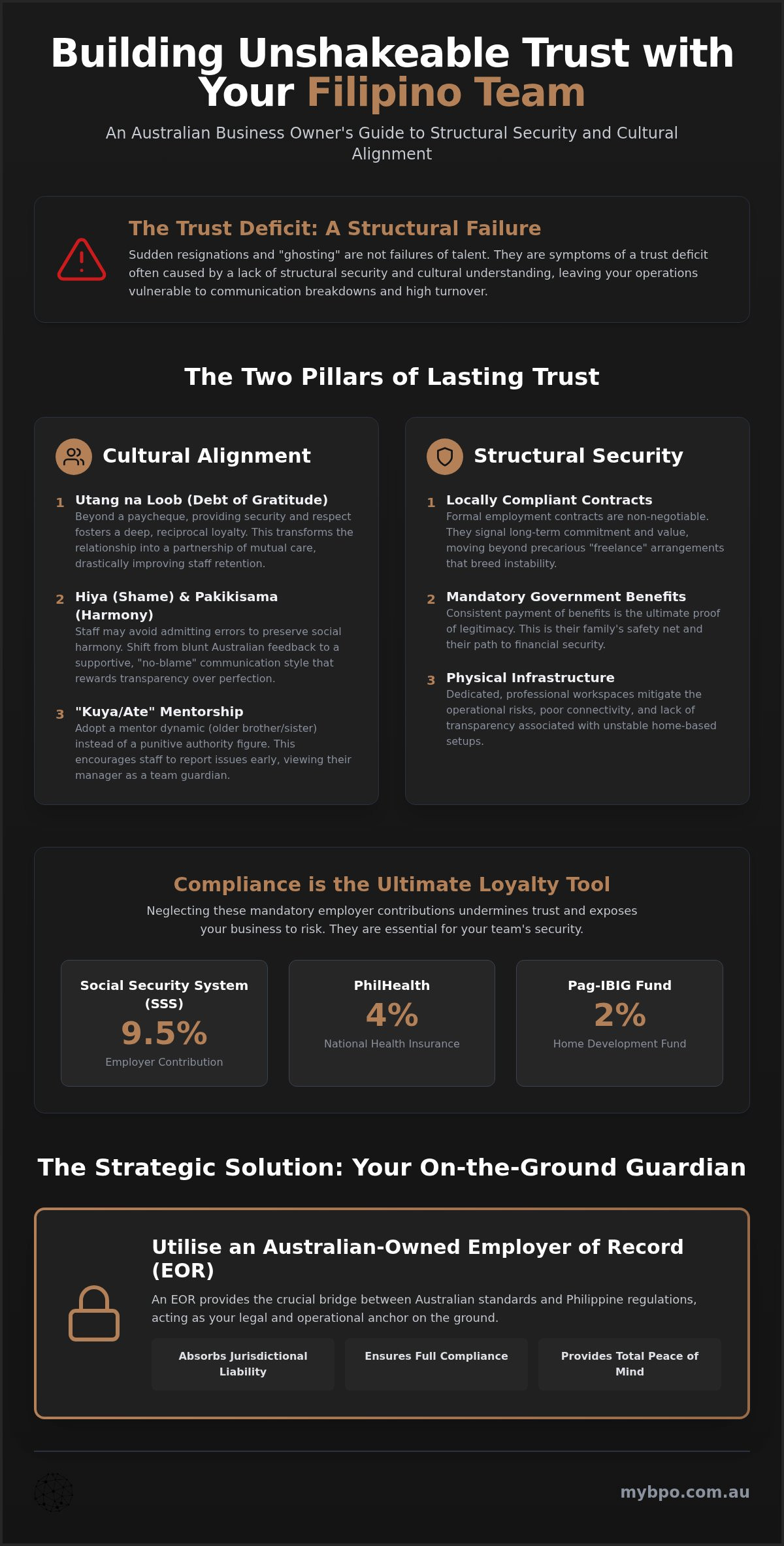
One of the most critical concepts is Utang na Loob, or a debt of gratitude. In the Philippine workplace, this translates to a profound sense of reciprocal loyalty. If an Australian employer provides security, respect, and fair treatment beyond a simple paycheque, the employee feels a moral obligation to return that support through high performance and long-term commitment. This is a powerful tool for building trust with remote filipino employees, as it shifts the relationship from a simple exchange of labour for money into a partnership of mutual care.
Conversely, the concept of Hiya (shame or embarrassment) can create significant operational risks if not managed correctly. Because preserving social harmony, or Pakikisama, is a cultural priority, Filipino staff may avoid direct confrontation or hesitate to admit mistakes to avoid causing “face” issues for themselves or their manager. While Australians value blunt, direct feedback, this can be perceived as aggressive or disrespectful. Bridging this gap requires a move away from the “tell it like it is” approach toward a more nuanced, supportive style of communication that rewards transparency over perfection.
The Role of Hierarchy and Respect
Filipino society places high value on hierarchy, which often manifests as a reluctance to challenge a superior’s decision. This mindset can lead to silence even when a project is at risk. Mitigating this requires a deliberate effort to create a safe harbour for feedback. By adopting the “Kuya” (older brother) or “Ate” (older sister) dynamic, managers can foster a mentorship-based environment. This structural shift encourages staff to report issues early, as they view the manager as a guardian of the team’s collective success rather than a punitive authority figure.
Bridging the Social Gap Digitally
Building trust with remote filipino employees requires moving beyond transactional emails. Trust isn’t built on Jira tickets; it’s established through genuine social integration. In the Philippines, the workplace is often viewed as an extension of the family unit. Acknowledging personal milestones, such as birthdays or family achievements, is a strategic trust-builder. Virtual town halls should be utilised to celebrate wins across both the Australian and Philippine offices. This creates a unified culture where offshore staff feel like an integral part of the business rather than a disconnected resource.
Structural Trust: Why Compliance is the Ultimate Loyalty Tool
Trust is often perceived as an emotional outcome of good leadership. However, in the Philippine context, trust is fundamentally anchored in structural security. When an Australian firm engages staff through informal “freelance” arrangements, it unintentionally signals a lack of permanence. Building trust with remote filipino employees begins with the provision of a legitimate, locally compliant employment contract. This document serves as more than a legal formality; it’s a statement of intent that the worker is a valued, long-term member of the organisation rather than a disposable resource.
Legitimacy is verified through the consistent payment of mandatory government contributions. These include the Social Security System (employer contribution of 9.5%), PhilHealth (4%), and the Pag-IBIG Fund (2%). For a Filipino employee, these benefits represent their family’s health safety net and their path to home ownership. When an employer neglects these, the relationship becomes fragile. Successfully navigating business challenges in the Philippines requires a partner that understands these local nuances. An Employer of Record Australia provides this exact bridge, ensuring all statutory obligations are met with precision.
The 13th Month Pay and Financial Security
The 13th-month pay is a statutory requirement in the Philippines, traditionally paid by December 24th. It’s not a discretionary bonus. It is a critical component of the employee’s annual compensation that they rely on for family obligations. Australian firms that fail to account for this, or pay it late, quickly earn a “fly-by-night” reputation. Adhering to this cycle demonstrates financial stability and professional respect. This compliance directly correlates with reduced turnover, as staff feel their financial future is secure with a reliable partner.
Mitigating Risks for the Australian Business
The 2026 Australian regulatory environment, specifically the implications of the Closing Loopholes Act, has increased the scrutiny on how offshore workers are classified. Engaging in a sham contracting Philippines risk creates a culture of transience where staff feel no obligation to protect your interests. Beyond loyalty, this structure secures your intellectual property. By using a local Philippine entity to hold contracts, you ensure your IP rights are enforceable within the local jurisdiction. You can secure your offshore operations by partnering with an Australian-owned specialist that absorbs these jurisdictional liabilities on your behalf.
Operational Transparency through Physical Infrastructure
While cultural intelligence and legal compliance form the bedrock of a partnership, trust is frequently eroded by the practical realities of a remote environment. In the Philippines, residential infrastructure often lacks the stability required for high-stakes Australian operations. Frequent power outages and fluctuating internet speeds create a “black box” where managers are left wondering if a disconnection is a technical failure or a lack of engagement. Building trust with remote filipino employees requires removing this ambiguity through tangible, physical infrastructure.
A dedicated workspace Philippines provides the professional anchor necessary to eliminate these operational blind spots. By moving staff from a home-based setup into a managed office, you secure access to high-speed fibre-optic redundancy and industrial-grade power backups. This shift transforms the relationship from one of constant verification to one of assumed reliability. It allows the Australian business owner to focus on strategic growth, confident that the physical environment supports, rather than hinders, daily productivity.
Professionalism Beyond the Screen
Isolation is a significant driver of turnover in the remote sector. A managed office environment mitigates the “lonely worker” syndrome by providing a community of peers and a structured professional setting. This environment signals that the employee is part of a real organisation, not just an anonymous contractor behind a laptop. A physical office also provides a controlled environment for sensitive Australian data, ensuring your business information isn’t exposed in unsecure residential settings. This layer of physical security is a critical component of your overall risk management strategy.
Equipment Leasing and Tech Support
The “Bring Your Own Device” (BYOD) model is a common point of failure for offshore teams. It introduces security vulnerabilities and leaves the employee responsible for their own tech support, leading to preventable downtime. Providing high-quality leased equipment is a powerful signal of investment in the employee’s success. When you provide the right tools from day one, you establish a standard of excellence and professional respect. On-the-ground tech support ensures that any issues are resolved immediately, maintaining the momentum of your operations and reinforcing the “compliance shield” through company-managed, secure devices.
How to Organise Your Communication for Maximum Trust
Communication is the operational artery of your offshore partnership. Without a structured cadence, the distance between Australia and the Philippines quickly transforms from a geographical gap into a strategic vulnerability. Building trust with remote filipino employees requires a communication framework that prioritises transparency over surveillance. If your staff feel monitored rather than supported, they will naturally retreat into a defensive posture, often concealing errors until they become critical failures.
Establishing a “No-Blame” culture is the most effective mitigation strategy against the concealment of mistakes. By shifting the focus from individual error to systemic improvement, you encourage staff to report issues early. This transparency must be reinforced through daily huddles that move beyond simple task lists. Dedicate time to discussing “wins” alongside “blockers”. This practice ensures that the team feels their contributions are visible and valued, reducing the fear of negative repercussions.
Ambiguity is a primary driver of mistrust in any remote environment. You must implement clear, documented KPIs that provide an objective basis for performance reviews. When expectations are codified, employees feel secure in their standing and understand exactly how their success is measured. Using collaborative tools like Slack or Trello allows for real-time visibility without the need for micromanagement, allowing you to optimise your remote management with precision and professional gravity.
The Power of Video in Building Bonds
Text-based communication lacks the nuance required for high-stakes feedback. In a remote setting, a poorly worded email can be misinterpreted as a severe reprimand, triggering a “Hiya” response that stalls productivity. Encouraging a “camera-on” policy for huddles helps humanise the relationship, though it shouldn’t be enforced with aggressive rigidity. For asynchronous feedback, video messages provide the tone and context that text cannot. These sessions allow you to deliver complex instructions or critiques while maintaining a supportive, advisory tone that protects the relationship.
Feedback Loops and Performance Management
Effective feedback loops must be both consistent and culturally sensitive. Constructive criticism should always be delivered in private one-on-one sessions, focusing on career pathing and skill development rather than just past mistakes. This approach protects the employee’s dignity while addressing performance gaps. Conversely, recognition should be public. Rewarding loyalty and high performance in front of the team is a powerful motivator in Filipino culture, reinforcing the collective sense of achievement and strengthening the bond between the Australian office and the offshore team.
The MyBPO Advantage: Your On-the-Ground Trust Guardian
For an Australian business owner, the primary barrier to building trust with remote filipino employees is the lack of physical presence. You cannot personally verify the integrity of a workspace or navigate the complexities of local labour codes from your Australian base. MyBPO serves as your vigilant on-the-ground representative, bridging the gap between Australian professional expectations and the operational realities of the Philippines. We don’t just facilitate a digital connection; we provide a tangible management structure that protects your interests and your team.
Effective offshore recruitment Philippines requires a foundation of mutual trust from the very first interview. When candidates see an established Australian-owned entity with a physical office and local management, it signals a level of stability that freelance platforms cannot match. This local presence is your best insurance against “ghosting” or disengagement. If a staff member faces a challenge, they have a local management team to turn to, ensuring issues are resolved before they impact your business.
A Local Ally for Your Remote Team
Digital platforms are inherently transactional and often fail to capture the cultural nuances essential for long-term loyalty. Our local HR teams provide the human touch that digital dashboards cannot replicate. We handle local grievances, manage cultural friction, and provide a safe harbour for both parties. This local intervention prevents minor misunderstandings from escalating into resignations. You retain the authority over the work, while we absorb the burden of local relationship management and operational risk.
Securing Your Future Growth
Scaling an offshore team is only viable when the foundation is legally and operationally sound. By utilising our EOR services, you gain the peace of mind that comes from total payroll Philippines for Australian companies compliance. We ensure every tax obligation and benefit contribution is met, shielding you from jurisdictional liability and the risks associated with the 2026 Closing Loopholes Act. This structural integrity allows you to focus on high-level strategy rather than administrative complexities. Secure your offshore team with MyBPO today to establish a high-performing, loyal extension of your Australian office.
Securing Your Competitive Advantage Through Structural Integrity
The transition from a transient freelance arrangement to a stable, high-performing offshore team requires more than just better software. It demands a deliberate strategy that aligns cultural intelligence with robust legal protections. By respecting the nuances of Philippine values and providing the structural security of a compliant employment contract, you transform a remote resource into a loyal partner. We’ve established that physical infrastructure and transparent communication are not just operational preferences; they are the essential safeguards that protect your Australian business from turnover and compliance risks.
Building trust with remote filipino employees is significantly more effective when you have a vigilant on-the-ground guardian to navigate local complexities. MyBPO provides this essential bridge as an Australian-owned and operated specialist. With physical offices in Brisbane, Manila, and Bacolod, we offer comprehensive EOR and equipment leasing solutions that absorb your jurisdictional liability. You can now move forward with the professional gravity and peace of mind required to scale your international operations successfully.
Secure your offshore team and build lasting trust with MyBPO. Your business deserves the protection of a partner that understands both worlds.
Frequently Asked Questions
Is it harder to build trust with Filipino employees than with Australian staff?
Building trust is not necessarily more difficult, but it requires a distinct cultural approach. While Australian staff often build trust through direct task completion, Filipino employees prioritse social harmony and relationship-building. If you fail to acknowledge the human element or milestones, the trust-building process may take longer. Establishing a personal connection early is the most effective way to secure genuine loyalty and long-term commitment.
How does the “Hiya” concept affect honest communication in remote teams?
The concept of “Hiya,” or shame, can lead employees to avoid admitting mistakes or seeking clarification to prevent embarrassment for themselves or their manager. This often results in project delays if not proactively managed. You must create a “no-blame” environment where reporting a hurdle is viewed as a professional strength. This structural shift encourages transparency and ensures that operational risks are identified before they escalate.
Can providing a physical office in the Philippines really improve staff loyalty?
Yes, a physical office provides a level of structural stability that home-based setups cannot match. It signals a long-term commitment to the employee’s career and offers a professional environment with reliable redundancy for power and internet. This tangible investment is a critical factor in building trust with remote filipino employees, as it distinguishes your business from transient, “fly-by-night” operators who lack local infrastructure.
What are the biggest red flags that trust is breaking down with an offshore worker?
Sudden drops in communication, missed huddles, or uncharacteristic delays in responding to messages are primary indicators of disengagement. If an employee becomes overly formal or stops sharing updates on “wins” and “blockers,” they may be feeling disconnected or unsupported. Addressing these signs early through a private, supportive one-on-one session is essential to prevent the relationship from deteriorating into a sudden resignation or “ghosting” incident.
How do I handle performance issues without damaging the relationship?
Performance issues must be handled privately and framed as a collaborative path toward professional growth. Focus on objective, documented KPIs rather than personality traits to avoid triggering a defensive response. By positioning yourself as a mentor invested in their success, you preserve the employee’s dignity while maintaining the high standards required for your Australian operations. This approach reinforces trust even during difficult corrective conversations.
Does the Fair Work Act apply to my remote staff in the Philippines?
The Fair Work Act generally does not apply to offshore staff who are not Australian residents. However, you are legally obligated to comply with the Philippine Labour Code. Failure to meet local statutory requirements, such as mandatory contributions or holiday pay, can lead to severe legal complications and a total loss of trust. Ensuring local compliance is the only way to secure your operations against jurisdictional risks.
Why is an Employer of Record (EOR) better for building trust than direct hiring?
An EOR provides a legitimate local structure that direct hiring often lacks. It ensures that staff receive all statutory benefits, secure contracts, and professional HR support in their own jurisdiction. This structural legitimacy is a primary driver of building trust with remote filipino employees, as it guarantees their employment rights are protected by an Australian-owned entity with a physical, on-the-ground presence in the Philippines.
What role does the “13th-month pay” play in employee trust and retention?
The 13th-month pay is a non-negotiable statutory requirement that Filipino workers rely on for significant family obligations in December. Paying this accurately and on time demonstrates your reliability and respect for local labour laws. Neglecting this payment, or treating it as a discretionary bonus, is one of the fastest ways to erode trust and encourage your best talent to seek employment with more compliant competitors.
Need a strategy session?
Tell us about your team and we will map out the right structure, fixed-cost quote included.
Book a call