Blog
How to Switch EOR Providers: A Seamless Australian Guide
If you believe that switching your offshore payroll is simply a matter of migrating data between software platforms, you are exposing your firm to a significant regulatory minefield. For many Australian businesses, the initial appeal of a faceless global aggregator quickly fades when hidden exchange rate markups and unresponsive call centres begin to impact the bottom line. Transfering EOR providers is not merely an administrative update; it is a strategic exercise in risk mitigation that requires a deep understanding of both Fair Work requirements and Philippine labour codes.
We understand the anxiety that stems from the Closing Loopholes Act and the persistent threat of sham contracting labels. You need more than a digital interface; you require a “safe harbour” that absorbs your operational liability and provides genuine on-the-ground support. This guide will teach you how to navigate the complexities of transferring EOR providers for your Philippine team while ensuring total compliance with Australian and local labour laws. We will outline a structured path to a seamless payroll transition, focusing on how to lower your legal exposure and secure a more transparent, supportive environment for your offshore staff.
Key Takeaways
- Identify why Australian firms are moving away from faceless global aggregators toward corridor specialists who can better manage Fair Work risks and worker classification.
- Execute a structured 5-step framework for transfering EOR providers that prioritises contract audits and “Recognition of Service” agreements to protect your staff.
- Avoid the “Aggregator Trap” by verifying that your provider maintains their own physical Philippine registration with the SEC and DOLE rather than using third-party sub-contractors.
- Ensure financial transparency by eliminating hidden exchange rate markups and securing a clear, itemised breakdown of the total cost of employment.
- Benefit from the security of an Australian-owned partner that offers local Brisbane support and physical infrastructure in Manila and Bacolod to absorb your operational liability.
Why Australian Firms are Transferring EOR Providers in 2026
The era of the faceless global digital aggregator is coming to a close for many Australian SMEs. While these massive platforms offered a quick entry point into the Philippine market, they often lack the jurisdictional depth required to protect an Australian business from local regulatory shifts. Many companies are now transfering EOR providers to secure a partner that understands the specific interplay between Australian Fair Work standards and Philippine labour laws. The shift is driven by a need for structural integrity rather than mere digital convenience.
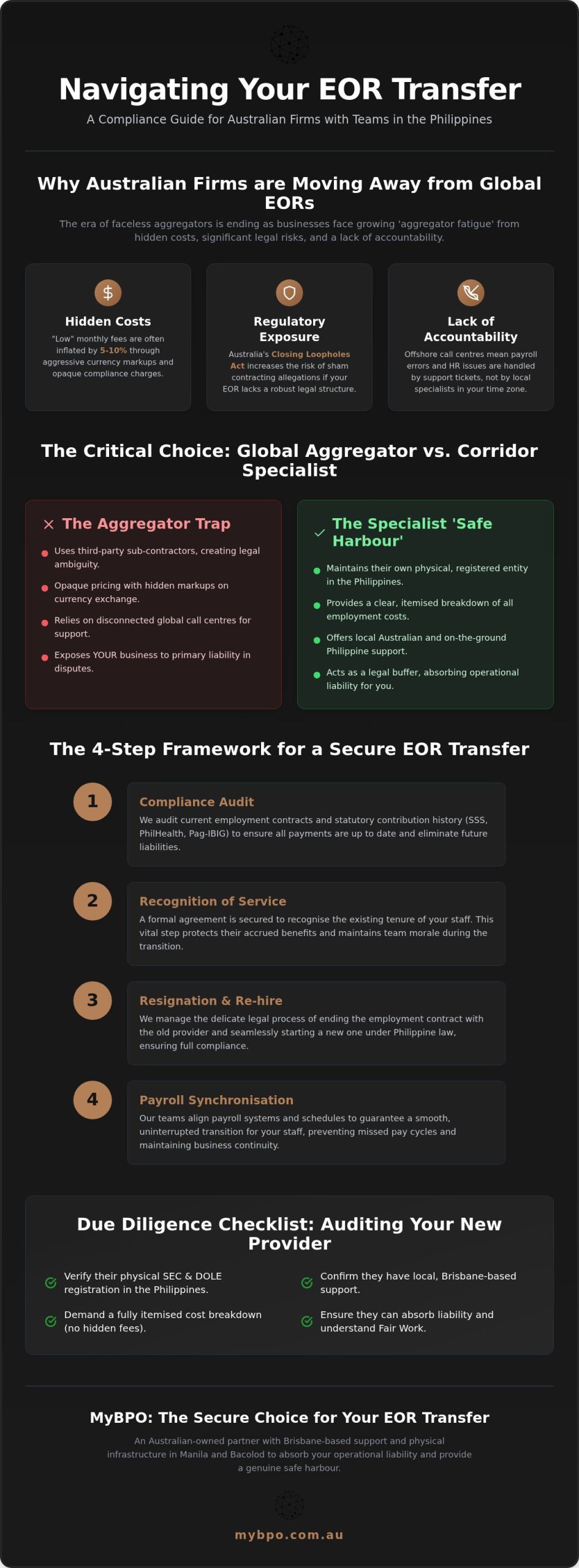
Aggregator fatigue is a growing reality. When a payroll error occurs or a disciplinary issue arises in Manila, a support ticket sent to a call centre in Europe or the United States is insufficient. Australian managers require immediate, local accountability. They are also discovering that the “low” monthly fees advertised by global providers are frequently offset by aggressive currency spread markups and opaque “compliance fees” that only appear on the final invoice. These hidden costs can inflate the total cost of employment by as much as 5 to 10 percent, making the initial price point a deceptive metric.
The Impact of the Closing Loopholes Act on Offshore Staffing
The Australian legal landscape changed significantly with the introduction of the Closing Loopholes Act. This legislation has sharpened the focus on worker classification, increasing the risk that offshore staff could be deemed “common law employees” if the EOR structure is not robust. If your provider does not have a physical presence and a clear legal standing in both Australia and the Philippines, your business remains the primary target for sham contracting allegations.
An Australian-owned EOR acts as a critical legal buffer, absorbing the employer liability that a software-only platform cannot. This protection is vital for firms that want to scale without the constant threat of a Fair Work audit. For a deeper analysis of these specific dangers, read our guide on exposing the sham contracting Philippines risk. Understanding these precedents is the first step in securing your offshore operations.
Operational Friction and the Need for Local Accountability
Managing a team across the AU-PH corridor involves navigating two distinct sets of regulations. If your EOR provider is headquartered in a third country, you are essentially adding a layer of unnecessary complexity. Operational friction is inevitable when your point of contact is asleep during your business hours. This delay can lead to missed payroll deadlines or unresolved staff grievances that damage morale.
A Brisbane-based partner ensures that your HR team can speak with a specialist who understands both the Fair Work Commission’s expectations and DOLE (Department of Labour and Employment) requirements in real time. Transfering EOR providers to a local specialist removes the communication barrier. It provides a “safe harbour” where your business is treated as a priority rather than a ticket number in a global queue. This local presence transforms the EOR from a mere service provider into a protective shield for your business.
The 5-Step Framework for Transferring EOR Providers
Successfully transfering EOR providers requires a methodical approach that prioritises business continuity and legal safety. This is not a simple “lift and shift” operation. It is a transition of legal responsibility that must be handled with surgical precision. To ensure your Philippine team remains productive and compliant, we follow a rigorous five-step framework designed to mitigate the risks inherent in cross-border employment.
- Step 1: The Compliance Audit. We begin by auditing current employment contracts and statutory contribution history. It’s essential to verify that SSS, PhilHealth, and Pag-IBIG payments are up to date to avoid future liability.
- Step 2: Recognition of Service. We secure a formal agreement that recognises the existing tenure of your staff. This protects their accrued benefits and maintains morale during the transition.
- Step 3: Resignation and Re-hire. This stage involves managing the delicate process of ending the contract with the old provider and starting the new one under Philippine law.
- Step 4: Payroll Synchronisation. We align payroll cycles to prevent double-taxation or missed payments. This ensures your staff experience zero financial disruption.
- Step 5: Asset and Data Handover. The final step involves the secure migration of employee data and the physical transfer of company equipment.
If you are concerned about how these steps apply to your specific team, our specialists can help you organise a professional EOR transition that protects your interests.
Navigating the Philippine Resignation and Re-hire Process
The transition of staff in the Philippines is governed by strict procedural requirements. Under local labour law, employees typically observe a 30-day notice period. During this time, they must complete a “clearance” process to ensure all company property is returned and financial obligations are settled. Failing to manage this correctly can lead to delayed final pay and potential grievances.
A critical component of this switch is the calculation of pro-rated 13th-month pay. Your outgoing provider must settle the portion of the 13th-month pay earned up to the date of resignation. For a detailed breakdown of these obligations, refer to our guide on Payroll in the Philippines for Australian Companies. Accurate calculations at this stage are vital for maintaining trust with your offshore team.
Securing Data and Equipment During the Move
Data security is a primary concern when transfering EOR providers. Moving employee records between digital platforms creates a temporary window of vulnerability. We mitigate this by using secure, encrypted migration protocols that ensure no sensitive information is exposed. We also coordinate the physical handover of equipment, which is often a logistical hurdle for global aggregators who lack a local presence.
Having physical infrastructure in Manila and Bacolod allows us to manage hardware transitions directly. Whether your staff use leased equipment or company-owned assets, our on-the-ground teams facilitate the collection, inspection, and redistribution of hardware. This physical oversight reduces the risk of loss or damage and ensures your team has the tools they need to remain operational from day one of the new contract.
Global Aggregators vs. Local Specialists: Which is Safer?
When you are transfering EOR providers, the primary question shouldn’t be about the dashboard interface. It must be about the legal entity that holds the employment contract. Many global aggregators operate as a “thin” software layer, subcontracting the actual employment of your staff to third-party local firms. This “Aggregator Trap” creates a fragmented legal chain where the company you pay is not the company that stands before the Department of Labour and Employment (DOLE) in the Philippines. If a dispute arises, this lack of direct ownership can leave your Australian business exposed to significant liability.
A local specialist in the AU-PH corridor provides a “compliance shield” that global platforms cannot replicate. True liability absorption requires the provider to own the local infrastructure and have a physical presence in both jurisdictions. This ensures that when Fair Work or DOLE raises a query, there is a single, accountable partner to manage the resolution. You aren’t just buying a software subscription; you are securing a partner that understands the professional gravity of cross-border employment and takes on the burden of risk on your behalf.
The difference between a chatbot and a physical Manila office becomes clear during a crisis. A global provider might offer 24/7 support, but that support often comes from a call centre agent with no knowledge of your specific team or the nuances of your industry. In contrast, a specialist with Australian management on-site in the Philippines provides the protective oversight needed to prevent issues before they escalate. This human-centric approach is the only way to navigate the complexities of offshore staffing with total confidence.
The Risk of Subcontracted EOR Services
Provider sprawl is a genuine threat to your operational security. If your EOR subcontracts to a local firm you’ve never vetted, you lose visibility over statutory contributions and contract compliance. This fragmentation increases your vulnerability to sham contracting claims under Australian law. MyBPO’s direct ownership model eliminates this third-party risk by maintaining a single, unbroken legal chain from Brisbane to Manila. We don’t outsource your compliance; we secure it through our own registered entities.
Local Knowledge: Beyond the Software Interface
Software cannot manage a staff grievance or understand how local Philippine cultural nuances impact team productivity. A digital platform is a tool, not a strategy. Having Australian management on-site provides a cultural bridge that ensures your offshore team feels integrated into your business culture. For firms that require the highest level of operational security, a dedicated workspace in the Philippines offers a physical anchor for your staff. This tangible presence is the ultimate safeguard against the faceless nature of global outsourcing, ensuring your team is supported by real people in a professional environment.
Due Diligence Checklist: Auditing Your New EOR Provider
Before you sign a new service agreement, you must perform a rigorous audit of your prospective partner. Transfering EOR providers is a high-stakes transition that requires more than a cursory glance at a sales deck or a digital dashboard. You must demand documented proof of the provider’s physical Philippine business registration through the Securities and Exchange Commission (SEC) and the Department of Labour and Employment (DOLE). Without these specific local registrations, the provider cannot legally employ staff or remit statutory contributions, which leaves your Australian business as the only entity liable for regulatory penalties.
Your audit should also extend to the provider’s Australian footprint. A secure partner will have a local corporate structure and comprehensive professional indemnity insurance that specifically covers cross-border employment risks. This dual-jurisdiction presence ensures that you have a “safe harbour” in Brisbane while your staff are protected in Manila or Bacolod. If a provider cannot produce these credentials, they are likely a digital aggregator rather than a specialist, which significantly increases your operational risk.
To ensure a successful transition, use the following checklist during your selection process:
- Entity Verification: Request copies of SEC and DOLE registration certificates.
- Insurance Coverage: Confirm the provider holds Australian-based liability insurance.
- Financial Integrity: Require a transparent breakdown of the “Total Cost of Employment” with no hidden currency spreads.
- Tenure Protection: Secure a written guarantee that employee seniority and leave balances will be honoured.
If you are ready to move away from opaque pricing and subcontracted services, you can request a compliance audit of your current EOR structure to identify hidden risks and secure your team’s future.
Tenure and Benefit Continuity for Your Team
Resetting an employee’s tenure to zero is a significant risk that often leads to high turnover and legal disputes. If you fail to honour existing leave balances and seniority, you aren’t just damaging morale; you are creating a legal opening for constructive dismissal claims under Philippine law. Your new EOR must be willing to sign a “Recognition of Service” agreement that mirrors each staff member’s original start date. Clear communication is essential here. Your Philippine team needs to feel that their accrued benefits are secure to remain engaged and productive during the changeover.
Financial Transparency and Currency Risks
Transparency is the only effective antidote to the hidden costs prevalent in the global EOR industry. Many providers offer an attractive management fee while quietly profiting from aggressive exchange rate markups on the monthly payroll. You must audit the specific exchange rates used. Total Cost of Employment refers to the comprehensive sum of gross salary, statutory contributions, and management fees, calculated using transparent, mid-market exchange rates without hidden margins or undisclosed compliance surcharges. Understanding this figure is the only way to ensure your offshore operations remain cost-effective and sustainable.
Why MyBPO is the Secure Choice for Your EOR Transfer
Selecting a partner for transfering EOR providers is a decision that dictates your long-term operational stability. MyBPO is an Australian-owned and operated private company that maintains physical representation in both Brisbane and the Philippines. This dual-presence allows us to act as a “safe harbour” for your business, absorbing the legal and operational complexities that global aggregators often leave on your desk. We understand the specific Fair Work risks you face because we operate under the same Australian regulatory framework as your firm.
Our physical infrastructure in Manila and Bacolod provides a tangible anchor for your offshore operations. When you move your team to MyBPO, you are placing them in a professional environment managed by Australian leadership. This direct oversight ensures that your intellectual property is secured and your corporate culture is maintained across borders. We don’t just facilitate payroll; we provide the structural integrity required to scale with confidence. By eliminating third-party subcontractors, we secure a direct legal chain that protects your interests in both jurisdictions.
Direct access to our Brisbane-based leadership ensures that your strategic goals are always aligned with your offshore execution. You are not a ticket number in a global database. You are a partner in a secure, transparent corridor. We take on the burden of risk so you can focus on growth.
Your Vigilant Guardian in the AU-PH Corridor
MyBPO functions as a “compliance shield” by taking on the role of the legal employer in the Philippines. This model effectively mitigates the risk of being deemed a “common law employer” under Australian precedents. On-the-ground support in Manila and Bacolod also means your staff have direct access to HR specialists who understand their local needs and cultural nuances. This presence is vital for employee engagement and retention. For a comprehensive look at how this structure protects your business, see our Employer of Record Australia: The Definitive Guide.
Ready to Make the Switch?
Transfering EOR providers does not have to be a source of operational friction. Our onboarding team handles the “heavy lifting” of contract migration and data transfer, ensuring that no statutory contributions or leave balances are missed. We provide a methodical, step-by-step transition that minimises disruption to your daily operations. If you are uncertain about your current provider’s compliance levels, we offer a confidential audit of your existing EOR arrangement. This process identifies potential vulnerabilities and provides a clear, actionable path to a more secure offshore future.
Securing Your Future in the AU-PH Corridor
Mitigating the risks of international employment requires more than a functional software platform. It demands a partner that understands the professional gravity of Fair Work compliance and the intricacies of Philippine labour law. By prioritising direct entity ownership and ensuring the continuity of employee benefits, you transform a potentially disruptive transition into a strategic advantage for your business. The path to a more secure offshore operation begins with a thorough audit of your current legal standing and financial transparency.
As an Australian-owned and operated specialist with a physical presence in both Brisbane and the Philippines, we are uniquely positioned to manage the complexities of transfering EOR providers on your behalf. We act as your compliance shield, absorbing operational liability while providing on-the-ground support to your workforce in Manila and Bacolod. Our team are specialists in AU-PH compliance, ensuring your transition is handled with the precision your business requires. You don’t have to navigate these regulatory waters alone.
Secure your offshore team today—Request a confidential EOR transition audit with MyBPO. We look forward to helping you build a more resilient and compliant offshore team.
Frequently Asked Questions
Will my Philippine employees lose their tenure if I switch EOR providers?
Tenure can be preserved through a formal Recognition of Service agreement with your new provider. While the legal employer changes, this document ensures that seniority, accrued leave balances, and retirement benefits are carried over from the original start date. Failing to secure this agreement can lead to significant morale issues or legal disputes, as staff may feel their years of service are being disregarded during the transition.
How long does it typically take to transfer EOR providers in the Philippines?
A standard transition typically requires 30 to 45 days to complete safely. This timeline accounts for the mandatory 30-day notice period required for employees in the Philippines and the time needed to audit existing contracts and statutory records. Rushing this process increases the risk of payroll errors or compliance gaps that could trigger a Department of Labour and Employment (DOLE) audit.
Can I switch EOR providers mid-month, or should I wait for a new payroll cycle?
You should ideally wait for the start of a new payroll cycle or calendar month to initiate the switch. Mid-month transfers complicate tax withholdings and statutory contribution reporting for both the outgoing and incoming providers. Synchronising the move with a new cycle ensures a cleaner data migration and prevents confusion regarding which entity is responsible for the employee’s final pay and 13th-month accruals.
Do I need to pay separation pay to employees when transferring them to a new EOR?
Separation pay is generally not required if the employee voluntarily resigns to join the new EOR under a Recognition of Service agreement. However, if the current provider terminates the contract due to redundancy or business closure, legal obligations may differ. It is critical to review the specific terms of the existing employment contracts to ensure no statutory requirements are triggered during the transfer process.
How does an Australian-owned EOR reduce my risk under the Fair Work Act?
An Australian-owned EOR reduces your risk by providing a local legal entity that understands Fair Work Commission standards and the Closing Loopholes Act. When transfering EOR providers to a domestic specialist, you gain a partner that absorbs the operational liability within your own jurisdiction. This structure creates a “safe harbour” that protects your Australian firm from being classified as a common law employer.
What happens to my team’s health insurance and statutory benefits during the switch?
Health insurance (HMO) and statutory benefits must be carefully transitioned to ensure no lapse in coverage occurs. The new provider will set up new accounts for SSS, PhilHealth, and Pag-IBIG, while private HMO policies must be re-negotiated or transferred. Ensuring these benefits remain active is essential for maintaining team morale and fulfilling your duty of care to your offshore staff during the changeover.
Is there a risk of double-paying taxes during the EOR transition period?
There is a risk of tax complications if the transition is not precisely timed. If both providers report income for the same period, it can lead to over-withholding or errors in the annual tax reconciliation (Form 2316). We manage this risk by conducting a thorough audit of the year-to-date tax history before transfering EOR providers, ensuring that the new entity picks up exactly where the old one stopped.
What documentation do I need to collect from my current EOR before transferring?
You must secure copies of all current employment contracts, individual income tax records, and proof of the latest statutory contribution payments. Additionally, you should request a detailed breakdown of accrued leave balances and 13th-month pay history. Having this documentation in hand allows the new provider to verify compliance and ensure a seamless transition for every team member without financial disruption.
Need a strategy session?
Tell us about your team and we will map out the right structure, fixed-cost quote included.
Book a call