Blog
Managing Filipino Staff: Guide for Australian Firms

When an offshore team member smiles, nods, and promises a task is on track, they aren’t always confirming practical execution; often, they’re merely demonstrating cultural politeness. For Australian business leaders, setting expectations with your filipino staff requires far more than casual conversational briefings or assumed alignment across time zones.
You already know that offshore capability offers immense operational leverage, yet you’ve likely wrestled with the frustration of vague deliverables, missed deadlines, or the fear that straightforward Australian directness is triggering silent disengagement. Without structured governance, minor miscommunications quickly compound into operational drift and legal friction under Philippine employment standards.
This guide delivers a clear blueprint to bridge that gap. You’ll learn how to implement objective operating procedures with measurable benchmarks, foster genuine psychological safety so workers raise bottlenecks early, and safeguard daily output through compliant local employment frameworks. Here is how you transform polite compliance into high-performing accountability.
Key Takeaways
- Mastering the cultural interplay of hiya and pakikisama prevents Australian managerial directness from inadvertently causing operational friction or silence.
- Effective methods for setting expectations with your filipino staff replace casual conversational assumptions with objective Standard Operating Procedures and unambiguous definitions of done.
- A graduated five-stage onboarding sequence instils early task confidence while systematically catching execution errors before they impact workflow delivery.
- Documented KPIs and structured, psychologically safe check-ins encourage offshore personnel to flag project bottlenecks well before deadlines fail.
- Partnering with a formal Employer of Record (EOR) provides the legal infrastructure to institutionalise accountability while absorbing Philippine Labour Code compliance risks.
The Operational Challenge: Setting Expectations with Your Filipino Staff
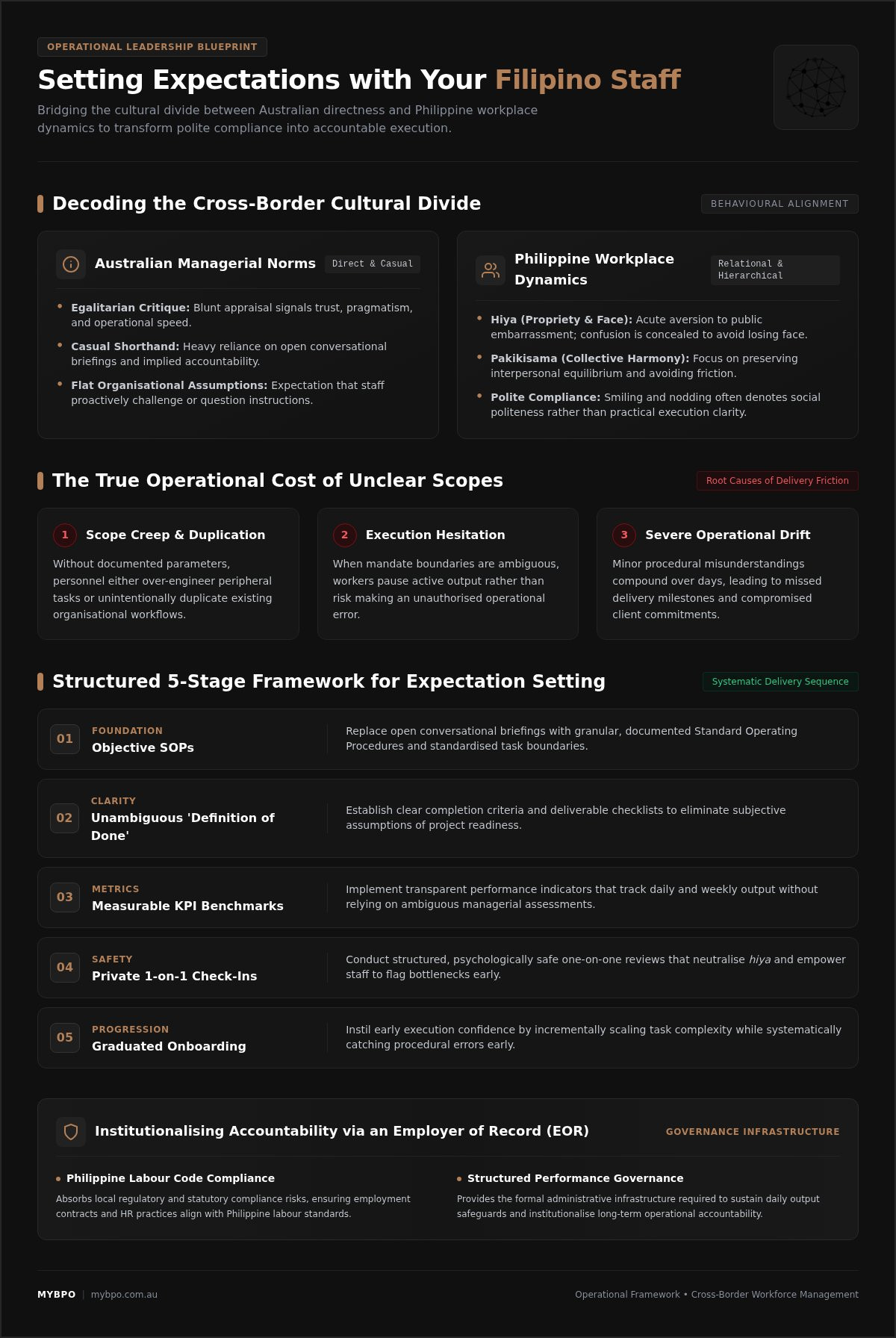
Expanding operational capacity into the Philippines delivers clear labour efficiencies, but technical capability alone cannot guarantee execution. When Australian organisations encounter delivery friction, the root cause is rarely competence. It is misaligned assumptions. Australian managerial culture relies heavily on egalitarian critique, casual shorthand, and implied accountability. In contrast, Philippine workplace dynamics operate within structured hierarchies and deliberate social preservation. If leadership fails to recognise this divide, workflow integrity breaks down quickly.
Mastering the discipline of setting expectations with your filipino staff is not merely an administrative exercise. It serves as an active risk-mitigation strategy. Without explicit operational frameworks, team members default to silence rather than seeking clarification, creating unaddressed project bottlenecks. Establishing rigorous benchmarks early shields your organisation from productivity losses while protecting offshore staff from the anxiety of navigating ambiguous professional boundaries.
Why Australian Directness Requires Cultural Context
Australian managers typically favour candid, unvarnished communication. In domestic boardrooms, blunt appraisal signals trust, pragmatism, and speed. However, applying this unvarnished delivery overseas collides directly with traditional Filipino cultural values, which prioritise relational preservation, collective harmony, and respect for organisational rank.
When an Australian director delivers sharp, unstructured critique in a public forum or digital channel, offshore personnel rarely interpret it as simple feedback. Instead, they often experience it as severe personal censure. This friction triggers withdrawal, defensive hesitation, and high turnover. Contextualising your communication style does not mean lowering your performance bar. Rather, it means recalibrating how instructions are delivered to secure genuine operational buy-in.
The True Cost of Unclear Role Scopes
Imprecise task delegation creates immediate financial and operational drag. When leaders rely on open-ended directives like “review these files when convenient”, the outcomes are consistently counterproductive:
- Scope creeping and duplicate efforts: Without documented parameters, staff either over-engineer peripheral tasks or duplicate existing workflows.
- Execution hesitation: A worker unsure of their mandate will pause activity rather than risk making an unauthorised error.
- Severe operational drift: Minor procedural misunderstandings compound over days, resulting in missed delivery dates and compromised client commitments.
Setting expectations with your filipino staff through granular boundaries eliminates this systemic guesswork. When teams understand their exact remit, accountability transitions from a theoretical ideal into daily practice. For businesses managing distributed technical teams, partnering with managed dual-shoring specialists like ZANGAARD can reinforce structured operational oversight and maintain alignment between onshore leaders and offshore contributors.
Decoding Cultural Drivers: Hiya, Pakikisama, and Indirect Communication
Managing offshore teams across borders demands a clear understanding of domestic sociological drivers. In the Philippine corporate environment, communication is inherently relational rather than purely transactional. When setting expectations with your filipino staff, leaders must recognise that workplace interactions are governed by social obligations designed to preserve communal equilibrium and mutual respect.
Understanding Hiya and the Fear of Losing Face
At the foundation of Philippine professional interaction lies hiya, an acute sense of propriety and an aversion to public embarrassment. If a team member struggles with an ambiguous directive, hiya often prevents them from asking for clarity during an open meeting. Admitting confusion in front of peers can feel like a profound loss of face. To neutralise this risk, performance coaching and critical task evaluations must always take place inside private, supportive one-on-one sessions where staff feel safe addressing operational roadblocks.
Navigating Pakikisama and Team Cohesion
Equally influential is pakikisama, the cultural priority placed on collective harmony and avoiding interpersonal friction. This trait yields loyal, cohesive units, but it also creates operational vulnerabilities. Employees often hesitate to flag an underperforming colleague because speaking up threatens group solidarity. Applying an established cross-cultural management framework helps resolve this issue by replacing subjective personal evaluations with objective, team-wide output benchmarks that remove personal confrontation from daily accountability.
Moving Beyond the Default ‘Yes’ Response
In high-context cultures, a polite affirmative response often signals respect and acknowledgment of authority rather than practical comprehension. Real alignment requires changing how work is delegated. You can eliminate ambiguity by implementing concrete feedback loops:
- Phase out closed prompts: Stop asking “Do you understand?” or “Can you get this done?” as these invite reflexive agreement.
- Require verbal walkthroughs: Ask team members to explain the workflow sequence back to you in their own words before commencing.
- Normalise early issue escalation: Explicitly clarify that uncovering operational bottlenecks is valued and expected.
Executing these structured routines, reinforced by an established provider of dedicated virtual assistants, protects your operational integrity and ensures that daily tasks translate into reliable business outcomes.
Developing Objective Performance Frameworks: SOPs and Measurable KPIs
Verbal briefings and casual task handovers invite operational drift. As detailed in the DFAT Philippines country brief, strong commercial ties have driven substantial Australian investment into Philippine professional service teams. Capitalising on this capability requires codifying institutional knowledge into structured, verifiable systems. Effective processes for setting expectations with your filipino staff replace assumption with objective documentation, ensuring every deliverable meets rigorous standards.
Constructing Bulletproof Standard Operating Procedures
Subjective task descriptions invariably lead to uneven quality. Standard Operating Procedures (SOPs) protect your firm by converting complex responsibilities into repeatable, auditable workflows. To build effective documentation:
- Map sequential workflows: Detail processes step by step, pairing written directives with recorded visual walkthroughs to eliminate ambiguity.
- Define clear completion criteria: Establish an unambiguous “Definition of Done” covering required data fields, formatting rules, and sign-off requirements.
- Maintain a centralised repository: Organise playbooks in an accessible cloud library so team members can verify expectations independently.
This operational blueprint gives your staff clear boundaries, reducing hesitation and ensuring operational tasks run consistently. Just as behavioural research specialists such as Ergoneers study visual attention and workflow interaction to optimise task clarity, structuring documentation around how staff naturally process visual information helps eliminate operational friction.
Establishing Fair, Quantifiable Benchmarks
Accountability requires measurable parameters. When setting expectations with your filipino staff, pair productivity volume with strict quality thresholds. For instance, pairing a processing benchmark with a maximum error threshold of two per cent prevents speed from eroding output standards.
Establish definitive Service Level Agreements (SLAs) governing delivery timelines, communication channels, and milestone reporting. Align these expectations with the operational boundaries established during your initial offshore recruitment Philippines campaign. When metrics are quantifiable and documented, performance evaluations remain transparent, evidence-based, and detached from subjective impressions.
A Structured Five-Stage Framework for Setting Expectations
Successful remote integration relies on methodical execution rather than good intentions. When Australian organisations onboard offshore talent, introducing responsibilities gradually safeguards project milestones while embedding operational accountability. Implementing this structured five-stage framework removes guesswork, systematically setting expectations with your filipino staff from day one.
Stage 1 and 2: System Alignment and Interactive Walkthroughs
The onboarding cycle begins with comprehensive administrative clarity. In Stage 1, issue detailed written job profiles, complete systems access, and quantifiable benchmark targets. Stage 2 builds on this foundation through live, interactive walkthroughs of core Standard Operating Procedures.
Rather than presenting a passive slide deck, conduct practical workflow demonstrations where staff actively engage with daily tools. Ensuring team members operate from a professional environment, such as a secure dedicated workspace Philippines, eliminates technical interruptions and solidifies professional focus during these early training sequences.
Stage 3 and 4: Supervised Execution and Micro-Feedback Cadences
Theory must translate into supervised practice before independent delivery begins. In Stage 3, assign small, low-risk test batches to evaluate real-time procedural execution. This controlled exposure highlights process gaps before they impact production environments.
Stage 4 establishes daily, five-minute micro-feedback sessions during the opening month. These check-ins serve critical operational functions:
- Validating early workflow accuracy: Confirming correct execution reinforces compliant habits immediately.
- Protecting employee dignity: Addressing deviations in private digital channels prevents cultural withdrawal and preserves working trust.
- Resolving procedural bottlenecks: Daily touchpoints normalise immediate problem escalation rather than silent workarounds.
Stage 5: Autonomous Delivery and Quarterly Reviews
Once procedural consistency is verified, team members graduate to self-directed task management. Shift the cadence to weekly operational catch-ups focused entirely on milestone progress and system optimisation.
Every quarter, conduct formal performance appraisals that review achievement against documented KPIs, evaluate capability expansion, and plan compensation trajectories. Tying day-to-day outputs to broader company milestones deepens organisational commitment. To build your offshore operational structure on compliant foundations, contact MyBPO to manage your workforce integration securely.
Institutionalising Accountability: Operational Governance via an EOR
Verbal understandings and standard operating manuals provide daily guidance, but they cannot enforce accountability on their own. In cross-border employment, operational standards require formal legal backing to remain effective. If your offshore staffing lacks an enforceable statutory foundation, setting expectations with your filipino staff becomes an exercise in voluntary cooperation rather than binding business governance.
Australian firms engaging remote teams directly often operate under an illusion of control. Informal relationships and overseas invoices leave leadership vulnerable. When an offshore worker fails to deliver, an Australian company holding no registered legal entity in the Philippines has virtually no formal recourse. True operational discipline requires local statutory structures that reinforce performance requirements under domestic law.
Why Informal Contracting Undermines Performance Management
Engaging offshore talent as self-employed independent contractors creates operational exposure. A contractor paid via peer-to-peer digital transfers operates outside regular disciplinary mechanisms. If you attempt to dictate strict working hours, enforce procedural playbooks, and manage daily task cadences, you trigger serious legal misclassification risks. To understand the operational and regulatory exposure of this arrangement, review the sham contracting Philippines risk facing foreign organisations.
Beyond regulatory penalties from agencies like the Bureau of Internal Revenue (BIR), unmonitored contractors frequently take on concurrent clients. This dynamic fragments their attention, resulting in missed delivery windows, sudden project drop-offs, and neglected Service Level Agreements. Without local oversight, managers are left with zero structural leverage to correct poor performance.
The EOR as Your Local Operational and HR Compliance Shield
Partnering with an Employer of Record resolves this structural vulnerability. An EOR functions as the legal employer of record on the ground, absorbing Philippine Labour Code liabilities while you maintain full day-to-day managerial control over project milestones. This structure guarantees that setting expectations with your filipino staff is reinforced through legally compliant employment contracts, mandatory benefit remissions, and formal local human resource policies.
Direct on-the-ground HR teams in hubs like Manila and Bacolod manage the procedural requirements necessary to enforce workplace accountability. If delivery falls below documented standards, the EOR executes the statutory twin-notice rule—issuing formal Notices to Explain (NTE) and conducting due-process hearings. Secure your operational expansion by leveraging an established employer of record Australia service to safeguard productivity and maintain complete statutory protection.
Securing Operational Clarity and Long-Term Accountability
Achieving sustained productivity across borders requires more than casual instructions and good intentions. Setting expectations with your filipino staff succeeds only when cultural empathy is reinforced by documented standard operating procedures, objective metrics, and enforceable legal infrastructure. By replacing conversational assumptions with structured onboarding workflows, Australian businesses eliminate execution bottlenecks and empower offshore talent to excel.
Long-term operational security ultimately depends on robust local governance. As an Australian-owned entity, MyBPO provides transparent commercial accountability across Australia, backed by dedicated on-the-ground HR and operational teams in Manila and Bacolod. Our comprehensive compliance shield absorbs complex Philippine Labour Code liabilities, insulating your organisation from employment risks while preserving your daily managerial control.
Secure your offshore operational success with MyBPO’s compliant EOR solutions and build a disciplined, highly engaged team positioned for enduring commercial growth.
Frequently Asked Questions
Why do Filipino staff often say yes even when they need further clarification?
Filipino professionals frequently say yes out of professional deference and a cultural inclination toward interpersonal harmony. In the local corporate culture, admitting confusion to a senior leader can trigger hiya, or a perceived loss of face. An affirmative reply often indicates polite acknowledgement of your instructions rather than confirming they’ve grasped every step. Managers should replace binary questions with requests for practical walkthroughs to confirm understanding before project kickoff.
How can Australian managers deliver critical feedback without causing employee disengagement?
Critical feedback must always be delivered in private, dedicated one-on-one sessions to protect employee dignity. Direct, blunt criticism in shared digital channels can feel like public humiliation, causing immediate withdrawal or quiet resignation. Frame necessary corrections around objective Standard Operating Procedures rather than personal capability. Emphasise collaborative problem-solving, reassure the worker of their standing within the business, and establish clear, documented steps for remediation.
What are the most effective daily key performance indicators for remote offshore staff?
Effective daily metrics combine volumetric output with strict quality thresholds. When setting expectations with your filipino staff, track tangible units completed alongside an allowable error rate of less than two per cent. Additionally, establish clear Service Level Agreements for internal communication turnaround, such as responding to high-priority client messages within thirty minutes. Balancing productivity targets with accuracy safeguards operational consistency across distributed teams.
Can you enforce strict Australian working hours across remote Philippine team members?
Yes, Australian firms can enforce specific working hours, particularly since Philippine Standard Time aligns closely with domestic trading hours. Manila is within zero to three hours of Australian standard business windows year-round. However, if your scheduled operational rosters extend between 10:00 PM and 6:00 AM local Philippine time, mandatory night shift differential premiums of at least ten per cent legally apply under local labour regulations.
What should an Australian business do if an offshore staff member repeatedly misses deadlines?
First, verify whether ambiguous instructions or technical blockers contributed to the delay. If procedural clarity was established, initiate formal performance management. In cross-border arrangements, setting expectations with your filipino staff requires adhering to local procedural due process. Under Philippine labour standards, handling repeated non-performance requires issuing a formal Notice to Explain giving the worker five calendar days to respond, followed by an administrative review before enacting disciplinary measures.
How does an Employer of Record help enforce workplace expectations and operational policies?
An Employer of Record bridges the jurisdictional divide by serving as the legal employer on the ground in the Philippines. While your firm directs daily operational tasks, the EOR embeds company policies within legally compliant employment contracts. On-site HR teams in Manila and Bacolod assist by managing attendance tracking, facilitating performance improvement plans, and executing statutory disciplinary processes, ensuring your operational expectations remain legally enforceable.
Is written documentation more effective than verbal instruction when managing Filipino employees?
Written documentation is substantially more effective than verbal briefing alone. Audio calls often leave room for unspoken assumptions, and team members won’t always request repeated verbal explanations. Detailed Standard Operating Procedures, supplemented with step-by-step screen recordings and clear definitions of done, provide an enduring reference point. Written operational workflows empower staff to resolve technical ambiguities independently while maintaining uncompromising quality standards.
Need a strategy session?
Tell us about your team and we will map out the right structure, fixed-cost quote included.
Book a call