Blog
Offshore Bookkeeper Australia: The 2026 Guide to Secure and Compliant Scaling
What if the cost-saving strategy you’ve built to scale your accounting firm is actually a ticking regulatory time bomb under the Closing Loopholes Act 2026? You’re likely aware that finding skilled, affordable local talent has become an exhausting uphill battle for Australian practices. The decision to hire bookkeeper philippines professionals is a logical response to these market pressures, yet the fear of intellectual property theft and the complexity of Australian employment liability often stall progress before the first hire is even made.
It’s a valid concern because traditional freelance models no longer provide the security your clients demand. This guide reveals how to bridge that gap by using an Australian-owned EOR as your regulatory shield, integrating a high-performing offshore team that functions as a seamless extension of your local office while providing total legal protection from sham contracting risks. We’ll examine the structural integrity of the Employer of Record model, the necessity of dedicated physical workspaces for sensitive financial data, and the precise steps to ensure your firm maintains standardised Australian accounting quality for 2026 and beyond.
Key Takeaways
- Analyse the structural shifts in the 2026 Australian accounting talent market and why traditional recruitment methods are no longer sufficient to fill bookkeeping roles.
- Learn how to hire bookkeeper philippines professionals through an Employer of Record (EOR) model to effectively eliminate the legal liabilities of sham contracting.
- Identify the critical compliance requirements of the Closing Loopholes Act 2026 to ensure your offshore arrangements remain fully aligned with Australian Fair Work standards.
- Discover why dedicated physical workspaces and equipment leasing are essential for maintaining the security of sensitive financial data and intellectual property.
- Recognise the strategic advantage of partnering with an Australian-owned EOR that provides a local legal anchor and physical representation in the Philippines.
Navigating the Australian Accounting Talent Shortage in 2026
The Australian accounting sector has reached a critical inflection point. By 2026, the gap between available talent and the operational needs of firms has widened to an unsustainable degree. Local firms aren’t just competing for a small pool of graduates. They’re battling a structural deficit in the domestic labour market that threatens the viability of traditional bookkeeping services. If your firm relies solely on local recruitment to fill junior or mid-level roles, you’re likely facing rising salary expectations that outpace client fee increases. This creates a dangerous compression of margins that leaves little room for growth or strategic investment.
The 2026 Labour Market Reality
Vacancy rates in the Australian financial services sector remain at historic highs. The shift in expectations for junior bookkeepers has evolved. Many graduates now seek immediate entry into high-level advisory work, leaving a significant void in the foundational processing and compliance tasks that keep a firm running. This talent gap is driving firms toward globalised workforces not as a cost-cutting measure, but as a necessity for operational continuity. To hire bookkeeper philippines professionals is to secure a stable pipeline of talent that is often unavailable within the domestic market. Without this global perspective, firms risk stagnation as senior partners spend their billable hours on basic data entry rather than strategic client management.
Why “Offshore” is No Longer Optional
Maintaining competitive pricing for Australian clients while local compliance and overhead costs rise is a mathematical impossibility for many. The rising cost of local compliance, driven by complex Fair Work regulations, has made the delivery of basic bookkeeping services domestically a low-margin endeavour. Transitioning to a strategic offshore mindset allows you to absorb these pressures. By integrating Philippine teams, you aren’t just filling a seat. You’re building a scalable engine that frees your local staff to focus on high-value advisory work.
Technology has matured to bridge the gap between Australian and Philippine teams. Cloud-based platforms and secure equipment leasing ensure that your offshore unit functions with the same speed and integrity as your local office. When you hire bookkeeper philippines staff through a structured framework, you mitigate the risk of service degradation and secure the future of your firm’s profitability. This isn’t about survival anymore. It’s about building a robust, compliant structure that can withstand the regulatory and economic headwinds of the decade.
EOR vs. Traditional Outsourcing: Protecting Your Firm’s Integrity
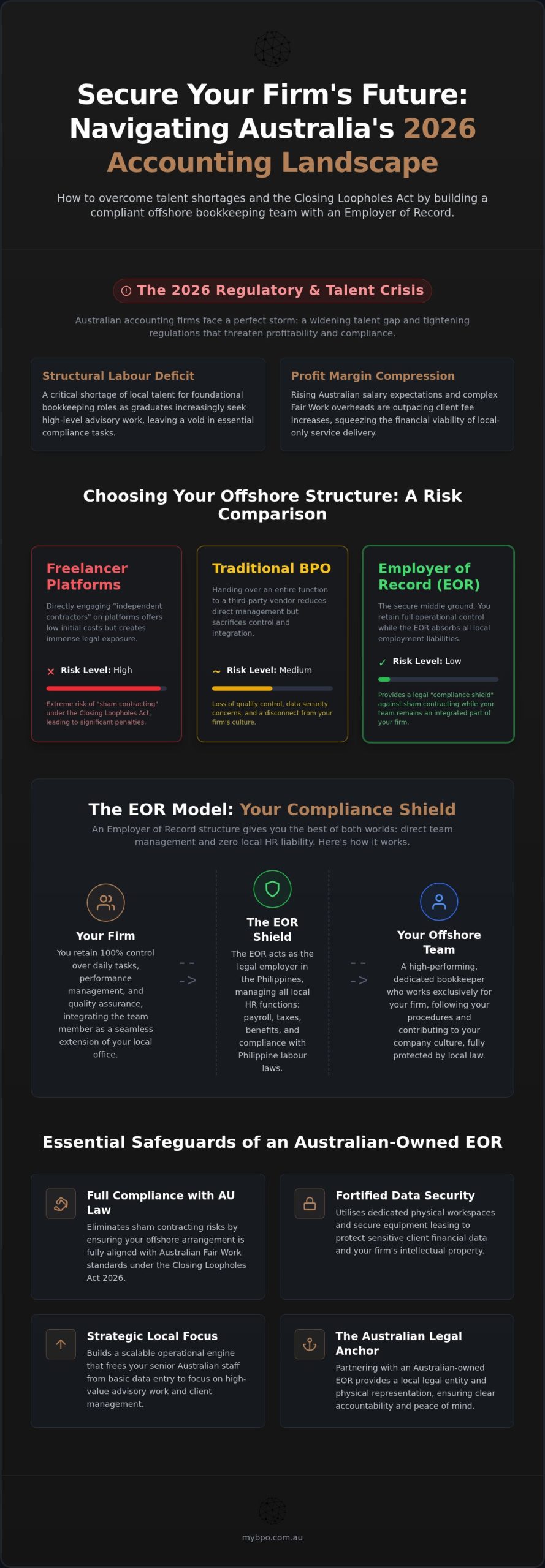
Choosing to hire bookkeeper philippines talent requires a clear understanding of the legal architecture supporting your offshore team. Many Australian directors mistakenly conflate “outsourcing” with a true Employer of Record (EOR) model. This distinction is critical for your firm’s integrity and legal safety. An EOR acts as the legal employer in the Philippines, managing payroll, taxes, and local labour law compliance, while you retain direct functional control over the staff member’s daily tasks and output. This structure allows you to build a team that mirrors your local office without the administrative burden of setting up a foreign entity.
The Three Pillars of Offshore Engagement
There are three primary ways to engage talent in the Philippines, each with varying levels of risk and control. Business Process Outsourcing (BPO) involves handing over an entire function to a third party. While this reduces management time, it often results in a loss of quality control and a lack of firm culture. Freelancer platforms offer the lowest cost but carry the highest risk. Engaging “independent contractors” directly frequently leads to sham contracting issues under Australian law, leaving your firm exposed to significant penalties. The Employer of Record (EOR) model provides a secure middle ground. It grants you the ability to manage your team directly while the EOR provides a “compliance shield” by absorbing all local employment liabilities. For a deeper analysis of these structures, consult our Employer of Record Australia: The Definitive Guide for Secure Offshore Expansion in 2026.
Why Direct Control Matters for Bookkeeping
Quality in bookkeeping is not a commodity; it is a reflection of your firm’s specific standards and workflows. When you hire bookkeeper philippines professionals through an EOR, you maintain the authority to train them in your specific Australian software stacks and reporting nuances. This direct relationship ensures that your offshore team is not just a distant service provider, but a cultural extension of your practice. Clear, direct communication is vital for maintaining the integrity of financial data. Without this level of control, you risk a “disconnect” where the offshore output requires constant correction by your local senior staff, effectively nullifying the efficiency gains you sought to achieve.
By utilising professional EOR services, you secure a framework where the legal risks of cross-border employment are mitigated. The EOR handles the complexities of Philippine labour codes and mandatory benefits, allowing you to focus entirely on the performance and integration of your new team members. This methodical approach ensures that your firm’s expansion is both scalable and compliant with the rigorous standards expected by Australian regulators.
Compliance First: Mitigating Sham Contracting and Fair Work Risks
The 2026 regulatory environment in Australia has significantly narrowed the definition of an independent contractor. For firms looking to hire bookkeeper philippines talent, the legal risks are no longer confined to Philippine borders. The Fair Work Act now exerts a profound influence on how offshore workers are categorised. If your offshore bookkeeper performs tasks under your direct supervision, uses your systems, and works set hours, they may be classified as an employee under Australian law, regardless of where they reside physically. Failing to recognise this shift exposes your practice to severe financial and reputational damage.
The Legal Trap of Independent Contractors
Many Australian practices believe that paying an offshore bookkeeper via a monthly invoice provides a layer of legal separation. This is a dangerous misconception. Under the Closing Loopholes Act 2026, the focus has shifted from the wording of a contract to the “real substance” of the working relationship. If the arrangement mirrors employment, your firm could be liable for back-pay, superannuation, and heavy penalties for sham contracting. You can find a detailed breakdown of these hazards in our guide on Exposing the Sham Contracting Philippines Risk: A Guide for Australian Firms in 2026.
The EOR as a Regulatory Shield
To mitigate these specific legal vulnerabilities, a robust Employer of Record (EOR) model is essential. MyBPO operates as a compliance shield by absorbing the local employment risks that you cannot manage from Australia. We ensure full compliance with the Department of Labor and Employment (DOLE) in the Philippines, managing every aspect of the employee’s legal standing. This includes the mandatory administration of:
- SSS (Social Security System): Providing essential social insurance for your Philippine team.
- PhilHealth: Securing medical insurance coverage as required by local law.
- Pag-IBIG: Managing mandatory provident savings and housing loan contributions.
Beyond basic payroll, an Australian-owned EOR provides a secure legal anchor. We facilitate legally enforceable contracts that protect your intellectual property and client data within the Philippine jurisdiction. By using our dedicated workspaces and equipment leasing, you ensure that sensitive financial information remains within a controlled, professional environment. This methodical approach allows you to hire bookkeeper philippines professionals with the confidence that your firm is protected from both Australian regulatory scrutiny and offshore operational risks.
Building a High-Performance Offshore Bookkeeping Unit
Integrating an offshore team into your practice requires more than just a successful recruitment drive. It demands a structured approach to performance and security that mirrors your domestic operations. When you hire bookkeeper philippines staff, the objective is to build a unit that functions with the same precision and accountability as your local office. This starts with a recruitment strategy focused on Australian-specific experience and ends with a physical infrastructure that protects your firm’s most sensitive assets.
Vetting for Australian Standards
Technical proficiency in general accounting is common, but proficiency in the Australian tax system is a specialist requirement. Your vetting process must rigorously test for GST, BAS, and payroll tax knowledge. It is essential to verify that candidates possess actual certifications in Xero or MYOB, as these are the cornerstones of the Australian bookkeeping corridor. Without these specific benchmarks, your local senior staff will spend excessive time correcting basic jurisdictional errors. For a comprehensive look at sourcing these specialists, see our Offshore Recruitment Philippines: The 2026 Buying Guide for Australian Firms.
Infrastructure and Data Security
The “work from home” model presents an unacceptable risk for firms handling client financial data and tax file numbers. Unsecured home networks and shared living spaces are vulnerabilities that no Australian director should tolerate. Utilising a dedicated workspace Philippines ensures that your team operates within a controlled environment with enterprise-grade security and redundant internet connections. This physical presence significantly improves staff retention by providing a professional career path and a clear boundary between work and home life.
Equipment leasing is a further compliance necessity. By providing the hardware your team uses, you maintain total control over software installations and data access. This strategy prevents the commingling of personal and professional data, which is a critical requirement for IP protection. Standardising your workflows across the AU-PH corridor is only possible when the hardware and environment are uniform. To ensure your firm meets these rigorous standards, you can establish a secure offshore unit through MyBPO and eliminate the operational gaps that lead to service degradation.
Why an Australian-Owned EOR is Your Essential Safeguard
Navigating the complexities of international employment requires more than just a software platform. When you decide to hire bookkeeper philippines talent, the jurisdictional bridge between Australia and the Philippines must be managed by a partner with actual accountability. Many offshore providers operate as foreign entities with no physical footprint or legal presence in Australia. If a data breach occurs or a contractual dispute arises, an Australian firm has little to no recourse against a provider located entirely overseas. MyBPO resolves this by providing local legal accountability, ensuring that you are dealing with an Australian-owned and operated company that understands the gravity of your professional obligations.
Accountability and Local Presence
The peace of mind that comes with an Australian-owned partner is a significant strategic advantage. We act as your intermediary, absorbing the operational friction that often accompanies cross-border management. If performance issues arise or if you need to navigate the nuances of local labour codes, you speak with a team that shares your business culture and time zone. This local presence is particularly vital when managing financial cycles and reporting deadlines. For a comprehensive look at the mechanics of local compliance, refer to our guide on Payroll in the Philippines for Australian Companies: The 2026 Compliance Reference.
Physical representation in the Philippines is equally critical. Unlike digital-only platforms, we maintain a tangible infrastructure that secures your operations. This on-the-ground support means we can manage staff engagement, hardware maintenance, and workspace security in real time. It allows us to bridge the cultural gap, ensuring that your offshore team members feel like a valued part of your Australian practice rather than isolated contractors.
Your Pathway to Secure Expansion
Scaling your firm shouldn’t feel like a leap into the unknown. Our onboarding process is designed specifically for Australian accounting practices, allowing you to start with a single dedicated bookkeeper before scaling to a full back-office unit. We manage the operational bridge, ensuring your new team members are integrated into your firm’s DNA from day one. This methodical approach allows you to hire bookkeeper philippines staff with the confidence that the structural risks are mitigated by a partner who is physically present in both countries.
Securing your firm’s future in 2026 requires a strategy that balances growth with absolute compliance. Don’t leave your firm’s integrity to chance with unmanaged freelance platforms or distant foreign providers. Organise a strategy call with MyBPO today to discuss how we can secure your offshore team and build a scalable, compliant bookkeeping unit that supports your long-term goals.
Future-Proofing Your Practice with Compliant Offshore Talent
The structural deficit in the Australian accounting labour market requires a shift from reactive hiring to strategic expansion. By 2026, the distinction between a secure, managed team and an exposed freelance arrangement has become the defining factor in firm stability. Success requires a commitment to rigorous compliance and physical data security that home-based models simply can’t provide. You must prioritise a framework that protects your firm from the reach of the Closing Loopholes Act while maintaining the high standards your clients expect.
When you hire bookkeeper philippines professionals through a dedicated EOR, you gain the ability to scale without the legal vulnerabilities of sham contracting. MyBPO provides the essential compliance shield as an Australian-owned and operated partner with physical office infrastructure in both countries. This ensures your intellectual property is protected while our specialist AU-PH compliance support manages the complexities of the 2026 regulatory landscape. It’s time to move beyond survival and build a scalable back office that feels like a natural extension of your local practice.
Secure your firm’s future with a compliant offshore team from MyBPO and reclaim the operational freedom needed to focus on high-value advisory work.
Frequently Asked Questions
Is an offshore bookkeeper in the Philippines legally considered my employee?
Technically, when you hire bookkeeper philippines talent through an Employer of Record (EOR), they are the legal employee of the EOR entity in the Philippines. This structure provides a compliance shield for your Australian firm. If you engage them directly via a freelance marketplace, you risk the relationship being classified as employment under Australian law. MyBPO absorbs this risk by acting as the legal employer, managing all local labour code obligations on your behalf.
How does the Closing Loopholes Act affect offshore staffing in 2026?
The Closing Loopholes Act 2026 shifts the legal focus from the written contract to the actual substance of the working relationship. If an offshore worker functions as an employee, they must be treated as one. This makes traditional invoice-only freelance arrangements highly risky for Australian directors. Using a structured EOR model ensures that the worker is correctly classified as an employee within their own jurisdiction, which mitigates the risk of sham contracting claims under Australian law.
Do I need to pay Australian Superannuation for staff in the Philippines?
You generally don’t have a legal obligation to pay Australian Superannuation for non-residents performing work entirely outside Australia. However, if a relationship is successfully challenged as sham contracting, you could be liable for unpaid entitlements. By using an EOR, the staff member receives mandatory Philippine benefits like SSS and PhilHealth instead. This clear legal separation protects your firm from the reach of Australian superannuation guarantee requirements while ensuring the worker is fully supported locally.
How do I ensure my offshore bookkeeper understands Australian GST and BAS?
Ensuring technical proficiency requires a rigorous recruitment process that tests specifically for Australian tax law nuances. You should prioritise candidates who hold current Xero or MYOB certifications and have documented experience with Australian GST and BAS requirements. MyBPO facilitates this by vetting candidates for their understanding of the Australian financial corridor. This methodical approach ensures your offshore unit maintains the same quality standards as a domestic junior bookkeeper while allowing your senior staff to focus on advisory.
What are the risks of using a freelancer instead of an EOR for bookkeeping?
The primary risks include intellectual property theft and a complete lack of data security oversight. Freelancers often work from unmanaged home environments on personal devices, which creates significant vulnerabilities for sensitive financial data. Additionally, the absence of a legal employer of record leaves your firm exposed to sham contracting liabilities. An EOR provides a secure, physical workspace and a legally enforceable contract, which mitigates these operational and regulatory dangers while providing professional accountability for your practice.
Can I provide my own software and hardware to an offshore team?
You can and should control the hardware and software used by your offshore team to ensure data integrity. MyBPO offers equipment leasing services that allow you to specify exactly what hardware is provided to your staff. This ensures that sensitive client data remains within a secure, managed environment. It also prevents the commingling of personal and professional data, which is a critical requirement for maintaining IP protection and meeting Australian privacy standards in 2026.
What happens if there is a data breach with my offshore bookkeeper?
If a breach occurs within a managed EOR environment, you have clear protocols and an Australian entity for legal recourse. MyBPO utilises dedicated workspaces with restricted access and enterprise-grade security to prevent such incidents. Unlike unmanaged freelancers, where you have zero visibility into their digital environment, an EOR provides a safe harbour. We manage the physical and digital security layers, allowing you to respond to any issues with the backing of a professional infrastructure.
How much can I realistically save by hiring an offshore bookkeeper?
While the direct labour costs in the Philippines are significantly lower than in Australia, your focus should be on the total cost of compliance. You can typically reduce your operational overhead for bookkeeping roles by a substantial margin while maintaining high quality. To hire bookkeeper philippines staff through a structured EOR model allows you to scale without the heavy recruitment and office costs associated with domestic expansion, directly improving your firm’s profit margins and scalability.
Need a strategy session?
Tell us about your team and we will map out the right structure, fixed-cost quote included.
Book a call