Blog
Terminating an Employee in the Philippines Legally: The 2026 Guide for Australian Businesses

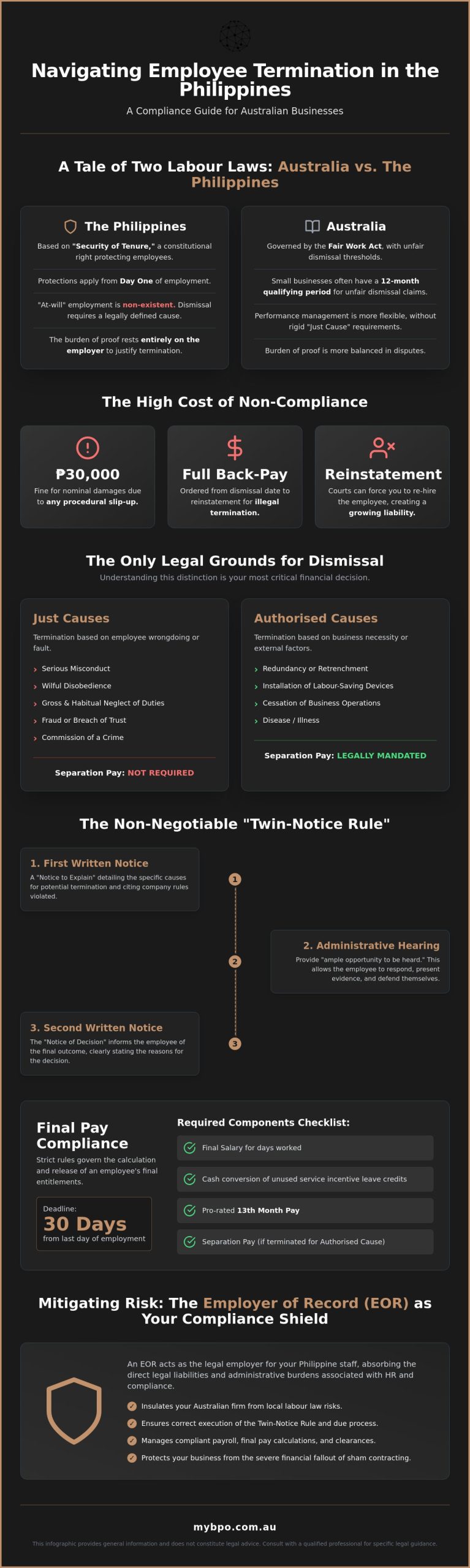
The Philippine Constitution guarantees “security of tenure,” which means you cannot simply “fire at will” as you might in other jurisdictions. When terminating an employee in the philippines legally, you aren’t just managing a staff member; you’re navigating a rigid, pro-employee legal framework where any procedural slip-up can lead to a P30,000 fine for nominal damages. It’s a high-stakes environment where the Australian concept of performance management often clashes with local “Just Cause” requirements.
You’re likely worried about the complexities of the NLRC or the potential for back-pay liabilities that can cripple an offshore operation. This 2026 guide ensures you master Philippine labour law so your staff transitions remain compliant and risk-free. We’ll provide a clear checklist for legal termination, explain the 30-day final pay mandate, and show you how to protect your Australian business from the financial fallout of procedural errors.
Key Takeaways
- Understand why “at-will” employment is non-existent in the Philippines and how the local Constitution protects staff tenure more strictly than Australian Fair Work standards.
- Distinguish between “Just Causes” such as serious misconduct and “Authorized Causes” like redundancy to ensure you establish valid legal grounds before initiating any dismissal.
- Master the non-negotiable “Twin-Notice Rule” and administrative hearing process required for terminating an employee in the philippines legally to avoid automatic fines for procedural errors.
- Learn the strict 30-day deadline for releasing final pay and the specific components, such as pro-rated 13th-month pay, required to satisfy DOLE compliance.
- Discover how an Employer of Record (EOR) acts as a compliance shield, absorbing legal liabilities and protecting your firm from the severe risks of sham contracting.
Understanding Philippine Security of Tenure vs. Australian At-Will Assumptions
For many Australian business owners, the relatively straightforward unfair dismissal thresholds of the Fair Work Act provide a false sense of security. In the Philippines, the legal reality is fundamentally different. The Labor Code of the Philippines establishes a concept known as “Security of Tenure.” This isn’t just a guideline; it’s a constitutional right. It means that an employee cannot be dismissed without a specific, legally defined “Just” or “Authorized” cause. Unlike Australia, where small businesses often have a 12-month window before unfair dismissal claims can be made, Philippine labour protections apply from day one. If you are terminating an employee in the philippines legally, you must accept that the court’s default position is to protect the worker’s livelihood over your operational convenience.
The financial stakes are significantly higher than most offshore employers realise. If the National Labor Relations Commission (NLRC) deems a dismissal illegal, they don’t just award a few weeks of pay. They can order the immediate reinstatement of the employee to their former position with full back-wages, benefits, and allowances from the time of dismissal until the actual reinstatement. For an Australian firm, this creates a permanent, growing liability that cannot be ignored. By 2026, the regulatory environment has shifted to scrutinise offshore arrangements more closely, making the “fire and forget” approach a legacy of the past.
The Burden of Proof: Why the Employer Always Starts on the Back Foot
In any dispute, Philippine law dictates that all doubts in the interpretation of labour provisions are resolved in favour of the employee. This means the burden of proof rests entirely on your shoulders. You must prove, with substantial evidence, that the termination was valid. Without a paper trail of warnings, performance plans, and meeting minutes, you’ll likely lose. This is particularly dangerous when businesses fall into the sham contracting Philippines risk, thinking they can bypass these rules by calling staff “independent contractors” when they are, in fact, employees.
Closing Loopholes: Australian Liability for Offshore Decisions
The 2026 regulatory landscape has significantly narrowed the escape routes for Australian directors. Under the recent “Closing Loopholes” legislative shifts in Australia, the definition of employment has tightened. If your Australian entity exercises direct control over Philippine staff, you aren’t just subject to local labour courts; you may be exposing your Australian company to domestic penalties for sham contracting. Simply “stopping the contract” without following the twin-notice rule is a recipe for litigation that can follow you across borders. Terminating an employee in the philippines legally requires a bridge between both legal systems to ensure your Australian assets remain protected.
Just Causes vs. Authorized Causes: The Only Legal Grounds for Dismissal
The Philippine Labor Code leaves no room for ambiguity when it comes to the legal basis for dismissal. You cannot terminate a relationship based on a “bad vibe” or a general sense that a staff member isn’t a “culture fit.” Instead, you must categorise the termination under either a Just Cause or an Authorized Cause. This distinction is the most critical financial decision you’ll make during the process. While Just Causes relate to employee wrongdoing and require no separation pay, Authorized Causes stem from business necessity and mandate a statutory payout. Understanding these categories is the first step toward terminating an employee in the philippines legally.
Proving poor performance as a Just Cause is a notorious hurdle for Australian managers. In the local courts, simple incompetence rarely meets the threshold for dismissal. To succeed, you must demonstrate “gross and habitual neglect,” which requires a documented history of failures despite repeated warnings. Because this is so difficult to prove, many firms find themselves trapped in expensive litigation when they attempt to fire for performance without following strict due process in termination. If you’re unsure which category your situation falls into, engaging an Employer of Record can provide the necessary legal distance and expert guidance to make the right call.
Navigating Just Cause: Proving Serious Misconduct
Serious misconduct must be “serious” enough to imply that the employee is no longer fit to work for you. In a remote Australian-Philippine work context, this often manifests as data breaches, fraud, or wilful disobedience of lawful orders from Australian management. To pass the “Wilful Disobedience” test, you must prove the order was reasonable, lawful, and made known to the employee. It’s not enough to say they didn’t do their job; you must prove they intentionally ignored a specific directive.
Authorized Causes: Managing Redundancy and Retrenchment
When an Australian firm scales back offshore operations, “Redundancy” is the most common authorized cause. This occurs when a position is no longer necessary for the continued operation of the business. “Retrenchment,” on the other hand, is used to prevent serious business losses. Both require a 30-day notice to the employee and the Department of Labor and Employment (DOLE). The financial liabilities are specific:
- Redundancy: One month’s pay for every year of service. A fraction of at least six months is considered one full year.
- Retrenchment: One-half month’s pay for every year of service, with a minimum of one month’s pay.
- Tax Exemption: Under the National Internal Revenue Code, separation pay for authorized causes is exempt from income tax, as the termination is beyond the employee’s control.
For a worker in the National Capital Region (NCR) earning the minimum wage of P755.00 per day as of July 2026, these calculations must be precise to avoid “underpayment” claims that can trigger further legal action.
The Twin-Notice Rule: The Non-Negotiable Procedural Due Process
In the Philippines, having a valid reason for dismissal is only half the battle. If you fail to follow the strict procedural steps mandated by law, the termination is considered “tainted” or technically illegal. Under Supreme Court jurisprudence verified in 2026, failing to follow due process in a Just Cause dismissal results in a mandatory P30,000 fine for nominal damages, even if the reason for firing was perfectly valid. If it’s an Authorized Cause and you miss the procedural marks, that penalty rises to P50,000. These aren’t just administrative suggestions; they are the mechanical requirements for terminating an employee in the philippines legally.
The “Twin-Notice Rule” refers to the two specific written communications you must provide to the employee. Between these notices, there must be a genuine opportunity for the worker to defend themselves. For an Australian manager, this process might feel overly bureaucratic compared to the more flexible performance management cycles back home. However, skipping these steps effectively hands the employee a winning case at the National Labor Relations Commission (NLRC). You must treat this as a rigid ritual designed to protect your firm from back-pay liabilities that can accumulate while a case winds through the courts.
Drafting the Notice to Explain (NTE)
The first step is the Notice to Explain (NTE). This document must serve as a detailed “bill of particulars” rather than a vague complaint about “poor attitude.” You must specify the exact dates, times, and incidents of the alleged misconduct or performance failure. Crucially, you must grant the employee at least five calendar days to submit a written response. This “cooling off” period is an absolute requirement. The NTE must also include a clear warning that dismissal is a possible outcome of the investigation. If you don’t explicitly state that their job is on the line, the notice is legally insufficient.
Conducting the Administrative Investigation
Once the employee has responded, you must provide an “opportunity to be heard.” For Australian managers, this typically takes the form of a recorded video conference. While it doesn’t need to be as formal as a courtroom trial, you must allow the employee to explain their side and present their own evidence. It’s vital to remember that the employee is entitled to have counsel or a representative present during this hearing. Denying them this right can nullify the entire process. Record the session and keep a detailed transcript; these documents will be your primary shield if the termination is later challenged as a sham or a breach of due process.
During these internal investigations, maintaining high evidentiary standards is vital; if you are looking into specialised verification tools as part of your process, you can learn more about Morgan Polygraph to understand the facts and myths behind modern lie detection.
The final step is the Notice of Decision. This document must contain a clear finding of facts, the specific evidence you considered, and the final decision based on the Labor Code. By following this structured path, you ensure your Australian firm isn’t acting on a whim but is following a defensible, legal path that secures your operations against litigation.
Final Pay, Clearances, and Post-Termination Compliance
The administrative process following a dismissal is just as legally sensitive as the dismissal itself. In the Philippines, the Department of Labor and Employment (DOLE) is particularly vigilant regarding the timely release of final wages. According to Labor Advisory No. 06, Series of 2020, you must release an employee’s final pay within 30 days from the date of separation. Failure to meet this deadline is a common trigger for DOLE inquiries. In 2025, issues related to final pay accounted for 23,496 inquiries to the DOLE hotline. Fulfilling these requirements is a core component of terminating an employee in the philippines legally.
Clearance is a prerequisite for this payment. You have the right to withhold final pay until the employee returns company assets, but this must be managed efficiently to avoid breaching the 30-day limit. This is where many offshore firms stumble. If you aren’t physically present to collect assets, you need a structured local partner to handle the logistics and ensure the “clean break” remains compliant. Managing these deadlines prevents a standard exit from escalating into a costly labour dispute.
Calculating the Final Settlement
The final pay run is not a standard salary payment. It must include several statutory components to satisfy 13th month pay Philippines compliance obligations. This requires a pro-rated payment based on the total basic salary earned during the calendar year. Additionally, you must compensate the employee for any unused Service Incentive Leave (SIL) if they have completed at least one year of service.
Managing the return of leased equipment and revoking data access should occur immediately upon serving the Notice of Decision. An EOR typically handles the inventory of hardware and the final tax adjustments. They ensure that SSS, PhilHealth, and Pag-IBIG contributions are correctly updated to reflect the termination, protecting you from future claims of unpaid benefits.
The Certificate of Employment and Quitclaim
You are legally required to issue a Certificate of Employment within three days of the employee’s request. This document should simply state the dates of employment and the nature of the work performed. Avoid including negative comments about the termination. Such remarks can be used as evidence of “malice” in future litigation. The “Release, Waiver, and Quitclaim” is your primary protection against future claims, but a simple signature isn’t enough.
In the Philippines, a quitclaim must be notarised to be effective. The employee must sign it voluntarily with a full understanding of what they are waiving. Courts may set aside a quitclaim if the consideration is considered unconscionably low. To secure your business against these risks, you can outsource your HR compliance to an EOR that manages the entire exit process on your behalf.
Mitigating Termination Risk: The EOR as Your Compliance Shield
Direct hiring or engaging staff through B2C marketplaces creates a significant liability gap for Australian firms. Without a local legal presence, you cannot fulfil the procedural requirements for terminating an employee in the philippines legally because you lack the standing to issue valid notices or hold administrative hearings. This exposure often leads to sham contracting Philippines risk, where an Australian entity is blindsided by claims of illegal dismissal from workers they believed were merely independent contractors. In the eyes of the NLRC, if you control the work, you are the employer; if you aren’t registered locally, you are an employer in breach of the law.
An Employer of Record (EOR) serves as the definitive resolution to this complexity. By acting as the legal employer on record, the EOR assumes all statutory responsibilities, including the management of the twin-notice rule and the distribution of final pay. This allows your Australian business to focus on operational output while the EOR manages the high-stakes regulatory requirements of the local labour code. Building your offshore team on a secure EOR framework ensures that every dismissal is backed by professional HR experts who understand the nuances of Philippine jurisprudence.
Risk Absorption: Shifting the Legal Burden
MyBPO acts as the local legal entity, effectively shielding the Australian parent company from direct litigation. When a termination becomes necessary, we absorb the legal liability and manage the entire procedural ritual. This includes drafting the Notice to Explain and conducting the administrative investigation on your behalf. Because MyBPO is Australian-owned and operated, we understand the specific risk appetite of Australian businesses. We provide professional indemnity and ensure that all employment contracts are structured to withstand the scrutiny of a Philippine labour court, providing a level of security that direct hiring simply cannot match.
Strategic Offboarding: Protecting Your Brand and Culture
Termination is not merely a legal event; it is a critical moment for brand protection. A poorly managed exit can lead to reputational damage or the compromise of sensitive data. Our strategic offboarding process ensures that intellectual property and client data are secured the moment a decision is made. We maintain professional standards during these difficult transitions, ensuring that the “clean break” required by law is executed without emotional or operational fallout. By managing the return of hardware and the revocation of digital access, we mitigate the risk of post-employment retaliation. Your next step should be to consult with MyBPO to audit your current offshore contracts and ensure your business is protected by a robust compliance shield.
Securing Your Cross-Border Workforce for the Long Term
Navigating the complexities of Philippine labour law is a mandatory requirement for any Australian firm looking to scale offshore. You must respect the constitutional guarantee of security of tenure and strictly adhere to the twin-notice rule to avoid expensive nominal damages. Successfully terminating an employee in the philippines legally requires more than just a valid reason; it demands precise procedural execution and a deep understanding of local statutory timelines. If these standards aren’t met, your business faces significant financial and legal liabilities that can hinder your expansion.
As an Australian-owned and operated partner, MyBPO provides the essential on-the-ground support in Manila and Bacolod to manage these risks effectively. We bridge the gap between Fair Work expectations and Philippine Labor Code compliance, acting as your vigilant guardian against regulatory slip-ups. Secure your offshore operations with MyBPO’s Australian-owned EOR services to ensure your business remains protected and compliant. You can build a high-performing offshore team with confidence when you have a specialist partner managing your local legal burden.
Frequently Asked Questions
Can I terminate an employee in the Philippines for “cultural misfit”?
No, you cannot dismiss a staff member simply for being a “cultural misfit.” Philippine labour law requires a specific Just or Authorized cause for termination. Vague terms like “culture fit” don’t meet the legal threshold and are often viewed as a lack of valid grounds. If you attempt this, you risk an illegal dismissal claim at the NLRC. Every dismissal must be grounded in the specific grounds outlined in the Labor Code to ensure you are terminating an employee in the philippines legally.
How much is separation pay for a redundant employee in the Philippines in 2026?
For redundancy, the statutory rate is one month’s pay for every year of service. A service period of at least six months is considered a full year for this calculation. If an employee earning the 2026 NCR minimum wage of P755.00 per day is made redundant after two years, they must receive two full months of separation pay. This payment is exempt from income tax as it is classified as an authorized cause beyond the employee’s control.
Is a 30-day notice period mandatory for all terminations in the Philippines?
No, the 30-day notice is specifically required for authorized causes like redundancy, retrenchment, or business closure. For just cause terminations involving misconduct or neglect, you must follow the twin-notice rule instead. This involves a Notice to Explain, a five-day response window, and a final Notice of Decision. Failing to distinguish between these two procedural paths often leads to Australian firms being fined P30,000 to P50,000 for technical due process violations.
What happens if an employee refuses to sign the Notice to Explain?
If an employee refuses to sign the Notice to Explain (NTE), you should have two disinterested witnesses sign a statement confirming the refusal. Alternatively, you can send the notice via registered mail to their last known residence. This provides the necessary legal proof of service. The administrative investigation then proceeds regardless of their refusal to acknowledge the document, protecting your right to manage the workforce and conclude the disciplinary process.
Can an Australian company be sued in the Philippines if they use a contractor model?
Yes, Australian firms using a direct contractor model are highly vulnerable to local litigation. If the “contractor” performs duties under your direct control, Philippine courts will likely reclassify them as a regular employee under the “control test.” This exposes your business to sham contracting claims and significant back-pay liabilities. Terminating an employee in the philippines legally is nearly impossible under a contractor model because you lack the local legal standing to execute mandatory due process.
Is 13th month pay required if an employee is terminated for just cause?
Yes, pro-rated 13th month pay is mandatory regardless of the reason for dismissal. Even if an employee is terminated for serious misconduct, fraud, or theft, they are legally entitled to the 13th month pay earned up until their final day. You cannot withhold this statutory benefit as a penalty for their actions. Failing to include this in the final pay within the 30-day window is a clear compliance breach that invites DOLE intervention.
What is the role of the NLRC in employment termination disputes?
The National Labor Relations Commission (NLRC) acts as the primary quasi-judicial body for resolving employment disputes. It is where employees file claims for illegal dismissal, unpaid benefits, or damages. The burden of proof at the NLRC always rests on the employer. If you cannot prove both the legal cause and the procedural due process, the NLRC will likely order the immediate reinstatement of the worker with full back-wages from the date of termination.
Can I terminate an employee during their probationary period in the Philippines?
Yes, you can terminate a probationary employee if they fail to meet the reasonable standards communicated at the start of their engagement. You must prove that the employee was clearly informed of these performance criteria on day one. Even during the probationary period, you must still follow procedural due process. This includes providing a notice and an opportunity to be heard before the six-month mark to prevent them from automatically gaining regular status.
Need a strategy session?
Tell us about your team and we will map out the right structure, fixed-cost quote included.
Book a call