Blog
Preventing Offshore Team Burnout: Australian Firm Guide

What if the high churn rate in your Philippine team isn’t a talent issue, but a structural failure of your Australian compliance framework? While 40% of Australian employees reported burnout in late 2025, the risks are often magnified for offshore staff navigating different labour codes and significant time zone shifts. You’ve likely felt the frustration of a high-performing staff member suddenly resigning or noticed the telltale signs of fatigue during morning syncs. It’s a costly cycle that drains your recruitment budget and stalls your operational momentum.
Understanding how to prevent offshore team burnout is no longer just a management preference; it’s a critical risk mitigation strategy. If your engagement model lacks the proper legal and physical safeguards, you’re essentially operating without a safety net. This guide provides the structural and cultural frameworks required to protect your Philippine workforce and secure long-term operational performance.
We’ll explore how an Employer of Record (EOR) acts as a compliance shield to reduce staff anxiety and why dedicated physical workspaces are essential for monitoring employee well-being. By the end, you’ll have a clear path to a stable, high-performing team and the peace of mind that your ethical and legal obligations are fully met.
Key Takeaways
- Quantify the hidden costs of “churn and burn” recruitment cycles, including the specific risks to data security and intellectual property protection within the Philippine corridor.
- Identify critical friction points like the health impacts of graveyard shifts and the operational stress caused by public holiday misalignment between Australia and the Philippines.
- Discover how to prevent offshore team burnout by implementing a robust Employer of Record (EOR) structure that provides a legal and psychological “compliance shield” for your staff.
- Leverage dedicated physical workspaces and equipment leasing to reduce technical frustration and create a clear boundary between professional and domestic life.
- Implement a performance-first framework that uses regionalised KPIs and virtual town halls to ensure your offshore team feels integrated and valued by your Australian headquarters.
The Hidden Cost of Offshore Burnout for Australian Businesses
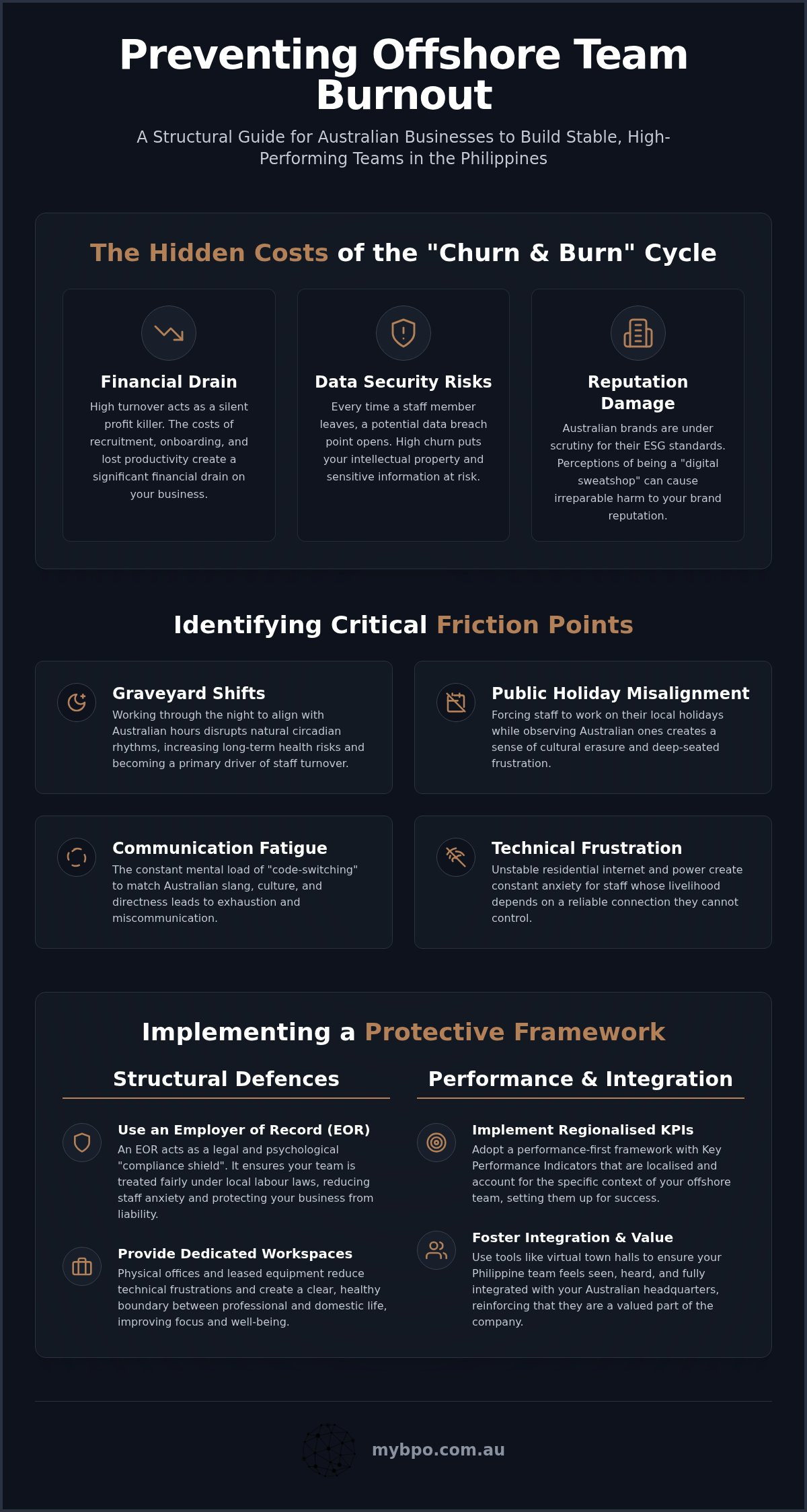
Burnout is often dismissed as an individual struggle with workload, but for an Australian firm, it represents a structural failure in risk management. Occupational burnout manifests as chronic workplace stress that hasn’t been successfully managed, leading to a breakdown in operational performance. When Philippine staff reach this point, the resulting “churn and burn” cycle creates a massive financial drain. In 2026, Australian employers are discovering that the cost of replacing a skilled offshore worker far outweighs the investment required to sustain them.
High turnover doesn’t just impact your bottom line; it compromises your data security. Every time a team member leaves, a potential breach point opens. If your processes for offboarding aren’t airtight, your intellectual property remains at risk. This is why learning how to prevent offshore team burnout is a core requirement for protecting your business assets. When an offshore team fails, the psychological toll also shifts to your Australian onshore managers, who must absorb the extra work while simultaneously managing the stress of a failing project. Burnout is a lead indicator that your structural compliance is vulnerable.
Quantifying the Cost of Attrition
Recruitment fees and the time lost during onboarding are silent profit killers. It takes weeks to find a replacement and months for them to reach full productivity. This creates the “Attrition Ripple Effect”: a phenomenon where the loss of one key staff member leads to increased workloads for remaining staff, a subsequent decline in Australian client service levels, and a degradation of team morale. If your staff turnover exceeds 20%, you aren’t just losing people; you’re losing the institutional knowledge that keeps your business competitive.
The Reputation Risk of Ethical Failures
There is also a significant reputation risk to consider. Australian brands are now under intense scrutiny regarding their Environmental, Social, and Governance (ESG) standards. If your offshore operation is perceived as a “digital sweatshop” due to excessive hours or poor conditions, it can cause irreparable damage to your local brand reputation. Ethical treatment is no longer a peripheral concern; it’s a commercial necessity in the AU-PH corridor. Utilising a robust employer of record Australia setup ensures that your team is treated fairly under local laws, providing a compliance shield that protects your brand from ethical liability.
Identifying Friction Points in the Australian-Philippine Corridor
The Australian-Philippine business corridor offers a unique talent pool, but it also presents specific operational frictions that can quickly lead to exhaustion if not managed correctly. According to the World Health Organization on burnout, this condition is an occupational phenomenon resulting from chronic workplace stress that hasn’t been successfully mitigated. In a cross-border context, this stress is often physical. Many Philippine workers endure “Graveyard Shifts” to align with global markets, which disrupts natural circadian rhythms and increases long-term health risks. While the AU-PH time difference is manageable, the cumulative effect of night-work is a primary driver of staff turnover.
Public holiday misalignment is another significant friction point. Forcing Philippine staff to work on their local holidays while expecting them to observe Australian ones creates a sense of cultural erasure. This misalignment, combined with the burden of constant “code-switching” to match Australian slang and directness, leads to deep communication fatigue. Technical frustration also plays a role. In many residential areas of the Philippines, internet and power instability are common. When a staff member’s livelihood depends on a connection they can’t control, the resulting anxiety is a major factor in how to prevent offshore team burnout effectively.
The Time Zone Trap
The 2-3 hour difference between Australia and the Philippines (depending on daylight savings) can be a double-edged sword. It’s close enough to allow real-time collaboration, but this often leads to “always-on” expectations. Managers might inadvertently extend the Philippine work day by sending late-afternoon requests that arrive during the staff’s evening. To protect your team, you must establish clear boundaries for synchronous work. Shifting towards asynchronous tasks for non-urgent projects allows your team to preserve their sleep cycles and reduces the pressure of immediate response times.
Cultural Communication Barriers
The Philippine “Yes” culture often clashes with the blunt, direct nature of Australian business communication. A staff member might agree to a deadline they know is impossible simply to avoid appearing uncooperative. When these misunderstood expectations lead to missed targets, the resulting pressure can be overwhelming. Furthermore, isolation in home-based roles accelerates feelings of detachment from the Australian headquarters. Cultural isolation acts as a catalyst for burnout, turning minor misunderstandings into major psychological hurdles. Providing a dedicated workspace can mitigate these risks by offering a professional environment with stable infrastructure and peer support.
Structural Defences: Using EOR and Infrastructure to Mitigate Stress
If your offshore framework relies on precarious digital platforms and unmanaged remote environments, you are building on unstable ground. Burnout is frequently the result of underlying structural anxiety rather than just a heavy task list. A professional employer of record Australia setup provides the legal certainty and psychological safety required for a stable, long-term workforce. When a worker knows their employment is secure and their rights are protected by an Australian-owned entity, their baseline stress levels drop significantly.
Beyond legalities, physical infrastructure plays a critical role in maintaining mental health. Equipment leasing removes the constant stress of “bring your own device” (BYOD) failures, which are a primary source of technical frustration in the Philippines. When hardware fails in a remote setting, the burden of repair often falls on the employee, leading to lost productivity and financial strain. Providing managed hardware and on-the-ground HR support creates an essential safety net that absorbs these operational shocks. When considering how to prevent offshore team burnout, Australian directors must look beyond daily output and examine the physical and legal foundations of the role.
Legal Security as a Wellness Strategy
Many firms inadvertently expose themselves to the sham contracting Philippines risk, which leaves workers without essential legal protections. This precarity is a direct contributor to chronic workplace stress. Under an EOR model, formal employment contracts ensure that mandatory benefits like SSS, PhilHealth, and Pag-IBIG are managed correctly. These contributions are not just administrative line items; they are the foundation of long-term loyalty and financial security for your Philippine staff. Formalising this relationship eliminates the “precarious worker” mindset that often leads to early resignation.
The Power of a Dedicated Workspace
Utilising a dedicated workspace Philippines solution is far superior to home-based work for maintaining focus and mental health. Residential areas often suffer from inconsistent power and internet connectivity, which forces employees into a state of constant high alert. By providing a professional centre with redundant power and high-speed fibre, you treat reliable infrastructure as a basic requirement for performance. This professional environment also facilitates the social benefits of working alongside peers, effectively mitigating the cultural isolation that often acts as a catalyst for burnout in remote roles.
Implementing a ‘Performance-First’ Management Framework
Empathy is a necessary leadership trait, but it is insufficient as a standalone strategy for maintaining a remote workforce. To secure long-term operational integrity, Australian firms must implement a structured management framework that prioritises objective performance while respecting regional realities. If your management style relies solely on “checking in,” you will likely miss the subtle indicators of fatigue until it is too late. A performance-first approach replaces vague oversight with clear KPIs that account for Philippine operational factors, such as local infrastructure challenges or seasonal weather disruptions. By formalising these expectations, you eliminate the ambiguity that often leads to chronic stress.
A critical component of this framework is the implementation of quarterly “Health of Team” audits conducted via on-the-ground partners. These audits serve as an early warning system, identifying friction points before they escalate into resignations. When combined with regular virtual town halls, these sessions foster a culture of inclusion with the Australian headquarters. This ensures that your offshore staff don’t feel like an isolated satellite office, but rather a core part of your corporate identity. Understanding how to prevent offshore team burnout requires this level of structural vigilance and a commitment to transparent communication.
Setting Realistic Expectations
Moving from “hours worked” to “outcomes delivered” is essential for a sustainable remote model. In the Philippines, the 13th Month Pay is a mandatory legal requirement, but performance-based bonuses should be layered on top to incentivise high-quality output rather than mere attendance. Within this context, we define the Sustainable Output Model as a management framework that balances high-intensity delivery with scheduled recovery periods and infrastructure-backed support. If your metrics ignore the physical toll of the “Graveyard Shift” or the mental load of cross-border work, your retention rates will inevitably suffer.
Bridging the Cultural Divide
Australian managers often require specific training in Philippine workplace etiquette to avoid accidental friction. The local culture highly values “saving face,” which can lead to staff staying silent about workload issues until they reach a breaking point. You must actively encourage psychological safety, where team members feel secure enough to flag obstacles early without fear of reprisal. Local team leaders play a vital role here, acting as mediators who can translate Australian directness into a context that motivates rather than discourages. To ensure your management team is equipped for this challenge, you can partner with an Australian-owned EOR that provides the local leadership and cultural expertise required for success.
Securing Your Talent Asset with MyBPO’s Protective EOR Model
MyBPO serves as a vigilant guardian for your international operations. While other providers offer generic growth partnership claims, we provide a tangible compliance shield that absorbs the legal and operational risks of cross-border employment. Our Australian-owned and operated structure ensures a high level of accountability that offshore-only entities cannot match. By maintaining a physical presence in both Australia and the Philippines, we provide the human presence necessary to identify the subtle signs of fatigue before they escalate. This proactive vigilance is the most effective method for how to prevent offshore team burnout while securing your talent assets for the long term.
A high-performance team shouldn’t feel like a disconnected satellite; it should function as a natural extension of your Australian office. We achieve this by building a bridge between two different worlds, grounded in physical reality and human accountability. When you remove the burden of risk from your onshore managers, they’re free to lead with clarity. Our model doesn’t just provide a service; it takes on the weight of jurisdictional complexity, allowing your business to feel a sense of relief and operational freedom.
The MyBPO Advantage: Vigilance and Presence
Physical representation in both jurisdictions is a non-negotiable requirement for operational security. Digital platforms alone cannot navigate the complexities of local labour codes or provide the immediate support a struggling employee requires. Our specialised approach to payroll in the Philippines for Australian companies ensures that every statutory contribution is met with precision. This technical accuracy removes the administrative burden from your onshore team, allowing your managers to focus on core business growth rather than jurisdictional red tape. When you secure the foundations of employment, you mitigate the “precarious worker” mindset that often leads to early resignation.
Next Steps for Secure Scaling
Transitioning to a more secure model is a strategic necessity for any firm serious about retention. If you currently rely on independent contractors, you’re likely exposed to significant compliance risks and high turnover. We recommend a thorough review of your current offshore structure to identify hidden risks, as understanding how to prevent offshore team burnout is the first step toward building a resilient operation. Moving to a secure EOR model provides the stability your workforce needs to thrive. You can secure your operational future by contacting MyBPO for a strategic consultation on Philippine staffing. We’ll help you navigate the complexities of the AU-PH corridor and implement a protective framework that ensures your team remains productive, healthy, and loyal.
Securing Your Operational Future in the AU-PH Corridor
Sustainable offshore performance is built on a foundation of structural integrity and legal certainty. By addressing the physical realities of the Philippine work environment and implementing a robust compliance shield, you transform a vulnerable operation into a resilient talent asset. Burnout isn’t merely a consequence of workload; it’s the result of unmanaged friction points like technical instability and legal precarity. When these risks are absorbed by a professional framework, your team is empowered to deliver consistent, high-quality results.
Mastering how to prevent offshore team burnout requires moving beyond remote-only models and embracing physical representation and local accountability. As Australian-owned and operated compliance specialists, MyBPO provides the physical infrastructure and on-the-ground support necessary to protect your workforce within the AU-PH regulatory corridor. You don’t have to navigate these complexities alone. Take the first step toward a more stable, high-performing offshore operation today. Secure your offshore team’s future with MyBPO’s EOR services and gain the peace of mind that comes with total operational protection.
Frequently Asked Questions
What are the first signs of burnout in an offshore Philippine team?
Initial indicators include a noticeable drop in responsiveness, withdrawal from virtual social channels, and an increase in uncharacteristic errors. Because Philippine culture often values “saving face,” staff might continue to agree to deadlines they cannot meet even when overwhelmed. Monitoring these subtle shifts in communication is a vital part of how to prevent offshore team burnout before it leads to a sudden resignation. Consistent engagement through on-the-ground partners can identify these red flags early.
Does the Australian Fair Work Act apply to my staff in the Philippines?
The Australian Fair Work Act does not typically apply to individuals working in the Philippines. Instead, your staff are governed by the Philippine Labour Code, which includes specific regulations regarding night shift differentials, overtime, and termination procedures. Attempting to apply Australian standards to an offshore team can lead to significant compliance gaps and worker anxiety. Utilising an EOR ensures your team receives the correct local entitlements, which provides the legal security necessary for long-term retention.
How can I manage time zone differences without causing employee fatigue?
Managing the two to three-hour difference requires a shift towards asynchronous communication for non-urgent tasks. You should avoid the “always-on” trap by establishing clear boundaries for when staff should be reachable. If your team works Australian hours, ensure they aren’t expected to respond to late-afternoon requests during their evening. Providing structured overlaps for meetings while allowing for independent work blocks helps protect their sleep cycles and reduces the risk of chronic fatigue.
Is it better to have a home-based or office-based offshore team?
An office-based environment is generally superior for preventing exhaustion and maintaining productivity. While home-based work offers flexibility, it often exposes staff to inconsistent power and internet connectivity in residential areas. A dedicated workspace provides redundant infrastructure and a professional social environment, which effectively mitigates the isolation often felt by remote workers. This structural support is a critical component of how to prevent offshore team burnout by removing daily technical stressors.
What mandatory benefits must I provide to prevent staff turnover in the Philippines?
To maintain a stable workforce, you must provide mandatory statutory benefits including SSS (Social Security System), PhilHealth, and Pag-IBIG (Home Development Mutual Fund). Additionally, the 13th-month pay is a legal requirement in the Philippines that staff rely on for financial security. Neglecting these contributions creates a “precarious worker” mindset, which significantly increases the likelihood of churn. Providing these benefits through a formal employment structure demonstrates a commitment to ethical treatment and professional security.
Can an Employer of Record (EOR) help improve offshore team retention?
An Employer of Record significantly improves retention by acting as a compliance shield that provides staff with formal employment status. When workers are hired as independent contractors, they lack access to health insurance and retirement benefits, leading to high levels of anxiety. An EOR model absorbs the administrative burden and ensures all local labour laws are met. This formalised relationship creates a sense of professional belonging and security that independent contracting simply cannot match.
How do I handle Philippine public holidays for my Australian-facing team?
You should respect Philippine public holidays to maintain team morale and cultural inclusion. If your operations require staff to work on local holidays to align with the Australian calendar, you must pay the mandatory holiday premiums as per the Philippine Labour Code. Forcing staff to work on significant local holidays without proper compensation or recognition creates deep-seated friction. A balanced approach that acknowledges both calendars fosters a more integrated and loyal offshore team.
What role does equipment quality play in preventing remote worker stress?
Equipment quality is a primary factor in mitigating remote worker stress. Technical frustration caused by slow hardware or unreliable devices is a major driver of mental exhaustion. When a staff member’s performance is hindered by tools they cannot control, their anxiety levels rise. Implementing an equipment leasing model ensures your team has access to enterprise-grade hardware and immediate technical support, removing a significant layer of daily operational friction that contributes to burnout.
Need a strategy session?
Tell us about your team and we will map out the right structure, fixed-cost quote included.
Book a call