Blog
Employer of Record: Secure Philippine Hiring Guide 2026
An Australian business can’t simply outsource its legal obligations to a digital platform and hope for the best. With the Fair Work Commission’s increased scrutiny on sham contracting, your offshore strategy must be grounded in more than just a handshake agreement. You likely feel the tension between the urgent need to scale and the genuine fear of massive penalties for non-compliance. It’s a valid concern for directors who want to leverage Philippine talent but don’t have the capacity to master a foreign labour code.
By utilising a professional employer of record offshore staff framework, you can bridge the gap between Australian and Philippine jurisdictions without the $40,000 AUD setup costs of a local entity. This guide provides a secure roadmap for 2026, showing you how to manage the 15% SSS contribution rates and mandatory 13th-month pay while maintaining total operational control. We’ll explore how to protect your firm from liability, ensure your staff have the right equipment, and create a stable environment that protects your intellectual property.
Key Takeaways
- Understand why the “grey market” of direct offshore contracting is being targeted by regulators and how to transition to a fully compliant model.
- Discover how an employer of record offshore staff framework acts as a compliance shield, absorbing legal liability and managing complex Philippine statutory contributions.
- Identify the specific operational triggers that lead to sham contracting penalties and learn how to protect your Australian firm from the Fair Work Ombudsman.
- Learn why a legal contract is insufficient without physical security, and how dedicated workspaces and equipment leasing ensure uptime and data protection.
- See the strategic advantage of partnering with an Australian-owned entity to navigate dispute resolution and bridge the gap between two different legal jurisdictions.
The Evolving Landscape of Offshore Staffing for Australian Businesses
The Australian offshore staffing market has moved beyond the era of simple cost-arbitrage. In 2026, the focus has pivoted sharply toward risk-mitigation and the pursuit of high-quality, stable talent. For years, many firms operated in a “grey market,” engaging Philippine workers as independent contractors to bypass local taxes and benefits. This model is rapidly closing as regulatory pressure from both Australian and Philippine authorities intensifies. Businesses that once prioritised the lowest possible price point now recognise that operational stability is the only way to protect their long-term interests.
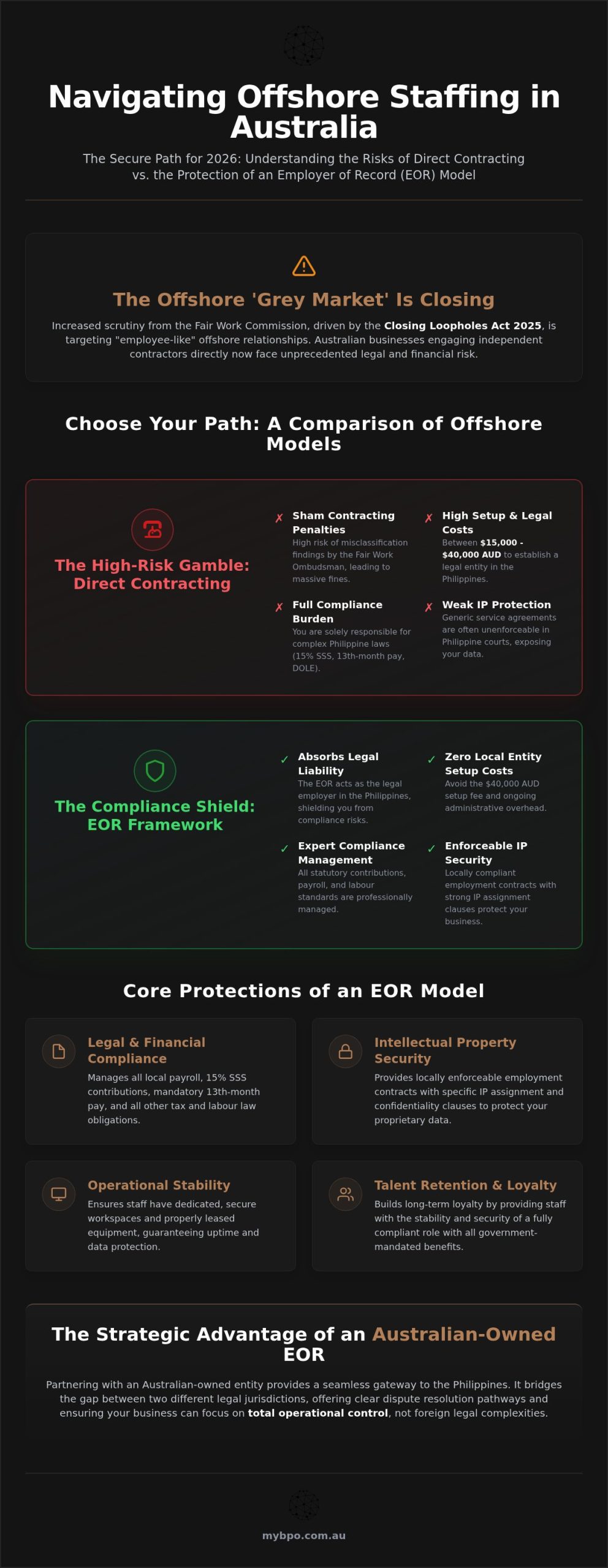
An Employer of Record (EOR) is now the standard for secure expansion; it is a third-party organisation that takes on the legal responsibilities of an employer, allowing you to hire staff without establishing a local subsidiary. An EOR serves as a robust legal shield that absorbs jurisdictional risk by assuming the role of the primary employer under Philippine law. By using an employer of record offshore staff model, your business can focus on output while the EOR manages the intricate details of payroll, statutory contributions, and local labour standards.
The Impact of the Closing Loopholes Act 2025
Legislative changes in Australia have fundamentally altered the risk profile of offshore staffing. The Closing Loopholes Act 2025 has granted the Fair Work Commission broader powers to scrutinise “employee-like” relationships, even when those workers are located overseas. If your offshore contractors perform work under the same conditions as Australian employees, you face a significant risk of being found in breach of sham contracting laws. Australian firms are now under a microscope, and the financial penalties for misclassification can be devastating for a mid-sized company. This regulatory shift makes the EOR model a necessity rather than an optional luxury.
This requirement for compliance extends to all global hiring efforts. For instance, companies expanding into Europe can mitigate similar risks by partnering with an Employer of Record Netherlands to manage their Dutch workforce legally and efficiently.
Why Direct Hire is Becoming a Legal Liability
Attempting to hire directly in the Philippines without a local entity is a high-stakes gamble. Establishing a legal entity in the Philippines typically costs between $15,000 and $40,000 AUD in setup fees alone, excluding the ongoing costs of local accounting and legal counsel. Beyond the financial barrier, the administrative burden of staying compliant with the Philippine Department of Labor and Employment (DOLE) is immense. Non-compliance with local standards, such as the mandatory 13th-month pay or the 15% SSS contribution rate, can lead to your business being blacklisted from the region. For a more detailed breakdown of these risks, see our guide on Employer of Record Australia: The Definitive Guide for Secure Offshore Expansion in 2026.
How an Employer of Record Protects Your Business and Your Staff
Adopting an employer of record offshore staff model transforms your international hiring from a precarious transaction into a protected partnership. In this arrangement, the EOR acts as the “Legal Employer” in the Philippines. They are the entity registered with local authorities, meaning they carry the primary burden of employment liability. If a regulatory audit occurs or a labour dispute arises, the EOR is the entity that stands in the gap. This allows Australian directors to manage their team’s daily output and performance without needing to master the intricacies of a foreign legal system.
Protection also extends to your intellectual property (IP). Many Australian firms mistakenly rely on generic service agreements with remote contractors that are virtually unenforceable in a Philippine court. An EOR issues locally compliant employment contracts that include specific IP assignment and confidentiality clauses. These are drafted to be enforceable within the local jurisdiction, creating a secure environment for your proprietary data and processes. By securing these legal foundations, you can organise your offshore team with the same confidence you have in your local Australian office.
There is also a significant psychological advantage to this model. Philippine professionals highly value stability and the security of government-mandated benefits. When you provide a fully compliant role with comprehensive social security contributions, you aren’t just hiring a worker; you are building long-term loyalty. Staff who feel legally and financially secure are far less likely to churn, which protects your business from the high costs of recruitment and retraining.
Statutory Compliance: SSS, PhilHealth, and Pag-IBIG
The administrative burden of Philippine statutory contributions is a common pain point for Australian firms. In 2026, the Social Security System (SSS) employer contribution is 10% of the employee’s salary, forming part of a total 15% rate. When you factor in PhilHealth premiums and Pag-IBIG funds, the total employer statutory load typically sits between 12% and 14%. An EOR manages these calculations and remittances with precision. This level of accuracy is vital to avoid Department of Labor and Employment (DOLE) penalties. For a detailed breakdown, consult our guide on Payroll in the Philippines for Australian Companies: The 2026 Compliance Reference.
The 13th Month Pay and Local Labour Standards
In the Philippines, the 13th-month pay is a non-negotiable statutory requirement mandated by Presidential Decree 851. It is equivalent to one month of an employee’s basic salary and must be paid by December 24th. Managing this alongside specific leave entitlements and night shift differentials requires expert local knowledge. By utilising an EOR, you eliminate the risk of inadvertently creating sham contracting arrangements. The EOR ensures your business honours all local customs and labour standards while maintaining the high operational expectations of an Australian company.
EOR vs. Independent Contractors: Avoiding the Sham Contracting Trap
The perceived cost-effectiveness of hiring offshore contractors often masks a significant legal vulnerability for Australian directors. Under the Fair Work Act, sham contracting occurs when an employer misrepresents an employment relationship as an independent contracting arrangement to avoid responsibility for employee entitlements. If your business dictates the working hours, provides the specific software or hardware, and integrates the individual into your core team, the Fair Work Ombudsman may classify that worker as an employee regardless of their geographic location. The financial penalties for misclassification are severe; they include heavy fines for the corporation and potential personal liability for directors who are “involved” in the breach.
Operational control is the primary litmus test for regulators. When you hire an independent contractor, you’re technically purchasing a result; when you hire an employee, you’re purchasing their time and labour. An employer of record offshore staff framework formalises this distinction by assuming the role of the legal employer, ensuring all statutory benefits like the 15% SSS contribution and 13th-month pay are handled correctly. While direct contractor payments appear to reduce initial overheads, an Australian firm engaging an employer of record offshore staff model eliminates the risk of being retrospectively assessed for unpaid payroll tax and superannuation guarantee charges on what regulators deem to be employee wages.
The Pascua v Doessel Group Precedent
The landmark case of Pascua v Doessel Group serves as a stark warning for Australian firms. In this instance, the Australian courts ruled that a worker in the Philippines was entitled to Australian workplace protections because the “substance and reality” of the relationship was one of employment, not contracting. This precedent confirms that physical borders do not provide a shield against Australian labour laws. If your current offshore structure relies on direct “freelance” agreements for roles that are fundamental to your daily operations, you are likely sitting on a significant compliance deficit. For a deeper analysis of these legal triggers, read our guide on Exposing the Sham Contracting Philippines Risk: A Guide for Australian Firms in 2026.
Managing the Grey Market of Remote Work
Many businesses begin their offshore journey through freelance marketplaces, which often function as a “grey market” of unregulated labour. While these platforms are useful for project-based tasks, they are unsuitable for core business functions that require high levels of security and integration. Transitioning to an EOR model allows you to move these vital roles into a formalised structure without disrupting your workflow. This shift provides your staff with the stability of a real employment contract, which naturally reduces the churn associated with the freelance economy and secures your operational continuity.
Operationalising Success: Beyond Payroll to Infrastructure
A legal framework is merely the foundation of a successful offshore strategy. While many providers treat the employer of record offshore staff model as a simple payroll exercise, the operational reality in the Philippines requires a more robust, physical approach. A compliant contract cannot prevent a local power outage or restore a failed internet connection in a remote province. If your business relies on high-uptime functions, you must look beyond the digital paperwork to the tangible environment where your staff actually perform their work.
Managing staff performance from thousands of kilometres away introduces the risk of “ghosting” and decreased engagement. This often occurs when the psychological distance between the Australian office and the remote worker becomes too great. On-the-ground support serves as a vital bridge; it provides your team with a sense of belonging and accountability that a Slack channel alone cannot achieve. By integrating your employer of record offshore staff into a managed environment, you ensure that performance issues are identified and mitigated before they impact your bottom line. To ensure your team has the physical support they need, you can enquire about our integrated EOR and facility solutions today.
Equipment Leasing and Data Security
The “Bring Your Own Device” (BYOD) model is a significant liability for Australian firms bound by strict data privacy regulations. Relying on an employee’s personal laptop makes it nearly impossible to enforce enterprise-grade security protocols or ensure consistent software updates. Leasing enterprise-grade hardware through your EOR partner ensures that every team member is working on a secure, standardised machine. This approach also simplifies maintenance; if a device fails, the EOR manages the immediate replacement or repair, ensuring your operations don’t grind to a halt while waiting for a local courier.
Dedicated Workspaces vs. Remote Risks
Work-from-home (WFH) environments in the Philippines are often subject to infrastructure volatilities that can compromise business continuity. Dedicated workspaces provide the necessary redundancies, such as back-up power generators and multiple high-speed internet lines, which are rarely available in residential areas. Beyond the technical benefits, a professional office environment fosters a culture of discipline and focus that is difficult to maintain in a domestic setting. For a deeper look at how physical infrastructure protects your investment, read our guide on Dedicated Workspace Philippines: Securing Your Offshore Operations in 2026.
Why an Australian-Owned EOR is Your Safest Gateway to the Philippines
Dealing with an Australian-owned entity provides a layer of security that global, automated platforms cannot replicate. If a contract dispute arises or a regulatory query needs immediate attention, you aren’t forced to navigate a foreign legal system or deal with an anonymous support ticket in a different time zone. You operate under the protection of Australian commercial law, with a partner who understands the specific nuances of the Fair Work Act intimately. This local accountability is the cornerstone of a secure employer of record offshore staff strategy, ensuring that your business remains protected in both jurisdictions.
MyBPO functions as a “Safe Harbour” for Australian firms by bridging the gap between two distinct business cultures. While the Philippines offers high English literacy and a vast pool of graduates, the labour dynamics are vastly different from the Australian market. We act as your cultural and regulatory interpreter, ensuring that your expectations for output align with local employment customs. This dual-presence model allows us to absorb the complexities of cross-border compliance, leaving you free to focus on your core business objectives without the fear of hidden legal traps.
The Advantage of Local Australian Representation
Having a Brisbane-based point of contact simplifies every aspect of your offshore expansion. Communication is direct, and the security of Australian ownership means your legal recourse remains within your home jurisdiction. If you encounter a challenge with staff performance or statutory changes, you can speak with an expert who shares your business values and understands the high stakes of Australian corporate responsibility. This proximity ensures that your offshore team is an integrated extension of your business rather than a disconnected silo, providing a level of transparency that offshore-only providers cannot match.
Scaling Your Team with Absolute Compliance
Growth should not introduce new legal vulnerabilities. Whether you are hiring your first virtual assistant or building a multi-role offshore department, a structured onboarding process ensures every step is documented and compliant. We manage the transition from recruitment to long-term operational stability, providing the necessary equipment leasing and dedicated workspaces required for high-performance output. To understand how to find the right talent to fill these roles securely, consult our Offshore Recruitment Philippines: The 2026 Buying Guide for Australian Firms.
By choosing an Australian-owned partner, you’re not just purchasing a service; you’re securing a local ally. This partnership allows you to navigate the 2026 regulatory environment with confidence, knowing that your employer of record offshore staff are managed within a framework designed for total protection. This is the final piece of the puzzle for achieving operational freedom and long-term stability in the Philippine market.
Establishing Your Safe Harbour for 2026
The landscape of offshore staffing has fundamentally shifted toward a requirement for total transparency and legal rigour. Relying on unregulated contractors is no longer a viable strategy for Australian firms that value longevity and director safety. By implementing a robust employer of record offshore staff framework, you eliminate the threat of sham contracting while securing high-quality talent. This model ensures that every statutory obligation, from the 15% SSS rate to the mandatory 13th-month pay, is managed with absolute precision.
True operational stability requires more than just a legal contract; it demands a physical presence that protects your data and your uptime. As an Australian-owned and operated specialist, MyBPO provides the on-the-ground support in the Philippines necessary to bridge jurisdictional gaps. We are specialists in both Fair Work and DOLE compliance, acting as a shield that absorbs your legal liability so you can focus on growth. Secure your offshore team with an Australian-owned EOR specialist and build your team with the confidence that only a local ally can provide.
Frequently Asked Questions
What is the difference between an EOR and a recruitment agency in the Philippines?
A recruitment agency focuses solely on the initial sourcing and placement of talent, whereas an Employer of Record (EOR) manages the ongoing legal employment of that staff member. While recruitment is a one-time transaction, an EOR assumes long-term responsibility for payroll, taxes, and total compliance with the Philippine Department of Labor and Employment (DOLE) standards. This allows you to manage the team’s output while the EOR absorbs the administrative and legal burden.
Is an Employer of Record legal under Australian Fair Work laws?
Utilising an employer of record offshore staff framework is a legally recognised method for Australian firms to engage international talent while adhering to the Fair Work Act. This structure creates a formal employment link through a locally registered entity, which prevents the common legal pitfalls associated with direct “freelance” agreements. It ensures that the relationship is transparent and compliant with the “substance and reality” tests used by Australian regulators to identify legitimate employment.
How does an EOR handle Philippine statutory benefits like SSS and PhilHealth?
An EOR calculates and remits all mandatory contributions directly to the relevant Philippine government agencies on your behalf. This includes the 15% SSS contribution rate, PhilHealth premiums, and Pag-IBIG funds required for 2026. Because these contributions are handled by a local entity, your business is protected from the complexities of foreign statutory filings and the risks of non-compliance with local social security laws.
What happens if I need to terminate an offshore employee under an EOR?
Termination must follow the strict “just” and “authorised” causes outlined in the Philippine Labour Code, a process that the EOR manages to ensure legal compliance. They facilitate the mandatory two-notice rule and administrative hearings required to prevent claims of illegal dismissal. This protects your Australian firm from direct involvement in foreign labour disputes and ensures that the separation is handled professionally and legally.
Can an Employer of Record help with equipment leasing for my offshore staff?
Many specialist providers like MyBPO offer integrated equipment leasing to ensure your staff have enterprise-grade hardware that meets Australian data security standards. This removes the logistical burden of shipping laptops overseas and ensures that hardware maintenance is handled locally. By leasing through your EOR partner, you ensure that your team has the necessary tools to maintain uptime without the risks associated with “Bring Your Own Device” (BYOD) policies.
Why should an Australian company prefer an Australian-owned EOR provider?
An Australian-owned EOR provides local accountability under Australian commercial law and an intimate understanding of the Fair Work Act’s impact on offshore staffing. You gain a point of contact in your own time zone who can bridge the cultural and regulatory gap between Australian business expectations and Philippine labour realities. This proximity ensures that any disputes or compliance queries are resolved with a partner who shares your jurisdictional standards and business values.
Does using an EOR eliminate the risk of sham contracting penalties?
Using an EOR significantly mitigates the risk of sham contracting penalties by establishing a legitimate, documented employment relationship through a registered Philippine entity. This structure ensures that your employer of record offshore staff are correctly classified as employees from the outset, receiving all mandated benefits and protections. By avoiding direct contractor arrangements for core business roles, you satisfy the scrutiny of the Fair Work Ombudsman and protect your directors from personal liability.
How much does an Employer of Record service cost for a Filipino staff member?
The cost of an EOR service typically involves a fixed monthly management fee per employee, which covers the cost of absorbing legal liability and managing local payroll. This fee is separate from the employee’s gross salary and statutory contributions, reflecting the value of the compliance shield and administrative support provided. While prices vary based on the level of infrastructure and support required, the EOR model remains a cost-effective alternative to the $15,000 to $40,000 AUD required to establish a private local entity.
Need a strategy session?
Tell us about your team and we will map out the right structure, fixed-cost quote included.
Book a call