Blog
Philippine Payroll & Tax Compliance: 2026 Guardian’s Guide

Your expansion into the Philippines is a strategic masterstroke, but a single misstep in local labour law can trigger a Fair Work investigation back in Australia before you’ve even processed your first pay run. You’ve likely realised that managing a remote team involves far more than a simple monthly bank transfer. The constant anxiety over Department of Labor and Employment (DOLE) audits, coupled with the complex nuances of philippine payroll and tax compliance for foreign companies, creates a significant administrative burden that can stifle your growth and expose you to unnecessary liability.
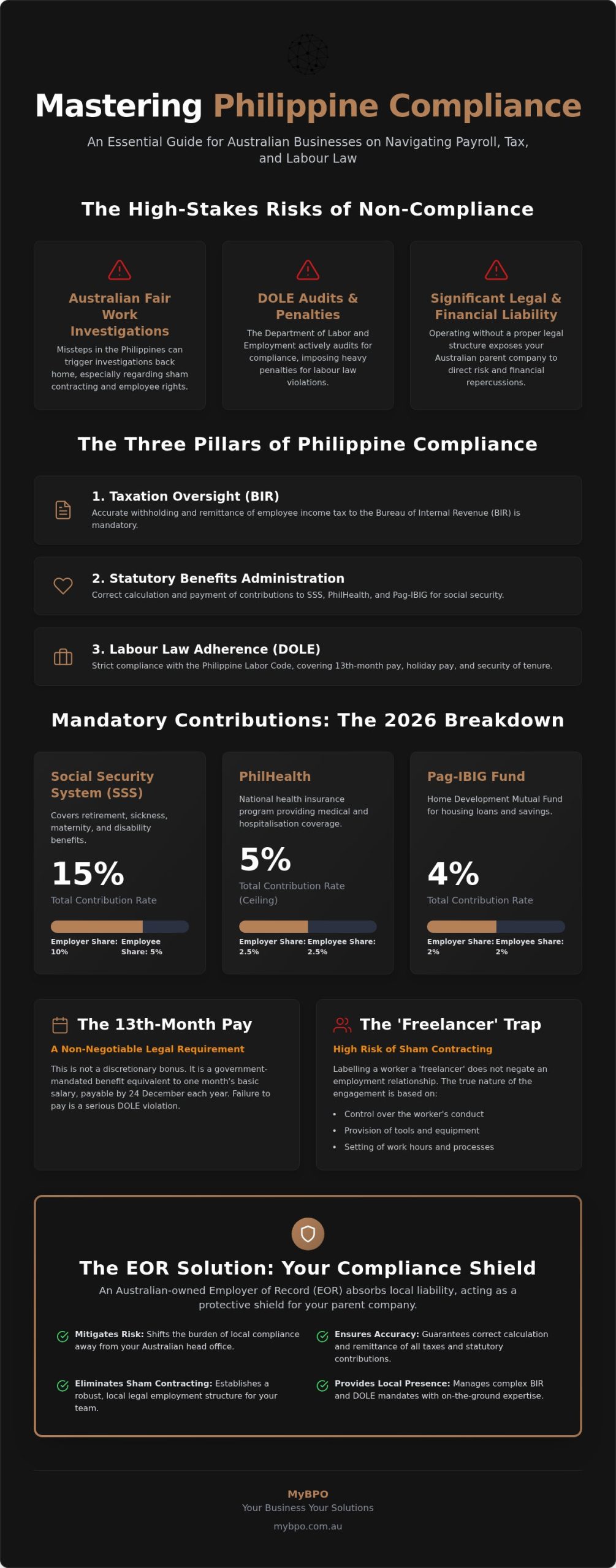
We understand that you want to focus on scaling your business, not decoding the Social Security System’s 15% contribution rate or the 5% PhilHealth premium ceiling. This guide provides the definitive blueprint to mastering local regulations with total confidence, allowing you to absorb risk and secure your operational integrity. We will examine the mandatory 13th-month pay requirements, the latest Bureau of Internal Revenue (BIR) tax brackets, and how a specialised Employer of Record (EOR) serves as a protective shield for your Australian interests.
Key Takeaways
- Navigate the 2026 statutory contribution increases, including the 15% SSS rate and 5% PhilHealth ceiling, to ensure your offshore operations remain above board.
- Understand why the 13th-month pay is a non-negotiable legal requirement rather than a discretionary bonus to prevent Department of Labor and Employment (DOLE) audits.
- Mitigate the risk of Australian Fair Work investigations into sham contracting by implementing a robust, local legal employment structure.
- Discover how mastering philippine payroll and tax compliance for foreign companies provides a strategic shield for your Australian parent entity.
- Secure your business growth by partnering with an Australian-owned EOR that provides the physical presence needed to manage complex Bureau of Internal Revenue (BIR) mandates.
What is Philippine Payroll and Tax Compliance for Foreign Companies?
For an Australian organisation, philippine payroll and tax compliance for foreign companies represents the structural alignment of offshore operations with the Republic’s legal mandates. It is not merely a clerical function; it’s a sophisticated risk-management framework. True compliance requires the integration of three distinct pillars: taxation oversight by the Bureau of Internal Revenue (BIR), the administration of statutory benefits, and strict adherence to Department of Labor and Employment (DOLE) standards. When these elements aren’t synchronised, the Australian parent company remains exposed to significant legal and financial repercussions.
Establishing a ‘Compliance Shield’ involves moving away from the vulnerability of direct, unrecorded payments. Many firms mistakenly believe that transferring funds via digital wallets satisfies their obligations. In reality, this practice creates a legal vacuum where no taxes are withheld and no contributions are recorded. A robust compliance structure ensures that every peso is accounted for and every statutory obligation is met, shifting the burden of local liability away from your Australian head office.
- Taxation: Accurate withholding and remittance of compensation income tax to the BIR.
- Statutory Benefits: Management of mandatory contributions to SSS, PhilHealth, and Pag-IBIG.
- Labour Law: Adherence to the Philippine Labor Code, including holiday pay and security of tenure.
The Jurisdictional Challenge for Australian Firms
Australian directors often assume that their domestic employment standards or simple contractor agreements provide sufficient coverage offshore. This is a dangerous assumption. The Philippine tax system overview highlights that the BIR expects any entity benefiting from local labour to facilitate the collection of compensation income tax at the source. Australian firms cannot simply export their payroll rules; they must adapt to a different jurisdictional reality. Compliance is the mitigation of cross-border liability through the rigorous adherence to local fiscal and employment mandates.
Why ‘Freelance’ is a High-Risk Strategy in 2026
Relying on a freelance model in 2026 is an invitation for regulatory scrutiny. The DOLE uses a specific four-fold test to determine if an employment relationship exists, regardless of the terminology used in a contract. If your organisation provides equipment, sets working hours, or supervises the daily process, that worker is likely a ‘deemed employee’ rather than a contractor. Misclassification triggers back-dated benefit payments and heavy penalties during routine audits. You must understand the specific sham contracting Philippines risk that Australian firms face when they bypass formal employment structures in favour of informal arrangements.
Statutory Contributions: SSS, PhilHealth, and Pag-IBIG Requirements
Managing philippine payroll and tax compliance for foreign companies requires a granular understanding of the Republic’s social safety net. These contributions aren’t optional perks; they’re mandated by law to provide retirement, health, and housing security for your local staff. Failing to remit these funds correctly doesn’t just hurt your employees; it places your organisation in the crosshairs of government regulators who view non-payment as a serious breach of labour rights.
To calculate the total cost of employment accurately, you must account for the specific employer shares that sit on top of the gross salary. In 2026, these rates have been adjusted to ensure the long-term viability of national funds. The current breakdown for most professional staff includes:
- SSS: A 10% employer share and a 5% employee share based on the Monthly Salary Credit.
- PhilHealth: An equal 2.5% split between employer and employee to meet the 5% total mandate.
- Pag-IBIG: A 2% contribution from both parties, capped at the current PHP 10,000 compensation base.
SSS Contributions and the 2026 Rate Schedule
The Philippine Social Security System (SSS) serves as the bedrock of local employee welfare, covering everything from sickness benefits to retirement pensions. For 2026, the contribution rate is 15% of the Monthly Salary Credit (MSC). With the maximum MSC now set at PHP 35,000, your total monthly obligation per high-earning employee is a fixed, predictable cost. If you fail to remit these payments on time, a 2% monthly penalty accrues automatically. This compound interest on debt can quickly spiral, turning a simple administrative oversight into a significant financial liability that could trigger a deeper audit of your entire offshore operation.
Managing PhilHealth and Pag-IBIG Remittances
PhilHealth premiums have reached the mandated 5% ceiling in 2026 to support the expansion of national benefit packages. The salary floor for these calculations is PHP 10,000, while the ceiling has been set at PHP 100,000. Simultaneously, the Pag-IBIG Fund requires contributions that secure long-term loyalty by allowing staff to access low-interest housing loans. While these individual amounts may seem small, the administrative burden of reporting to three separate agencies every month is a common point of failure for foreign firms. Each agency maintains its own portal and strict deadline, requiring meticulous record-keeping to avoid “red flags” during a Department of Labor and Employment (DOLE) inspection. If your internal team isn’t equipped to handle this level of local bureaucracy, partnering with an Australian-owned EOR can simplify the entire process and ensure your staff remain fully covered.
Withholding Tax and the Mandatory 13th-Month Pay
The Bureau of Internal Revenue (BIR) effectively deputises every employer as a collection agent. For an Australian firm, this means your responsibility extends beyond merely sending a salary; you’ve got to accurately withhold and remit income tax on behalf of your staff. Failure to discharge this duty correctly leads to ‘Late Filing’ traps, including surcharges and interest that can compromise your standing in the local market. Maintaining philippine payroll and tax compliance for foreign companies requires a precise understanding of these monthly and annual cycles. Managing payroll in the Philippines for Australian companies ensures these obligations are met without exposing the parent entity to risk.
The 13th-Month Pay: Deadlines and Calculations
The 13th-month pay is frequently misunderstood as a discretionary Christmas bonus. It’s a statutory requirement under Presidential Decree No. 851. All rank-and-file employees who’ve worked for at least one month are legally entitled to this payment, which equates to one-twelfth of their total basic salary earned within the calendar year. You must complete this payment by December 24th. For staff who joined your team mid-year, the calculation is pro-rated based on their total basic salary earned during their months of service. If you miss this deadline or miscalculate the amount, you’ll face immediate DOLE complaints and mandatory settlements. You’re also required to submit a compliance report to DOLE by January 15th of the following year to prove the obligation was met.
Income Tax Withholding (BIR Form 1601-C)
Monthly income tax withholding is a non-negotiable pillar of philippine payroll and tax compliance for foreign companies. In 2026, the graduated tax table remains the standard for Philippine residents. While the first PHP 250,000 of annual income is tax-exempt, the subsequent bracket for income up to PHP 400,000 attracts a 15% tax on the excess over the exemption. As the year concludes, you’re required to perform ‘annualisation.’ This process involves recalculating the total tax due for the year against what was actually withheld, ensuring the final pay run of December corrects any discrepancies. Every employee must then receive BIR Form 2316 by January 31st. This document serves as their official proof of tax payment and it’s a cornerstone of financial transparency between the employer and the local workforce.
Mitigating Australian Regulatory Risks: Fair Work and Sham Contracting
Australian business owners must recognise that their offshore operations are no longer invisible to domestic regulators. The ‘Closing Loopholes’ legislation has significantly sharpened the focus on how Australian firms engage labour globally. If your offshore team functions as an integral part of your daily operations, the Fair Work Ombudsman (FWO) may scrutinise your arrangements for signs of sham contracting. Achieving total philippine payroll and tax compliance for foreign companies isn’t just about satisfying local authorities; it’s about insulating your Australian entity from domestic prosecution and heavy financial penalties.
The risk profile for Australian firms has shifted. Direct hiring without a local entity creates a ‘paper trail’ that regulators can use to establish an employer-employee relationship, regardless of your intent. To mitigate this, you must build a structure that satisfies both the Australian Fair Work Act and the Philippine Labor Code. This dual-layered requirement makes an Australian-owned compliance partner essential. We provide the physical presence and local expertise required to act as a vigilant guardian for your interests, ensuring your offshore expansion doesn’t become a domestic liability.
Avoiding the Sham Contracting Trap
The mere presence of a ‘Contractor Agreement’ provides no legal immunity. Australian courts and the FWO apply a multi-factorial test that prioritises the reality of the working relationship over the label on the document. If you control their hours, provide their equipment, and they work exclusively for your firm, they’re likely ‘deemed employees’. Misclassification carries severe financial penalties for Australian organisations, often resulting in massive back-pay orders and fines. By utilising an EOR, you transfer the legal status of ‘Employer’ to a local entity. This structure allows the EOR to absorb the legal risks associated with employment, ensuring your Australian firm remains a client rather than a direct employer.
Permanent Establishment (PE) and Corporate Tax Risks
A significant and often overlooked danger is the creation of a Permanent Establishment (PE). If your Australian firm manages its own philippine payroll and tax compliance for foreign companies without a local entity, the Bureau of Internal Revenue (BIR) may argue that your AU company is ‘doing business’ within the Philippines. This trigger can expose your Australian revenue to local corporate taxation and complex audit requirements. The ‘Compliance Shield’ approach isolates your corporate liability by ensuring all employment activity occurs within a local legal structure. Our EOR services prevent accidental Permanent Establishment by acting as the local legal employer, ensuring your Australian firm maintains a safe jurisdictional distance from the Philippine corporate tax net. To secure your business against these multi-layered risks, you should explore our comprehensive EOR solutions and safeguard your offshore operations.
The EOR Solution: Securing Your Philippine Payroll with MyBPO
Managing philippine payroll and tax compliance for foreign companies requires more than just software; it demands a physical presence and a deep understanding of two distinct legal systems. MyBPO serves as your local legal employer, acting as a vigilant guardian for your Australian interests. By assuming the role of the Employer of Record (EOR), we move the legal and administrative burden of employment from your Australian head office to our established local entity. This structural shift ensures that your offshore team is fully integrated into the Philippine regulatory framework while you maintain complete operational control over their daily output.
Our Australian-owned and operated structure provides a unique advantage in the AU-PH employment corridor. We don’t just understand Philippine labour law; we understand how it interacts with Australian Fair Work nuances and the specific risks of sham contracting. Our on-the-ground support team in the Philippines handles the complex bureaucracy of local government agencies in person, ensuring that filings are never late and compliance is never in question. This physical representation is the difference between a high-risk digital arrangement and a secure, long-term business strategy.
Operational freedom is the ultimate goal of a structured payroll system. We streamline your entire offshore financial process by providing a single, consolidated invoice in AUD. This removes the friction of currency volatility and the administrative nightmare of managing multiple PHP transfers. We then handle the precise distribution of funds to local staff and government agencies, ensuring that every tax obligation is met and every benefit is paid with absolute transparency.
Risk Absorption: Our Compliance Guarantee
The core value of our EOR service is the total absorption of local employment risk. When you partner with us, we take full accountability for the timely filing and remittance of SSS, PhilHealth, Pag-IBIG, and BIR requirements. If local regulations change, as seen with the 2026 contribution hikes, we navigate those transitions on your behalf. This creates a ‘safe harbour’ for your offshore expansion, allowing you to scale your team without the constant anxiety of regulatory penalties or legal disputes. For a deeper look at how this model protects your firm, consult our guide on employer of record Australia.
Next Steps for Your Australian Business
Transitioning from a precarious ‘freelance’ model to a fully compliant employment structure is a straightforward process with the right partner. Our onboarding team is specialist in migrating existing offshore teams into our EOR framework, ensuring there’s no disruption to your daily operations. We recommend starting with a comprehensive compliance audit of your current Philippine team to identify any hidden liabilities or misclassification risks. This proactive approach allows us to secure your foundation before you focus on further growth. Secure your offshore team today with MyBPO’s EOR services and gain the operational freedom to focus on what you do best.
Securing Your Australian Business for Long-Term Growth
Your expansion into the Philippines represents a significant opportunity, but it must be built on a foundation of legal certainty. As we’ve examined, the 2026 regulatory landscape requires meticulous attention to SSS hikes, PhilHealth ceilings, and the mandatory 13th-month pay. Ignoring these local mandates or relying on informal ‘freelance’ arrangements exposes your Australian firm to severe Fair Work scrutiny and potential sham contracting penalties.
Mastering philippine payroll and tax compliance for foreign companies is the only way to ensure your offshore operations remain a strategic asset rather than a liability. By partnering with an Australian-owned specialist, you gain a vigilant guardian that provides physical on-the-ground support and total risk absorption. We handle the complex Bureau of Internal Revenue (BIR) filings and labour law requirements so you can focus entirely on scaling your business.
If you’re ready to move from uncertainty to total operational freedom, now’s the time to secure your structure. Protect your business from offshore compliance risks with MyBPO and build your team with absolute confidence. Your successful cross-border future starts with a compliant foundation today.
Frequently Asked Questions
Is 13th-month pay mandatory for foreign companies hiring in the Philippines?
Yes, the 13th-month pay is a non-negotiable statutory requirement for any foreign firm engaging staff in the Philippines. This benefit applies to all rank-and-file employees who’ve worked for at least one month during the calendar year. It’s not a discretionary bonus; failure to pay this by the legal deadline results in immediate liability and potential Department of Labor and Employment (DOLE) sanctions. Employers must also file a compliance report by January 15th annually.
What are the SSS, PhilHealth, and Pag-IBIG contribution rates for 2026?
In 2026, the SSS contribution rate is 15% of the Monthly Salary Credit, with a maximum credit of PHP 35,000. PhilHealth premiums have reached the 5% mandate, split equally at 2.5% each for employers and employees, with a PHP 100,000 salary ceiling. Pag-IBIG remains at 2% for both parties, capped at a PHP 10,000 compensation base. These specific rates ensure that your organisation maintains total philippine payroll and tax compliance for foreign companies while protecting staff welfare.
Can an Australian company pay Philippine staff directly in AUD?
While you can technically transfer AUD, doing so directly to an offshore worker usually constitutes a breach of local labour laws. Philippine employees must be paid in Philippine Pesos (PHP) to facilitate accurate withholding of income tax and statutory contributions. Paying in AUD via digital wallets often results in ‘under-the-table’ arrangements that expose your Australian firm to significant regulatory risks, including misclassification and permanent establishment liabilities.
What is the penalty for non-compliance with Philippine payroll tax?
Penalties for non-compliance are severe and multi-layered. The Social Security System (SSS) imposes a 2% monthly accrual on unremitted contributions. The Bureau of Internal Revenue (BIR) applies surcharges and interest for late tax filings. Beyond financial costs, the Department of Labor and Employment (DOLE) can initiate audits that lead to mandatory settlement orders. For Australian firms, these local breaches can also trigger domestic investigations by the Fair Work Ombudsman into your global employment practices.
Do I need a local Philippine entity to run a compliant payroll?
You don’t need to establish a local Philippine entity if you utilise an Employer of Record (EOR) service. An EOR acts as the legal employer on the ground, absorbing all payroll, tax, and labour law responsibilities. If you choose to hire directly without an entity, you’re operating outside the legal framework, which creates a permanent establishment risk and leaves your Australian parent company fully liable for all local regulatory breaches.
How does the Australian Fair Work Act affect my offshore team in the Philippines?
The Australian Fair Work Act now extends its reach to how domestic firms engage global labour. If your Philippine team is misclassified as contractors while performing the duties of employees, you face significant domestic penalties for sham contracting. The Fair Work Ombudsman uses a multi-factorial test to determine the true nature of the relationship. Ensuring philippine payroll and tax compliance for foreign companies through a formal EOR structure is the most effective way to mitigate these Australian regulatory risks.
What is the Bureau of Internal Revenue (BIR) requirement for foreign employers?
The Bureau of Internal Revenue (BIR) requires all employers to act as withholding agents for compensation income tax. This involves monthly filings via Form 1601-C and the annualisation of taxes at year-end. Foreign employers must ensure every employee receives a BIR Form 2316 by January 31st each year. Without a local legal presence or an EOR partner to facilitate these filings, your firm cannot legally satisfy these mandatory fiscal obligations in the Philippines.
What is the difference between a contractor and a compliant EOR employee in the Philippines?
A contractor arrangement is an informal relationship where you pay a flat fee without statutory benefits or tax withholding. This model is high-risk and often considered illegal misclassification. Conversely, an EOR employee is a legally recognised worker with full SSS, PhilHealth, and Pag-IBIG coverage. The EOR structure provides a compliance shield, ensuring that the worker is protected by local labour laws while the Australian firm is insulated from direct employer liabilities.
Need a strategy session?
Tell us about your team and we will map out the right structure, fixed-cost quote included.
Book a call