Blog
Managing EOR Exchange Rate Risks for Australian Firms

What if a five per cent dip in the Australian Dollar quietly added thousands to your offshore wage bill before you had a chance to budget for it? Many directors treat currency volatility as a backend accounting detail, yet in a peso-denominated arrangement it lands entirely on the employer, and it lands every single month. You’re likely already tired of unpredictable monthly invoices that make your 2026 budget forecasts feel like guesswork. Managing exchange rate risk in Employer of Record arrangements is no longer just a fiscal preference; it’s a critical shield for your talent pipeline and operational integrity.
In this article, you’ll discover how to protect your Australian firm from AUD/PHP volatility while maintaining total compliance with Philippine labour laws. We’ll outline a structured path to achieving budget certainty and ensuring your staff receive fair, stable wages regardless of market shifts. We will also examine how a proactive management strategy allows you to absorb these risks, securing your position as a reliable employer in a complex global corridor.
Key Takeaways
- Understand why salaries set in pesos keep currency movement off your staff payslips and place it squarely on your budget, where it can be managed deliberately.
- Compare spot-rate billing against a rate fixed for the term, and decide which suits your appetite for month-to-month variance.
- Master the technical aspects of managing exchange rate risk in Employer of Record arrangements to ensure stable pay for staff while protecting your corporate bottom line.
- Identify practical mitigation strategies, such as accrual buffers and natural hedging, to secure budget certainty for the 2026 financial year.
- Discover the security of partnering with an Australian-owned specialist that provides a physical bridge between Australian fiscal requirements and Philippine labour compliance.
The Volatility Factor: Why AUD/PHP Fluctuations Matter in EOR
In an Employer of Record (EOR) partnership, Foreign exchange risk represents the potential for financial loss or budget variance caused by shifts in currency values between the time a service is agreed upon and the time the invoice is settled. For Australian firms, this risk is specifically concentrated in the AUD/PHP corridor. While the Philippine Peso often remains relatively stable due to strong remittance inflows and central bank intervention, the Australian Dollar frequently acts as a “risk-on” proxy for global economic sentiment. If global markets experience turbulence, the AUD can depreciate rapidly, even if the Philippine economy remains robust.
Beyond the headline rate, many businesses overlook the hidden conversion fees and “spreads” applied by traditional banks or opaque EOR providers. These margins can quietly erode your profitability, turning a seemingly competitive service fee into a costly overhead. By effectively managing exchange rate risk in Employer of Record arrangements, you establish a “compliance shield” that separates your corporate treasury from the volatile mechanics of local payroll. This structural barrier ensures that market noise doesn’t interfere with your ability to meet local obligations.
The Impact on Fixed Labour Budgets
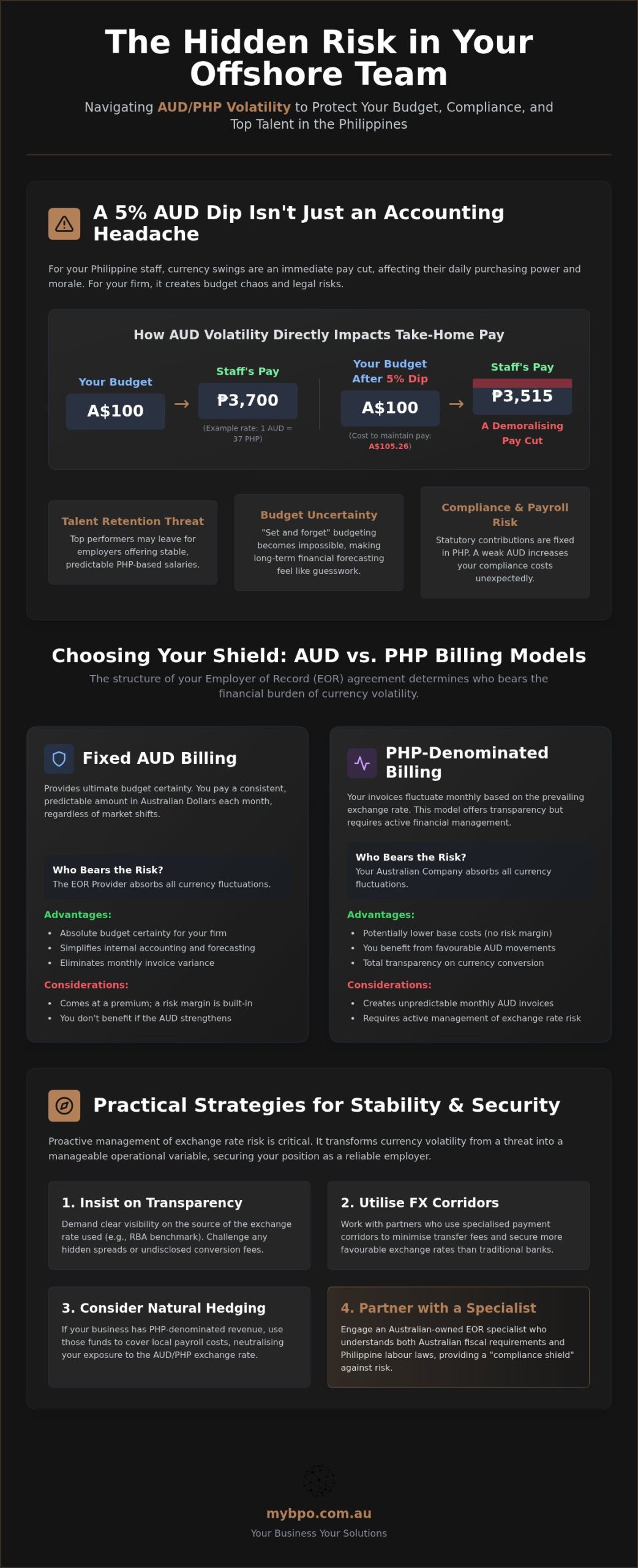
A 5% depreciation in the AUD might seem minor on a balance sheet, but it creates an immediate deficit in a fixed labour budget. If you’ve budgeted for annual offshore wages and the AUD drops, you’re suddenly forced to find additional capital just to maintain the same PHP take-home pay for your team. This volatility makes “set and forget” budgeting impossible for international operations. It’s especially dangerous when forecasting for the mandatory 13th-month pay in the Philippines, which must be paid by December 24th. If the AUD is weak during the final quarter, your year-end liabilities could be significantly higher than anticipated.
Regulatory Requirements vs. Currency Swings
Currency fluctuations do not absolve an employer of their statutory obligations. You must maintain precise SSS PhilHealth Pag-IBIG contributions employer standards regardless of whether the AUD is trading at 45 or 40 Pesos. These contributions are calculated based on PHP salary brackets, meaning your Australian-dollar cost for social security and health insurance rises whenever the AUD weakens. Managing exchange rate risk in Employer of Record arrangements ensures that these legal mandates are met without jeopardising your firm’s financial stability. Philippine labour law dictates that statutory benefits remain fixed in local currency terms, leaving the Australian entity to absorb the resulting FX variance.
Billing Models: Spot Rate vs. Fixed Rate
The structure of your service agreement determines which party bears the financial burden of market volatility. When managing exchange rate risk in Employer of Record arrangements, the choice between AUD and PHP-denominated billing is the most significant lever for budget control. Each model offers a different balance of risk and reward; selecting the wrong one can lead to unexpected invoice spikes or inflated base costs that quietly erode your margins over time. Because salaries and statutory contributions are set in pesos, the only real question is how those pesos convert into the dollar figure on your invoice: at the rate prevailing on the day, or at a rate fixed for the term. A transparent agreement states which of the two applies, and names the rate itself.
Identifying hidden margins is critical for Australian finance directors. Some providers offer what appears to be a mid-market rate but apply a significant spread, effectively charging an undisclosed premium on every dollar converted. You must insist on seeing the specific source of the exchange rate used, such as the Reserve Bank of Australia or a recognised commercial benchmark, to ensure your costs remain verifiable. If you are looking for a partner that prioritises transparency, MyBPO provides clear visibility into the mechanics of your cross-border payments.
Fixed Rate Billing: Certainty at a Premium
A fixed rate locks the AUD to PHP conversion for the term of your agreement, so the same peso payroll converts to the same dollar figure every month, whatever the market does. The rate is set below the prevailing spot rate, which is why it costs more from day one. A rate fixed at 38 pesos to the dollar buys fewer pesos than a spot rate of 42, so you send more dollars to fund the same salary: on a recent three-person quote that premium worked out at roughly nine per cent. What you buy for it is a number that cannot move, which makes annual budgeting straightforward. The trade-off is that you give up the savings if the Australian Dollar strengthens.
Spot Rate Billing: The Standard Approach
Spot billing is how most engagements run, and it is how we quote by default. Your peso payroll converts at the rate prevailing when the invoice is raised, so the dollar figure moves month to month: lower when the Australian Dollar is strong, higher when it weakens. There is no premium built into the rate, which is why it suits most firms. What it asks of you is a little forecasting discipline, a modest buffer, and sound payroll Philippines for Australian companies management to track the monthly variance. Pair it with the buffer described below and the swings stay comfortably absorbable.
The Talent Risk: How FX Affects Your Philippine Team
Currency volatility is often viewed through a purely fiscal lens, yet the question your team actually cares about is simpler: does my pay change when the market moves? Under a properly structured EOR it does not. Philippine employees live in an economy where rent, utilities and groceries are priced in pesos, so the salary is agreed in pesos and paid in pesos. The conversion happens on your side of the arrangement, never on theirs. That single design choice is what keeps market movement off your team payslips and squarely on your budget, where it can be managed deliberately.
A robust filipino employee engagement strategy prioritises financial security as the foundation for high performance, and peso-denominated pay is the most basic form of that security. The risk shows up in the arrangements that skip it. Firms paying offshore contractors directly in Australian Dollars push every market swing onto the worker, and when a competitor offers a stable peso salary instead, that difference is felt immediately. Stability in local currency is table stakes for retention rather than a perk.
Why Peso-Denominated Pay Protects Retention
Setting the salary in pesos does the job that more elaborate protection mechanisms are invented to do. The employment contract names a peso figure, that figure is what lands in the employee account each pay cycle, and a movement in the Australian Dollar has no bearing on it. Your staff are never asked to follow the currency markets to work out what they will earn. We handle the conversion, the statutory calculations and the remittance behind the scenes, so the only number your team needs to think about is the one written in their contract.
Transparency in the Pay Slip
Clarity still matters, even when the peso figure is fixed. Payslips should show the contracted peso salary alongside each statutory deduction, so an employee can reconcile what they were promised against what they received without having to ask. Our presence in Bacolod means those questions get answered in person, in the same time zone, rather than through a support queue on another continent. Managing exchange rate risk well means your staff never have to think about it at all.
Practical Strategies to Mitigate Currency Exposure
Managing exchange rate risk in Employer of Record arrangements requires a structured approach to contract design. For Australian firms the choice is already on the table: take the spot rate and absorb the monthly variance, or fix the rate for the term and pay a stated premium for a number that cannot move. Neither answer is universally right. If your margins are thin enough that a nine per cent swing would hurt, buy the certainty. If you have the headroom to ride the market and want the upside when the Australian Dollar runs strong, take the spot rate and hold a buffer against the months when it does not.
Natural hedging is another vital tool for mitigation. By maintaining AUD-held accounts specifically earmarked for future PHP liabilities, you can effectively lock in rates when the Australian Dollar is strong. This proactive accumulation of capital ensures that mandatory year-end costs are already covered, regardless of market conditions in December. To remain competitive, you should also conduct quarterly budget reviews that account for shifting average pay in the philippines trends. These reviews allow you to adjust your forecasts based on real-world data rather than static projections from the previous financial year.
The ‘Buffer’ Approach
A disciplined contingency plan is essential for absorbing unforeseen volatility. We recommend calculating a 3-5% buffer into your offshore labour budget from the outset. If the AUD remains strong, these surplus funds should not simply vanish; they can be strategically reinvested into team bonuses, training, or equipment upgrades to drive engagement. This approach is particularly critical for managing the 13th-month pay liability. By accruing this mandatory payment incrementally throughout the year in a buffered account, you eliminate the risk of a significant cash flow shock during the Christmas period.
Leveraging Local Australian Expertise
Partnering with an Australian-owned EOR provides a level of protection that global, platform-only providers cannot match. A local specialist understands the specific nuances of Australian Business Activity Statements (BAS) and corporate reporting requirements. You gain the advantage of an Australian account manager who operates in your time zone and understands the unique pressures of the AU-PH corridor. While global platforms offer scale, they often lack the “compliance shield” provided by a partner with a physical presence in both Brisbane and the Philippines. If you want to secure your offshore budget, choosing a partner that states its exchange rate up front on every quote and invoice is the first step toward long-term stability.
Securing Your Offshore Strategy with MyBPO
MyBPO functions as a “Safe Harbour” for Australian firms seeking to expand into the Philippines without the typical exposure to cross-border volatility. As an Australian-owned and operated entity, we understand the specific fiscal pressures and reporting standards required by Australian directors. We provide a physical bridge between your home operations and your offshore team, maintaining offices in Brisbane and Bacolod to ensure a human presence at every stage of the employment lifecycle. This tangible infrastructure allows us to act as a vigilant guardian against the sham contracting Philippines risk that often plagues firms using unverified digital platforms or direct contractor models.
Our commitment to transparent billing ensures that your finance team is never left guessing about the mechanics of an invoice. By managing exchange rate risk in Employer of Record arrangements with the exchange rate stated up front on every quote and invoice, we eliminate the hidden margins that often inflate international labour costs. We absorb the operational complexity of currency conversion and statutory reconciliation, allowing you to focus on your core business objectives while we secure your talent pipeline against market-driven attrition.
Australian-Led Compliance
Dealing with foreign labour codes is a high-stakes endeavour that requires local accountability. Speaking to an Australian expert about Philippine labour law is essential for ensuring your strategy aligns with both Fair Work standards and Philippine Department of Labour and Employment (DOLE) mandates. We organise your offshore payroll to be “audit-ready” in both jurisdictions, providing the structural integrity needed to withstand scrutiny from the ATO or Philippine tax authorities. This Australian-owned accountability means you aren’t just hiring a service; you’re securing a partner that operates under the same legal and professional expectations as your own firm. We ensure that every SSS, PhilHealth, and Pag-IBIG contribution is calculated with precision, regardless of the AUD’s performance.
Taking the Next Step
If your current offshore structure relies on the hope that exchange rates will remain favourable, your business is carrying an unmanaged liability. Transitioning from a risky contractor model to a secure EOR structure is the only way to achieve long-term budget certainty and legal protection. We invite you to a risk-assessment consultation where we can evaluate your current offshore team’s exposure to FX volatility and compliance gaps. Our team will provide a clear roadmap for stabilising your costs and protecting your staff’s purchasing power. Don’t let market swings dictate the success of your international expansion. Secure your offshore team with MyBPO today and establish a foundation of stability for the 2026 financial year.
Establishing Financial Stability in the AU-PH Corridor
Currency volatility in the Australian-Philippine corridor is a structural reality that requires a proactive management strategy. The evidence is clear: AUD/PHP fluctuations can quickly turn a predictable labour budget into a significant liability, especially when talent retention and statutory compliance are at stake. By choosing the right billing model and holding a sensible buffer against the lean months, you move from reacting to market noise to securing long-term operational integrity.
Managing exchange rate risk in Employer of Record arrangements is the difference between a fragile offshore presence and a resilient, scalable team. As an Australian-owned and operated specialist with on-the-ground support in Bacolod, MyBPO acts as your vigilant guardian of AU-PH compliance. We absorb the complexities of cross-border employment so you can lead your business with the calm confidence of a specialist who understands the high stakes involved.
Protect your offshore budget with MyBPO’s secure EOR services and ensure your Philippine operation remains a stable, high-performing asset for years to come. Your path to a secure offshore strategy starts with a partner who understands the physical reality of international employment and the necessity of structural protection.
Frequently Asked Questions
What is the biggest exchange rate risk in an EOR arrangement?
The primary risk is budget variance on your side of the arrangement. Salaries and statutory contributions are fixed in pesos, so when the Australian Dollar weakens the same payroll costs you more dollars, and that gap has to come from somewhere. Your staff are unaffected, which is exactly how it should be. Managing exchange rate risk in Employer of Record arrangements means deciding in advance how you will fund that variance: by absorbing it at the spot rate, or by fixing the rate for the term.
Should I pay my Philippine employees in AUD or PHP?
You should always denominate salaries in Philippine Pesos (PHP) to ensure your team has a stable income relative to their local cost of living. Paying in AUD forces the employee to carry the currency risk, which creates significant financial stress and reduces their long-term loyalty. While an AUD-denominated contract might seem easier for your Australian accounting team, it often results in higher turnover and complicates the calculation of mandatory statutory benefits.
How do global EOR platforms handle currency conversion fees?
Global EOR platforms typically automate currency conversion through large-scale financial providers, often applying a hidden margin or spread on top of the mid-market rate. These fees are frequently bundled into the total invoice, making it difficult for Australian firms to identify the true cost of the conversion. Unlike local specialists who prioritise transparent billing, these platforms may prioritise their own profit margins over providing the most competitive exchange rate for your offshore labour budget.
Can exchange rate fluctuations cause compliance issues with Philippine labour law?
Currency swings can trigger compliance failures if the Australian Dollar’s depreciation prevents you from meeting the mandatory PHP-based contribution brackets for social security and health insurance. Philippine labour law requires that statutory benefits like SSS, PhilHealth, and Pag-IBIG are calculated using the employee’s gross PHP salary. If your AUD budget doesn’t flex to cover these local currency requirements, you risk legal penalties and the potential loss of your business’s audit-ready status.
What happens to the 13th-month pay if the AUD drops significantly?
If the AUD drops significantly in the final quarter, your 13th-month pay liability increases in Australian Dollar terms. This mandatory benefit is equivalent to one month’s basic salary and must be paid by December 24th each year. Without a proactive strategy for managing exchange rate risk in Employer of Record arrangements, such as natural hedging or monthly accruals, your firm could face a significant and unbudgeted cash flow shock during the year-end settlement period.
How often should I review my offshore labour budget for FX risks?
We recommend conducting a formal review of your offshore labour budget at least once every quarter. This frequency allows you to adjust your forecasts based on real-world AUD/PHP trends and local wage inflation in the Philippines. A quarterly cadence ensures that your rate arrangement still fits your budget and that any currency-driven gains or losses are accounted for before they impact your annual financial reporting or the morale of your dedicated virtual assistants.
Does an Australian-owned EOR offer better FX protection than a global one?
An Australian-owned EOR provides superior protection because they operate under the same regulatory and fiscal expectations as your home business. Unlike global platforms that use generic models, a local specialist understands Australian reporting requirements and the specific nuances of the AU-PH corridor. Our physical presence in Australia and the Philippines allows us to act as a compliance shield, absorbing the complexity of cross-border payments while managing exchange rate risk in Employer of Record arrangements effectively.
Do currency swings change what my Filipino staff get paid?
Not under a peso-denominated contract, which is the standard structure we use. The salary is agreed in pesos, and that is the figure paid each cycle regardless of where the Australian Dollar sits. The variance lands on your invoice instead. If you are currently paying offshore contractors directly in Australian Dollars the opposite is true, and your team is carrying the risk, which is one of the quieter reasons those arrangements tend to churn.
Need a strategy session?
Tell us about your team and we will map out the right structure, fixed-cost quote included.
Book a call